Boo-st your food data. Save 20% on scraping services
Menus · Grocery · Alcohol · AI Intelligence, across 40+ countries

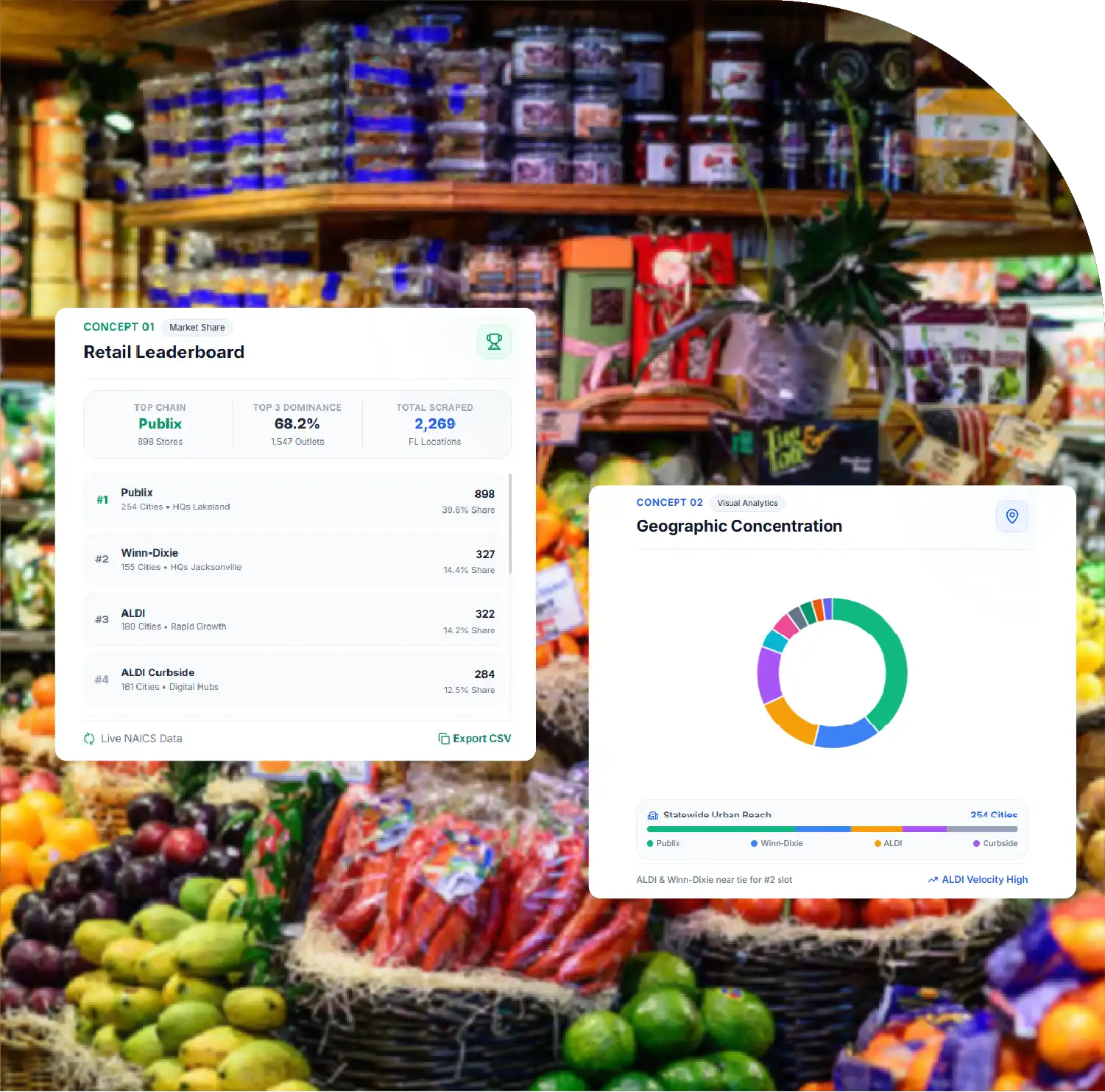
1. Publix Leads Florida Grocery Market: Publix operates 919 locations across 256 Florida cities.
2. Three Chains Dominate Market Footprint: Publix, Winn-Dixie, and ALDI represent 68.43% of locations.
3. ALDI Shows Broad Geographic Coverage: ALDI operates 319 locations across 180 Florida cities.
4. Top Ten Chains Have 2,287 Locations: The dataset captures 2,287 grocery locations across Florida.
5. Location Data Supports Market Intelligence: Store-level datasets enable competitive, expansion, and territory analysis.

Florida's grocery retail market continues to demonstrate strong concentration around established supermarket brands, while regional and specialty operators maintain meaningful footprints across individual cities. This report examines the method to Scrape 10 Largest Grocery Chains In Florida 2026 based on store locations and city coverage.
The largest grocery chains in Florida in 2026 are led by Publix, Winn-Dixie, and ALDI, with Publix holding a substantial lead at 919 locations across 256 cities. Winn-Dixie follows with 327 locations across 155 cities, while ALDI operates 319 locations across 180 cities. Together, these three brands account for 68.43% of the 2,287 locations represented by the top 10 chains.
Florida Grocery Chain Location Data Scraping enables retailers, investors, market researchers, delivery platforms, and real estate companies to convert store-level information into structured market intelligence. Location counts, geographic coverage, competitive density, and city-level presence can help reveal where grocery brands have established strong positions and where opportunities remain.
The Florida grocery landscape also includes ALDI Curbside, TomThumb, Key Food, Save A Lot, Sprouts, The Fresh Market, and Bravo Supermarkets. While their location footprints are considerably smaller than Publix, several brands achieve broad geographic coverage relative to their store counts.
Florida represents a highly competitive grocery environment where large regional chains coexist with national discount, specialty, and neighborhood-oriented operators. Store location data provides a practical way to understand this competitive structure beyond overall brand popularity.
Publix is the clear market leader within the supplied dataset, with 919 Florida locations. Its presence across 256 cities gives the brand the broadest geographic reach among the ten chains. The scale of its footprint indicates a dense physical retail network capable of serving consumers across numerous Florida markets.
Winn-Dixie ranks second with 327 locations across 155 cities. Its footprint is substantially smaller than Publix but remains significant enough to represent a major competitive presence. ALDI ranks third with 319 locations, but its 180-city presence exceeds Winn-Dixie in terms of city coverage.
| Rank | Grocery Chain | Florida Locations | Cities Present In | Share of Top-10 Locations | Relative Position |
|---|---|---|---|---|---|
| #1 | Publix | 919 | 256 | 40.18% | Dominant market leader |
| #2 | Winn-Dixie | 327 | 155 | 14.30% | Major regional competitor |
| #3 | ALDI | 319 | 180 | 13.95% | Major discount competitor |
| #4 | ALDI Curbside | 284 | 161 | 12.42% | Extensive service footprint |
| #5 | TomThumb | 103 | 31 | 4.50% | Smaller regional presence |
| #6 | Key Food | 103 | 58 | 4.50% | Multi-city presence |
| #7 | Save A Lot | 67 | 57 | 2.93% | Broad reach relative to stores |
| #8 | Sprouts | 63 | 50 | 2.75% | Specialty grocery footprint |
| #9 | The Fresh Market | 52 | 40 | 2.27% | Premium/specialty positioning |
| #10 | Bravo Supermarkets | 50 | 32 | 2.19% | Localized regional presence |
| Total | Top 10 Chains | 2,287 | --- | 100% | Florida grocery market sample |
The figures show a significant concentration at the top of the ranking. Publix alone represents approximately 40.18% of the locations included in this top-10 dataset. The next three entries—Winn-Dixie, ALDI, and ALDI Curbside—collectively add more than 40% of the listed locations.
This concentration is important for businesses conducting competitive market assessments. A company entering Florida can use location data to identify markets where leading chains already have dense coverage and compare them against areas with fewer competing stores.
Store counts alone do not fully explain a grocery chain's market presence. City coverage provides an additional layer of analysis because it shows how widely a retailer distributes its locations across Florida.
ALDI illustrates this distinction particularly well. Although ALDI has 319 locations compared with Winn-Dixie's 327, it operates across 180 cities versus Winn-Dixie's 155. This indicates broader city-level penetration despite having slightly fewer stores.
Save A Lot provides another useful example. The chain has 67 locations across 57 cities, meaning its store network extends across a relatively large number of cities compared with its overall store count. The Fresh Market has 52 locations across 40 cities, while Sprouts has 63 locations across 50 cities.
Scrape Florida Supermarket Location Data to support analyses that go beyond simple store counting. Businesses can evaluate city penetration, competitive overlap, geographic clusters, whitespace opportunities, and potential expansion territories.
| Chain | Locations | Cities | Locations per City* | Approx. Location Share | Geographic Coverage Indicator | Market Interpretation |
|---|---|---|---|---|---|---|
| Publix | 919 | 256 | 3.59 | 40.18% | Very High | Deep statewide network |
| Winn-Dixie | 327 | 155 | 2.11 | 14.30% | High | Strong regional presence |
| ALDI | 319 | 180 | 1.77 | 13.95% | Very High | Wide city penetration |
| ALDI Curbside | 284 | 161 | 1.76 | 12.42% | Very High | Broad service coverage |
| TomThumb | 103 | 31 | 3.32 | 4.50% | Moderate | Concentrated store network |
| Key Food | 103 | 58 | 1.78 | 4.50% | Moderate | Distributed urban presence |
| Save A Lot | 67 | 57 | 1.18 | 2.93% | High relative to size | Broad small-format reach |
| Sprouts | 63 | 50 | 1.26 | 2.75% | Moderate-High | Specialty-focused expansion |
| The Fresh Market | 52 | 40 | 1.30 | 2.27% | Moderate | Premium grocery coverage |
| Bravo Supermarkets | 50 | 32 | 1.56 | 2.19% | Moderate | Localized market penetration |
| Top 10 Total | 2,287 | --- | --- | 100% | --- | Combined market footprint |
*Locations per city is calculated by dividing reported locations by reported cities and is an analytical indicator rather than a count of unique stores in each city.
Modern grocery competition increasingly depends on understanding where consumers can access competing stores. Physical locations influence delivery radius, customer acquisition, local pricing competition, advertising exposure, and distribution strategies.
Florida Grocery Market Data Intelligence can help companies transform raw location records into structured datasets for market analysis. A location intelligence database can include chain name, store address, city, state, ZIP code, coordinates, store type, operating status, and other relevant attributes.
For retailers, this information can support expansion planning. A retailer can compare its current footprint with competitor locations and identify cities where demand may be underserved.
For commercial real estate companies, store locations can help evaluate retail corridors, shopping-center opportunities, and surrounding competitive density. Investors can also use chain footprints as an input when evaluating local grocery-market attractiveness.
For food delivery companies, supermarket locations can help identify potential service zones and estimate the competitive environment surrounding individual stores.
The supplied data highlights several important patterns.
First, the Florida grocery market is highly concentrated at the top. Publix's 919 locations exceed the combined footprints of several lower-ranked chains. Its 256-city presence also demonstrates extensive geographic reach.
Second, discount grocery operators have substantial market visibility. ALDI's 319 locations and ALDI Curbside's 284-location footprint demonstrate significant penetration across Florida.
Third, some smaller chains show impressive geographic efficiency. Save A Lot operates 67 locations across 57 cities, suggesting a comparatively distributed footprint. Sprouts also reaches 50 cities with only 63 locations.
Fourth, the market contains different competitive models. Large supermarket chains emphasize scale, discount operators compete through value-oriented positioning, specialty retailers focus on differentiated product categories, and regional brands concentrate their operations in selected markets.
Extract Florida Supermarket Location Data to help organizations compare these different operating models through standardized location-level records. When refreshed regularly, the resulting dataset can reveal openings, closures, relocations, new city entries, and changes in competitive density.
The growing use of artificial intelligence is changing how grocery location datasets are analyzed. Instead of relying solely on spreadsheets, companies can combine structured location information with AI models to identify patterns across thousands of records.
AI Grocery Intelligence can support automated competitor mapping, store clustering, market scoring, expansion recommendations, and anomaly detection. For example, an AI system could identify Florida cities where a retailer has no presence but several competing chains have established stores.
AI can also help classify stores according to geographic characteristics, competitive intensity, proximity to residential areas, and surrounding commercial activity. When location datasets are updated regularly, businesses can monitor how these indicators change over time.
Reliable grocery datasets can serve multiple business functions. Market researchers can use them for competitive benchmarking, retailers can use them for expansion analysis, and investors can use them for market sizing.
Grocery Data Scraping Services can collect structured information from grocery websites, store locators, directories, and other publicly available sources. Data can then be standardized into formats suitable for analytics platforms, business intelligence tools, or internal databases.
Another important application is delivery-market analysis. Grocery delivery companies need accurate information about store availability and geographic coverage to understand potential fulfillment areas.
Grocery Delivery Scraping API solutions can provide continuously refreshed store and product-related information for businesses that require machine-readable data feeds. APIs can make it easier to integrate grocery information into pricing systems, dashboards, recommendation engines, and competitive-monitoring applications.
Florida grocery location data can support several practical use cases:
A useful grocery location dataset should contain more than a brand name and store count. A comprehensive database can include store name, complete address, city, state, ZIP code, latitude, longitude, store category, store status, phone number, website, operating hours, and source URL.
Data normalization is particularly important when comparing chains. Different retailers may use different naming conventions for store types, addresses, or service formats. Standardizing these fields makes cross-chain comparisons more reliable.
Regular refresh cycles are equally important. Grocery footprints change because of new openings, closures, acquisitions, relocations, rebranding, and changes in operating models. A current dataset can therefore provide more value than a static list published once.
The 2026 Florida grocery landscape shows a clear leadership position for Publix, followed by Winn-Dixie and ALDI. Across the supplied top-10 dataset, the chains represent 2,287 locations, with the three leading brands accounting for 68.43% of the total. However, city coverage reveals additional competitive differences that store counts alone cannot capture.
Supermarket Store Locator DB solutions can consolidate store-level information into structured, searchable databases that support competitive research, expansion planning, and geographic analysis.
Chain Location Data provides the foundation for measuring retail footprints, comparing market penetration, and identifying areas with potential opportunities or intense competition.
Grocery Dashboard applications can transform these datasets into interactive views of store density, brand distribution, city coverage, and competitive trends. As Florida's grocery market continues to evolve, regularly refreshed location intelligence can help retailers, investors, delivery businesses, and market researchers make faster, more data-driven decisions.
Are you in need of high-class scraping services? Food Data Scrape should be your first point of call. We are undoubtedly the best in Food Data Aggregator and Mobile Grocery App Scraping service and we render impeccable data insights and analytics for strategic decision-making. With a legacy of excellence as our backbone, we help companies become data-driven, fueling their development. Please take advantage of our tailored solutions that will add value to your business. Contact us today to unlock the value of your data.