Introduction
Grocery shopping is an essential household activity, but comparing prices across multiple supermarkets can be time-consuming. Consumers often visit different websites or mobile applications to find affordable products, compare discounts, and calculate the total cost of their weekly shopping baskets. A price comparison site for local supermarket basket prices simplifies this process by bringing product prices from multiple retailers into one convenient platform.
Businesses can Scrape Local Supermarket Basket Price Data to identify price differences across stores, locations, product categories, and shopping periods. Instead of comparing individual products in isolation, these platforms evaluate complete baskets containing everyday essentials such as milk, bread, eggs, rice, vegetables, cooking oil, cereals, and household supplies.
Access to Local Supermarket Price Comparison data helps consumers discover affordable shopping destinations while enabling retailers, market researchers, and consumer intelligence companies to understand competitive positioning. A structured comparison platform can reveal which supermarkets offer the lowest overall basket prices, which products contribute most to household expenses, and how promotional offers influence purchasing decisions.
Through Supermarket Product Price Data Extraction, businesses can collect product names, brand information, package sizes, listed prices, discounts, availability, and location-specific details. When these records are standardized and updated regularly, they support reliable comparisons and meaningful savings calculations.
What Is a Local Supermarket Basket Price Comparison Site?
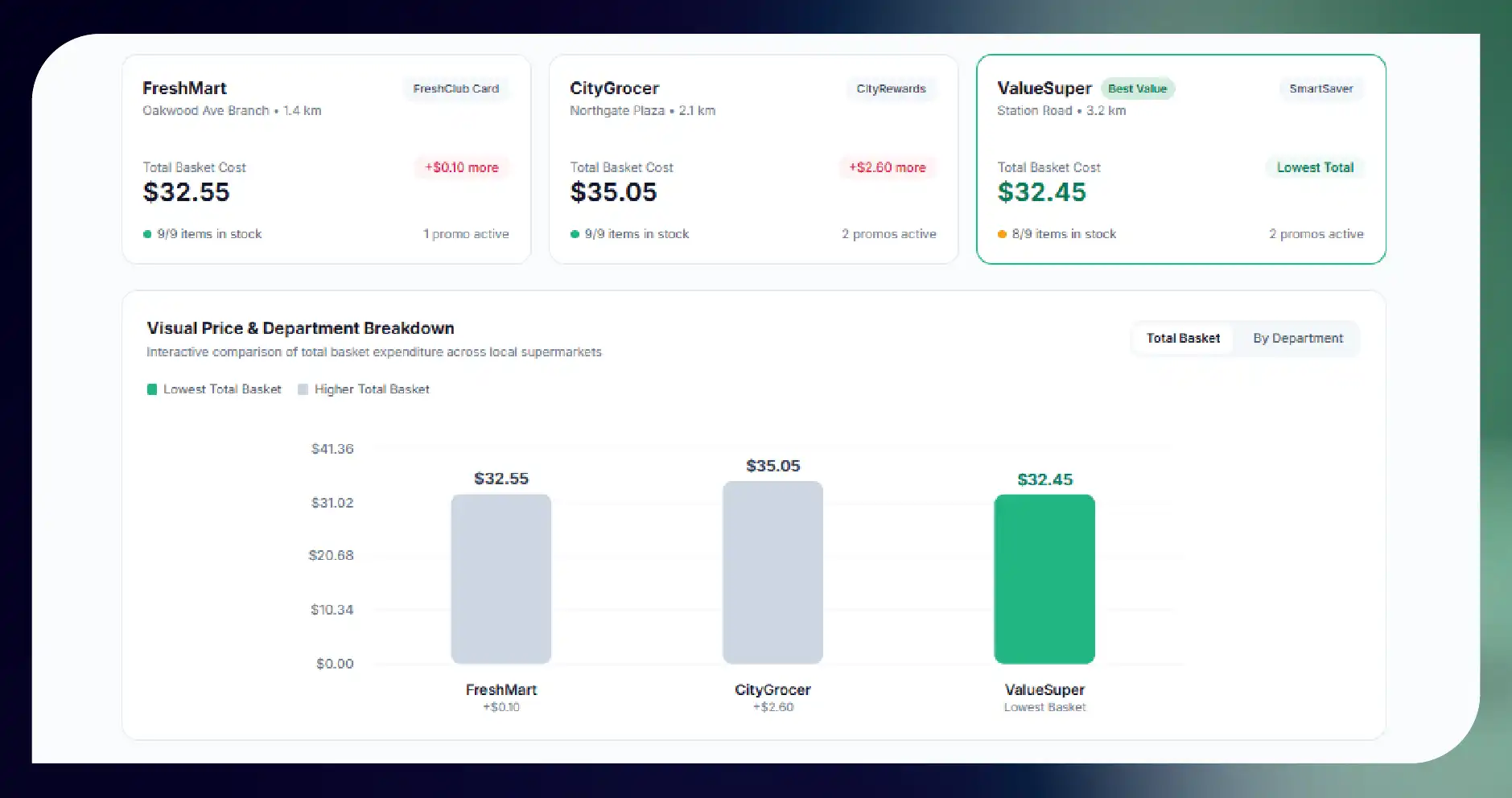
A local supermarket basket price comparison site is a digital platform that compares the total cost of a predefined collection of grocery products across supermarkets serving a particular geographic area.
Unlike traditional comparison tools that focus on individual products, basket-based platforms calculate the combined cost of multiple items. This provides a more practical understanding of household spending because consumers generally purchase several products during one shopping trip.
For example, a household may need milk, bread, eggs, rice, pasta, apples, chicken, detergent, and breakfast cereal. One supermarket might offer cheaper dairy products, while another provides better prices for fresh produce and cleaning supplies. A basket comparison platform evaluates these differences collectively.
The platform can present several useful comparisons:
- Total basket cost: The combined price of all selected products at each supermarket.
- Individual product prices: The cost of each item across participating retailers.
- Potential savings: The difference between the cheapest and most expensive comparable baskets.
- Store-level comparisons: Price differences between supermarket branches in nearby locations.
- Promotional opportunities: Discounts, loyalty offers, multibuy deals, and temporary price reductions.
- Availability indicators: Whether products are listed as available, unavailable, or out of stock.
By combining these features, the platform transforms scattered pricing information into actionable shopping intelligence.
Why Local Grocery Basket Price Comparison Matters?
1. Rising Household Grocery Expenses
Food prices influence household budgets, particularly for families purchasing essential products every week. Even small differences in the prices of frequently purchased items can accumulate into substantial annual savings. Grocery Basket Savings Analytics helps consumers evaluate the total financial impact of choosing one supermarket over another. Rather than relying on individual discounts, shoppers can identify retailers offering better value across their regular purchases.
2. Differences in Regional Pricing
Supermarket prices can vary between cities, neighbourhoods, and individual branches. Retailers may adjust prices according to local competition, operating costs, customer demand, and regional promotional strategies. Supermarket Pricing Intelligence helps businesses understand these variations and identify competitive stores within a practical travel distance. It can also highlight areas where the same product costs more despite being sold by the same retail chain.
3. Complex Promotional Offers
Discounts can make grocery comparisons difficult. A product advertised at a reduced price may not necessarily provide the best value if its package size is smaller or a competing retailer offers a lower standard price. Local Grocery Price Monitoring enables comparison platforms to evaluate promotional prices alongside regular prices, package quantities, eligibility conditions, and applicable loyalty requirements. This helps consumers understand the actual savings available.
4. Growing Digital Grocery Adoption
Online supermarket websites and grocery applications provide consumers with convenient access to product listings and pricing information. However, comparing multiple retailers still requires switching between platforms and manually recording prices. Real-Time Price Monitoring helps comparison platforms track available pricing updates and consolidate relevant information into one interface. Users can evaluate complete shopping baskets before deciding where to purchase their groceries.
How Grocery Basket Price Data Is Collected?
Building an accurate comparison platform requires a systematic approach to collecting, processing, and validating supermarket information.
Identify Relevant Supermarkets and Data Sources
The first step is selecting supermarkets that serve the target market. Sources may include retailer websites, online grocery catalogues, authorized APIs, public product feeds, and other permitted digital sources.
The selection should reflect local shopping habits and include retailers with meaningful geographic overlap. Comparing stores that serve different customer areas without considering travel distance could produce misleading recommendations.
Extract Essential Product Information
A comprehensive dataset should capture the information required to match products and calculate basket prices.
Important fields include:
- Supermarket and branch identification
- Product name, brand, and category
- Package size, weight, or volume
- Standard and promotional prices
- Unit price per kilogram, litre, or item
- Product availability and stock status
- Promotion start and end dates, when available
- Collection timestamp and source reference
- Delivery charges or minimum-order requirements, where applicable
Collecting these attributes creates a more useful foundation than recording product prices alone.
Standardize Product Names and Quantities
Different supermarkets may describe the same product differently. One retailer might list a product as "Whole Milk 1L," while another uses "Fresh Full-Cream Milk, 1000 ml."
Product matching systems normalize names, brands, package sizes, and measurement units to identify comparable products. Exact matches can be prioritized, while uncertain matches can be reviewed using product identifiers or additional attributes.
This step is especially important when comparing private-label products with branded alternatives. Similar product categories do not automatically indicate identical quality or specifications.
Calculate Comparable Basket Prices
Once product records are standardized, the platform calculates the total cost of a predefined basket at each supermarket.
The calculation should account for package quantities, applicable discounts, and product availability. If an item is unavailable, the system should flag the missing product instead of silently treating its price as zero.
Platforms can offer multiple basket definitions, including a fixed-brand basket, a lowest-price equivalent basket, and a household-specific basket. These options help consumers compare like-for-like purchases while retaining flexibility.
Refresh and Validate Pricing Records
Supermarket prices change because of promotions, supplier costs, competitive adjustments, and inventory conditions. Therefore, the platform needs a regular refresh schedule based on source availability and the frequency of price changes.
Automated validation can identify missing values, unexpected price movements, duplicate products, and inconsistent package sizes. Historical records help distinguish genuine price changes from extraction errors.
Data collection should respect applicable laws, website terms, privacy requirements, and source access restrictions.
Essential Features of a Successful Comparison Platform
Personalized Shopping Baskets
Consumers should be able to create baskets based on their household requirements. A family purchasing baby products and bulk groceries may have different priorities from a single shopper buying basic essentials.
Saved baskets make repeat comparisons easier and allow users to track changes in their usual grocery expenditure over time.
Unit-Price Comparison
Comparing products with different package sizes can produce inaccurate conclusions if shoppers consider only the displayed price.
For example, a 500-gram cereal pack priced at ₹150 costs ₹300 per kilogram, while a one-kilogram pack priced at ₹260 costs ₹260 per kilogram. Although the larger package costs more upfront, its unit price is lower.
Unit-price normalization provides a more transparent basis for comparing value.
Store Distance and Shopping Convenience
The cheapest basket may not always represent the lowest overall shopping cost. Consumers may need to consider travel expenses, delivery fees, minimum-order thresholds, and the time required to visit multiple supermarkets.
A useful platform can display nearby branches and estimate additional costs when reliable information is available. It should explain whether displayed totals include delivery charges and other applicable fees.
Historical Price Trends
Historical records allow users to see whether grocery prices are increasing, decreasing, or remaining stable.
Price charts can highlight seasonal changes, recurring discounts, and products that frequently experience price fluctuations. These insights help consumers plan purchases and identify better shopping periods.
Transparent Savings Calculations
Savings estimates should clearly explain their calculation method. For example, the difference between the cheapest and most expensive comparable basket represents potential savings before additional shopping costs.
Platforms should distinguish theoretical savings from realized savings and disclose exclusions, unavailable products, and promotional conditions. Transparent calculations build consumer confidence.
How Grocery Basket Comparisons Benefit Retailers and Businesses?
Basket-level pricing intelligence also creates opportunities beyond consumer savings.
Retailers can benchmark their prices against nearby competitors and identify categories where they appear expensive or offer stronger value. These insights support pricing decisions without requiring teams to manually review multiple supermarket websites.
Consumer intelligence providers can analyze changes in grocery expenditure across geographic areas. Researchers can examine how price differences vary by product category, retailer format, and promotional period.
Consumer brands can monitor retail price positioning and evaluate how discounts affect their products relative to competing brands. Grocery technology companies can use structured datasets to power comparison engines, shopping assistants, and personalized recommendations.
The broader opportunity lies in converting frequently changing retail information into consistent, searchable, and comparable records.
Challenges in Building a Reliable Price Comparison Site
Despite its advantages, supermarket basket comparison involves several practical challenges.
- Product matching: Similar names may represent different brands, sizes, formulations, or product qualities. Automated matching requires robust normalization and validation.
- Location-specific prices: Prices and availability may differ between branches. The platform must associate each record with the correct store and geographic area.
- Promotional complexity: Multibuy offers, loyalty discounts, coupons, and membership requirements can complicate calculations. Platforms should clearly distinguish generally available prices from conditional offers.
- Incomplete baskets: Some supermarkets may not stock every requested product. Missing items should be disclosed, and basket completeness should be displayed alongside the total.
- Data freshness: Delayed updates can cause users to see prices that are no longer available. Timestamping and refresh monitoring help communicate data reliability.
- Operational scalability: Monitoring multiple retailers, locations, and product categories requires efficient collection pipelines, quality checks, and structured storage.
Addressing these challenges is essential for producing comparisons that consumers can trust and businesses can use confidently.
How Food Data Scrape Can Help You?
1. Comprehensive Price Collection
Food Data Scrape collects permitted supermarket product information across selected retailers, helping businesses consolidate prices, package sizes, discounts, and availability into structured datasets for reliable grocery basket comparisons.
2. Competitor Benchmarking
Compare grocery basket costs across supermarkets, identify pricing gaps, and evaluate promotional strategies. These insights help retailers understand competitive positioning and make informed pricing decisions using consistent, comparable product records.
3. Automated Data Refresh
Establish scheduled collection workflows that capture price changes and product availability at appropriate intervals. Regular updates help comparison platforms maintain relevant records and reduce reliance on manual monitoring.
4. Basket Savings Analysis
Analyze predefined shopping baskets, compare total costs, and identify products contributing most to price differences. Businesses can use these insights to develop transparent savings calculations and more useful consumer recommendations.
5. Scalable Dataset Delivery
Food Data Scrape can organize collected information into structured formats suitable for dashboards, analytics systems, and comparison applications, supporting expanding retailer coverage and more efficient grocery intelligence workflows.
Conclusion
A price comparison site for local supermarket basket prices helps consumers make informed grocery decisions by comparing complete shopping lists rather than isolated products. With accurate product matching, standardized unit prices, transparent promotional calculations, and location-specific information, these platforms can reveal meaningful savings opportunities and simplify everyday shopping.
Businesses can use Grocery Data Scraping to collect permitted retail information, monitor price movements, and build reliable comparison experiences. Well-organized Grocery Store Datasets support product matching, historical analysis, competitive benchmarking, and location-based insights across participating supermarkets.
By combining these capabilities with transparent Grocery Price Comparison, businesses can create useful digital services that help shoppers manage household budgets while enabling retailers and market researchers to understand local grocery competition. The strongest platforms prioritize data quality, regular updates, fair comparisons, and clear explanations of how prices and potential savings are calculated.
Are you in need of high-class scraping services? Food Data Scrape should be your first point of call. We are undoubtedly the best in Food Data Aggregator and Mobile Grocery App Scraping service and we render impeccable data insights and analytics for strategic decision-making. With a legacy of excellence as our backbone, we help companies become data-driven, fueling their development. Please take advantage of our tailored solutions that will add value to your business. Contact us today to unlock the value of your data.
Get a Free Food Data Sample in 48 Hours.
Tell us your platforms, target markets and required fields — we'll map exactly what's possible with food data scraping, recommend the right approach, and send a working sample so you can verify quality before any commitment.