
This report analyzes the growing importance of retail data extraction from LuLu Hypermarket to support modern grocery analytics and pricing optimization strategies. It focuses on how Scrape Lulu Hypermarket Grocery Data enables structured capture of product-level attributes such as pricing, availability, and promotional activity across diverse grocery categories. This approach helps retailers and analysts gain deeper visibility into market behavior and improve decision-making accuracy. By converting raw retail listings into structured formats, organizations can better understand demand fluctuations, seasonal pricing patterns, and category performance trends. The study also highlights how such datasets contribute to improved forecasting models and operational efficiency in highly competitive grocery markets. Overall, the report demonstrates how systematic data extraction from large-scale hypermarket platforms supports smarter retail planning, enhanced pricing strategies, and stronger market responsiveness in an increasingly digital grocery ecosystem.
Data Tracking: Enables structured tracking of grocery product information across multiple categories and SKUs.
Price Monitoring:Improves visibility into pricing changes, discounts, and promotional patterns.
Stock Analysis:Supports real-time analysis of stock availability and demand behavior.
Forecast Accuracy: Enhances forecasting accuracy for retail planning and inventory management.
Market Strategy: Strengthens competitive decision-making in dynamic grocery market environments.

The modern retail industry is increasingly driven by automation, analytics, and real-time insights. One of the most effective ways to gain competitive advantage in FMCG markets is through structured data extraction from leading hypermarkets.Among these, LuLu Hypermarket serves as a critical source of grocery pricing and product intelligence across multiple regions including the Middle East and Asia.
The process to Scrape Lulu Hypermarket Grocery Data enables businesses to collect structured product-level information such as pricing, discounts, availability, and category performance. This data becomes foundational for retail forecasting and strategic decision-making.
In parallel, Web Scraping Grocery Data plays a central role in transforming unstructured online listings into usable datasets that can power analytics platforms.When combined with automated pipelines, it allows organizations to continuously monitor price fluctuations and promotional strategies across thousands of SKUs.
A key application of this ecosystem is Lulu Hypermarket Price Monitoring, which focuses on tracking dynamic pricing changes across categories like dairy, meat, beverages, and packaged foods.
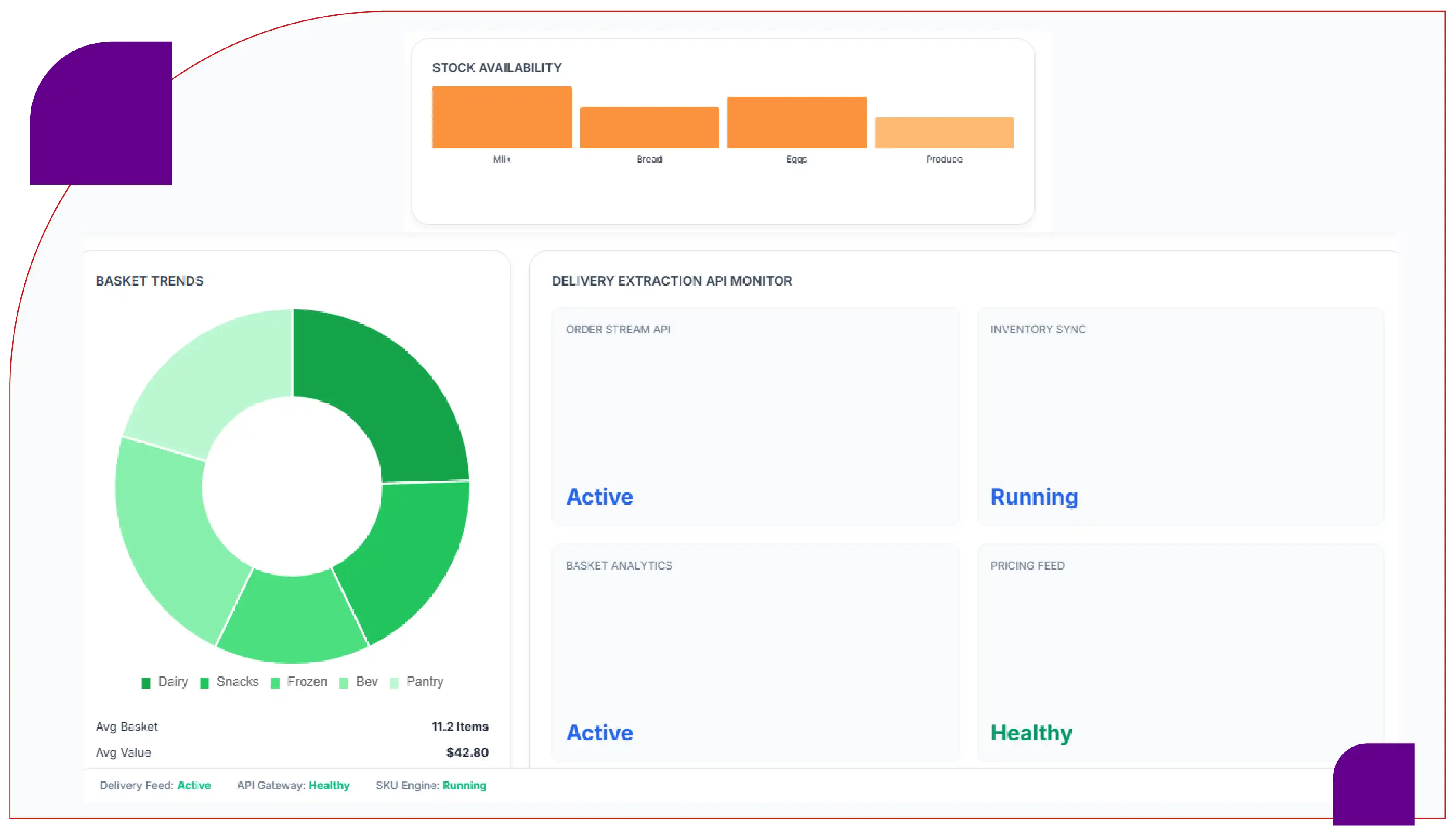
One of the most valuable segments of grocery analytics is delivery-based intelligence. Modern grocery platforms associated with LuLu provide structured and semi-structured data that can be leveraged for deep behavioral analysis.
Lulu Grocery Delivery Data Scraping enables extraction of order-level insights, delivery timelines, stock availability, and basket composition trends. This allows analysts to understand how digital consumers interact with grocery platforms, especially during peak demand cycles such as weekends or festive seasons.
To operationalize this data flow, enterprises often deploy a Grocery Delivery Extraction API, which automates ingestion of delivery data streams.This API-based approach eliminates manual extraction and ensures real-time updates across analytics dashboards.
Delivery intelligence also helps identify substitution patterns, where customers replace unavailable items with alternative SKUs.This provides valuable insight into demand elasticity and inventory optimization strategies.
Retail competition in grocery ecosystems is highly dynamic, requiring continuous monitoring of price shifts and promotional campaigns.This is where structured intelligence frameworks become essential.
Lulu Competitive Price Intelligence allows businesses to benchmark SKU-level pricing against competitors and identify margin optimization opportunities.It is particularly useful for FMCG brands seeking to maintain price consistency across multiple retail channels.
Beyond pricing, Lulu Grocery Market Intelligence focuses on broader consumption trends, category growth, and customer behavior segmentation.It integrates historical sales data with real-time scraping outputs to build predictive models for demand forecasting.
Market intelligence systems also help identify high-growth categories such as organic foods, ready-to-eat meals, and health-focused grocery items.These insights are critical for product positioning and supply chain planning.
The foundation of any retail intelligence system is a well-structured dataset. Grocery data extracted from hypermarket platforms typically includes product metadata, pricing history, discount percentages, availability status, and delivery information.
A Lulu Hypermarket Grocery Dataset consolidates this information into structured formats suitable for analytics and machine learning models.These datasets are used for price optimization, demand forecasting, and recommendation systems.
At a broader level, standardized Grocery Datasets enable cross-market comparisons and long-term trend analysis.They also support the development of AI-driven retail engines that can automatically adjust pricing strategies based on demand signals.
Advanced retail analytics platforms rely heavily on API-driven architectures for real-time data ingestion and visualization.
The LuLu Hypermarket Qatar Grocery Delivery Scraping API is an example of a system designed to extract real-time grocery feeds, including pricing updates, inventory changes, and promotional flags.This API enables seamless integration with enterprise-level analytics systems.
Once the data is collected, it is typically visualized through a Grocery Price Dashboard, which provides interactive insights into category performance, price volatility, and competitor benchmarking.
These dashboards allow decision-makers to quickly identify pricing gaps, monitor promotional effectiveness, and adjust strategies accordingly.
| SKU ID | Product Name | Category | Pack Size | Base Price (QAR) | Discount % | Final Price (QAR) | Availability | Delivery Time |
|---|---|---|---|---|---|---|---|---|
| LULU1001 | Basmati Rice Premium | Grains | 5 kg | 45.00 | 12% | 39.60 | In Stock | 2–3 hrs |
| LULU1002 | Fresh Milk Full Cream | Dairy | 1 L | 7.00 | 5% | 6.65 | In Stock | 1–2 hrs |
| LULU1003 | Olive Oil Extra Virgin | Oils | 1 L | 30.00 | 10% | 27.00 | Low Stock | 3–4 hrs |
| Category | SKU Count | Avg Discount % | Top SKU | Demand Index | Price Volatility | Stock-Out Rate | Delivery Efficiency |
|---|---|---|---|---|---|---|---|
| Dairy | 130 | 6.8% | Fresh Milk Full Cream | High | Medium | Low | 9.3 |
| Grains | 90 | 9.1% | Basmati Rice Premium | Very High | Low | Low | 9.6 |
| Beverages | 150 | 6.0% | Instant Coffee | High | Medium | Medium | 8.9 |
The integration of scraped grocery data into enterprise systems enables organizations to shift from reactive decision-making to predictive intelligence. Retailers can optimize pricing strategies, improve inventory allocation, and enhance customer satisfaction through data-driven insights.
By leveraging structured datasets and API-based ingestion systems, businesses can significantly reduce manual effort while increasing the accuracy of forecasting models.
This approach also enables real-time responsiveness to market fluctuations, ensuring that pricing strategies remain competitive across multiple regions.
The evolution of grocery analytics is heavily dependent on structured data pipelines and intelligent dashboards that transform raw information into actionable insights. Systems such as Grocery Price Tracking Dashboard provide real-time visibility into pricing fluctuations, while Grocery Data Intelligence enables deeper predictive modeling and strategic forecasting.
At a broader level, the use of Grocery Datasets ensures scalability in analytics operations, allowing businesses to expand insights across categories, regions, and time periods.
Are you in need of high-class scraping services? Food Data Scrape should be your first point of call. We are undoubtedly the best in Food Data Aggregator and Mobile Grocery App Scraping service and we render impeccable data insights and analytics for strategic decision-making.With a legacy of excellence as our backbone, we help companies become data-driven, fueling their development. Please take advantage of our tailored solutions that will add value to your business. Contact us today to unlock the value of your data.