Introduction
Menu innovation is no longer driven by culinary creativity alone. In 2026, every new dish, limited-time offer, or product launch is expected to deliver measurable commercial results. Restaurant operators, food manufacturers, and consumer brands are making product decisions based on real-world demand signals instead of assumptions. Organizations that understand evolving menu patterns early gain a competitive advantage by introducing concepts before markets become crowded.
Businesses that Scrape Menu Data for AI-Powered Menu Innovation gain access to continuously updated insights about pricing, ingredients, flavors, consumer preferences, seasonal offerings, and menu positioning across thousands of restaurants. Likewise, Menu Data Scraping for AI-Powered Menu Innovation enables enterprises to transform scattered restaurant information into structured datasets that power predictive decision-making. Modern AI Menu Intelligence Data further enhances these capabilities by identifying emerging opportunities before they become mainstream, allowing brands to innovate with greater confidence.
Why Menu Data Has Become the Foundation of Innovation?
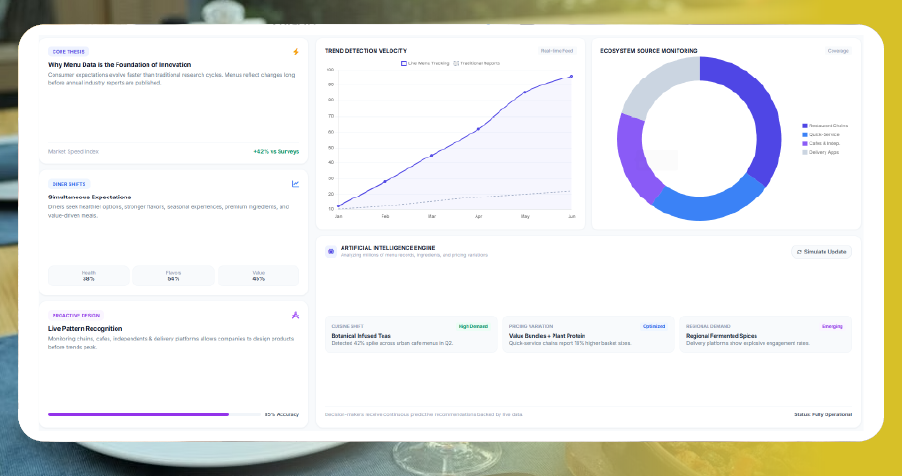
Consumer expectations continue to evolve faster than traditional market research cycles. Diners are simultaneously looking for healthier options, stronger flavors, seasonal experiences, premium ingredients, and value-driven meals. Restaurant menus reflect these changes long before annual industry reports are published.
By monitoring menu updates across restaurant chains, quick-service brands, cafes, independent restaurants, and delivery platforms, companies can identify patterns as they emerge. Instead of reacting to established trends, businesses can proactively design products and campaigns based on live market intelligence.
Artificial intelligence further strengthens this process by analyzing millions of menu records, ingredient combinations, pricing variations, cuisine preferences, and regional demand shifts. Rather than reviewing spreadsheets manually, decision-makers receive predictive recommendations backed by continuously updated restaurant data.
AI is Transforming Menu Innovation
Artificial intelligence does far more than summarize restaurant menus. It identifies relationships that would otherwise remain hidden within enormous datasets.
For example, AI can recognize that certain ingredients are appearing together more frequently across multiple restaurant categories. It can detect when flavor combinations migrate from premium restaurants into fast-casual chains. It can also predict whether an emerging ingredient is likely to become a nationwide trend or remain limited to specific regions.
Instead of asking what restaurants served last quarter, AI answers far more valuable questions:
- Which ingredients are accelerating fastest?
- Which cuisines are gaining consumer attention?
- What pricing strategies improve adoption?
- Which menu categories are becoming saturated?
- Where are the remaining opportunities?
These insights dramatically reduce uncertainty during product development.
Building Better Products with Live Restaurant Intelligence
Research and development teams often spend months creating products based on historical consumer surveys. Unfortunately, consumer preferences may have already shifted before those products reach the market.
Continuous Food menu trend data extraction provides R&D teams with current information about changing ingredient usage, flavor evolution, dietary preferences, and menu positioning.
Instead of relying solely on focus groups, product developers can validate concepts using thousands of real restaurant menus updated daily.
For example, they can monitor:
- Growth of protein-rich offerings
- Expansion of plant-based alternatives
- Seasonal flavor introductions
- Premium ingredient adoption
- Regional cuisine popularity
- Health-focused menu claims
These signals help companies prioritize concepts that already demonstrate growing consumer acceptance.
Understanding Flavor Evolution Through Menu Analytics
Today's consumers increasingly seek memorable eating experiences. Flavor intensity, fusion cuisine, global ingredients, and unique combinations influence purchasing decisions more than ever before.
Through Menu Analytics Data Scraping, businesses can monitor how flavor profiles evolve across different restaurant segments.
Instead of viewing individual menu items separately, AI groups similar ingredients into broader flavor movements. This allows brands to identify patterns such as:
- Smoky flavor expansion across barbecue and burgers.
- Sweet-and-spicy combinations entering chicken, pizza, and appetizers.
- Regional sauces becoming national menu staples.
- Premium herbs appearing in affordable casual dining.
- Dessert flavors migrating into beverages.
These insights allow food manufacturers to build commercially viable products before competitors recognize the opportunity.
Competitive Benchmarking at Scale
Restaurant competition is no longer limited by geography. National chains monitor regional innovators, while independent restaurants influence large franchise brands through viral menu concepts.
Comprehensive Food Menu Trend Data Extraction enables businesses to compare thousands of restaurant menus simultaneously.
AI systems automatically benchmark:
- Menu expansion rates
- Category diversity
- Ingredient frequency
- Price positioning
- Promotional strategies
- Seasonal launches
- Limited-time offers
- Regional variations
This level of benchmarking helps companies understand where competitors are investing and where untapped opportunities remain.
Identifying Consumer Demand Before It Peaks
One of the biggest challenges in menu innovation is timing.
- Launching too early creates consumer education challenges.
- Launching too late means entering a saturated category.
AI-powered restaurant analysis identifies early demand signals by continuously monitoring new menu additions across markets.
When a specific ingredient begins appearing across independent restaurants before reaching national chains, businesses gain valuable lead time.
Similarly, AI detects when niche cuisines begin expanding beyond metropolitan markets, signaling broader commercial potential.
These predictive capabilities reduce innovation risk while increasing first-mover advantages.
Restaurant Data Supports Every Business Function
Menu intelligence is valuable far beyond product development.
- Marketing teams use menu insights to create campaigns aligned with current dining preferences.
- Sales teams strengthen presentations with market-backed evidence instead of assumptions.
- Procurement departments forecast ingredient demand more accurately.
- Category managers identify whitespace opportunities.
- Executive leadership evaluates long-term investment priorities using measurable restaurant trends.
Modern Restaurant menu analytics using AI creates a unified intelligence platform where every department works from the same continuously updated dataset.
Instead of isolated research projects, organizations build ongoing market awareness.
Why Web Scraping Makes AI More Powerful?
Artificial intelligence depends entirely on high-quality data.
Restaurant websites, delivery platforms, digital menus, food aggregators, mobile applications, and franchise portals collectively contain millions of valuable menu records. However, this information exists in inconsistent formats across thousands of sources.
Professional Web Scraping Food Data automates collection while preserving accuracy, consistency, and scalability.
The collected information typically includes:
- Restaurant names
- Menu categories
- Item descriptions
- Ingredient lists
- Nutritional information
- Pricing
- Promotions
- Images
- Availability
- Cuisine types
- Geographic coverage
- Seasonal offerings
Once standardized, AI engines can analyze this structured information to uncover meaningful business insights.
Without automated data collection, organizations simply cannot maintain the scale necessary for reliable predictive analytics.
Unlock AI-powered menu innovation with real-time restaurant data—contact us today to stay ahead of every food trend.
Real-Time Intelligence Creates Faster Decisions
Traditional restaurant research often takes weeks or months to compile.
- During that period, menus continue changing.
- Ingredients gain popularity.
- Prices fluctuate.
- Competitors launch new products.
- Consumer preferences evolve.
Real-time menu scraping eliminates these delays by continuously updating enterprise databases.
Instead of relying on quarterly reports, businesses receive ongoing intelligence about market movements.
This enables faster product validation, quicker promotional planning, and more responsive innovation strategies.
Organizations that operate with current restaurant intelligence consistently outperform those relying on outdated market research.
AI-Powered Menu Innovation Across Multiple Industries
Although restaurants remain the primary beneficiaries, menu intelligence supports numerous industries.
- Food manufacturers identify growing ingredient demand before increasing production.
- Retail grocery companies align private-label products with restaurant trends.
- Meal-kit providers design recipes reflecting popular restaurant flavors.
- Cloud kitchens optimize virtual brands using local demand signals.
- Hospitality groups personalize menus across hotel properties.
- Investment firms evaluate restaurant growth opportunities.
- Food delivery platforms improve recommendations through evolving menu analysis.
Each of these industries benefits from continuously updated restaurant intelligence powered by AI and automated data collection.
Turning Restaurant Data into Strategic Business Value
The greatest advantage of AI-powered menu innovation lies in converting raw restaurant information into actionable business decisions.
Instead of collecting data simply for reporting, organizations create predictive models that guide innovation pipelines, pricing strategies, promotional campaigns, ingredient sourcing, and long-term product roadmaps.
- As machine learning models improve, every new menu update strengthens forecasting accuracy.
- Businesses no longer need to guess which food concepts deserve investment.
- They can validate opportunities using measurable restaurant intelligence collected across thousands of locations.
The result is faster innovation, reduced commercial risk, stronger operator conversations, and products that align with actual consumer purchasing behavior rather than assumptions.
How Food Data Scrape Can Help You?
Real-Time Menu Monitoring
We continuously collect restaurant menu updates, pricing, ingredients, and seasonal offerings, helping your business identify emerging food trends early and make faster product development and marketing decisions.
AI-Ready Structured Datasets
Our scraping solutions deliver clean, standardized, and structured menu datasets that seamlessly integrate with AI, analytics, and BI platforms for accurate forecasting, trend analysis, and strategic planning.
Competitive Menu Intelligence
Track competitor menus, pricing changes, promotional campaigns, ingredient innovations, and limited-time offers across multiple restaurant chains to uncover market opportunities and strengthen your competitive positioning.
Consumer Trend Discovery
Analyze evolving cuisines, flavors, dietary preferences, and menu categories using comprehensive restaurant data, enabling your teams to develop products that align with real-time consumer demand and purchasing behavior.
Enterprise-Scale Data Delivery
Access customized menu intelligence through APIs, cloud storage, databases, or scheduled reports, ensuring reliable, scalable, and automated data delivery that supports enterprise-wide innovation and business growth.
Conclusion
Menu innovation in 2026 demands more than creative thinking. It requires continuous visibility into restaurant activity, consumer preferences, ingredient evolution, pricing dynamics, and competitive positioning. AI delivers meaningful recommendations only when supported by accurate, real-time menu intelligence collected from diverse restaurant sources.
Organizations that Extract Restaurant Menu Data consistently gain a clearer understanding of changing market conditions, enabling smarter product development and faster commercial execution. Combined with comprehensive Restaurant Data Intelligence, businesses can identify emerging opportunities before competitors and confidently introduce products backed by measurable demand. As AI continues reshaping the food industry, robust Food Data Intelligence will remain the foundation for scalable, data-driven menu innovation, helping brands reduce uncertainty while creating offerings that resonate with both operators and consumers.
If you are seeking for a reliable data scraping services, Food Data Scrape is at your service. We hold prominence in Food Data Aggregator and Mobile Restaurant App Scraping with impeccable data analysis for strategic decision-making.