Introduction
The modern restaurant industry is no longer driven solely by taste, presentation, and location. Behind successful menu decisions is an increasing amount of market intelligence. Restaurants, food delivery companies, hospitality groups, and market researchers need to understand what competitors are selling, how dishes are priced, which cuisines are gaining attention, and how menus are changing over time. This is where the need to Scrape Menu Planning Data becomes a valuable business strategy.
Menus contain far more intelligence than a simple list of dishes. They reveal product positioning, pricing structures, dietary preferences, promotional strategies, seasonal offerings, cuisine trends, and competitive movements. By systematically collecting this information from relevant online sources, businesses can transform scattered menu information into organized datasets that support smarter planning.
Menu Planning Data Scraping allows companies to gather information such as restaurant names, cuisine types, dish names, descriptions, prices, categories, portion sizes, dietary labels, promotions, availability, and location details. Instead of manually reviewing hundreds of menus, businesses can create structured information that can be analyzed repeatedly.
At the same time, Restaurant Menu Data Scraping provides an opportunity to examine competitors at scale. A business operating in one city can compare nearby restaurants, while a national restaurant group can analyze pricing and menu strategies across multiple regions.
Why Menu Planning Has Become a Data-Driven Activity?
Creating a restaurant menu involves many interconnected decisions. Operators need to determine which products deserve space, how much each dish should cost, which categories need expansion, and what customers may expect from the restaurant.
Traditionally, these decisions were influenced by chef experience, customer feedback, historical sales, and competitor observation. Those factors remain important, but digital menus now provide another valuable information source.
Online restaurant menus can reveal market changes much faster than traditional research. When multiple competitors introduce similar dishes, increase prices, launch new meal combinations, or expand a particular category, those changes can become visible through systematic data collection.
The result is a more informed menu planning process.
Instead of asking, "What should we add to our menu?" restaurant managers can investigate what is already succeeding across their competitive landscape and identify opportunities that have not yet been fully explored.
What Information Can Be Collected From Menus?
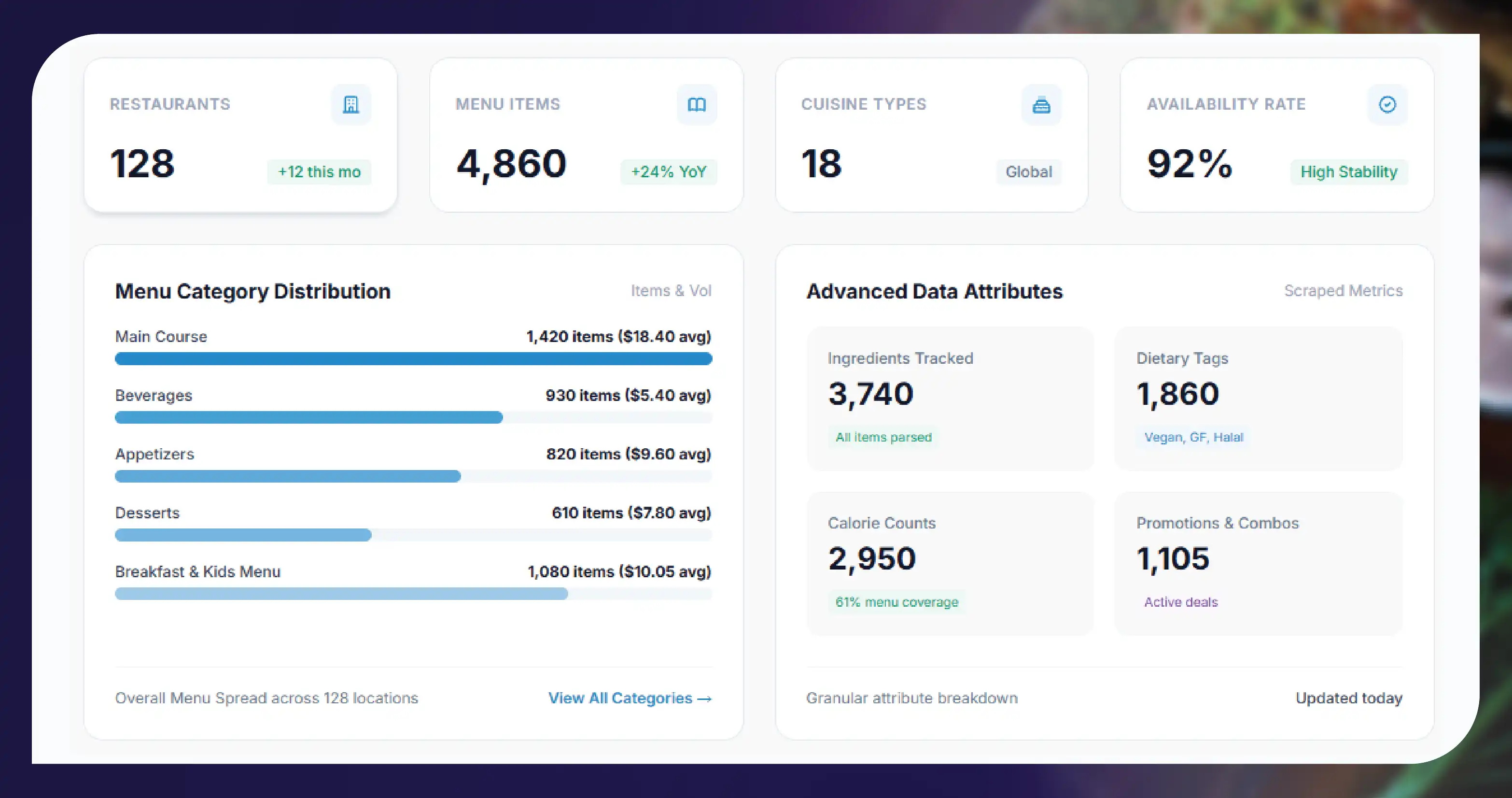
A menu dataset can be designed around the specific requirements of the business.
Basic information may include restaurant names, locations, cuisine types, dish names, categories, prices, and descriptions. More advanced datasets can capture portion sizes, ingredients, dietary tags, calories, meal periods, promotions, combo offers, and availability.
Businesses can also organize information around specific categories such as appetizers, main courses, desserts, beverages, breakfast items, children's meals, vegetarian dishes, vegan products, and specialty offerings.
The value increases when this information is collected repeatedly.
A menu captured once provides a snapshot. A menu captured regularly becomes a historical record capable of showing how restaurants evolve.
That distinction is critical for businesses interested in long-term market intelligence.
Turning Menu Information Into Pricing Intelligence
Pricing is one of the strongest applications of menu data.
Restaurant operators constantly face the challenge of setting prices that balance customer expectations, competitor positioning, operating costs, and profitability. Looking only at internal costs does not provide the complete picture.
Competitive pricing information adds important context.
For example, a restaurant introducing a premium seafood dish could compare prices charged by comparable restaurants. Analysts could examine whether similar dishes are concentrated around a particular price range or whether premium competitors successfully charge significantly more.
This type of analysis can reveal opportunities for repositioning products.
Menu Pricing Data Intelligence can help businesses understand whether they are positioned as value-oriented, mainstream, premium, or luxury providers. It can also reveal differences between markets where similar dishes may command very different prices.
Understanding Restaurant Menu Pricing
Prices should not be evaluated in isolation.
A $25 entrée may appear expensive compared with one competitor but inexpensive compared with premium restaurants in the same area. Therefore, pricing analysis should consider restaurant category, cuisine, location, ingredients, portion size, and positioning.
Restaurant Menu Pricing Data can be segmented according to these variables to create more meaningful comparisons.
Businesses can identify average prices for individual categories, compare premium and budget restaurants, monitor price changes, and determine how frequently competitors modify their prices.
This becomes particularly valuable during periods of inflation or changing ingredient costs.
Rather than making pricing adjustments blindly, restaurants can understand how the wider market is responding.
Discovering Menu Trends Before They Become Saturated
Food preferences can change quickly.
A particular ingredient, cuisine, beverage, or dietary concept may move from niche popularity into mainstream adoption. Restaurants that identify these shifts early may gain an advantage by introducing relevant products before the market becomes saturated.
Menu data can help track these movements.
Suppose analysts notice that plant-based dishes are appearing across an increasing number of restaurants. They can then examine which types of plant-based products are being introduced, how they are described, what prices they command, and which restaurant segments are adopting them.
The same methodology can be applied to high-protein meals, specialty coffee, regional cuisines, fusion dishes, gluten-free products, functional beverages, premium desserts, and other emerging categories.
Competitive Menu Monitoring
Competition does not remain static.
A restaurant that performs competitive research once every six months may miss dozens of important changes. Competitors can add new dishes, discontinue products, change prices, introduce promotions, or completely redesign their menus between research cycles.
Continuous data collection makes these changes easier to identify.
Restaurant managers can establish monitoring processes that capture menu updates at regular intervals. Historical records can then be compared with newer datasets to identify what changed.
This transforms menu research from a one-time project into an ongoing competitive intelligence system.
The Importance of Restaurant Menu Data Analytics
Collecting information is only the beginning. The real value comes from analyzing it.
Restaurant Menu Data Analytics can uncover patterns across thousands of menu items. Businesses can calculate average prices, identify fast-growing categories, compare geographic markets, measure menu diversity, and detect changes in competitor positioning.
Analytics can also help identify product gaps.
Imagine that a restaurant discovers that competitors offer numerous premium desserts but very few premium breakfast products. This could represent an opportunity to develop a differentiated breakfast range.
Likewise, if a particular cuisine has become highly competitive in one neighborhood but remains underrepresented in another, the data could support expansion decisions.
Supporting Seasonal Menu Development
Seasonality creates another important opportunity.
Restaurants frequently adjust their offerings around summer, winter, holidays, festivals, tourism periods, and local events. Historical menu information can reveal which products competitors previously introduced during specific periods.
Businesses can examine whether seasonal products tend to be positioned as premium items, limited-time offers, discounted products, or regular menu additions.
This intelligence can support decisions about when to launch seasonal products and how to position them.
It can also help businesses avoid unnecessary duplication. If every competitor launches the same seasonal product, introducing an identical offering may provide little differentiation.
Using AI for Smarter Menu Intelligence
Artificial intelligence is making large-scale menu analysis increasingly practical.
AI Restaurant Intelligence can help classify dishes, identify similar products, normalize inconsistent names, categorize ingredients, detect unusual price movements, and summarize competitive changes.
For example, different restaurants may use different names for similar dishes. AI-assisted classification can recognize these similarities and group products into comparable categories.
AI can also help analysts process large volumes of menu descriptions and identify recurring ingredients, preparation styles, dietary claims, and positioning language.
This makes it possible to move beyond basic scraping toward intelligent food-market analysis.
From Raw Data to Business Strategy
The strongest menu intelligence programs connect collected information with business decisions.
A restaurant may use competitor pricing data to reconsider its own menu prices. A food delivery company may use menu trends to identify high-growth cuisine categories. A hospitality group may compare menu positioning across properties.
Investors and market researchers can use menu datasets to understand restaurant concepts and competitive density. Food manufacturers can analyze menus to discover ingredients or product categories gaining visibility.
The applications extend well beyond restaurant management.
Start Scraping Menu Planning Data Today and Turn Restaurant Menu Trends Into Actionable Competitive Intelligence.
Building a Long-Term Menu Intelligence Repository
One of the biggest advantages of systematic menu collection is the ability to create historical datasets.
With repeated collection, businesses can establish timelines showing when products were introduced, when prices changed, and when dishes disappeared.
Over several months or years, these records can reveal larger market patterns.
Businesses can determine whether certain price increases were temporary or part of a broader trend. They can identify seasonal menu cycles and understand how competitive strategies evolve.
This historical perspective can become an important component of strategic planning.
How Food Data Scrape Can Help You?
1. Identify Profitable Menu Opportunities
Food data can reveal underrepresented dishes, emerging categories, pricing gaps, and underserved customer preferences, helping restaurants identify promising opportunities for menu expansion and product development.
2. Benchmark Competitor Pricing
Systematically collected menu information allows businesses to compare similar products across competitors, understand prevailing price ranges, evaluate positioning, and make better-informed pricing decisions.
3. Monitor Emerging Food Trends
Regular menu analysis can uncover growing cuisines, ingredients, dietary preferences, beverages, and product formats, helping businesses recognize changing consumer interests and respond before competitors.
4. Simplify Competitive Research
Automated food data collection can reduce repetitive manual research by organizing information from numerous online sources, enabling teams to spend more time interpreting insights rather than gathering records.
5. Strengthen Strategic Planning
Historical food datasets provide evidence for menu development, pricing, expansion, promotions, and positioning decisions, allowing businesses to replace assumptions with measurable competitive and market intelligence.
Conclusion
The restaurant menu has evolved into a valuable source of market intelligence. Every dish, description, price, category, promotion, and menu change can contribute to a broader understanding of the food marketplace.
Businesses that systematically collect and analyze menu information can identify competitive movements, understand pricing structures, discover emerging trends, and develop stronger menu strategies.
Real-Time Price Monitoring can further strengthen this approach by helping businesses recognize competitive price changes as they occur rather than relying on outdated research.
For organizations that need scalable collection, organization, and analysis, Food Data Scraping Services can provide the infrastructure required to transform large volumes of online information into usable datasets.
Ultimately, Restaurant Menu Data is most powerful when it moves beyond simple collection and becomes part of an ongoing intelligence strategy. With consistent monitoring, advanced analytics, and AI-assisted interpretation, businesses can make menu planning more responsive, competitive, and data-driven.
Are you in need of high-class scraping services? Food Data Scrape should be your first point of call. We are undoubtedly the best in Food Data Aggregator and Mobile Grocery App Scraping service and we render impeccable data insights and analytics for strategic decision-making. With a legacy of excellence as our backbone, we help companies become data-driven, fueling their development. Please take advantage of our tailored solutions that will add value to your business. Contact us today to unlock the value of your data.
Get a Free Food Data Sample in 48 Hours.
Tell us your platforms, target markets and required fields — we'll map exactly what's possible with food data scraping, recommend the right approach, and send a working sample so you can verify quality before any commitment.
Request a strategy call
Thanks — our data team will reach out within 48 hours with your sample.