About The Client
The client was a rapidly growing quick-commerce business operating across multiple digital marketplaces, offering thousands of grocery, household, personal care, and packaged food products. As its catalog expanded, the company needed accurate product information to support competitive analysis, catalog management, and marketplace intelligence. The business faced challenges in maintaining consistent product identifiers, images, SKUs, and product attributes across different platforms. It required a scalable data solution capable of collecting frequently changing catalog information while preserving accuracy and consistency. Our team developed a structured approach for creating a quick-commerce product images and barcode dataset, bringing essential product attributes together in a standardized format. The solution also supported quick-commerce SKU data extraction, enabling the client to monitor product-level information efficiently. Through automated product barcode and image data scraping, the client gained cleaner catalog records, improved product matching, and better visibility into assortment and marketplace changes. This data ultimately strengthened its catalog operations, competitive monitoring, and analytical decision-making.
Key Challenges
-
Inconsistent Product Information
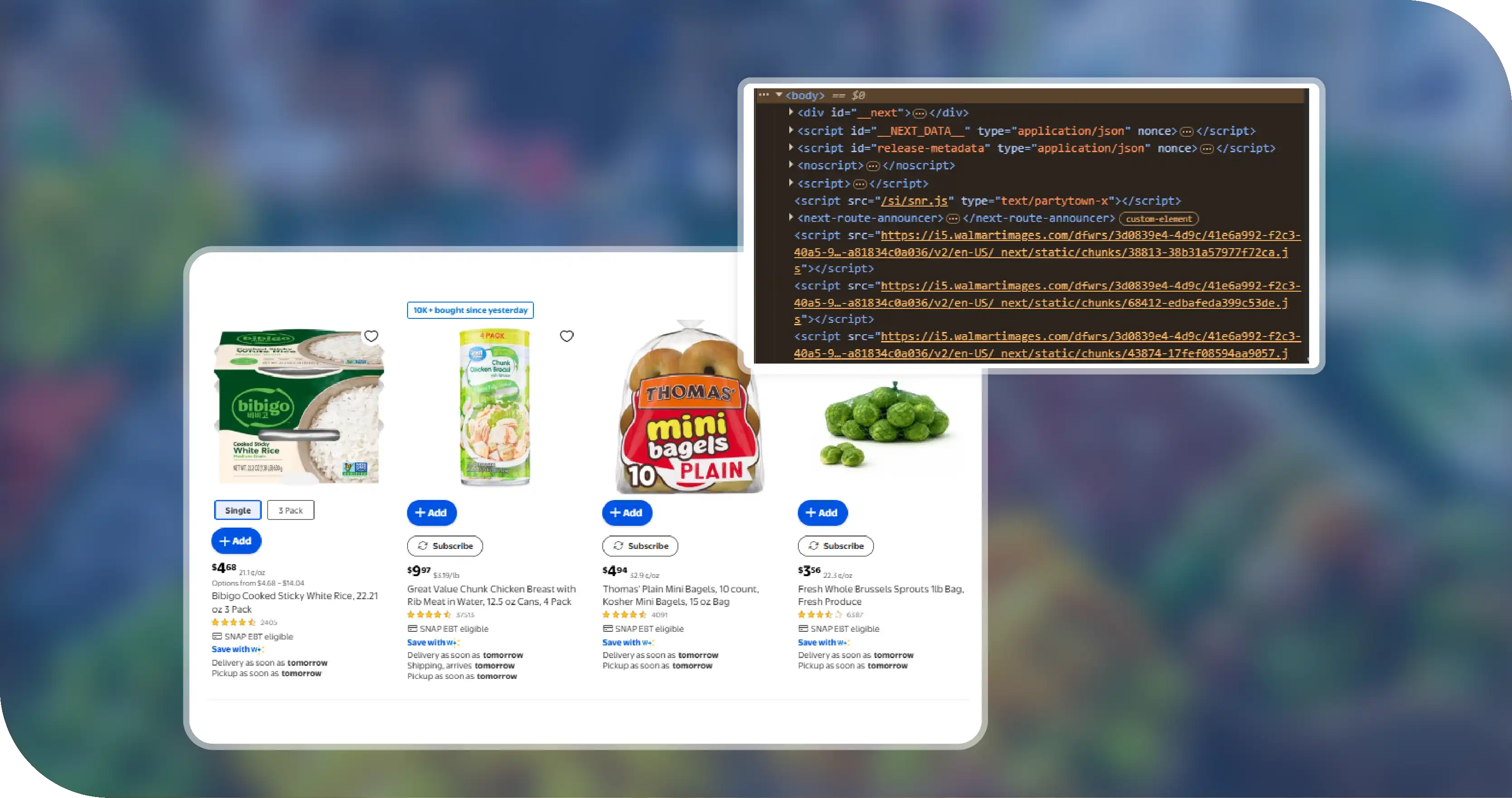
The client faced inconsistent product names, SKUs, barcodes, prices, and attributes across quick-commerce platforms. Effective quick-commerce product data extraction required standardized fields, validation processes, and structured outputs to ensure reliable product matching and minimize duplicate or incomplete records. -
Frequently Changing Catalogs
Product availability, pricing, promotions, and listings changed frequently, making the method to Scrape Quick Commerce Data challenging at scale. Automated workflows needed to capture updated information consistently while handling dynamic pages, changing layouts, temporary product listings, and platform-specific catalog structures. -
Complex Category Structures
Different platforms organized groceries, beverages, household goods, personal care, and other products using varying category hierarchies. Web Scraping for Quick Commerce Categories Data required flexible extraction methods to identify relevant categories, preserve relationships, and create a consistent taxonomy for analysis.
Key Solutions
-
UPC and Barcode Standardization
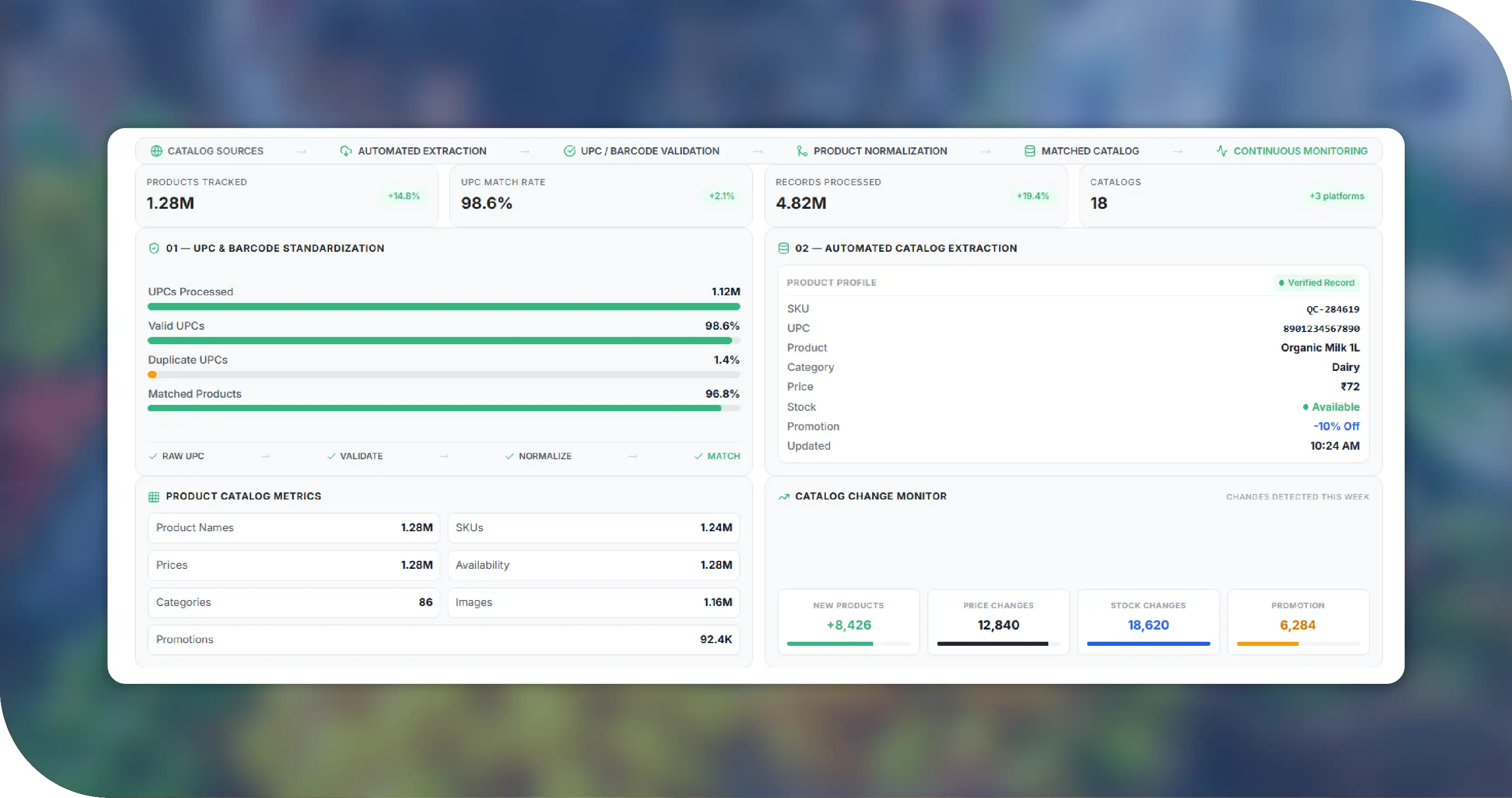
We implemented automated validation and normalization processes for Product Barcode & UPC Data, ensuring identifiers remained consistent across platforms. This improved product matching, reduced duplicates, and created dependable records for catalog analysis, competitive benchmarking, inventory intelligence, and marketplace monitoring. -
Automated Catalog Extraction
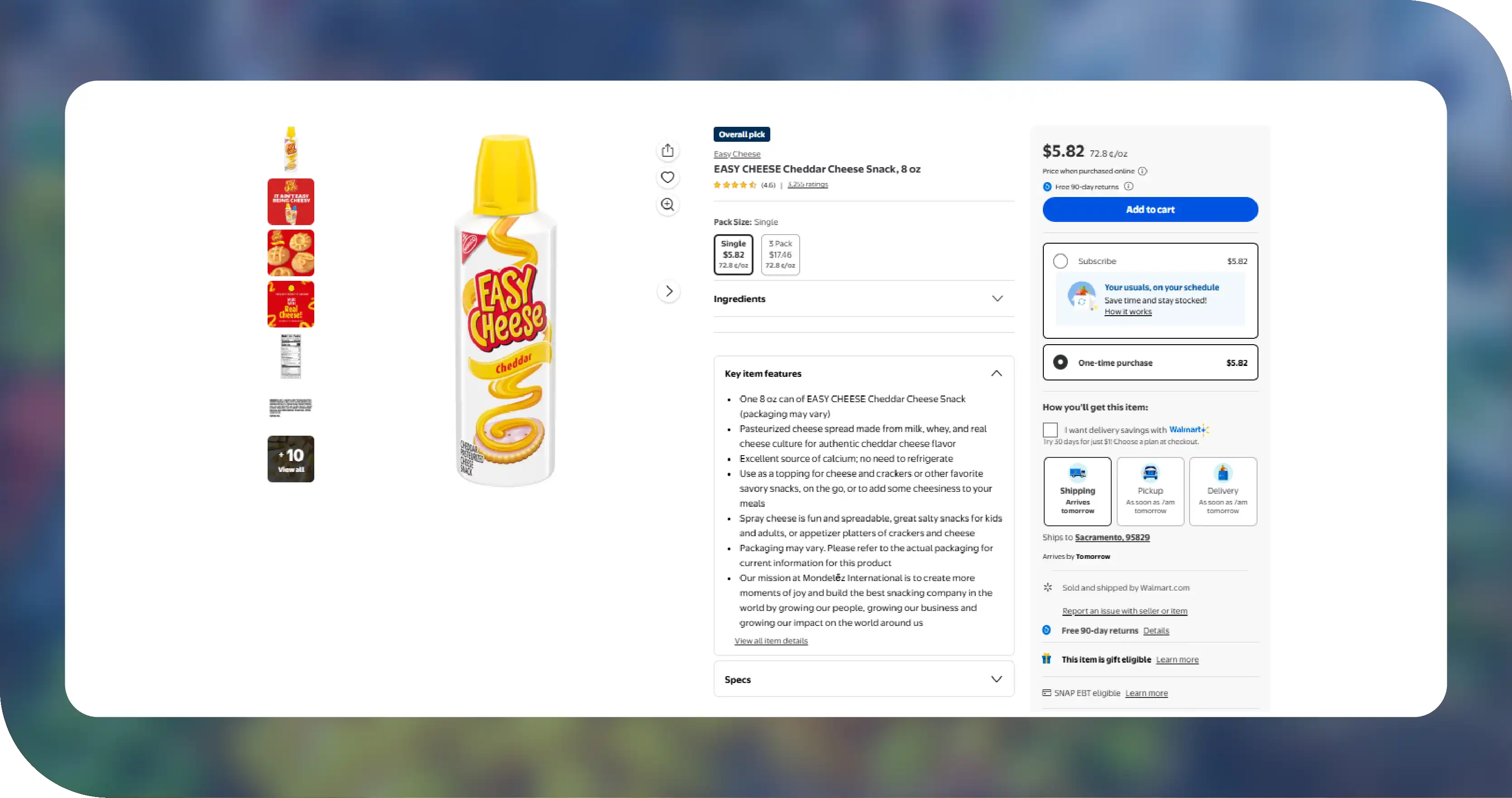
Scalable automated workflows enabled continuous Scraping Quick Commerce Data across dynamic product pages and changing catalog structures. The solution captured product names, SKUs, prices, availability, categories, images, and promotional information while maintaining structured and analysis-ready datasets for business applications. -
FMCG Catalog Intelligence
Specialized workflows supported Extracting FMCG Data Quick Commerce across grocery, packaged food, beverage, household, and personal-care categories. Category mapping, attribute normalization, and image collection created comprehensive product records, helping the client evaluate assortment, identify product gaps, and monitor competitors.
Performance Snapshot
| Metric | Before Solution | After Solution | Improvement |
|---|---|---|---|
| Products Tracked | 8,500 | 45,000 | 429% |
| UPC Records | 6,200 | 43,000 | 594% |
| Product Images | 4,100 | 44,500 | 985% |
| Categories Mapped | 18 | 95 | 428% |
| Data Accuracy | 78% | 97% | 19 pts |
| Manual Research Hours | 520 | 85 | 84% Reduced |
| Platforms Covered | 3 | 12 | 300% |
Methodologies Used
-
Automated Web Data Extraction
We deployed automated extraction workflows to collect product names, SKUs, prices, categories, availability, UPCs, and images from multiple quick-commerce platforms. These workflows were designed for scalability, enabling consistent collection across large catalogs while reducing manual intervention and improving overall data coverage. -
UPC and Barcode Validation
We applied validation techniques to identify, normalize, and verify UPC and barcode values. Duplicate identifiers, incomplete records, and formatting inconsistencies were systematically detected and corrected, creating reliable product-level records that supported accurate matching, catalog comparison, and downstream analytical applications. -
Product Image Collection
Dedicated extraction processes captured product image URLs and associated metadata from catalog pages. Images were linked with their corresponding products, SKUs, and barcode identifiers, creating cohesive records that enabled visual catalog management, product recognition, marketplace comparison, and digital shelf analysis. -
Category and Attribute Mapping
We developed structured category-mapping methodologies to organize products across grocery, FMCG, beverages, household, personal care, and other segments. Platform-specific classifications were standardized into consistent categories, while product attributes were normalized to improve cross-platform comparisons and simplify dataset analysis. -
Data Cleaning and Structuring
Collected information underwent comprehensive cleaning, validation, deduplication, and formatting before delivery. Missing values, inconsistent naming conventions, duplicate products, and malformed records were addressed systematically. The resulting dataset was structured into standardized fields, making it suitable for dashboards, databases, and analytics.
Advantages of Collecting Data Using Food Data Scrape
-
Scalable Catalog Coverage
Our data scraping services enable businesses to collect extensive quick-commerce product information across multiple platforms and categories. Automated workflows support large catalogs efficiently, helping clients obtain broader product coverage without depending on time-consuming manual collection or repetitive data-entry processes. -
Improved Data Accuracy
Structured extraction and validation processes help maintain accurate product names, SKUs, barcodes, prices, categories, availability, and images. Regular quality checks reduce duplicate, incomplete, or inconsistent records, giving businesses dependable datasets for product matching, competitive intelligence, and marketplace analysis. -
Faster Market Monitoring
Automated collection enables businesses to monitor catalog changes, pricing updates, product availability, and assortment movements more efficiently. Instead of relying on manual research, organizations receive structured information that helps them identify market changes quickly and respond with better-informed commercial strategies. -
Better Product Intelligence
Combining product attributes, UPCs, images, categories, and availability creates comprehensive product-level intelligence. Businesses can use this information to compare assortments, identify missing products, analyze competitor offerings, improve catalog organization, and support pricing, inventory, and merchandising decisions. -
Ready-to-Use Data Delivery
We provide cleaned, standardized, and structured datasets that can be integrated into existing databases, dashboards, analytical platforms, and business workflows. Consistent formatting simplifies downstream processing, reduces preparation time, and allows teams to focus on extracting insights rather than organizing raw data.
Client's Testimonial
"Working with the data scraping team transformed how we manage and analyze our quick-commerce catalog. We previously struggled with inconsistent SKUs, missing UPCs, changing product information, and scattered product images across platforms. Their solution delivered a structured, accurate, and scalable dataset that significantly improved our catalog operations. The combination of barcode information, product attributes, categories, availability, and images made product matching and competitive analysis much easier. We were particularly impressed by the data quality, consistency, and timely delivery. The final dataset has become an important resource for our marketplace monitoring, assortment analysis, and strategic decision-making. Their expertise and professionalism exceeded our expectations."
— Head of E-commerce & Marketplace Intelligence
Final Outcome
The project delivered a comprehensive and structured quick-commerce product catalog containing standardized product names, SKUs, UPCs, barcodes, categories, prices, availability, and product images. The client gained a reliable source of product intelligence that simplified catalog management and improved cross-platform product matching. Automated extraction reduced dependence on manual research while enabling broader catalog coverage and faster data collection. Cleaned and validated records minimized duplicates, missing information, and inconsistencies, making the dataset suitable for analytics and business intelligence applications. The enriched catalog also supported competitive pricing analysis, assortment benchmarking, inventory monitoring, and digital shelf evaluation. By integrating consistent product identifiers with visual product information, the client achieved greater catalog visibility and operational efficiency, ultimately enabling faster, more informed marketplace and merchandising decisions.