The Client
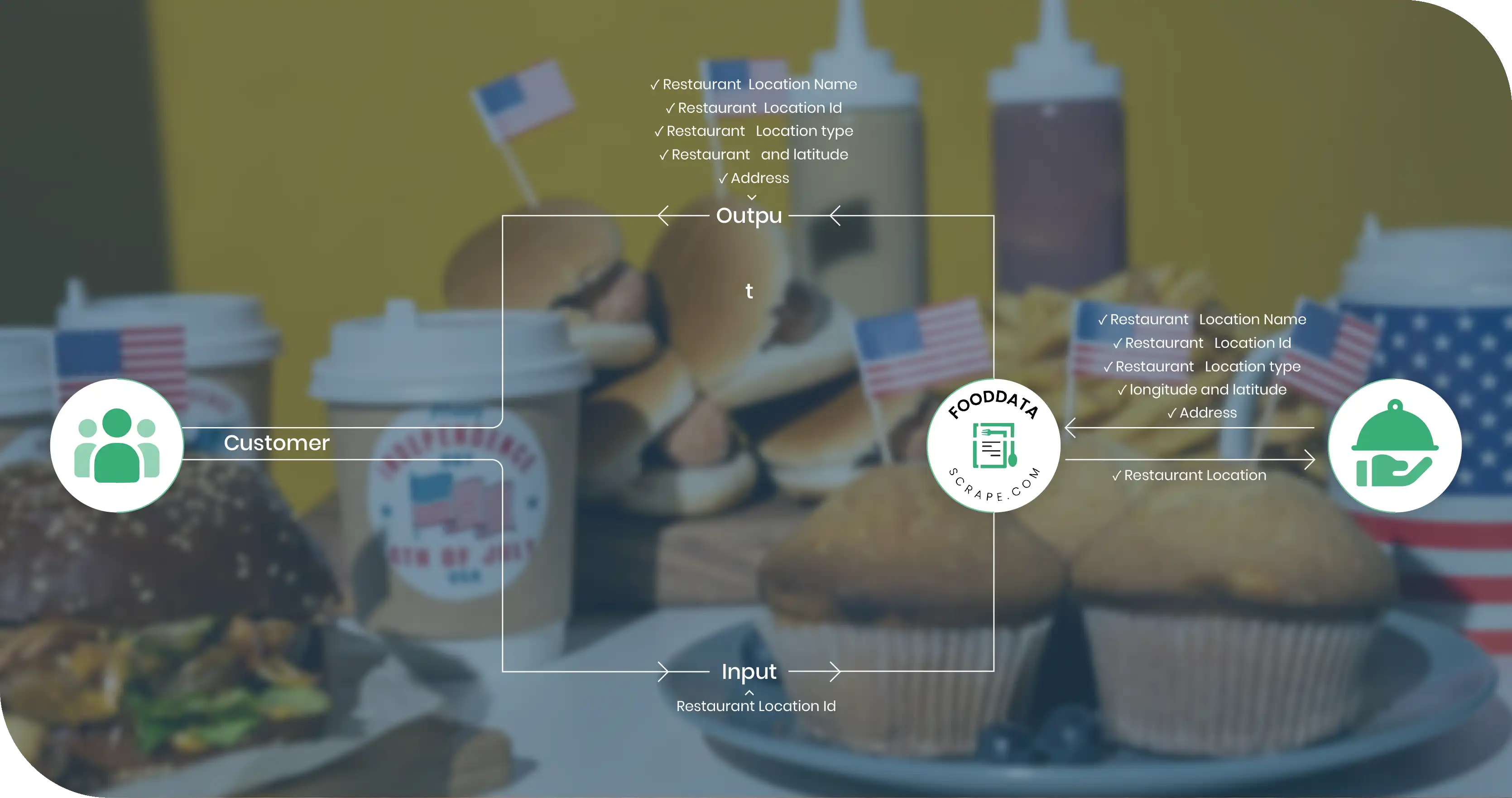
Our client is a food technology and market intelligence company focused on analysing restaurant performance across the United States. They required a continuously updated Uber Eats restaurant dataset United States to understand restaurant growth, menu diversity, pricing strategies, customer ratings, delivery coverage, and promotional activity. Their business relied on accurate restaurant intelligence from Uber Eats listings for benchmarking competitors, identifying emerging cuisines, monitoring regional restaurant expansion, and supporting investment decisions. Additionally, the client wanted restaurant location intelligence using Uber Eats data to map restaurant density, delivery zones, neighbourhood coverage, and market saturation across metropolitan and suburban regions. The collected datasets were integrated into internal dashboards, forecasting models, and reporting systems used by analysts and strategic planning teams. By automating restaurant data collection instead of manual research, the client significantly improved reporting frequency, reduced operational effort, enhanced analytical accuracy, and gained timely insights for business development, expansion planning, competitive monitoring, and commercial decision-making.
Key Challenges
-
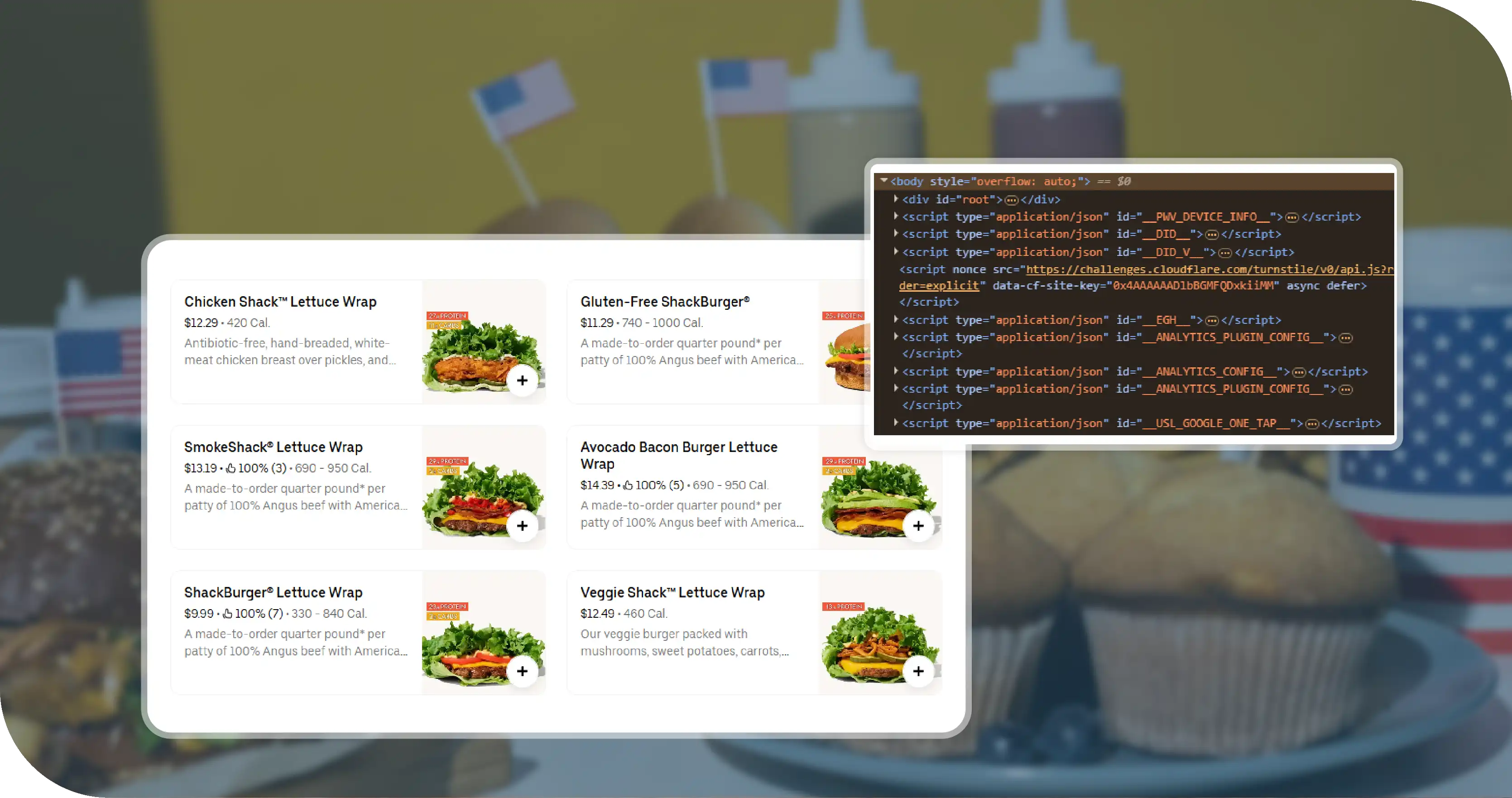
Dynamic Menu & Pricing Updates
Restaurant menus, promotional offers, and Uber Eats restaurant pricing and menu analytics changed frequently throughout the day, requiring continuous monitoring while maintaining highly accurate datasets across thousands of restaurants distributed throughout multiple US cities without missing important updates. -
Anti-Bot Protection
Strong platform protections limited automated access, making the implementation of rotating proxies, browser automation, adaptive crawling strategies, and the Uber Eats Food Delivery Scraping API integration essential for maintaining uninterrupted, scalable, and compliant restaurant data extraction workflows. -
Large-Scale Data Standardisation
Restaurants used inconsistent naming conventions, categories, cuisines, addresses, and menu structures. Normalising the collected Uber Eats Food Dataset into structured, analytics-ready records required advanced validation, deduplication, classification, and continuous quality assurance across millions of records.
Key Solutions
-
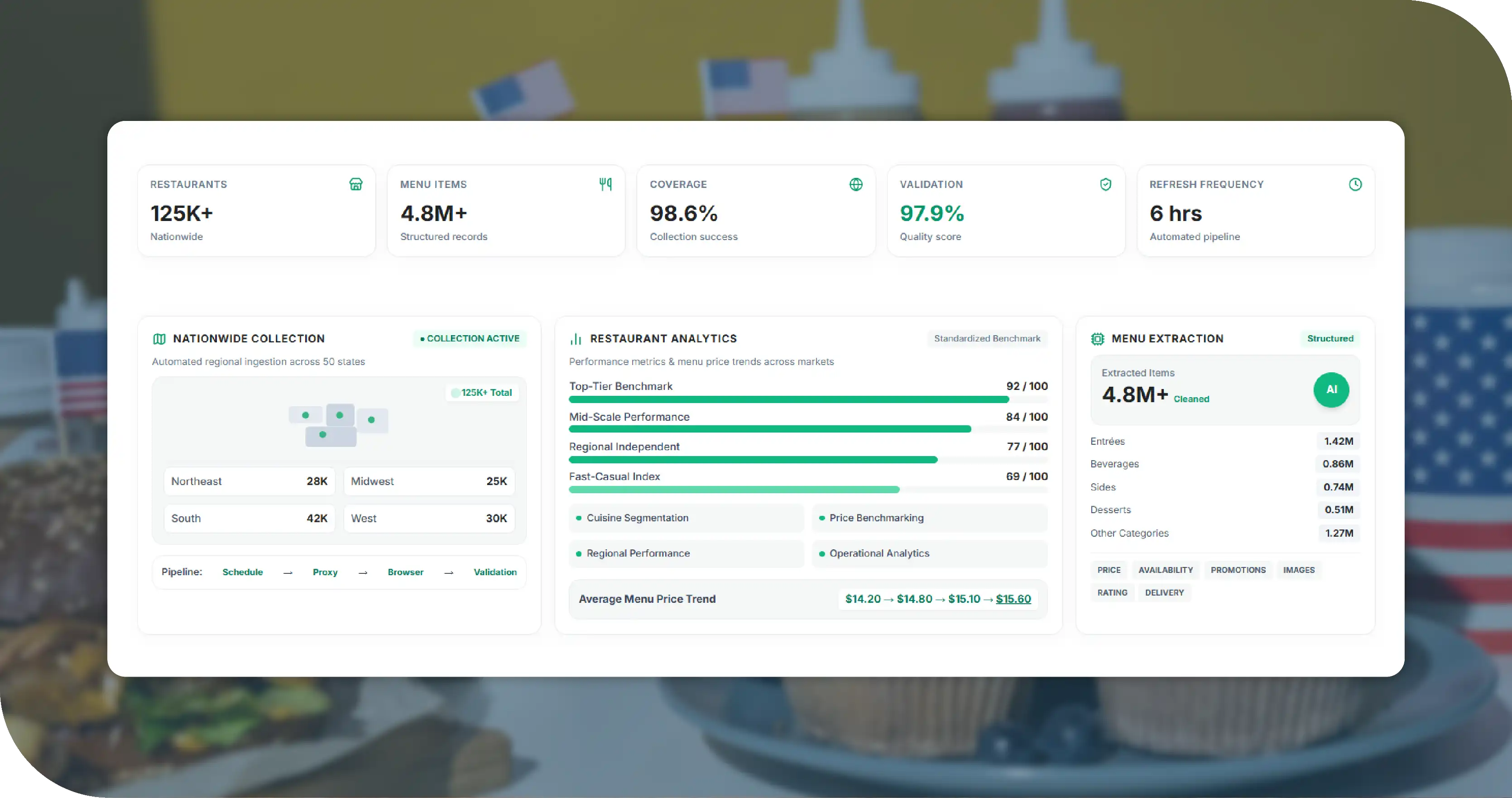
Automated Nationwide Collection
We implemented scalable Food Data Scraping in the USA pipelines with intelligent scheduling, proxy rotation, browser automation, and validation mechanisms to capture restaurant information efficiently while maintaining high data quality and consistent nationwide coverage. -
Unified Restaurant Analytics
Our platform transformed raw restaurant records into structured Restaurant Data Intelligence, enabling comparative analytics, restaurant benchmarking, cuisine segmentation, pricing analysis, regional performance tracking, and operational reporting through standardised datasets and automated quality validation. -
Intelligent Menu Extraction
Advanced extraction engines successfully Extract Restaurant Menu Data, including categories, item names, prices, availability, promotions, images, delivery fees, preparation times, restaurant ratings, and operational attributes for comprehensive restaurant intelligence.
Sample Scraped Data
| Restaurant | City | State | Cuisine | Rating | Reviews | Delivery Fee | ETA | Category | Menu Item | Price | Discount | Availability | Promo | Address | Latitude | Longitude |
|---|---|---|---|---|---|---|---|---|---|---|---|---|---|---|---|---|
| Burger House | New York | NY | Burgers | 4.6 | 2,430 | $2.99 | 28 min | Burgers | Classic Burger | $10.99 | 15% | Available | Yes | Manhattan | 40.758 | -73.985 |
| Pizza Express | Chicago | IL | Italian | 4.5 | 1,982 | $1.99 | 30 min | Pizza | Margherita | $13.49 | No | Available | Yes | Downtown | 41.878 | -87.629 |
| Sushi World | Seattle | WA | Japanese | 4.8 | 1,244 | $3.49 | 34 min | Sushi | Salmon Roll | $15.20 | 10% | Available | No | Capitol Hill | 47.606 | -122.332 |
| Taco Fiesta | Dallas | TX | Mexican | 4.4 | 1,510 | $2.49 | 25 min | Mexican | Chicken Taco | $4.75 | Yes | Available | Yes | Uptown | 32.777 | -96.797 |
| Curry Kitchen | San Jose | CA | Indian | 4.7 | 1,870 | $2.99 | 32 min | Indian | Butter Chicken | $16.95 | 20% | Available | Yes | Central | 37.338 | -121.886 |
| Green Bowl | Boston | MA | Healthy | 4.5 | 915 | $1.49 | 27 min | Salads | Caesar Bowl | $11.80 | No | Available | No | Back Bay | 42.360 | -71.058 |
Methodologies Used
-
Distributed Crawling Framework
We deployed distributed crawlers capable of collecting restaurant information across numerous cities simultaneously while balancing workload, reducing latency, preventing duplicate requests, and ensuring scalable nationwide restaurant coverage through intelligent scheduling. -
Intelligent Proxy Rotation
Adaptive proxy rotation combined with browser automation minimised blocking, ensured uninterrupted scraping sessions, improved collection reliability, maintained request diversity, and enabled consistent extraction from geographically distributed restaurant listings. -
Data Validation Pipeline
Automated validation routines checked restaurant names, menus, pricing, ratings, locations, and duplicates before exporting structured datasets, ensuring consistently accurate, reliable, and analytics-ready restaurant intelligence for business users. -
Incremental Data Monitoring
Incremental crawling captured only newly updated restaurant records, reducing bandwidth consumption while enabling faster refresh cycles, efficient processing, and timely monitoring of pricing, menu, and restaurant operational changes. -
Structured Data Engineering
Extracted information was standardised into structured schemas supporting dashboards, business intelligence systems, forecasting platforms, geographic analysis, competitive monitoring, and long-term restaurant market trend evaluation.
Advantages of Collecting Data Using Food Data Scrape
-
Faster Competitive Analysis
Businesses rapidly compare restaurants, pricing, promotions, cuisines, ratings, and delivery performance across multiple cities without investing significant manual effort or relying on outdated research reports. -
Better Pricing Decisions
Frequent restaurant pricing updates enable businesses to benchmark competitors, identify pricing opportunities, optimise promotional campaigns, and improve revenue strategies using continuously refreshed restaurant market intelligence. -
Improved Market Expansion
Restaurant datasets reveal underserved locations, cuisine demand, delivery coverage, and competitive density, helping organisations identify profitable markets before launching expansion initiatives or new delivery services. -
Enhanced Business Intelligence
Structured restaurant datasets integrate seamlessly with BI dashboards, forecasting platforms, CRM systems, and analytics applications to support strategic planning, investment decisions, and operational performance monitoring. -
Reduced Manual Research
Automated collection eliminates repetitive manual data gathering, increases reporting frequency, improves consistency, reduces operational costs, and enables analysts to focus on high-value business insights.
Client Testimonial
"Working with their data engineering team transformed our restaurant analytics capabilities. Their automated scraping solution consistently delivered accurate restaurant listings, menu information, pricing, ratings, and location intelligence across the United States. The structured datasets integrated seamlessly into our analytics platform, enabling faster competitive benchmarking and smarter business decisions. Their responsiveness, technical expertise, and commitment to data quality exceeded our expectations. We now receive timely restaurant intelligence that significantly improves our reporting accuracy, forecasting capabilities, and market expansion strategies. We highly recommend their restaurant data solutions to any organisation requiring reliable food delivery marketplace intelligence."
— Director of Market Intelligence
Final Outcome
The project delivered a scalable restaurant intelligence platform capable of continuously monitoring thousands of restaurants across the United States with exceptional accuracy and consistency. Businesses gained reliable access to menu information, pricing, restaurant locations, delivery estimates, customer ratings, promotions, and Cuisine-wise Menu Data for comprehensive competitive analysis. Automated reporting significantly reduced manual research while improving operational efficiency and decision-making. The structured datasets supported pricing optimisation, expansion planning, demand forecasting, restaurant benchmarking, and regional market analysis. By implementing advanced Food Data Scraping workflows, the client established a continuously updated restaurant intelligence ecosystem that enables analysts, consultants, food brands, and investors to make faster, data-driven commercial decisions using accurate, scalable, and analytics-ready restaurant datasets.