The Client
Our client is a rapidly growing retail intelligence and market analytics company serving global consumer brands, retailers, and eCommerce businesses. They specialize in competitive pricing, assortment analysis, promotional tracking, and category benchmarking across multiple online marketplaces. To strengthen their analytics platform, they needed a scalable solution to Extract Product Listings from 50+ Retailers for Competitive Analysis while maintaining high data accuracy and consistency. Their objective was to consolidate product information from diverse retail websites, normalize inconsistent listings, and create reliable SKU-level comparisons for strategic decision-making.
By implementing Retail SKU-Level Data Extraction, the client aimed to automate the collection of product attributes, prices, availability, brands, and specifications across thousands of listings updated daily.
Through advanced Product Benchmarking Data Scraping, they sought to improve competitive intelligence, reduce manual data processing, identify pricing opportunities faster, monitor assortment gaps, and deliver actionable retail insights that helped their customers make smarter merchandising and pricing decisions across highly competitive markets.
Key Challenges
-
Inconsistent Product Catalogs
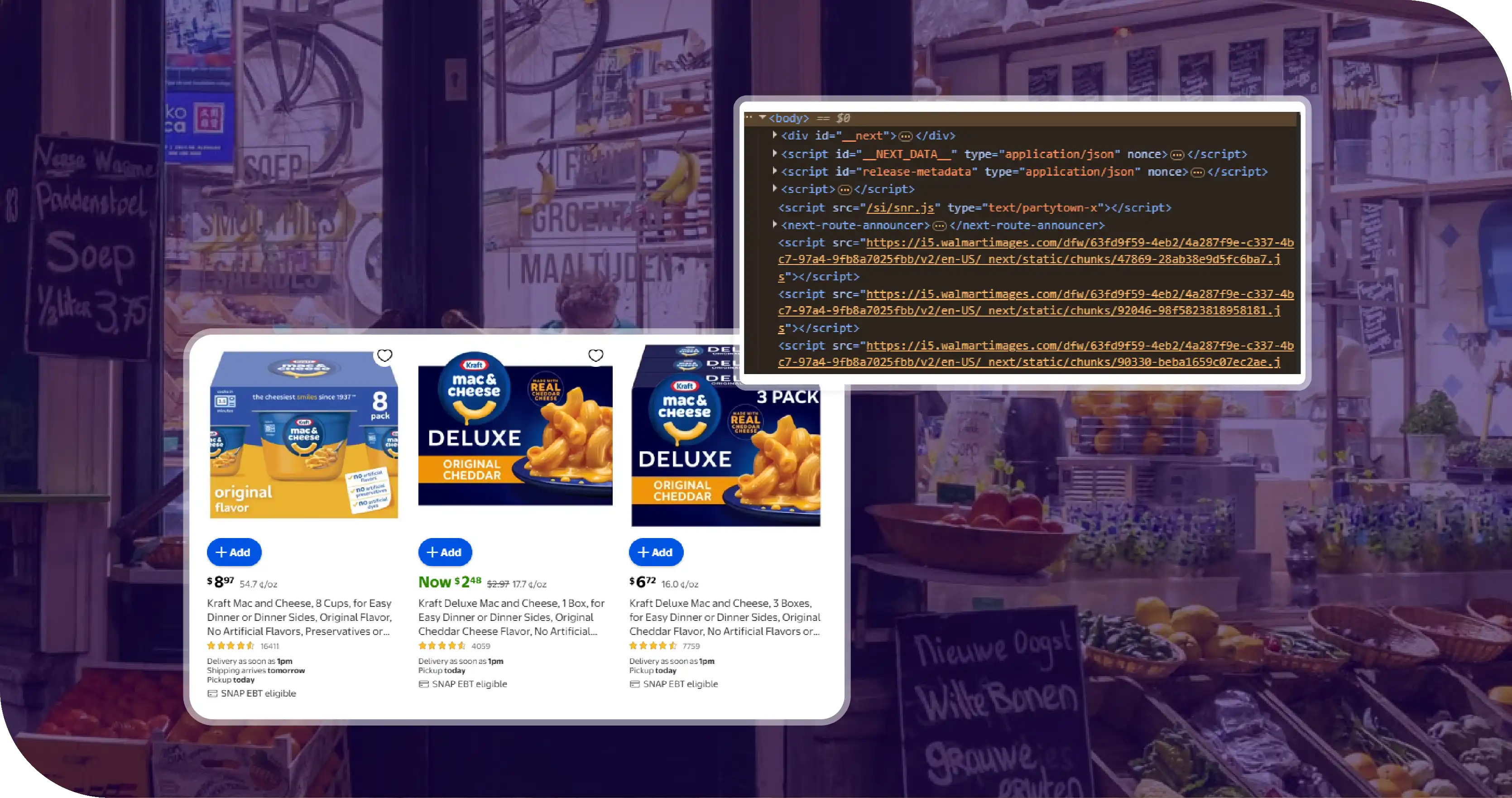
The client struggled to consolidate product information from dozens of retailers because naming conventions, SKUs, categories, and product attributes varied widely. Multi-Retailer Product Catalog Data Extraction became challenging due to duplicate listings, inconsistent metadata, and constantly changing product catalogs. -
Limited Visibility into Grocery Competitors
The client lacked an automated system to collect accurate grocery pricing, availability, and promotional information from multiple retailers. Manual Web Scraping Grocery Data efforts were slow, error-prone, and unable to keep pace with frequent catalog and pricing updates. -
Delayed Competitive Insights
Without standardized and continuously updated retail datasets, the client experienced delays in identifying pricing trends, assortment gaps, and promotional opportunities. The absence of reliable Grocery Data Intelligence reduced reporting accuracy and limited their ability to deliver timely, actionable market insights to customers.
Key Solutions
-
AI-Powered Product Matching Engine
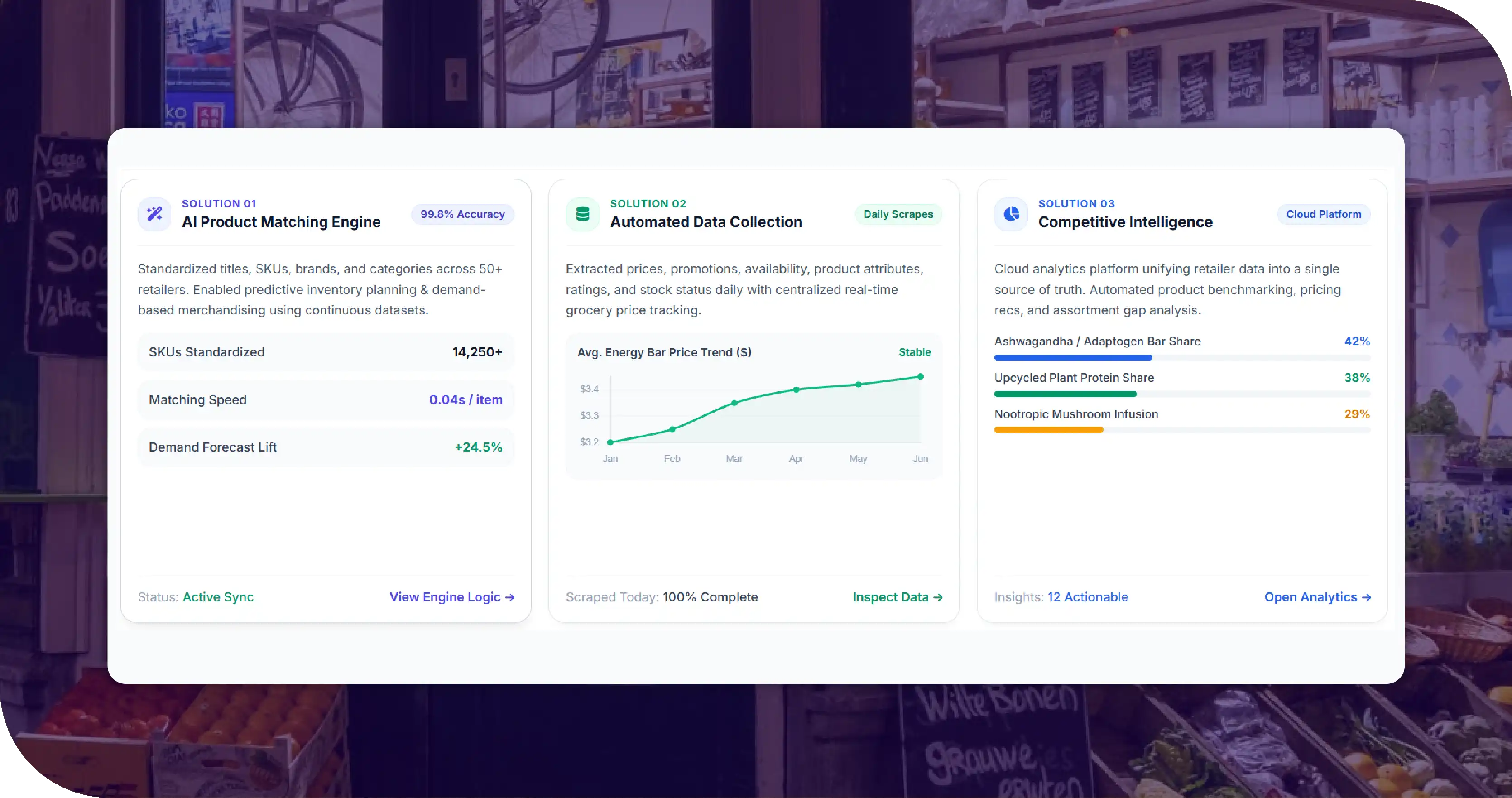
We implemented an intelligent product matching framework that standardized product titles, SKUs, brands, specifications, and categories across more than 50 retailers. Leveraging AI Demand Forecasting, the solution also enabled predictive inventory planning and demand-based merchandising decisions using continuously updated retail datasets. -
Automated Retail Data Collection Platform
Our team deployed a scalable data extraction infrastructure that collected prices, promotions, availability, product attributes, ratings, and stock status daily. A centralized Grocery Price Tracking Dashboard provided real-time visibility into competitor pricing, assortment changes, promotional campaigns, and regional market trends. -
Unified Competitive Intelligence Dashboard
We delivered a cloud-based analytics platform that unified retailer data into a single source of truth. Powered by AI Grocery Intelligence, the dashboard generated automated product benchmarking, pricing recommendations, assortment gap analysis, trend detection, and actionable business insights for faster strategic decisions.
Retail Product Matching & Competitive Intelligence Solution Overview
| Metric | Before Implementation | After Implementation | Improvement |
|---|---|---|---|
| Retailers Monitored | 12 | 54 | +350% |
| Product Listings Processed Daily | 180,000 | 2,450,000 | +1,261% |
| SKU Matching Accuracy | 78.4% | 98.6% | +20.2 pts |
| Duplicate Products | 14.8% | 1.9% | -87% |
| Daily Price Updates | Once Every 5 Days | Every 2 Hours | 60× Faster |
| Product Attributes Captured | 8 | 28 | +250% |
| Categories Covered | 34 | 162 | +376% |
| Price Comparison Accuracy | 81.5% | 99.1% | +17.6 pts |
| Manual Data Processing | 160 Hours/Week | 18 Hours/Week | -89% |
| Promotion Detection Rate | 67% | 98% | +46% |
| Stock Availability Accuracy | 74% | 97.5% | +31.8% |
| Dashboard Refresh Frequency | Weekly | Near Real-Time | Continuous |
| Competitive Reports Generated | 10/Month | 180/Month | +1,700% |
| Average Insight Delivery Time | 72 Hours | 45 Minutes | -99% |
| Overall Operational Efficiency | Baseline | +68% | Significant Improvement |
Methodologies Used
-
Intelligent Data Extraction Framework
We developed a scalable scraping infrastructure capable of collecting product listings, prices, availability, specifications, images, promotions, and metadata from dozens of retail websites. Automated scheduling ensured consistent data collection while adapting to website structure changes with minimal manual intervention. -
Product Standardization and Matching
Our team normalized product titles, brands, categories, units, and attributes before applying rule-based and machine learning algorithms to accurately match identical products across multiple retailers. This eliminated duplicate records and created a unified, comparable product catalog. -
Data Validation and Quality Assurance
Multiple validation layers verified pricing accuracy, SKU consistency, missing values, duplicate records, and attribute completeness. Automated quality checks continuously monitored incoming datasets, ensuring reliable and high-quality information for downstream analytics and business intelligence applications. -
Real-Time Data Processing Pipeline
We implemented automated ETL workflows that cleaned, transformed, enriched, and consolidated data into centralized storage. Incremental updates enabled rapid synchronization with retail websites, ensuring customers always had access to the latest pricing, inventory, and promotional information. -
Analytics and Reporting Integration
The processed datasets were integrated into interactive dashboards featuring competitor benchmarking, assortment analysis, pricing trends, promotional tracking, and customizable reports. This empowered stakeholders with actionable insights, faster decision-making, and comprehensive visibility into changing retail market dynamics.
Advantages of Collecting Data Using Food Data Scrape
-
Comprehensive Multi-Retail Coverage
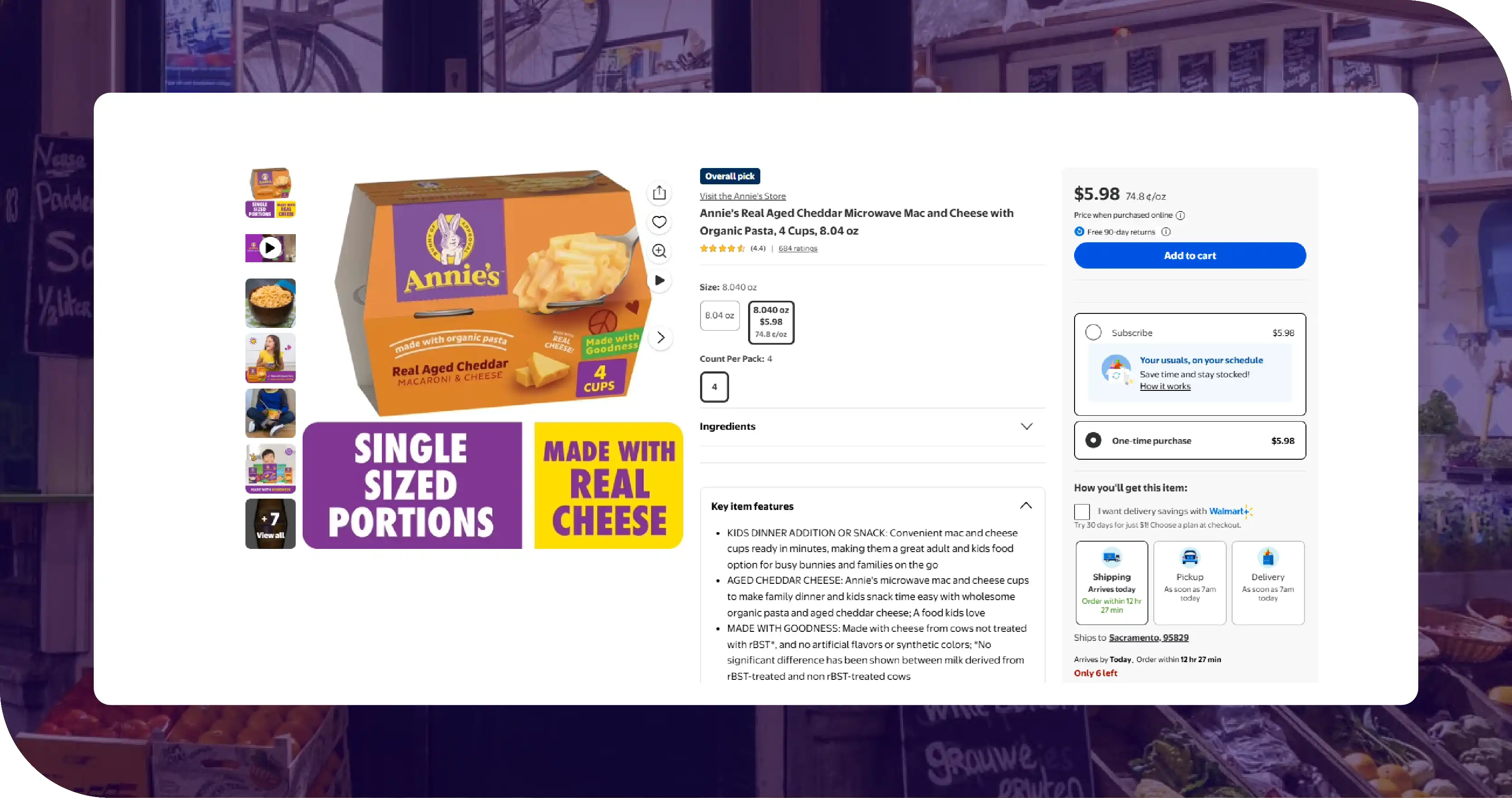
Our data scraping services collect accurate product, pricing, inventory, and promotional information from numerous retail websites simultaneously. This provides businesses with complete market visibility, enabling comprehensive competitor analysis and informed strategic decisions across multiple regions and product categories. -
Real-Time Market Intelligence
We deliver automated, high-frequency data updates that keep businesses informed about changing prices, stock availability, promotions, and assortment shifts. Access to fresh market intelligence enables faster responses to competitor actions and evolving consumer demand. -
Highly Accurate and Structured Data
Advanced validation, normalization, and quality assurance processes ensure consistent, clean, and reliable datasets. Businesses receive standardized product information that integrates seamlessly with analytics platforms, dashboards, and business intelligence tools for dependable decision-making. -
Scalable and Cost-Effective Solutions
Our infrastructure efficiently handles millions of product records across hundreds of retailers without increasing operational complexity. Automated data collection significantly reduces manual effort, lowers costs, and supports business growth without compromising performance or data quality. -
Actionable Business Insights
Beyond raw data collection, our services transform retail information into meaningful insights through benchmarking, trend analysis, assortment monitoring, and pricing intelligence. Organizations gain valuable recommendations that improve merchandising strategies, optimize pricing, and strengthen competitive positioning.
Client's Testimonial
"Partnering with this team transformed the way we collect and analyze retail market data. Their automated scraping solution delivered highly accurate product matching across more than 50 retailers, significantly improving our pricing intelligence and competitive benchmarking. The quality of the data, rapid delivery, and scalable infrastructure exceeded our expectations. We reduced manual processing time dramatically while gaining real-time visibility into pricing, promotions, and assortment changes. Their technical expertise, responsive support, and commitment to data accuracy helped us make faster, data-driven business decisions. We highly recommend their services to any organization seeking reliable retail data intelligence solutions."
—Head of Retail Intelligence
Final Outcome
The implemented solution delivered a unified, scalable retail intelligence platform that transformed the client's competitive analysis capabilities. By automating product matching, price monitoring, inventory tracking, and catalog standardization across more than 50 retailers, the client significantly improved data accuracy and operational efficiency. Real-time updates enabled faster responses to market changes, promotional campaigns, and competitor pricing strategies. Manual data collection efforts were drastically reduced, allowing teams to focus on strategic analysis rather than repetitive tasks. The centralized analytics platform provided reliable SKU-level comparisons, actionable benchmarking insights, and comprehensive market visibility. As a result, the client accelerated reporting, enhanced decision-making, optimized pricing strategies, identified assortment gaps more effectively, and strengthened its competitive position. The solution continues to scale seamlessly as new retailers, categories, and products are added, supporting long-term business growth and innovation.