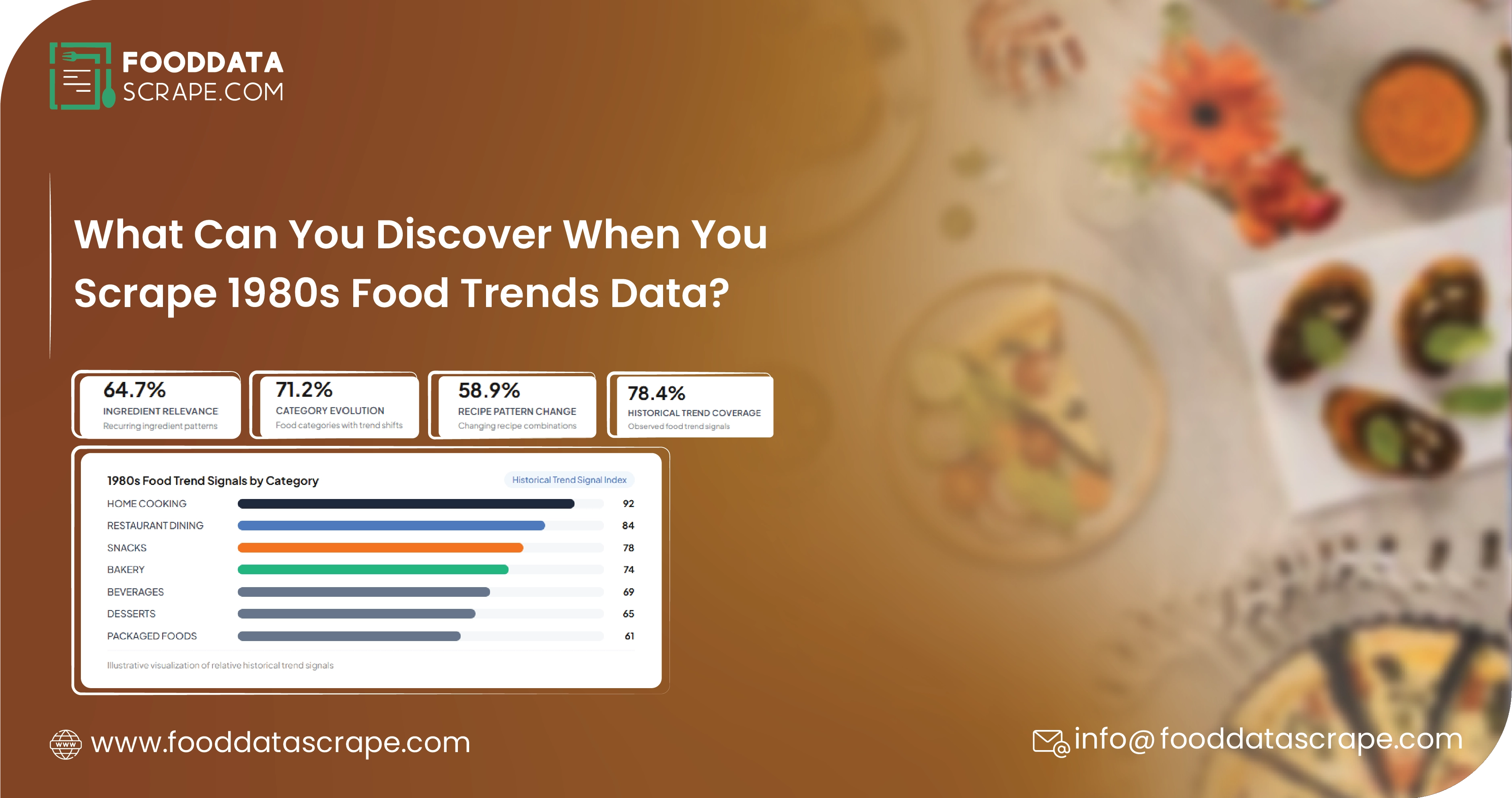
Introduction
The food industry is witnessing a renewed fascination with nostalgic flavors, classic recipes, retro beverages, and memorable dining experiences. As consumers seek familiar experiences with modern twists, foods associated with the 1980s are finding new relevance across restaurants, packaged foods, beverages, and digital food culture.
Scrape 1980s Food Trends Data to identify which classic dishes are returning, how frequently they appear across modern food channels, and where new commercial opportunities are developing.
1980s Food Trends Data Scraping can help businesses collect structured information from restaurant menus, food marketplaces, recipe platforms, consumer reviews, social media, and other digital sources.
2026 Food Trends Market Data Scraping further enables businesses to compare nostalgic food movements with current pricing, product innovation, consumer engagement, menu adoption, and category-level demand.
Rather than assuming that every retro food trend will return successfully, businesses can use data to understand which concepts are attracting sustained attention and which are simply temporary nostalgia-driven moments.
Why Are 1980s Food Trends Returning?
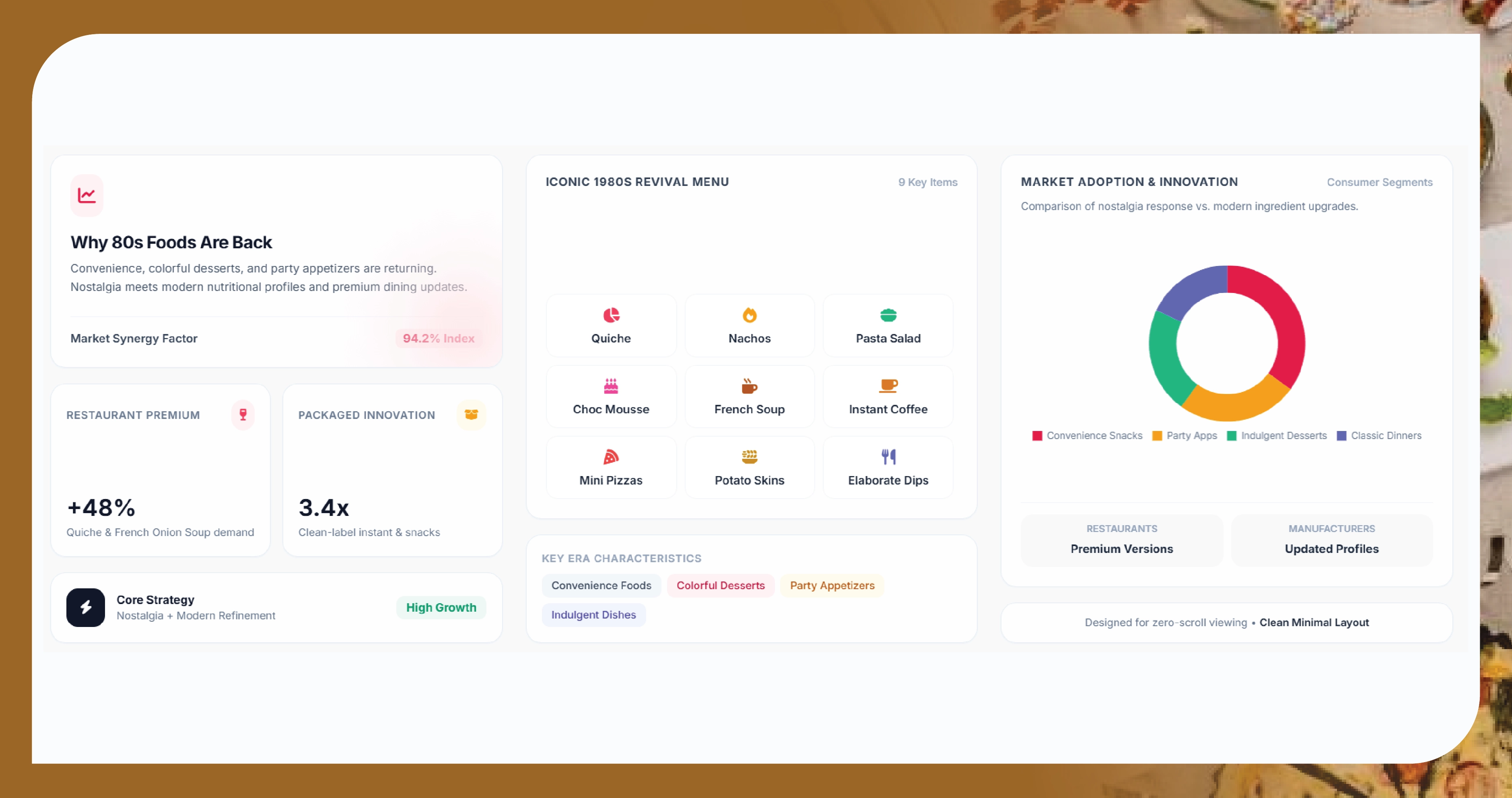
The 1980s were known for convenience foods, colorful desserts, party appetizers, indulgent dishes, packaged snacks, and entertaining-focused dining. Many of these characteristics continue to influence today's food culture.
Classic foods such as quiche, nachos, pasta salad, chocolate mousse, French onion soup, instant coffee, mini pizzas, potato skins, and elaborate appetizers can now be adapted for contemporary consumers.
Restaurants may introduce premium versions of familiar dishes, while manufacturers can create modern packaged versions with updated ingredients, portion sizes, flavors, and nutritional profiles.
The result is a market where nostalgia and innovation work together.
What Can 1980s Food Trends Data Reveal?
A properly structured dataset can provide much more than a list of popular foods. It can reveal how frequently individual foods appear, where they are gaining visibility, how their prices are changing, and how consumers respond to them.
| Data Point | Example Information | Business Value |
|---|---|---|
| Food Name | Quiche, nachos, mousse | Trend identification |
| Menu Frequency | Number of restaurant appearances | Adoption measurement |
| Price | Average menu or product price | Pricing strategy |
| Ingredients | Primary and secondary ingredients | Product development |
| Reviews | Ratings and customer comments | Preference analysis |
| Locations | Cities, regions, countries | Market targeting |
| Product Format | Frozen, packaged, fresh | Category expansion |
| Social Mentions | Posts and engagement | Trend discovery |
| Promotions | Discounts and campaigns | Competitive monitoring |
| Seasonality | Monthly or seasonal changes | Demand planning |
1980s Retro Food Trend Data Extraction
1980s Retro Food Trend Data Extraction allows businesses to transform information scattered across thousands of digital sources into organized datasets.
Potential data fields can include food names, ingredients, prices, restaurant names, menu categories, product formats, ratings, reviews, locations, publication dates, social engagement, and promotional activity.
For restaurant operators, this can reveal which retro-inspired dishes competitors are introducing.
For food manufacturers, the same information can highlight potential product categories and flavor opportunities.
For retailers, it can provide insight into which nostalgic products are appearing across different marketplaces and consumer segments.
Which 1980s Foods Are Worth Monitoring?
Not every nostalgic food has equal commercial potential. Data-driven monitoring can help businesses evaluate several categories.
Comfort Foods
Salisbury steak, beef stroganoff, tuna noodle casserole, and French onion soup represent familiar comfort-oriented concepts that can be modernized through premium ingredients and contemporary presentation.
Party Foods
Potato skins, nachos, deviled eggs, pizza rolls, mini pizzas, and layered dips can benefit from today's emphasis on sharing, entertaining, and small-format dining.
Desserts
Chocolate mousse, colorful gelatin desserts, retro cakes, and nostalgic candies can be redesigned around premium ingredients, creative presentation, and limited-edition launches.
Beverages
Colorful cocktails, wine coolers, instant coffee, and other recognizable beverage concepts can inspire contemporary drinks and social-media-friendly experiences.
Convenience Foods
Microwaveable meals, boxed meals, packaged snacks, and ready-to-eat products reflect a convenience culture that continues to influence modern food purchasing.
Retro Food Consumer Trend Analytics
Retro Food Consumer Trend Analytics helps businesses understand why consumers engage with nostalgic foods rather than simply measuring how often they appear.
Consumer reviews can reveal whether customers prefer traditional versions or modern interpretations. Social conversations can highlight emerging flavor combinations. Menu data can demonstrate whether restaurants are moving toward premium, miniature, healthier, or globally inspired versions of familiar dishes.
For example, a traditional nacho concept may evolve into a premium appetizer with regional ingredients. A classic pasta salad may incorporate quinoa, chickpeas, vegetables, or international dressings.
This type of analysis helps businesses understand how nostalgia is being translated into contemporary consumption.
Scrape Nostalgic Food Trends Data From Multiple Sources
Scrape Nostalgic Food Trends Data across different channels to build a broader market view.
Restaurant websites can provide menu and pricing information. Ecommerce marketplaces can reveal packaged food availability. Recipe platforms can show changing ingredient combinations. Consumer reviews can expose satisfaction and complaints. Social platforms can reveal emerging conversations and viral food concepts.
Combining these sources creates a more comprehensive dataset for identifying market movement.
Important datasets can include:
- Restaurant menu information
- Food and beverage product listings
- Product pricing
- Ingredient combinations
- Consumer ratings
- Review sentiment
- Search activity
- Social engagement
- Product launches
- Promotional activity
- Regional availability
- Seasonal demand
- Competitor offerings
Food Data Scraping for Competitive Intelligence
Food Data Scraping can help businesses continuously monitor competitors and identify changes in the marketplace.
Restaurants can track new menu additions, pricing strategies, portion formats, ingredients, and promotional offers.
Food manufacturers can monitor new product launches, package sizes, flavors, and category expansion.
Retailers can compare product availability and pricing across competing sellers.
A regularly updated dataset can also support competitor benchmarking by measuring menu penetration, average prices, product diversity, consumer ratings, and promotional activity.
Turning Nostalgia Into Product Opportunities
The commercial opportunity is not necessarily about reproducing an old food exactly as it appeared decades ago.
Instead, businesses can identify the characteristics consumers associate with nostalgic foods and reinterpret them for today's market.
A classic comfort dish can become a premium restaurant entrée. A familiar snack can become a convenient single-serve product. A retro dessert can become a visually distinctive limited-edition launch.
This approach allows companies to combine familiarity with novelty.
Data can help determine which combinations have the greatest potential by comparing consumer engagement, competitive activity, pricing, menu adoption, and product availability.
How Food Data Scraping Can Help You?
1. Identify Emerging Retro Food Opportunities
Scraped datasets reveal which nostalgic dishes are gaining menu appearances, product launches, consumer mentions, and digital engagement, helping businesses identify commercially promising retro-food opportunities.
2. Monitor Competitor Menu Innovation
Businesses can continuously track competitor menus, prices, ingredients, promotions, and new nostalgic offerings, creating actionable Food Trend Market Intelligence for menu planning, differentiation, positioning, and competitive benchmarking.
3. Understand Consumer Preference Shifts
Analyzing reviews, searches, social conversations, and food mentions helps businesses understand how consumers reinterpret traditional dishes and which combinations, ingredients, formats, and experiences generate stronger engagement.
4. Improve Product Development Decisions
Historical trend signals combined with current market data can help manufacturers evaluate potential product concepts, packaging directions, flavors, serving formats, and positioning strategies before making significant development investments.
5. Support Data-Driven Market Forecasting
Continuous trend monitoring provides structured signals for estimating demand, identifying seasonal opportunities, evaluating market momentum, and developing informed strategies around nostalgic food categories.
Conclusion
The resurgence of 1980s-inspired foods demonstrates how historical food culture can influence modern purchasing behavior, restaurant innovation, and product development. However, nostalgia alone does not determine whether a food concept will succeed.
Food Demand Forecasting can help businesses translate historical and current market signals into more informed expectations about future category performance.
Restaurant Menu Data Scraping can provide continuous visibility into how restaurants are introducing, pricing, and positioning nostalgic dishes.
Food Sales & Demand Trends can further help businesses understand market momentum and identify opportunities across products, menus, locations, and consumer segments.
When these datasets are combined, companies can move beyond simply observing nostalgic food trends and begin measuring their commercial potential.
Turn 1980s food nostalgia into actionable market intelligence with data-driven scraping, analysis, and forecasting.
Are you in need of high-class scraping services? Food Data Scrape should be your first point of call. We are undoubtedly the best in Food Data Aggregator and Mobile Grocery App Scraping service and we render impeccable data insights and analytics for strategic decision-making. With a legacy of excellence as our backbone, we help companies become data-driven, fueling their development. Please take advantage of our tailored solutions that will add value to your business. Contact us today to unlock the value of your data.
Get a Free Food Data Sample in 48 Hours.
Tell us your platforms, target markets and required fields — we'll map exactly what's possible with food data scraping, recommend the right approach, and send a working sample so you can verify quality before any commitment.
Request a strategy call
Thanks — our data team will reach out within 48 hours with your sample.