
The report delivers comprehensive insights into evolving consumer preferences, restaurant menu innovations, pricing movements, and global cuisine demand surrounding the FIFA World Cup 2026. Built on large-scale restaurant menu monitoring, food delivery platform analysis, pricing intelligence, and consumer engagement trends, the report helps businesses identify high-growth food categories and emerging market opportunities. It explores the increasing popularity of international cuisines, watch-party meal formats, promotional pricing strategies, and regional demand variations across major host cities. The research also examines how AI-powered analytics and real-time data collection enable restaurants, retailers, food manufacturers, and investors to respond quickly to changing consumer behavior. By combining menu intelligence with pricing and demand forecasting, organizations can optimize product launches, promotional campaigns, inventory planning, and competitive positioning. This report serves as a strategic resource for businesses seeking actionable food market intelligence and data-driven decision-making throughout one of the world's largest sporting events.
Cuisine Growth
International cuisines experience exceptional consumer demand during World Cup food celebrations globally.
Pricing Intelligence
Real-time pricing analysis improves promotional strategies across restaurants and retail channels.
Menu Innovation
Emerging dishes reshape competitive menus through changing multicultural consumer preferences rapidly.
Demand Forecasting
AI predicts food purchasing trends using continuously updated consumer behavior datasets.
Market Insights
Restaurant intelligence reveals profitable opportunities across global sports food ecosystems.

The FIFA World Cup 2026 is expected to become one of the largest global sporting events ever, creating unprecedented demand across restaurants, food delivery platforms, quick-service chains, supermarkets, convenience stores, beverage brands, and packaged food manufacturers. Every major sporting event influences consumer purchasing behavior, but the World Cup uniquely combines multicultural audiences, increased social gatherings, and higher food consumption, making it one of the strongest demand drivers for the foodservice industry.
Businesses increasingly rely on method to Scrape World Cup Food Trends 2026 strategies to understand changing customer preferences before competitors do. Instead of depending solely on historical sales reports, organizations are now collecting live menu information, regional pricing, cuisine popularity, promotional offers, delivery availability, and customer engagement metrics from digital platforms.
At the same time, World Cup Food Pricing Data Monitoring enables retailers and restaurant chains to optimize promotional pricing during high-demand match days, while World Cup Food Market Intelligence helps brands identify emerging cuisines, winning menu formats, and regional consumption patterns across North America.
The latest industry observations indicate remarkable demand shifts. Interest in international cuisines has increased by more than 56%, nearly one-third of consumers actively seek new global flavors, and game-day social dining occasions have risen by approximately 86%. These behavioral indicators demonstrate that brands capable of monitoring food trends in real time can significantly improve merchandising, inventory planning, promotional timing, and menu development.
Rather than guessing consumer preferences, companies now use automated data collection to monitor thousands of restaurant menus, delivery applications, grocery listings, pricing updates, customer reviews, and seasonal product launches throughout the tournament.
The expanded tournament format introduces more participating nations, additional host cities, and a longer competition schedule. Each match day creates spikes in demand for ready-to-eat meals, snacks, beverages, desserts, meal bundles, party platters, and regional specialties.
Consumer behavior increasingly favors shared dining experiences. Watch parties, sports bars, family gatherings, office celebrations, and neighborhood events collectively drive substantial increases in restaurant orders.
International cuisine is emerging as one of the strongest growth categories. Consumers no longer limit their choices to burgers and pizza during football matches. Brazilian barbecue, Mexican street food, Argentinian grilled meats, Korean fried chicken, Mediterranean platters, and Japanese appetizers are becoming preferred game-day selections.
This diversification creates valuable opportunities for restaurant operators and food manufacturers that can quickly identify regional demand patterns.
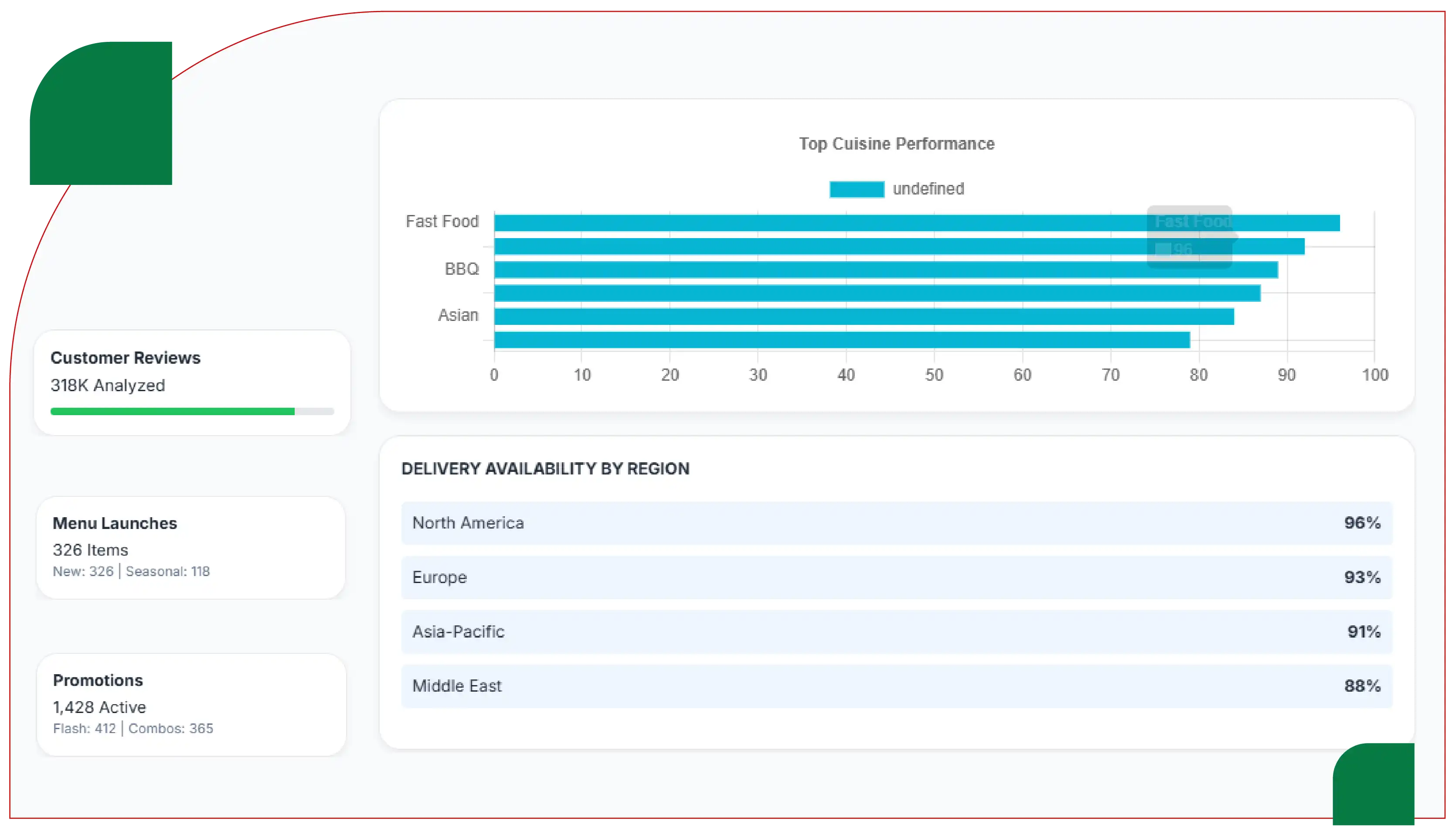
Traditional market research often provides insights weeks or months after consumer behavior has changed. Automated scraping technologies dramatically reduce this delay by collecting fresh data multiple times every day.
Organizations can monitor restaurant pricing, menu updates, promotional campaigns, delivery availability, customer ratings, cuisine expansion, and limited-time offers from thousands of digital sources simultaneously.
This real-time visibility allows brands to react immediately when consumer preferences shift during the tournament.
Businesses can also Extract Global Football Food Trends Data to compare cuisine performance across cities, identify emerging dishes, measure promotional effectiveness, and understand localized purchasing behavior throughout the competition.
| City | Cuisine | Popular Dish | Average Menu Price (USD) | Weekly Search Growth | Match-Day Orders | Menu Availability (%) | Consumer Rating |
|---|---|---|---|---|---|---|---|
| New York | Brazilian | Picanha Steak | 28.50 | 39% | 5,480 | 88 | 4.8 |
| Los Angeles | Mexican | Loaded Nachos | 15.20 | 46% | 7,210 | 94 | 4.7 |
| Miami | Brazilian | Churrasco Platter | 32.80 | 31% | 4,980 | 91 | 4.9 |
| Dallas | American | Buffalo Wings | 18.40 | 102% | 8,720 | 98 | 4.6 |
| Chicago | Argentinian | Grilled Ribeye | 30.60 | 28% | 3,610 | 79 | 4.8 |
| Houston | Colombian | Arepas | 13.90 | 26% | 2,950 | 73 | 4.5 |
| Seattle | Korean | Fried Chicken Combo | 22.30 | 44% | 4,220 | 84 | 4.7 |
| Atlanta | Mediterranean | Mixed Grill Platter | 24.80 | 35% | 3,980 | 82 | 4.6 |
| Boston | Japanese | Karaage Bowl | 19.50 | 29% | 2,870 | 76 | 4.7 |
| Orlando | Mexican | Taco Party Pack | 26.90 | 41% | 5,120 | 90 | 4.8 |
Sports occasions increasingly encourage culinary exploration. Consumers associate global sporting events with multicultural experiences, leading them to try foods representing participating nations.
Brazilian cuisine continues gaining momentum through premium grilled meats, while Mexican favorites remain among the strongest-performing shared dishes.
Latin American cuisine has emerged as one of the highest-performing international categories because it combines familiar flavors with shareable dining formats suitable for watch parties.
Restaurants introducing globally inspired menus often experience higher engagement, larger group orders, and increased average transaction values.
Modern analytics platforms increasingly depend upon AI-powered food trend scraping to automate the identification of emerging dishes, ingredient combinations, menu innovations, promotional language, and seasonal demand signals.
Artificial intelligence can classify millions of menu items into standardized cuisine categories, detect pricing changes, identify newly introduced dishes, recognize discontinued products, and measure popularity trends across thousands of restaurants.
Machine learning also improves forecasting accuracy by recognizing recurring seasonal behaviors associated with previous sporting tournaments.
Pricing remains one of the strongest competitive differentiators during major sporting events.
Restaurant operators continuously adjust menu prices according to ingredient costs, local demand, inventory levels, staffing capacity, and promotional campaigns.
Monitoring these changes allows competitors to benchmark pricing strategies while helping manufacturers evaluate consumer willingness to pay.
Retailers similarly analyze bundled meal pricing, beverage discounts, snack promotions, frozen meal packages, and ready-to-cook offerings throughout the tournament period.
| Product Category | Average Retail Price (USD) | Restaurant Price (USD) | Promotion Frequency | Demand Index | Average Basket Value | Match-Day Conversion Rate | Inventory Risk |
|---|---|---|---|---|---|---|---|
| Chicken Wings | 11.40 | 18.40 | High | 96 | 48.90 | 37% | Medium |
| Nachos | 8.20 | 15.20 | High | 91 | 44.70 | 34% | Low |
| Churrasco Combo | 22.10 | 32.80 | Medium | 82 | 73.60 | 28% | Medium |
| Pizza Bundle | 17.80 | 29.50 | Very High | 94 | 67.40 | 39% | Low |
| Burger Meal | 13.40 | 19.90 | High | 87 | 52.80 | 31% | Low |
| Taco Box | 15.60 | 26.90 | Medium | 84 | 61.30 | 29% | Medium |
| BBQ Platter | 24.30 | 36.80 | Medium | 80 | 82.70 | 24% | Medium |
| Beverage Combo | 9.60 | 15.30 | Very High | 89 | 39.60 | 41% | Low |
| Dessert Box | 12.50 | 18.20 | Medium | 76 | 34.40 | 22% | Low |
| Snack Platter | 19.70 | 31.10 | High | 86 | 70.20 | 33% | Medium |
Large sporting events consistently increase purchases of family meals, combo offers, platters, and party packs.
Restaurants responding with group-oriented menu options generally outperform businesses focused solely on individual servings.
Food manufacturers also benefit from larger package formats that align with watch-party consumption habits.
These purchasing patterns influence grocery assortment planning, inventory allocation, promotional timing, and advertising investments.
Delivery platforms provide one of the richest sources of competitive intelligence.
Organizations monitor restaurant rankings, sponsored listings, estimated delivery times, promotional discounts, customer ratings, menu expansions, and pricing adjustments throughout the tournament.
Combining multiple data sources generates Global Sports Food Market Intelligence that supports operational planning across retail, hospitality, food manufacturing, distribution, and investment analysis.
The integration of restaurant websites, delivery applications, grocery platforms, and consumer review portals creates a comprehensive understanding of tournament-related demand.
Historical tournament data combined with current menu activity enables more accurate food Demand Forecasting across multiple product categories.
Forecast models incorporate consumer searches, restaurant menu updates, social engagement, pricing movements, weather conditions, local match schedules, and inventory availability.
Accurate forecasts reduce stock shortages, minimize food waste, improve labor scheduling, and optimize promotional investments.
Manufacturers benefit by increasing production before demand spikes occur, while restaurants can prepare ingredients more efficiently.
The ability to anticipate changing consumer behavior represents a major competitive advantage during high-volume sporting events.
The FIFA World Cup 2026 represents far more than a sporting competition. It creates one of the largest seasonal opportunities for restaurants, retailers, food manufacturers, beverage companies, delivery platforms, and investors to understand rapidly evolving consumer preferences. Organizations capable of collecting and analyzing real-time menu, pricing, and demand data gain measurable advantages in promotional planning, inventory optimization, menu innovation, and customer engagement.
Leveraging Food Data Scraping enables businesses to monitor thousands of digital food sources simultaneously while identifying emerging cuisines, pricing shifts, and regional demand patterns with exceptional speed. Combining these insights with Restaurant Data Intelligence provides a comprehensive understanding of customer behavior across multiple channels, allowing companies to respond faster than competitors. Furthermore, the ability to Extract Restaurant Menu Data from restaurants, delivery applications, and digital ordering platforms supports evidence-based decision-making, ensuring brands remain aligned with changing consumer expectations throughout the World Cup and beyond. Continuous data-driven market intelligence will remain essential for organizations seeking sustainable growth in the increasingly competitive global food industry.
If you are seeking for a reliable data scraping services, Food Data Scrape is at your service. We hold prominence in Food Data Aggregator and Mobile Restaurant App Scraping with impeccable data analysis for strategic decision-making.