Introduction
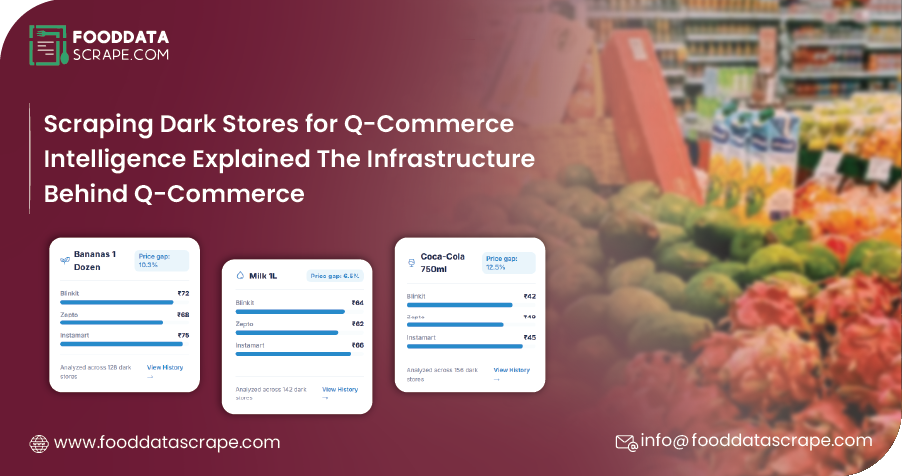
Quick commerce has transformed how consumers shop, turning traditional delivery windows into 10-30-minute expectations. Behind this speed is a powerful but often invisible infrastructure: dark stores. These micro-fulfillment facilities are strategically positioned close to customers, stocked with high-demand products, and optimized for rapid picking and dispatching.
Scraping Dark Stores helps businesses uncover this hidden layer of quick-commerce operations by collecting structured intelligence on store locations, product availability, assortment, pricing, delivery coverage, and operational patterns.
Scrape dark store infrastructure for quick commerce to understand how platforms build fulfillment networks, where facilities operate, what they stock, and how their geographic footprint changes over time.
For brands, retailers, investors, logistics providers, and quick-commerce operators, this information can reveal competitive gaps that are difficult to identify through conventional market research.
Dark store catchment area analysis can further reveal the geographic markets served by individual facilities and help businesses understand how fulfillment networks overlap, expand, or compete.
What Are Dark Stores?
Dark stores are retail facilities designed primarily for online order fulfillment rather than traditional customer shopping. They may resemble supermarkets or warehouses internally, but customers typically cannot walk in and browse products.
Platforms use these facilities to position inventory closer to consumers. When an order arrives, workers pick products, pack them, and hand the package to delivery personnel. This model minimizes travel distance and helps platforms meet aggressive delivery promises.
Dark stores can range from small neighborhood facilities to larger fulfillment centers supporting multiple surrounding areas. Their importance has grown alongside companies operating quick-commerce and on-demand grocery models.
For businesses studying this ecosystem, dark store location analysis provides valuable insight into where competitors are investing and which neighborhoods are receiving greater fulfillment coverage.
Why Dark Store Data Matters?
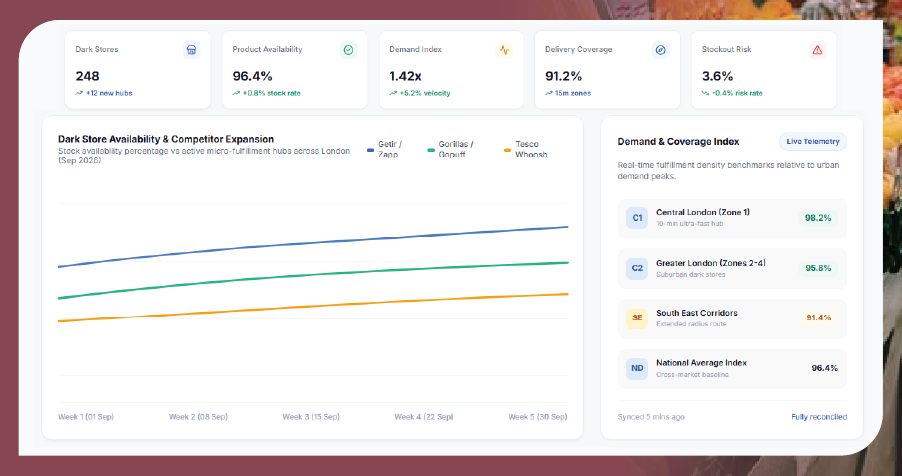
A dark store is more than a physical location. It represents a combination of inventory, demand, delivery capacity, geographic reach, and competitive strategy.
Suppose a quick-commerce platform opens several facilities around a high-income residential area. That expansion may indicate strong order density, favorable customer economics, or an opportunity to capture market share.
Similarly, if a competitor suddenly increases the number of dark stores within a particular city, brands can investigate whether the expansion corresponds with increased product availability, lower delivery times, aggressive pricing, or new customer acquisition initiatives.
This makes dark store product availability monitoring especially valuable for brands that want to determine whether their products are consistently visible and purchasable across different fulfillment locations.
What Data Can Be Scraped From Dark Stores?
Dark store data can include a wide range of attributes depending on the platform and business objective.
Location and Infrastructure Data
Businesses can collect information such as dark store names or identifiers, addresses, geographic coordinates, service zones, operating status, estimated delivery coverage, and facility-level availability.
Historical collection can also identify newly launched locations, relocated facilities, inactive stores, and changing service areas.
Product and Inventory Data
Product-level information may include product names, brands, categories, pack sizes, prices, discounts, availability status, SKUs, ratings, and promotional offers.
Tracking this information across different stores can reveal localized differences in assortment and pricing.
Delivery and Service Data
Where publicly observable, businesses can monitor estimated delivery times, minimum order requirements, delivery fees, order restrictions, and service availability.
Comparing these variables across neighborhoods helps identify operational differences between fulfillment zones.
Dark Store Product Availability Intelligence
Inventory availability is one of the most important dimensions of quick-commerce competition.
A product may be available in one dark store while being unavailable only a few kilometers away. These differences can occur because of localized demand, inventory allocation, replenishment schedules, or facility capacity.
Continuous data collection can help brands identify recurring stockouts and determine which geographic markets experience the greatest availability problems.
For consumer brands, this information can support distributor discussions, replenishment planning, and retail execution strategies. For competing platforms, it can expose assortment gaps that create opportunities for customer acquisition.
Understanding Quick-Commerce Competition
The growth of dark stores has created a new competitive landscape where companies compete not only on price but also on proximity.
A platform with more facilities may achieve shorter delivery times. However, more facilities also require greater investment in inventory, staffing, technology, and real estate.
This is why quick commerce dark store intelligence can help businesses evaluate the relationship between physical infrastructure and digital market performance.
By combining location, assortment, price, and availability data, analysts can develop a more complete view of how quick-commerce networks operate.
Mapping Dark Store Catchment Areas
Catchment analysis helps determine which residential and commercial areas are likely served by specific dark stores.
Businesses can compare store coordinates with customer-facing delivery zones, estimated delivery times, and neighboring facilities to build geographic coverage maps.
This can answer questions such as:
- Which neighborhoods have the highest dark-store density?
- Where do competing fulfillment zones overlap?
- Which areas have limited quick-commerce coverage?
- Where are new facilities appearing?
- Which neighborhoods could represent expansion opportunities?
Catchment analysis becomes even more powerful when combined with demographic, population, mobility, and spending datasets.
Dark Store Location Intelligence for Expansion
Choosing the right location is critical to quick-commerce economics.
A poorly positioned facility may have insufficient order density, while an optimally located facility can support a large customer base within a small delivery radius.
Historical dark-store location datasets can therefore help businesses identify expansion patterns.
For example, analysts can compare the locations of existing facilities with population density, competitor presence, retail activity, and estimated delivery coverage.
This enables businesses to identify underserved zones and understand where competitors are concentrating their investments.
Building a Q-Commerce Dark Store Dataset
A structured dataset can transform scattered online information into usable competitive intelligence.
A Dark Store Data Scraping project may organize information into fields such as platform, store ID, location, latitude, longitude, city, service area, product category, product name, SKU, price, discount, availability, delivery time, and timestamp.
Historical snapshots are particularly valuable because they allow businesses to track changes instead of analyzing only the current state.
A well-maintained Q-Commerce Dark Store DB can become a long-term intelligence asset for pricing teams, market researchers, investors, retailers, and logistics companies.
Tracking Market Expansion
Dark-store networks are constantly evolving. New facilities may launch while older locations become inactive or change their service boundaries.
Regular data collection can identify these changes and create an expansion timeline.
Analysts can then compare network growth across cities and platforms.
For instance, one platform may prioritize dense metropolitan neighborhoods, while another may focus on suburban expansion. A third may concentrate on smaller cities where competition is less intense.
These patterns provide strategic insight into each company's growth model.
Competitive Pricing and Stock Monitoring
Location intelligence becomes even more useful when combined with product-level pricing.
Businesses can compare the same product across multiple dark stores, platforms, and geographic areas. This can reveal localized discounts, promotional campaigns, price differences, and assortment variations.
Stock monitoring adds another layer of intelligence.
If a high-demand product repeatedly goes out of stock in one area while remaining available elsewhere, the pattern may indicate localized demand pressure or supply-chain limitations.
Combining price and availability creates a powerful framework for competitive retail monitoring.
Use Cases Across Industries
Dark store intelligence can support several business functions.
- Retail brands can monitor product availability and pricing across fulfillment zones.
- Quick-commerce platforms can benchmark competitor infrastructure and identify underserved locations.
- Investors can evaluate expansion strategies, market penetration, and operational footprints.
- Logistics companies can study fulfillment density and delivery coverage.
- Market researchers can measure the evolution of quick-commerce infrastructure across cities.
- Real-estate teams can investigate potential areas for micro-fulfillment expansion.
- Consumer analytics companies can combine dark-store information with pricing and demand datasets to build market intelligence products.
Challenges in Dark Store Data Collection
Dark-store scraping can be technically challenging because quick-commerce platforms frequently update their websites and applications.
Some information may be dynamically loaded, location-dependent, personalized, or available only after selecting a delivery area.
Data collection therefore requires robust extraction workflows capable of handling changing page structures, dynamic content, geographic variations, and frequent updates.
Data quality is equally important. Duplicate locations, inconsistent product names, changing store identifiers, and temporary availability issues can create misleading conclusions if they are not properly normalized.
A reliable process should include validation, deduplication, timestamping, geographic normalization, and historical storage.
Turning Scraped Data Into Business Intelligence
Raw data alone does not create competitive advantage. The real value comes from transforming collected information into actionable intelligence.
A dashboard can display dark-store locations on maps, compare product availability, monitor price movements, identify stockout patterns, and track network expansion.
Businesses can also create alerts for new store launches, major price changes, disappearing products, or sudden changes in delivery coverage.
When historical datasets are combined with visualization and analytics, decision-makers can move from simply observing the quick-commerce market to understanding how it is changing.
How Food Data Scrape Can Help You?
1. Build Comprehensive Dark Store Datasets
Food Data Scrape can collect structured information across multiple quick-commerce platforms, helping businesses create consistent datasets covering locations, products, prices, availability, and delivery attributes for analysis.
2. Monitor Competitive Store Expansion
Our data collection solutions can track new dark-store launches, changing locations, service areas, and network growth, enabling teams to understand competitor expansion patterns across cities and markets.
3. Track Products, Prices, and Availability
Food Data Scrape can continuously capture product-level information, allowing businesses to identify stockouts, price changes, promotions, assortment differences, and availability patterns across multiple fulfillment locations.
4. Support Geographic Market Intelligence
Collected location and service-area data can be combined with geographic analysis to identify underserved neighborhoods, overlapping catchment areas, competitor density, and potential opportunities for quick-commerce expansion.
5. Deliver Decision-Ready Data
Food Data Scrape can transform continuously collected dark-store information into structured datasets and customized feeds suitable for dashboards, market research, pricing intelligence, forecasting, and strategic planning.
Conclusion
Dark stores are becoming the physical backbone of the quick-commerce economy. Their locations, product assortments, prices, inventory availability, and service coverage provide valuable signals about consumer demand, competitive positioning, and market expansion.
Businesses that continuously monitor this infrastructure can understand where competitors are growing, which products are available, how pricing changes across neighborhoods, and where market opportunities remain untapped.
Q-Commerce Dark Store Location Data Scraping can provide the geographic foundation required to analyze fulfillment networks, identify expansion patterns, and benchmark competitor infrastructure.
Web Scraping Quick Commerce Data can extend this intelligence beyond locations by connecting dark-store infrastructure with product, pricing, availability, and delivery information.
Scrape Dark Store Stock & Pricing Data to create a continuously updated intelligence layer that supports competitive monitoring, assortment optimization, market research, and strategic decision-making.
Ready to turn dark-store activity into actionable market intelligence? Contact Food Data Scrape today to build a customized dark-store data collection solution for your business.
Are you in need of high-class scraping services? Food Data Scrape should be your first point of call. We are undoubtedly the best in Food Data Aggregator and Mobile Grocery App Scraping service and we render impeccable data insights and analytics for strategic decision-making. With a legacy of excellence as our backbone, we help companies become data-driven, fueling their development. Please take advantage of our tailored solutions that will add value to your business. Contact us today to unlock the value of your data.
Get a Free Food Data Sample in 48 Hours.
Tell us your platforms, target markets and required fields — we'll map exactly what's possible with food data scraping, recommend the right approach, and send a working sample so you can verify quality before any commitment.
Request a strategy call
Thanks — our data team will reach out within 48 hours with your sample.