Introduction
The grocery and food delivery industries may look closely connected, but their digital footprints tell very different stories. Scraping Grocery vs Food Delivery Data creates a unified view of how consumers encounter products, restaurants, prices, promotions, availability, and delivery experiences across two rapidly evolving markets. Businesses using grocery and food delivery data scraping can move beyond isolated observations and understand where customer expectations, pricing strategies, and purchasing behavior intersect.
A grocery vs food delivery pricing dataset makes this comparison measurable. Grocery platforms typically expose product-level information such as brands, pack sizes, discounts, stock status, and unit prices, while food delivery platforms reveal restaurant menus, meal prices, ratings, delivery fees, promotions, and estimated delivery times.
When these datasets are collected consistently, businesses can identify pricing gaps, competitive positioning, consumer preferences, promotional intensity, and changing market dynamics. The real opportunity is not simply collecting more data. It is connecting the right data points to understand how two different digital commerce models compete for the same consumer wallet.
Why Compare Grocery and Food Delivery Data?
Consumers increasingly make food decisions across multiple channels. Someone might purchase ingredients from a grocery application for dinner, order a prepared meal from a restaurant platform the following evening, and switch between both depending on price, convenience, time, and promotions.
This makes grocery data and food delivery data comparison particularly valuable.
Grocery data focuses heavily on individual products and baskets. Food delivery data focuses on prepared meals, restaurants, cuisines, menus, delivery economics, and customer experience. Comparing these datasets allows businesses to answer questions that neither dataset can answer independently.
For example, a grocery retailer may discover that pasta, cheese, sauces, and vegetables are heavily discounted while nearby restaurants simultaneously increase prices for pasta-based meals. A restaurant group could use similar intelligence to understand whether customers are receiving better value by preparing meals at home.
The comparison therefore becomes a strategic lens for understanding food economics rather than simply a price-monitoring exercise.
Grocery Data vs Food Delivery Data: Key Differences
| Comparison Factor | Grocery Data | Food Delivery Data |
|---|---|---|
| Core Offering | Raw ingredients, packaged foods, beverages, and grocery products | Prepared meals, dishes, combos, snacks, and beverages |
| Pricing Structure | Based on product size, brand, quantity, promotions, and retailer pricing | Influenced by ingredients, preparation, restaurant costs, delivery, and platform fees |
| Main Data Unit | Individual SKU or grocery product | Individual menu item or restaurant |
| Customer Intent | Buying products for home consumption or meal preparation | Buying ready-to-eat food for convenience |
| Promotions | Discounts, coupons, BOGO offers, bundles, and loyalty pricing | Meal discounts, combos, free delivery, coupons, and platform offers |
| Availability | Primarily determined by inventory and stock levels | Determined by restaurant hours, menu availability, capacity, and location |
| Delivery Factors | Delivery slots, fulfillment availability, and delivery charges | Delivery time, distance, delivery fee, and preparation time |
| Competitive Analysis | Compares brands, retailers, SKUs, pack sizes, and product prices | Compares restaurants, cuisines, menu items, ratings, and delivery economics |
| Price Frequency | Changes due to promotions, suppliers, inventory, and market conditions | Changes according to demand, restaurant strategy, promotions, and operating costs |
| Market Insights | Reveals grocery inflation, product demand, assortment, and retail competition | Reveals restaurant pricing, cuisine trends, convenience premiums, and competitive density |
| Key Business Users | Retailers, FMCG brands, grocery marketplaces, investors, and researchers | Restaurants, food platforms, QSR brands, investors, and market researchers |
| Analytical Opportunity | Product-level price tracking and assortment intelligence | Menu-level pricing, promotion, delivery, and restaurant intelligence |
What Grocery Data Reveals?
Grocery Data Scraping provides granular visibility into the products consumers can purchase for home consumption.
A structured grocery dataset can contain:
- Product names and descriptions
- Brands and categories
- Pack sizes and quantities
- Regular and discounted prices
- Unit prices
- Availability and stock status
- Product ratings and reviews
- Promotional offers
- Store and location information
- Product images
- Delivery availability
- Seller information
This information becomes especially powerful when collected repeatedly. Historical records can reveal price movements, promotional cycles, assortment changes, stockouts, and regional differences.
For example, a retailer monitoring thousands of grocery products can identify which categories experience frequent price changes and which brands consistently maintain premium positioning.
The same data can support competitive benchmarking across supermarkets, quick-commerce platforms, and online grocery marketplaces.
What Food Delivery Data Reveals?
Food delivery platforms generate an entirely different layer of commercial intelligence.
Through food delivery restaurant data scraping, businesses can analyze restaurants, menus, cuisines, pricing, promotions, ratings, and availability across locations.
Useful fields include:
- Restaurant name and location
- Cuisine type
- Menu categories
- Dish names
- Item prices
- Combo prices
- Discounts
- Delivery charges
- Minimum order values
- Ratings and review counts
- Estimated delivery times
- Restaurant operating hours
- Popular dishes
- Availability status
- Platform-specific promotions
Unlike grocery products, restaurant menu items are often affected by preparation costs, labor, packaging, restaurant positioning, delivery commissions, and demand patterns.
Consequently, menu prices can provide valuable insight into the economics of prepared food.
Grocery Versus Food Delivery Pricing
Price comparison becomes much more interesting when products and prepared meals are analyzed together.
Consider a simple example. A grocery platform might sell ingredients for a homemade pizza at a combined price of $8. A restaurant may offer a comparable prepared pizza for $16. However, the restaurant price includes preparation, labor, packaging, convenience, and delivery economics.
This creates several analytical dimensions:
| Dimension | Grocery | Food Delivery |
|---|---|---|
| Primary unit | Product | Menu item |
| Purchase purpose | Home preparation | Immediate consumption |
| Pricing drivers | Supplier, brand, promotions | Ingredients, labor, operations |
| Promotions | Coupons, markdowns, bundles | Discounts, combos, free delivery |
| Availability | Stock-based | Restaurant operating status |
| Delivery | Product fulfillment | Meal fulfillment |
| Competition | Retailers and marketplaces | Restaurants and platforms |
A business can use these differences to understand where consumers pay premiums for convenience and where grocery pricing creates opportunities for home-cooked alternatives.
Building a Unified Market Dataset
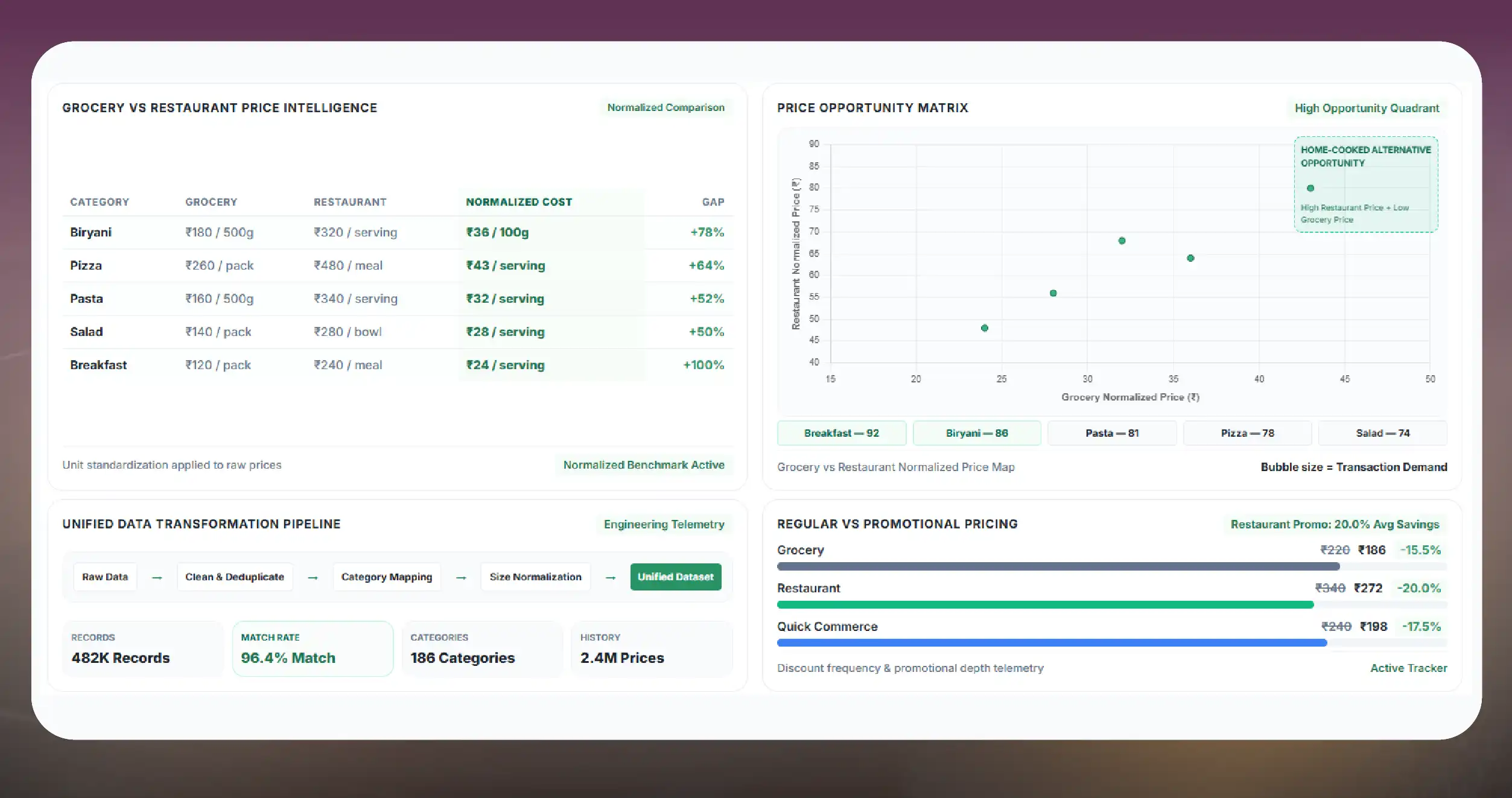
The most valuable approach is not collecting grocery and restaurant information separately. It is creating a standardized dataset that allows both ecosystems to be compared.
For example, businesses can normalize:
- Product and menu categories
- Serving or package sizes
- Geographic markets
- Regular prices
- Promotional prices
- Discount percentages
- Availability
- Delivery charges
- Time periods
Normalization makes comparisons more meaningful.
A 500-gram grocery product should not be directly compared with a restaurant dish serving two people without appropriate transformation. Similarly, a restaurant combo should be evaluated differently from an individual grocery SKU.
This is where data engineering becomes essential. Raw scraped information needs cleaning, categorization, deduplication, normalization, and historical storage before it becomes useful market intelligence.
Tracking Promotional Strategies
Promotions are one of the strongest areas of comparison.
Grocery businesses commonly use percentage discounts, multi-buy offers, coupons, loyalty pricing, and bundle promotions. Food delivery platforms frequently rely on restaurant discounts, meal combos, free-delivery campaigns, bank offers, and platform-funded promotions.
Tracking these strategies over time helps identify promotional intensity.
Businesses can determine:
- Which categories receive the most discounts?
- Which restaurants repeatedly run promotions?
- Which brands maintain stable pricing?
- When promotional activity increases?
- Which locations are most competitive?
- How frequently prices return to normal levels?
This transforms promotional monitoring from manual observation into measurable competitive intelligence.
Understanding Geographic Differences
Location can dramatically change both grocery and restaurant economics. grocery product data scraping helps businesses capture location-specific prices, availability, promotions, brands, and product assortments across different markets.
The same grocery product may have different prices across cities because of logistics, competition, local demand, and supply conditions. Restaurant menu prices can vary because of rent, labor costs, customer demographics, cuisine demand, and neighborhood positioning.
By collecting location-specific datasets, companies can compare markets at city, neighborhood, or delivery-zone levels. Grocery vs Food Delivery market analytics makes it easier to identify regional pricing patterns, promotional differences, competitive intensity, and consumer value gaps.
For instance, a restaurant brand could discover that its average menu price is significantly higher in one city than another. A grocery retailer could identify regions where competing brands frequently offer deeper discounts.
These insights support market expansion, localization, pricing decisions, competitive benchmarking, and more accurate regional strategy development.
Using AI for Grocery and Food Intelligence
AI Grocery Intelligence becomes considerably more powerful when historical grocery and delivery datasets are combined.
Machine learning models can identify unusual price movements, predict promotional periods, classify products, detect duplicate listings, and identify relationships between categories.
AI can also help interpret restaurant menus at scale. Similar dishes can be grouped even when restaurant naming conventions differ.
For example, "Chicken Alfredo Pasta," "Creamy Chicken Alfredo," and "Chicken Pasta Alfredo" can potentially be mapped into a common category for analytical purposes.
This creates cleaner datasets and enables more meaningful market-level comparisons.
AI-driven systems can also flag anomalies, such as a restaurant suddenly changing its menu prices or a grocery brand experiencing unusually high discount activity.
Real-Time Versus Historical Intelligence
Historical data explains what happened. Real-time data helps businesses understand what is happening now.
A Real-Time Delivery Scraping API can support continuously updated monitoring of restaurant menus, prices, promotions, delivery fees, and availability.
This can be particularly useful for:
- Dynamic pricing monitoring
- Competitor alerts
- Restaurant availability tracking
- Promotion detection
- Delivery-time benchmarking
- Menu change detection
- Local market monitoring
For grocery businesses, similar real-time collection can identify sudden price changes, stockouts, and promotional launches.
The combination of historical and real-time intelligence creates a much stronger analytical environment. Historical datasets reveal patterns, while live feeds identify current market movements.
Unlock smarter food-market insights with comprehensive grocery and food delivery data scraping tailored to your business needs.
Applications Across Different Businesses
The value of grocery and food delivery comparison extends across multiple industries.
- Retailers can benchmark product prices and promotional activity against prepared-food alternatives.
- Restaurant chains can monitor competitors and evaluate whether menu pricing remains competitive against home-cooking economics.
- Consumer brands can identify where their products appear across grocery platforms and how their prices compare with competing brands.
- Market researchers can measure food inflation, promotional intensity, category growth, and geographic pricing differences.
- Investors can use marketplace data to evaluate competitive density, pricing power, assortment, and market positioning.
- Food-tech companies can build recommendation, pricing, demand forecasting, and market intelligence products from structured datasets.
The key is converting raw marketplace information into comparable metrics.
Challenges in Comparing Both Data Types
Comparison also comes with technical challenges.
Product names and restaurant menu names are rarely standardized. Pack sizes differ, serving sizes vary, promotions can obscure base prices, and delivery fees may depend on distance, time, membership, or order value.
Data collection can also be affected by dynamic pages, changing website structures, regional variations, and inconsistent availability.
Therefore, reliable analysis requires a robust workflow involving data extraction, validation, normalization, historical storage, monitoring, and quality checks.
Businesses should also collect and use publicly available information responsibly and respect applicable website terms, privacy requirements, and legal restrictions.
How Food Data Scrape Can Help You?
Unified Collection
Food Data Scrape can consolidate grocery products and restaurant menus into standardized datasets, enabling consistent cross-market pricing, assortment, promotion, and availability comparisons.
Competitive Monitoring
It can track competitor prices, discounts, restaurant menus, grocery offers, delivery fees, and availability across multiple locations, helping businesses identify competitive movements faster.
Market Intelligence
Structured historical datasets reveal category trends, regional pricing differences, promotional behavior, assortment changes, and market gaps that manual research frequently misses.
Real-Time Insights
Automated collection can support frequent updates for pricing, menu changes, stock availability, promotions, and delivery conditions, enabling faster responses to rapidly changing marketplace conditions.
Decision Support
Clean, comparable datasets can strengthen pricing decisions, market expansion, product positioning, promotional planning, competitor benchmarking, and strategic analysis across food commerce ecosystems.
Conclusion
Grocery and food delivery platforms represent two sides of the modern food economy. One enables consumers to purchase ingredients and prepare meals, while the other monetizes convenience, preparation, and immediate consumption.
Comparing both datasets reveals far more than individual prices. It uncovers promotional behavior, consumer value perceptions, geographic differences, competitive positioning, assortment strategies, and the economics of convenience.
Businesses that combine Scrape Offers Data from Food Delivery Apps with structured grocery information can create a broader view of food-market dynamics. A scalable Food Scraping Api can further streamline the collection of restaurant, menu, pricing, promotion, and availability information.
Ultimately, the strongest intelligence comes from connecting these datasets rather than analyzing them in isolation. When grocery and food delivery signals are standardized, enriched, and monitored continuously, businesses gain a clearer picture of how food prices, consumer choices, and digital commerce are evolving.
Are you in need of high-class scraping services? Food Data Scrape should be your first point of call. We are undoubtedly the best in Food Data Aggregator and Mobile Grocery App Scraping service and we render impeccable insights and analytics for strategic decision-making. With a legacy of excellence as our backbone, we help companies become data-driven, fueling their development. Please take advantage of our tailored solutions that will add value to your business. Contact us today to unlock the value of your data.