Introduction
Quick commerce has changed the way consumers purchase groceries, beverages, snacks, personal care products, household essentials, and everyday necessities. Instead of waiting for traditional deliveries, customers now expect products to arrive within minutes. This rapid shift has created an intensely competitive digital marketplace where product prices, discounts, inventory, assortment, and visibility can change throughout the day.
For brands, retailers, market researchers, and FMCG companies, understanding these changes requires more than occasional manual checks. Scraping Quick Commerce Data provides a systematic way to collect structured marketplace information and convert constantly changing digital shelf activity into actionable business intelligence.
For instance, Blinkit price monitoring can help businesses track competitor prices, discounts, promotions, and location-based price variations. Similarly, Zepto price data scraping can reveal product prices, availability, pack sizes, discounts, categories, and assortment changes. When this information is collected consistently across multiple platforms, companies can identify trends that would otherwise remain hidden.
Why Quick Commerce Data Has Become So Valuable?
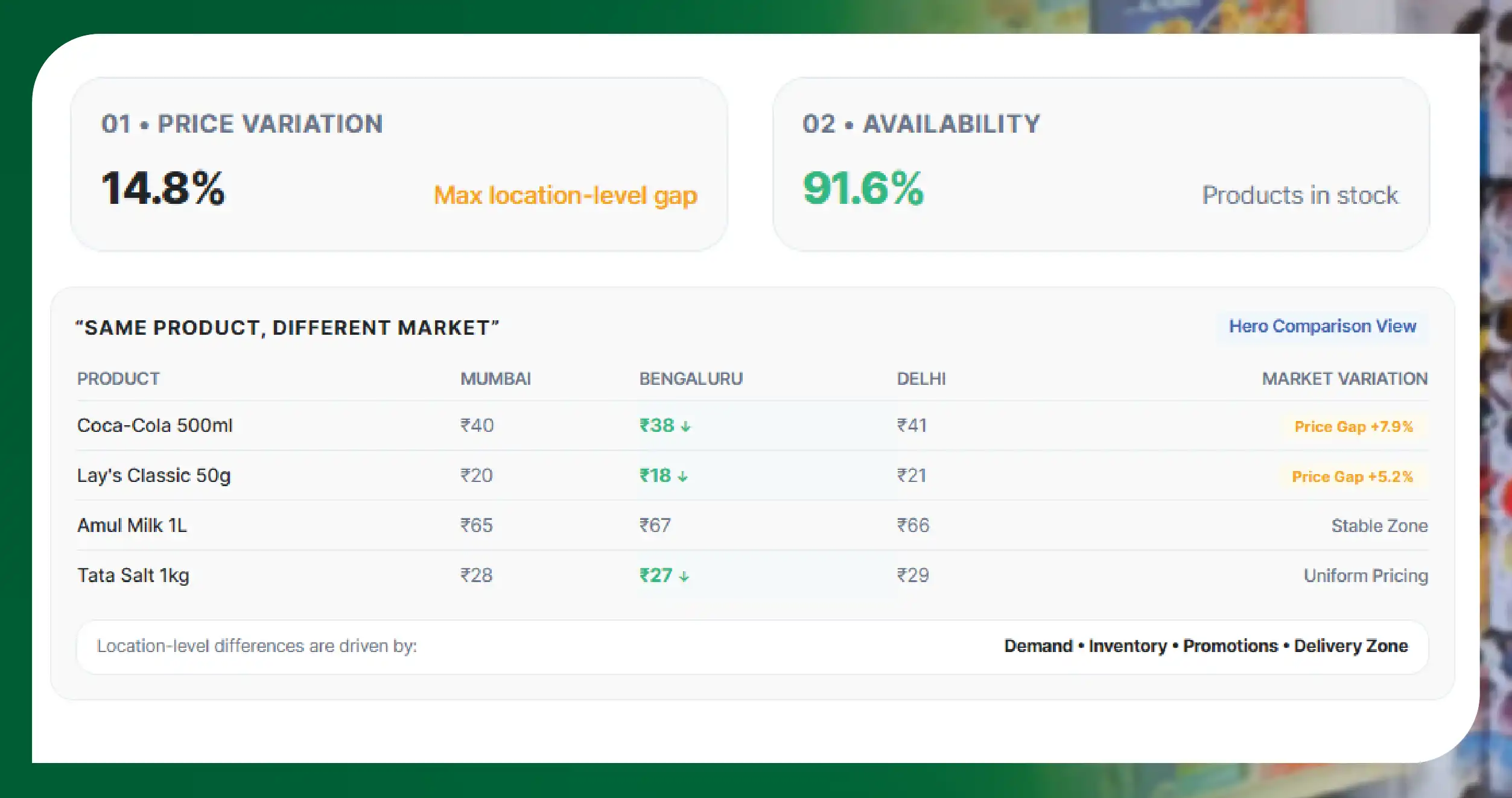
Quick-commerce platforms operate differently from conventional e-commerce marketplaces. Availability can depend on dark-store inventory, local demand, delivery zones, time of day, and promotional campaigns. A product available in one neighborhood may be unavailable only a few kilometers away.
Prices can also vary across locations. A particular FMCG product might sell at one price in Mumbai and another in Bengaluru, while a competitor may simultaneously run a discount in both locations.
This makes quick-commerce data highly valuable for companies that need real-time visibility.
Instead of depending on manual searches, businesses can establish automated collection workflows that capture marketplace information at defined intervals. The resulting historical dataset can then be analyzed to understand:
- Price movements
- Product availability
- Discount patterns
- Promotional activity
- Competitor assortment
- Product launches
- Category trends
- Location-level differences
- Marketplace visibility
- Competitive positioning
The goal is not simply to collect data. The goal is to transform changing marketplace activity into information that supports better commercial decisions.
What Quick Commerce Data Can Be Collected?
A well-designed data collection workflow can capture a broad range of publicly available product and marketplace attributes.
Depending on business requirements, datasets may include product names, brands, categories, subcategories, current prices, MRP, discounts, offers, pack sizes, availability, ratings, review counts, product URLs, images, descriptions, store information, delivery estimates, and timestamps.
Blinkit product data scraping can be particularly useful for FMCG companies that want to understand how their products are represented on a leading quick-commerce platform.
A standardized dataset might contain:
| Data Field | Example |
|---|---|
| Product Name | Coca-Cola Soft Drink |
| Brand | Coca-Cola |
| Category | Beverages |
| Pack Size | 750 ml |
| Listed Price | ₹45 |
| MRP | ₹50 |
| Discount | 10% |
| Availability | In Stock |
| Platform | Blinkit |
| Location | Bengaluru |
| Product Rating | 4.6 |
| Review Count | 2,184 |
| Collection Time | 10:30 AM |
When similar information is collected repeatedly, companies can compare current marketplace conditions against historical observations.
Turning Raw Data into Quick-Commerce Intelligence
Collecting millions of product records is only the first step. The real value emerges when the data is cleaned, standardized, analyzed, and converted into actionable insights.
This is where quick commerce intelligence becomes important.
Consider an FMCG company monitoring hundreds of products across multiple cities. Raw records can reveal which SKUs are becoming more expensive, which competitors are offering deeper discounts, which products frequently go out of stock, and which locations have stronger product availability.
Historical datasets can reveal patterns that are impossible to identify through one-time monitoring.
For example, a company may discover that competitors consistently reduce prices during weekends. Another brand may notice that a particular product category receives heavy discounting before festivals. A retailer could identify cities where competitor assortment is substantially broader.
These insights can influence pricing, promotions, distribution, assortment planning, and inventory strategies.
FMCG Brands and Quick-Commerce Monitoring
FMCG companies face intense competition because customers can compare products almost instantly. A consumer searching for biscuits, soft drinks, breakfast cereals, snacks, detergents, or personal-care products may see several competing brands on the same screen.
This makes FMCG quick commerce intelligence increasingly important.
Brands can monitor their marketplace presence against competitors and evaluate whether products are priced competitively and consistently available.
For example, an FMCG company can track:
- Competitor pricing
- Product availability
- Discount frequency
- Promotional offers
- Pack-size variations
- New product launches
- Category assortment
- Marketplace positioning
- Location-level availability
Such intelligence can help commercial teams identify opportunities and respond faster to competitive changes.
Blinkit, Zepto, and Instamart Competitive Analysis
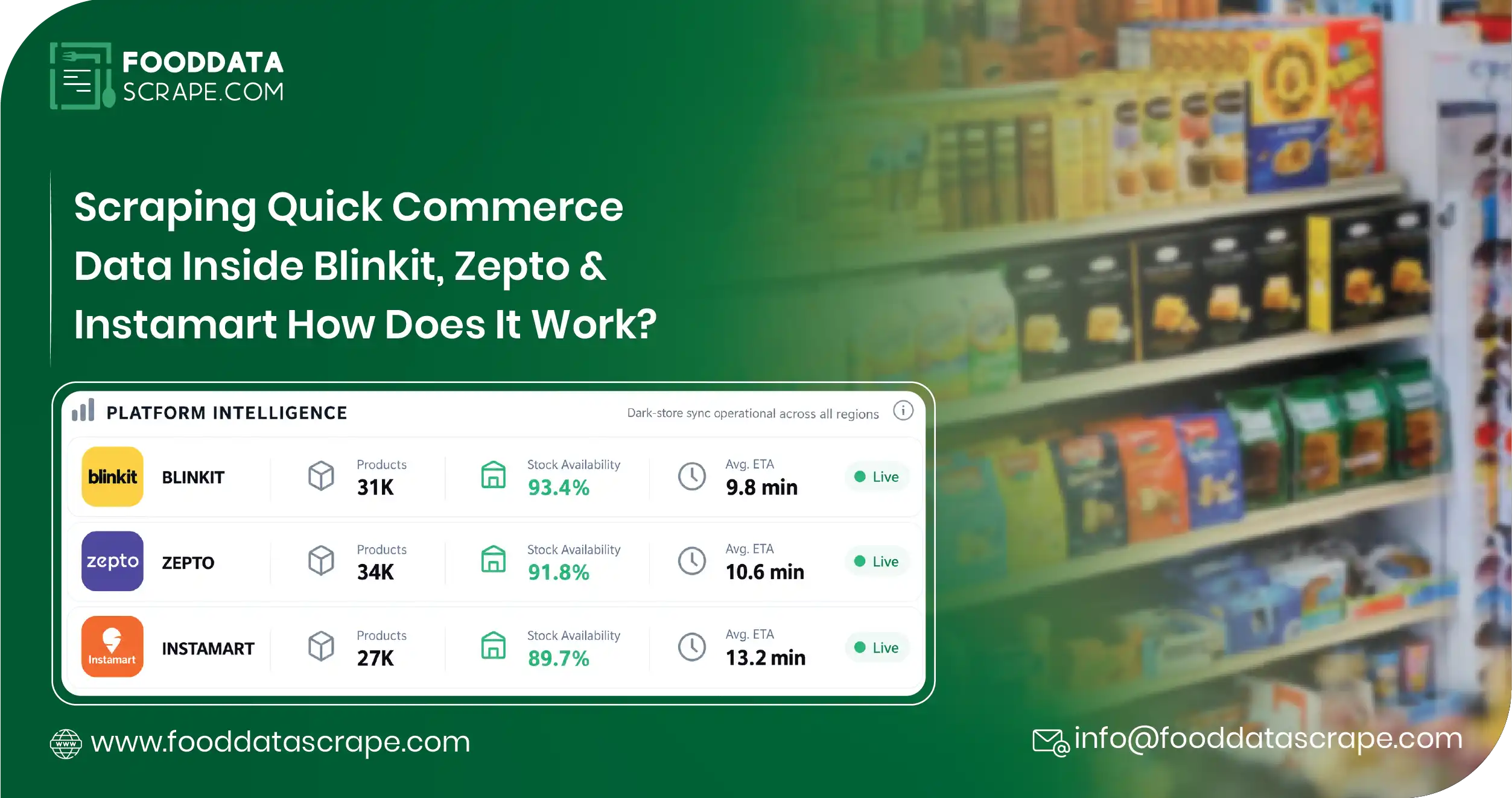
Quick-commerce competition becomes more meaningful when platforms are compared side by side. Blinkit, Zepto & Instamart data scraping enables businesses to develop a unified view of pricing, availability, assortment, and promotional activity across leading platforms.
Instead of checking every marketplace individually, businesses can consolidate the information into a standardized dataset.
For example, a cross-platform price comparison could look like this:
| Product | Blinkit | Zepto | Swiggy Instamart | Lowest Price |
|---|---|---|---|---|
| Coca-Cola Soft Drink 750 ml | ₹45 | ₹43 | ₹45 | Zepto |
| Lay's Magic Masala 90 g | ₹20 | ₹20 | ₹19 | Swiggy Instamart |
| Amul Taaza Milk 1 L | ₹62 | ₹60 | ₹61 | Zepto |
| Britannia Good Day 200 g | ₹40 | ₹39 | ₹40 | Zepto |
| Surf Excel Matic 2 kg | ₹385 | ₹379 | ₹382 | Zepto |
Such comparisons immediately highlight price differences and help businesses identify where their products or competitors are more aggressively priced.
Ready to turn fast-changing quick-commerce data into actionable insights? Partner with Food Data Scrape to scrape, monitor, and analyze Blinkit, Zepto, and Swiggy Instamart data at scale.
Extracting Data Across Multiple Platforms
Cross-platform data collection becomes especially valuable when organizations need continuous monitoring. Extract Blinkit, Zepto & Swiggy Instamart Data workflows can be configured according to the required frequency, product categories, cities, locations, or SKUs.
Some businesses may require daily data, while others may need multiple snapshots throughout the day for highly volatile categories.
The frequency can depend on factors such as:
- Product price volatility
- Promotional activity
- Category demand
- Inventory fluctuations
- Number of locations
- Business objectives
- Competitive intensity
The collected data can be structured into CSV, Excel, JSON, databases, APIs, or cloud environments depending on how the organization intends to use it.
Monitoring Quick-Commerce Prices by Location
Location is one of the most important dimensions of quick-commerce analysis.
Unlike traditional online stores that often display standardized national pricing, quick-commerce marketplaces can reflect localized inventory and market conditions. Prices, availability, discounts, and assortment may vary between cities and neighborhoods.
Suppose a snack brand monitors its products across Delhi, Mumbai, Bengaluru, Hyderabad, and Pune. The company may discover that one competitor offers deeper discounts in Mumbai while maintaining standard pricing elsewhere.
Such information can help businesses evaluate location-specific pricing strategies.
Historical location-level data can also reveal whether price differences are temporary or persistent. Over time, companies can create city-wise benchmarks and identify markets requiring closer attention.
Tracking Promotions and Discounts
Promotions play a major role in quick-commerce purchasing behavior. Platforms can use discounts, coupons, multi-buy offers, limited-time deals, and other promotional mechanisms to stimulate purchases.
Automated data collection allows businesses to capture these changes over time.
For example, a brand can monitor whether competitors frequently discount specific products or whether certain categories experience greater promotional pressure.
Marketing teams can use this information to compare their own campaigns against marketplace activity.
Instead of asking only, "What is our current price?" companies can ask more strategic questions:
- How often does the competitor discount this product?
- How large is the average discount?
- Which platform offers the lowest price?
- Which products receive the most promotions?
- Are discounts concentrated around weekends?
- Are promotional patterns different between cities?
The answers can support more informed promotional planning.
Product Availability and Assortment Intelligence
Price is only one part of quick-commerce competitiveness. Availability is equally important.
A product that is competitively priced but repeatedly unavailable may still lose sales opportunities. At the same time, a competitor with strong availability can capture additional customer attention.
Quick-commerce data can therefore be used to track:
- In-stock and out-of-stock status
- Assortment depth
- New products
- Discontinued products
- Competitor presence
- Location-specific availability
- Category-level assortment
By combining availability with pricing data, businesses can determine whether poor marketplace performance is related to pricing, inventory, assortment, or competitive pressure.
Competitor Product Benchmarking
Product benchmarking allows businesses to compare similar products across platforms.
For FMCG brands, this can involve comparing pack sizes, pricing, discounts, product descriptions, ratings, and availability.
For example, a beverage company may discover that its 750 ml product is priced higher than competing beverages while receiving fewer promotional placements. A packaged-food company might find that competitors offer smaller packs at lower entry prices.
These insights can contribute to decisions involving pack architecture, promotional planning, price positioning, and product portfolio strategy.
Creating a Historical Quick-Commerce Dataset
One-time scraping provides a snapshot. Recurring data collection creates a historical intelligence asset.
Suppose a company captures marketplace prices every day for twelve months. It can then analyze monthly price movements, promotional periods, seasonal fluctuations, and competitor behavior.
Historical data can help answer questions such as:
- When did competitor prices increase?
- How frequently did products go out of stock?
- Which months had the strongest promotions?
- Which cities experienced the highest price changes?
- Which products gained or lost marketplace availability?
- How did competitor pricing change after a new product launch?
This makes historical datasets valuable for trend analysis, forecasting, and strategic planning.
Building an Automated Quick-Commerce Data Pipeline
A reliable quick-commerce data workflow typically begins by defining the required platforms, products, categories, cities, locations, and data fields.
The collection layer then gathers relevant publicly accessible information. After extraction, the raw data is cleaned and standardized.
Product names may require normalization because the same product can appear with slightly different descriptions across platforms. Pack sizes, units, brands, and categories may also need standardization.
The next stage involves product matching. Once equivalent products are identified across marketplaces, price and availability comparisons become significantly more accurate.
Finally, the processed information can be stored in databases, cloud platforms, spreadsheets, APIs, or analytics systems.
Quality-control processes should also identify missing values, duplicates, unexpected changes, incorrect product matches, and inconsistent records.
Quick-Commerce Data for Pricing Strategy
Pricing teams can use marketplace data to understand competitive price positioning.
Instead of setting prices based only on internal assumptions, brands can observe actual marketplace conditions. If competitors consistently price a similar product 5% below the company's product, the brand can investigate whether the difference is justified by brand strength, pack size, promotions, or distribution.
Similarly, if a product is significantly cheaper on one platform than another, the business can investigate the reason and determine whether corrective action is required.
Price monitoring can therefore support more responsive and evidence-based pricing strategies.
Supporting Demand and Market Trend Analysis
Quick-commerce datasets can also contribute to broader market research.
When price, availability, promotions, and assortment data are collected over extended periods, businesses can identify changes in marketplace behavior.
For example, a sudden increase in the number of brands offering smaller pack sizes could indicate stronger demand for lower-ticket products. Increasing promotional activity in a category may signal intensifying competition.
When combined with other business datasets, quick-commerce information can support demand forecasting, market sizing, competitive analysis, and category strategy.
Challenges in Quick-Commerce Data Collection
Quick-commerce data collection requires careful planning because marketplace environments can change frequently.
Product pages, layouts, URLs, data structures, inventory states, and displayed attributes may change over time. Location-based information can also create additional complexity.
Data quality is another important consideration. Large datasets can contain duplicates, missing fields, inconsistent product names, and temporary marketplace anomalies.
A sustainable data pipeline therefore needs monitoring, validation, normalization, error handling, and periodic maintenance.
Businesses should also follow applicable laws, respect platform terms and technical restrictions, and focus on information that is publicly accessible and appropriate for their intended analytical purpose.
How Food Data Scrape Can Help You?
1. Automate Marketplace Monitoring
Food Data Scrape can help businesses automate recurring quick-commerce data collection, reducing manual research while creating structured datasets for monitoring prices, products, promotions, availability, and marketplace activity.
2. Cross-Platform Price Intelligence
Food Data Scrape can consolidate information from multiple quick-commerce platforms, enabling businesses to compare prices, discounts, pack sizes, offers, and competitive positioning across selected products and locations.
3. Product and Availability Tracking
Food Data Scrape can organize product-level information into standardized datasets, helping companies monitor assortment changes, stock availability, product visibility, competitor presence, and marketplace performance over time.
4. Historical Data for Market Analysis
Recurring data collection can create historical datasets that reveal pricing movements, promotional cycles, availability patterns, competitor changes, seasonal behavior, and emerging opportunities within the rapidly evolving quick-commerce ecosystem.
5. Customized Data Delivery
Food Data Scrape can structure extracted information around business requirements and support practical delivery formats for dashboards, databases, analytics systems, reporting workflows, market research, and competitive intelligence initiatives.
Conclusion
Quick commerce has created a marketplace where product prices, discounts, availability, and assortment can change rapidly. For brands and retailers, relying on occasional manual checks is no longer enough to understand this continuously evolving environment.
Extract quick Commerce Data to develop structured datasets that reveal pricing movements, competitor activity, product availability, promotional trends, and location-level marketplace differences.
Scrape Quick Commerce Data to create a consistent source of competitive intelligence that can support pricing teams, FMCG brands, retailers, researchers, and market analysts.
Web Scraping Quick Commerce Data can help businesses turn fast-changing marketplace information into measurable insights, enabling more informed decisions around pricing, promotions, assortment, distribution, inventory, and competitive strategy.
Are you in need of high-class scraping services? Food Data Scrape should be your first point of call. We are undoubtedly the best in Food Data Aggregator and Mobile Grocery App Scraping service and we render impeccable insights and analytics for strategic decision-making. With a legacy of excellence as our backbone, we help companies become data-driven, fueling their development. Please take advantage of our tailored solutions that will add value to your business. Contact us today to unlock the value of your data.