Introduction
The rapid growth of health-conscious dining has created a valuable data opportunity for FoodTech companies, restaurant aggregators, delivery platforms, nutrition applications, and consumer research teams. Specialty Diet Restaurant Data Scraping For FoodTech enables businesses to collect structured information about restaurants, menus, dietary categories, ingredients, nutrition, prices, locations, ratings, and availability from multiple digital sources.
Modern consumers increasingly search for vegan, vegetarian, gluten-free, keto, low-carb, high-protein, diabetic-friendly, allergen-aware, organic, and other specialized meal options. Health-Focused Restaurant Data Scraping helps FoodTech businesses understand this expanding demand by transforming scattered restaurant information into organized datasets.
At the same time, Specialty Diet Menu Data Extraction can capture menu names, descriptions, dietary labels, ingredients, nutritional attributes, serving sizes, prices, meal categories, and restaurant locations. When analyzed continuously, this information can reveal emerging food trends, pricing movements, geographic demand, menu gaps, and competitive positioning.
Why Specialty Diet Data Matters to FoodTech?
Specialty diets are no longer a niche segment. Consumers are actively looking for meals that align with lifestyle choices, fitness goals, allergies, medical recommendations, ethical preferences, and personal nutrition targets.
A FoodTech company can use restaurant data to identify how many establishments offer particular dietary options in a city, how menus vary across neighborhoods, and how prices differ between conventional and specialty meals.
For example, a dataset may reveal that high-protein meals are increasingly available around business districts, while vegan and vegetarian restaurants are concentrated around residential or university areas. Similar patterns can emerge for gluten-free, keto, organic, or low-calorie offerings.
This makes dietary restaurant data useful for:
- Food delivery platforms
- Restaurant discovery applications
- Nutrition applications
- Meal-planning platforms
- Fitness and wellness businesses
- Restaurant consultants
- Consumer research companies
- Food manufacturers
- Cloud kitchen operators
- Market intelligence teams
What Specialty Diet Restaurant Data Can Include?
A comprehensive specialty-diet dataset can combine restaurant-level, menu-level, nutritional, geographic, and commercial attributes.
Typical fields include:
| Data Category | Example Information |
|---|---|
| Restaurant Details | Name, cuisine, address, neighborhood |
| Dietary Category | Vegan, vegetarian, keto, gluten-free |
| Menu Information | Dish name, description, category |
| Nutrition | Calories, protein, carbohydrates, fats |
| Ingredients | Main ingredients and dietary components |
| Pricing | Listed price, discounted price |
| Availability | Available, unavailable, delivery status |
| Ratings | Customer rating and review count |
| Location | City, postal code, coordinates |
| Delivery | Delivery fee, minimum order, estimated time |
| Dietary Labels | Low-carb, dairy-free, sugar-free |
| Images | Menu and dish image references |
Such structured information makes it easier to compare restaurants and identify meaningful differences between dietary offerings.
Scrape Specialty Diet Restaurant Data for Competitive Analysis
FoodTech companies can Scrape Specialty Diet Restaurant Data to build competitive intelligence databases covering restaurants across cities, regions, or countries.
Instead of evaluating one restaurant at a time, businesses can analyze thousands of listings to understand competitive density and menu positioning. They can identify which restaurants have the largest vegan menus, which establishments are introducing keto meals, or where gluten-free offerings remain limited.
Price analysis is another important application. Businesses can compare specialty meals against conventional menu items to understand premium pricing, discount patterns, meal bundles, and price differences between locations.
Historical datasets can also reveal how restaurants change their specialty menus over time. A restaurant that initially offered five vegan dishes might expand to twenty, signaling stronger demand or a deliberate repositioning toward plant-based consumers.
Building FoodTech Restaurant Market Intelligence
FoodTech Restaurant Market Intelligence transforms raw restaurant information into strategic insights.
A FoodTech company can combine menu data with restaurant locations, customer ratings, prices, dietary labels, and delivery information to create a detailed view of the specialty-dining market.
For example, analysts can investigate:
- Which dietary category is expanding fastest?
- Which cities have the highest specialty restaurant density?
- What is the average price of keto meals?
- Which cuisines offer the most vegetarian choices?
- Which restaurants receive the strongest dietary-related reviews?
- Where are gluten-free options underserved?
- Which specialty dishes are gaining visibility?
- How frequently do restaurants introduce new dietary products?
These insights can support restaurant partnerships, geographic expansion, menu recommendations, promotional campaigns, and investment decisions.
Ready to unlock smarter FoodTech insights with specialty diet restaurant data? Partner with Food Data Scrape to build accurate, scalable datasets and turn restaurant data into actionable market intelligence.
Extract Restaurant Nutrition And Dietary Data for Better Discovery
Consumers often struggle to compare meals because nutritional and dietary information is inconsistent across restaurant websites and delivery platforms. Extract Restaurant Nutrition And Dietary Data to help FoodTech businesses create standardized information that makes restaurant discovery easier.
A nutrition-focused application, for instance, could organize meals according to calories, protein, carbohydrates, fat, ingredients, and dietary suitability. Users could then filter meals based on their selected preferences.
A restaurant comparison platform could also identify dishes containing specific ingredients or dietary labels. This creates a more personalized discovery experience than simply filtering restaurants by cuisine.
For FoodTech companies, standardized nutrition data can therefore become a foundation for recommendation engines, search filters, personalized meal suggestions, and consumer analytics.
Understanding Health & Specialty Diet Data
Health & Specialty Diet Data can reveal broader changes in consumer behavior.
The value comes from analyzing dietary information at scale rather than looking at isolated restaurant menus. When thousands of menus are collected and categorized consistently, businesses can identify patterns that may otherwise remain hidden.
For example, an increase in high-protein dishes could indicate growing fitness-oriented demand. More dairy-free products could reflect broader interest in plant-based alternatives. A rise in low-sugar desserts could signal changing preferences around healthier indulgence.
Combining menu information with reviews can provide another layer of insight. Customer discussions may highlight taste, portion size, ingredient quality, perceived health benefits, or the availability of dietary alternatives.
Restaurant Menu Data Scraping for Menu Intelligence
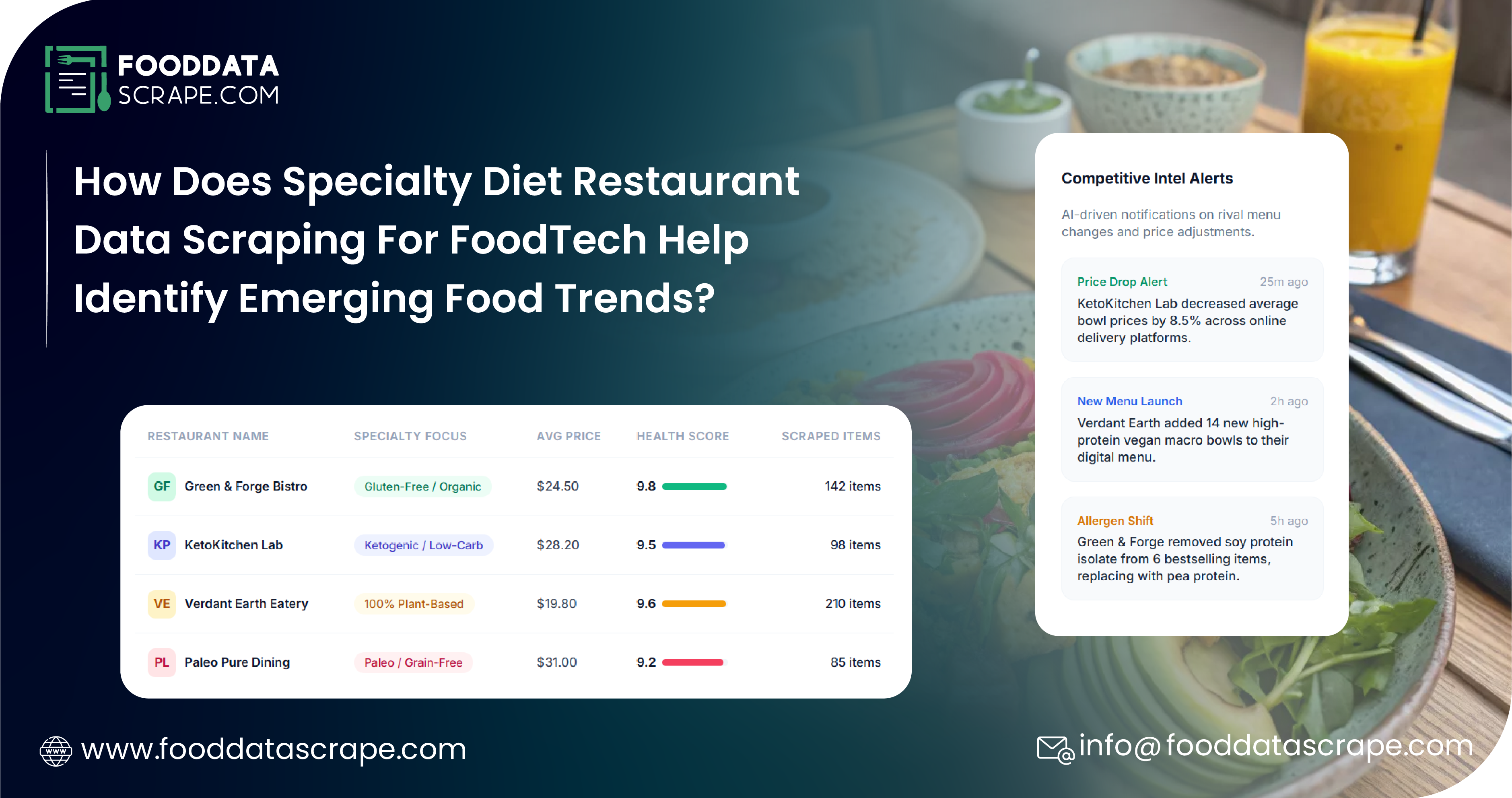
Restaurant Menu Data Scraping provides a broader foundation for analyzing specialty diets alongside conventional restaurant offerings.
Instead of isolating dietary products, businesses can compare specialty meals with the complete restaurant menu. This makes it possible to measure the share of a restaurant's menu dedicated to specific dietary categories.
A restaurant with 100 menu items and 30 vegan options has a very different positioning from one with 20 menu items and 15 vegan options. Both may be classified as vegan-friendly, but their strategic positioning and customer appeal can differ substantially.
Menu-level datasets can also identify:
- New dish launches
- Discontinued items
- Price changes
- Portion variations
- Combo meals
- Seasonal products
- Dietary substitutions
- Cuisine-specific trends
- Popular menu categories
This enables FoodTech businesses to continuously monitor the evolving restaurant ecosystem.
Mapping Specialty Diet Demand Across Locations
Location intelligence adds another valuable dimension to specialty restaurant analysis.
By organizing restaurants by city, postal code, neighborhood, or delivery zone, businesses can discover geographic gaps in specialty food availability.
Suppose one metropolitan area has a large concentration of vegetarian restaurants but limited gluten-free dining. Another region may show strong demand for high-protein meals but have relatively few restaurants offering them.
These gaps can help FoodTech platforms determine where new restaurant partnerships, cloud kitchens, meal services, or specialty food concepts could have the greatest opportunity.
Location-based analysis can also support hyperlocal recommendations. A consumer searching for vegan breakfast options could receive recommendations based on restaurants operating within the relevant delivery area rather than a broad city-wide listing.
Using Data for Personalized Food Recommendations
Personalization is becoming increasingly important across FoodTech platforms.
Specialty diet datasets can support recommendation models that consider dietary preferences, cuisine, price, location, nutrition, meal type, and historical customer behavior.
For instance, a user interested in high-protein vegetarian meals could receive recommendations ranked according to protein content, dietary suitability, distance, rating, and price.
Similarly, users looking for low-carb meals could be presented with dishes that match their preferred nutritional characteristics instead of manually reviewing hundreds of menu descriptions.
This improves discovery while giving FoodTech platforms additional opportunities to increase engagement and conversion.
Supporting Restaurant and Cloud Kitchen Strategies
Restaurant operators can also benefit from specialty diet intelligence.
Competitive datasets can reveal which dietary categories competitors are introducing, how much they charge, which cuisines are expanding into specialty meals, and which menu categories appear frequently across successful establishments.
Cloud kitchens can use these insights when developing new concepts. Instead of relying solely on assumptions, operators can study existing market supply and identify underserved dietary categories.
Menu developers can also benchmark portion sizes, pricing structures, meal combinations, and category diversity across comparable restaurants.
From Raw Data to Predictive Insights
The greatest value of specialty restaurant scraping comes when historical datasets are continuously updated and analyzed.
A single snapshot can describe the market today. A time-series dataset can show how that market is changing.
Tracking specialty menus over weeks and months can identify emerging dietary categories, recurring seasonal trends, price movements, new restaurant openings, menu expansion, and product discontinuation.
When these datasets are combined with restaurant reviews, delivery activity, geographic information, and consumer behavior, FoodTech businesses can move from descriptive analytics toward predictive decision-making.
How Food Data Scrape Can Help You?
1. Comprehensive Specialty Diet Data
Food Data Scrape can collect structured restaurant information covering vegan, vegetarian, keto, gluten-free, low-carb, high-protein, allergen-friendly, and other specialty dietary offerings across multiple locations.
2. Accurate Menu Intelligence
It can capture menu names, descriptions, ingredients, dietary labels, nutrition information, prices, categories, availability, and restaurant details, helping FoodTech businesses develop comprehensive specialty-diet databases.
3. Competitive Market Analysis
Collected data enables businesses to compare specialty menus, pricing, dietary categories, restaurant coverage, and product offerings, revealing competitive gaps and emerging opportunities within health-focused restaurant markets.
4. Personalized Food Discovery
Structured dietary datasets can support personalized recommendation platforms by helping users discover suitable restaurants and meals based on nutrition preferences, dietary requirements, location, cuisine, and budget.
5. Data-Driven FoodTech Decisions
Food Data Scrape supports dashboards, market intelligence, trend analysis, and forecasting by delivering regularly updated restaurant datasets that help businesses identify demand patterns and optimize strategic decisions.
Conclusion
Specialty restaurant data is becoming an important intelligence layer for the modern FoodTech ecosystem. From dietary menus and nutrition attributes to prices, locations, ratings, and availability, structured data helps businesses understand both consumer demand and competitive supply.
AI Restaurant Intelligence can turn continuously collected restaurant information into smarter recommendations, market analysis, competitive benchmarking, and menu insights.
With reliable Food Data Scraping Services, FoodTech companies can build scalable datasets that support restaurant discovery, nutrition applications, delivery intelligence, and strategic market research.
Finally, combining historical restaurant datasets with AI Demand Forecasting can help businesses anticipate dietary trends, identify emerging opportunities, optimize menus, and respond faster to changing consumer preferences. As health-focused dining continues to expand, high-quality specialty diet data can become a powerful foundation for smarter FoodTech products and more personalized dining experiences.
If you are seeking for a reliable data scraping services, Food Data Scrape is at your service. We hold prominence in Food Data Aggregator and Mobile Restaurant App Scraping with impeccable data analysis for strategic decision-making.
Get a Free Food Data Sample in 48 Hours.
Tell us your platforms, target markets and required fields — we'll map exactly what's possible with food data scraping, recommend the right approach, and send a working sample so you can verify quality before any commitment.