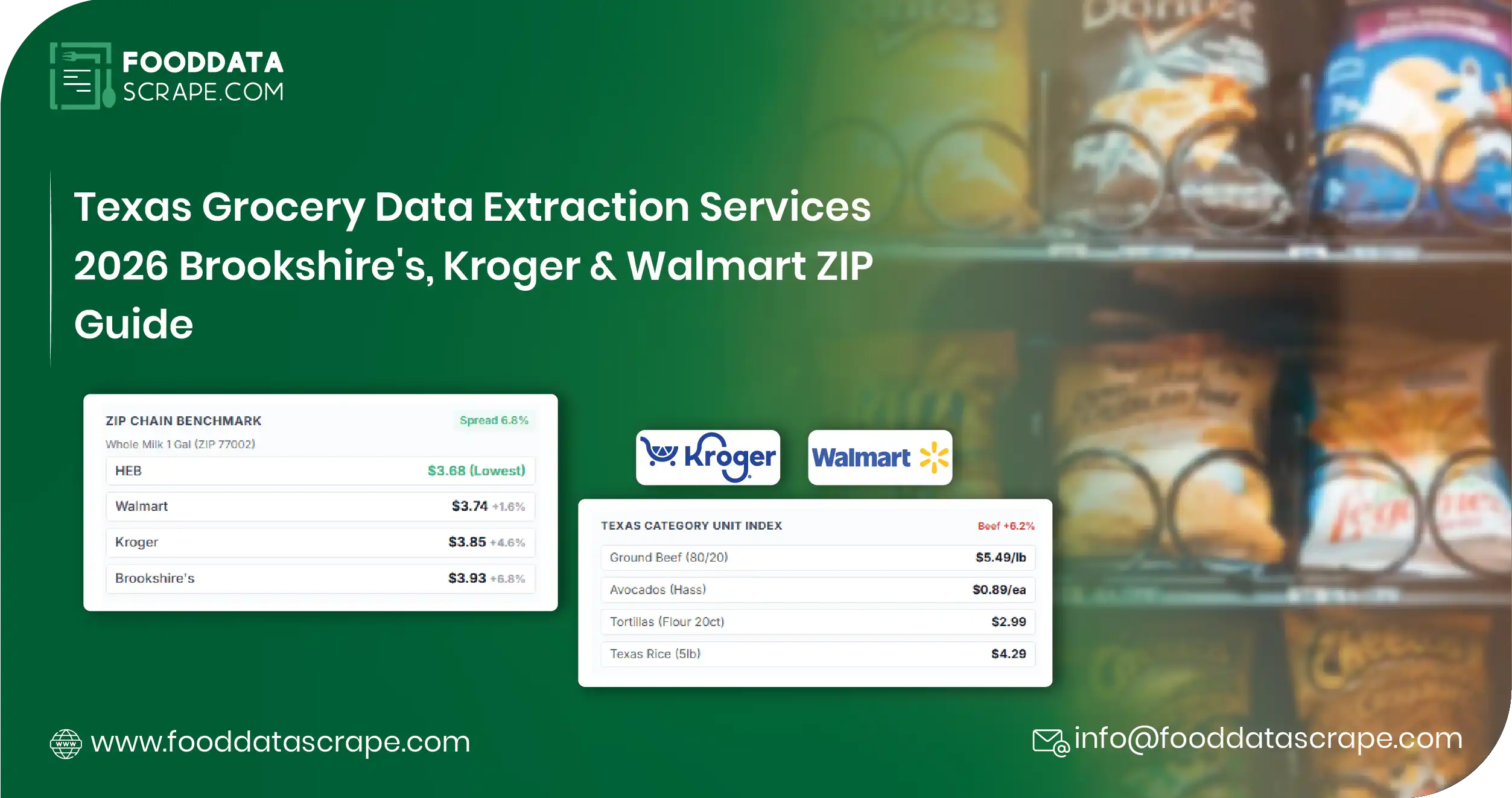
Introduction — Why Texas ZIP-Level Grocery Data Matters in 2026
The Texas grocery retail market is one of the most competitively fragmented in the United States — a market where a single Texas ZIP code might have a Brookshire's Grocery Company store, a Kroger, a Walmart Supercenter, an HEB (in Central and South Texas), a Tom Thumb, and multiple discount and specialty formats all serving overlapping catchments with meaningfully different pricing. For grocery app operators building consumer-facing price comparison tools, for FMCG brands managing category positioning across the state, and for regional chains benchmarking against national competitors, ZIP-level pricing granularity across every relevant Texas chain has become the operational baseline for competitive intelligence.
This is exactly the problem that a modern Texas Grocery Data Extraction Services pipeline solves. When Texas grocery e-commerce teams and category analysts deploy purpose-built Texas grocery data scraping services, they gain daily-refreshed, ZIP-level visibility across Brookshire's, Kroger, Walmart, and adjacent chains — enabling pricing decisions and consumer comparisons grounded in the actual per-ZIP competitive picture rather than statewide averages.
This guide breaks down how leading Texas grocery operators build ZIP-level pricing intelligence in 2026, with real sample data structures, use cases, and the specific pipeline architecture that powers Texas grocery programs at scale. Examples reference Longview and East Texas as representative regional cases, but the framework applies to Dallas-Fort Worth, Houston, San Antonio, Austin, and every Texas metro and regional market.
The 2026 Texas Grocery Landscape — What Changed
Three structural shifts have made ZIP-level grocery intelligence essential in Texas in 2026, and each one increases the value of a properly designed Brookshire's price data extraction and Kroger Texas grocery scraping pipeline.
1. Regional-chain resilience against national consolidation. Brookshire's Grocery Company (operating Brookshire's, Super 1 Foods, and Fresh by Brookshire's banners across East Texas, Louisiana, and Arkansas) has held meaningful market share against national chains through pricing discipline, community positioning, and category-mix advantages that require careful ZIP-level tracking to fully understand. Regional grocery chain data services covering Brookshire's alongside national competitors reveal competitive dynamics generic national platforms miss entirely.
2. Walmart's dominant Texas footprint requires per-ZIP pricing capture. Walmart operates 500+ Supercenter and Neighborhood Market formats across Texas — and Walmart Texas price monitoring at store-level rather than statewide-average level is essential because Walmart's Everyday Low Price positioning varies meaningfully by store based on local competitive intensity. Longview Walmart pricing on a given SKU may sit differently from Tyler Walmart pricing, and both may differ from Dallas Walmart pricing on the same day.
3. Grocery app consumer expectations require ZIP-anchored data. Consumer grocery apps that show shoppers "the cheapest place to buy" a basket of items require ZIP-level grocery price data US — statewide averages produce misleading recommendations because the actual store options within a shopper's 10-mile radius may not include the statewide cheapest option. A ZIP-anchored US grocery app data pipeline is the only way to produce accurate consumer-facing comparisons.
The Texas grocery operators winning in 2026 are those with the fastest, cleanest ZIP-level visibility into how their category is actually priced at the specific stores their target shoppers actually visit.
What Texas ZIP-Level Grocery Data Delivers
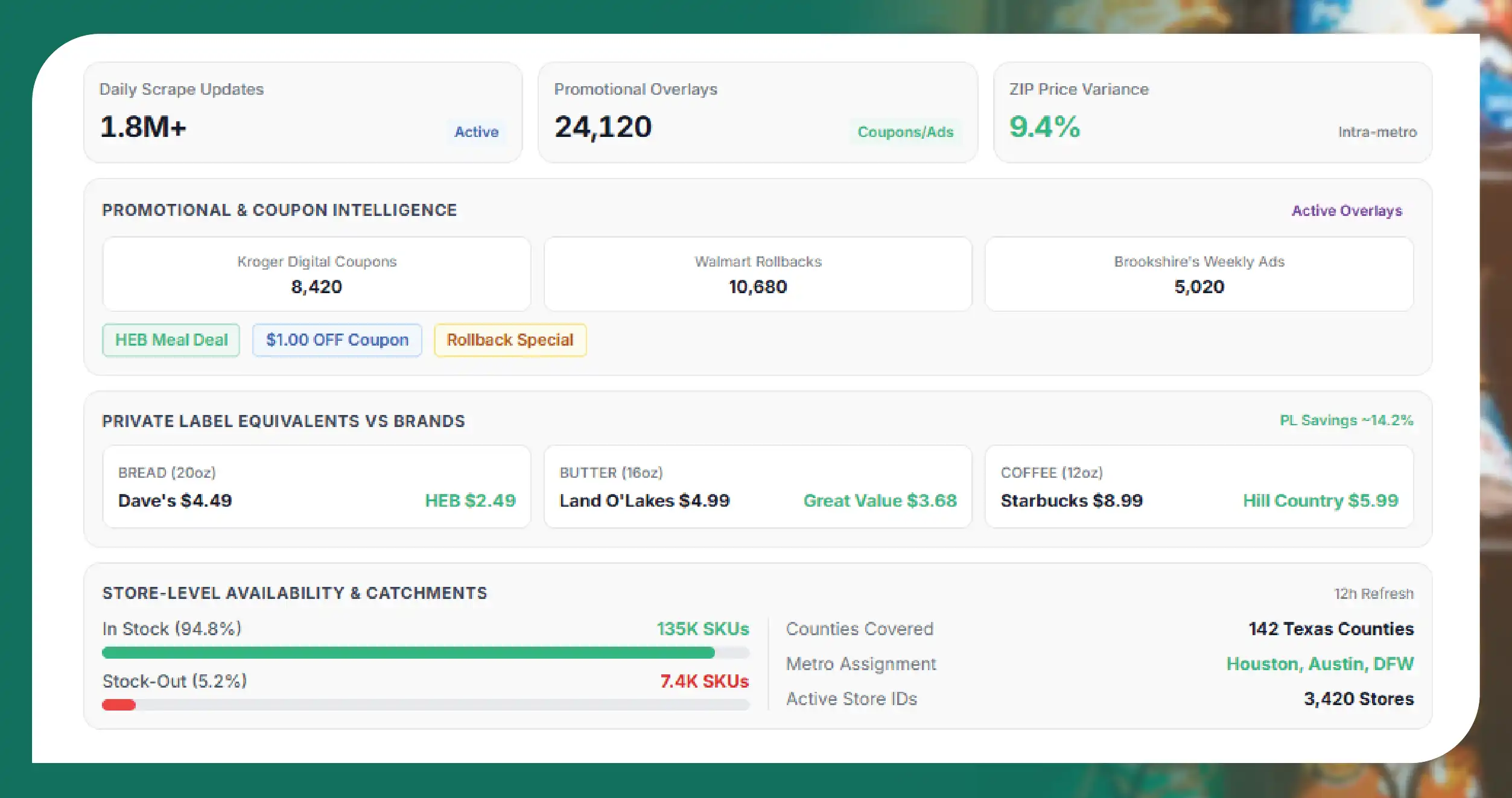
A modern Texas ZIP-anchored grocery data pipeline is a data infrastructure that continuously scrapes product listings, pricing, availability, and promotional overlays from every relevant Texas chain — anchored to specific store IDs and ZIP-code catchments rather than statewide roll-ups.
A well-designed US grocery e-commerce data scraping pipeline captures:
- Per-SKU shelf price in USD anchored to specific store IDs and ZIP codes
- Promotional overlays (Kroger Digital Coupons, Walmart Rollbacks, Brookshire's weekly ad specials)
- Availability and stock status per SKU per store
- Pack size, unit-price normalization, and multi-buy calculations
- Private-label equivalents (Kroger Brand, Great Value, Brookshire's Own)
- Category and subcategory tagging per chain's merchandising structure
- Store-level attribution with full address, ZIP, county, and metro assignment
- Daily or 12-hour refresh cadence based on category volatility
- Historical time-series for regional pricing pattern analysis
The output plugs directly into the operator's pricing dashboard, grocery app product, or category-review workflow — replacing statewide-average approximations with true per-ZIP competitive intelligence.
Sample Data — Real Longview Texas Grocery Snapshot
Below is a sample of the structured output a properly designed Texas grocery price comparison API produces for a grocery app monitoring 8 SKUs across three chains in Longview, Texas (ZIP codes 75601, 75602, 75604).
Sample 1 — ZIP-Level Cross-Chain Price Snapshot
| SKU | Brookshire's 75601 | Kroger 75601 | Walmart 75604 | Cheapest |
|---|---|---|---|---|
| Whole Milk 1 gal | $3.99 | $3.79 | $3.68 | Walmart |
| Large Eggs 12ct | $3.49 | $3.29 | $3.12 | Walmart |
| Wonder Bread 20oz | $2.98 | $2.79 | $2.68 | Walmart |
| Bananas 1 lb | $0.68 | $0.65 | $0.58 | Walmart |
| Kraft Mac & Cheese | $1.49 | $1.29 | $1.18 | Walmart |
| Charmin 12-roll | $14.99 | $13.99 | $12.98 | Walmart |
| Coca-Cola 12-pack | $8.99 | $7.99 (coupon) | $8.68 | Kroger |
| Chicken Breast 1 lb | $3.99 | $3.69 | $3.48 | Walmart |
The sample reveals the actual Longview competitive picture: Walmart is systematically the cheapest option across 7 of 8 SKUs in the 75604 ZIP, with gap percentages ranging from 8-21% below Brookshire's shelf pricing. Kroger sits in the middle on most SKUs and wins only on Coca-Cola thanks to a digital coupon overlay. Brookshire's is consistently the highest on published shelf price — a pattern the regional chain's category team needs to see clearly to inform their pricing strategy, promotional response, and positioning conversation with shoppers who now compare prices in real time on their phones.
Sample 2 — 4-Week ZIP-Level Trend Panel
| SKU (75601) | Wk 1 | Wk 2 | Wk 3 | Wk 4 |
|---|---|---|---|---|
| Whole Milk 1 gal | Walmart $3.68 | Walmart $3.68 | Walmart $3.72 | Walmart $3.72 |
| Large Eggs 12ct | Walmart $3.12 | Kroger $2.99 | Walmart $3.12 | Kroger $2.99 |
| Bananas 1 lb | Walmart $0.58 | Walmart $0.58 | Walmart $0.58 | Walmart $0.58 |
| Coca-Cola 12pk | Kroger $7.99 | Walmart $6.98 | Kroger $7.99 | Walmart $6.98 |
| Charmin 12-roll | Walmart $12.98 | Walmart $12.98 | Brookshire's $11.99 | Walmart $12.98 |
Four weeks of ZIP-anchored data reveals dynamics no statewide-average report captures: Bananas and Whole Milk stay stable-cheapest at Walmart; Large Eggs and Coca-Cola show alternating weekly winners as Kroger and Walmart rotate promotional programs; Brookshire's captured the cheapest-Charmin position for a single week during their weekly ad promotion. A grocery app showing consumers real-time recommendations needs exactly this alternating-winner visibility, and a Brookshire's category manager needs the Week 3 win-detection to measure whether their promotional program drove basket-shift or just discount-cannibalized existing loyal shoppers.
The Longview Texas Case — Regional Grocery Intelligence Entry Point
The Longview Texas pattern — a grocery app product team, category analyst, or regional retailer monitoring 20-100 SKUs across Brookshire's, Kroger, and Walmart in a specific East Texas metro — is a common entry point into Texas grocery intelligence deployment.
Longview and the broader East Texas market combine strong Brookshire's Grocery Company presence (headquartered in Tyler, Texas, 40 miles from Longview), Kroger Texas operations, Walmart Supercenter and Neighborhood Market coverage, and adjacent regional formats. A category analyst tracking 20-100 SKUs across this three-chain competitive set gets a clean, high-signal view of how ZIP-level grocery competition actually plays out — patterns that repeat with local variations across Dallas-Fort Worth (with the HEB Central Market and Tom Thumb additions), Houston (HEB, HEB Plus, Randalls), San Antonio (HEB dominance), Austin, and every regional Texas market.
The Longview Texas grocery intelligence patterns visible from ZIP-anchored tracking — Walmart's systematic price leadership, Kroger's digital-coupon-driven wins, Brookshire's promotional response cycles — appear across every Texas metro with local variations and inform how FMCG brands, category teams, and grocery apps should think about competitive positioning across the entire state.
How the Texas Grocery Data Pipeline Architecture Works
FoodDataScrape builds Texas grocery data pipelines on a five-layer architecture designed for the state's specific data challenges — pipelines built specifically for texas grocery price data zip level 2026 requirements at production scale.
Layer 1: Store and ZIP Mapping. For each engagement, the team maps every relevant Brookshire's, Kroger, Walmart, HEB, and specialty format store in the target metros or regions to specific store IDs and ZIP-code catchments. A Longview-focused engagement typically covers 20-40 stores across 3-5 chains and 5-10 ZIP codes.
Layer 2: Cross-Chain SKU Matching. The same product appears with different naming conventions, pack-size descriptions, and category placement across Brookshire's, Kroger, and Walmart. An AI SKU matching layer pairs equivalent SKUs across all monitored chains and links to their private-label equivalents (Kroger Brand ↔ Great Value ↔ Brookshire's Own) for like-for-like competitive comparison.
Layer 3: Continuous Daily Store-Level Scraping. Per-chain, per-store extractors pull shelf price, promotional overlays (Kroger Digital Coupons, Walmart Rollbacks, Brookshire's weekly ads), availability, and metadata daily across every mapped store and SKU. Data is normalized, deduplicated, and ZIP-anchored.
Layer 4: ZIP-Level Analytics Layer. Raw pricing data is transformed into per-ZIP decision-ready outputs — cheapest-per-SKU-per-ZIP calculations, chain-vs-chain gap trends, promotional cadence detection, private-label price-gap analysis. This is where raw Texas FMCG competitor tracking data becomes true regional intelligence.
Layer 5: Delivery and Integration. The platform delivers via REST API, CSV export, S3 delivery, or direct BI stack integration. Grocery apps integrate into consumer-facing products; category teams plug into pricing dashboards.
The build timeline from kickoff to production delivery is typically 4-6 weeks for a mid-scope engagement covering 20-40 stores across 3 chains in a Texas metro, including a free proof-of-concept sample delivered in the first week.
Why Texas Grocery Operators Choose ZIP-Level Data
FMCG brands, regional retailers, and grocery apps operating in Texas select ZIP-anchored Texas Grocery Data Extraction Services pipelines over statewide-average approximations for six specific reasons.
- Real store-level competitive picture. Statewide averages hide the actual store options within a shopper's radius. ZIP-level data reveals the true competitive set every shopper actually chooses from.
- Walmart store-level variance capture. Walmart's Everyday Low Price varies by store based on local competitive intensity. Store-level scraping captures this variance; statewide reports flatten it.
- Kroger digital-coupon detection. Kroger's digital coupon overlays vary by store and shopper segment. Purpose-built scraping captures the effective per-store price including active coupons.
- Brookshire's regional positioning visibility. Regional chains like Brookshire's require regional-scope data to properly benchmark — national platforms often exclude them entirely.
- HEB Texas competitor data extension. Central and South Texas engagements benefit from HEB Texas competitor data extension covering HEB, HEB Plus, and Central Market formats.
- Compliance-aware US grocery sourcing. Data sourcing operates within US retail data compliance frameworks — purpose-built compliance-aware sourcing delivers only compliantly-collected retail price data.
Sample Use Cases — How Texas Operators Actually Use the Data
Use Case 1: Consumer Grocery App Price Comparison. A Texas-based grocery comparison app integrates continuous ZIP-anchored data into its consumer product — showing shoppers the actual cheapest place to buy their basket at the specific stores within 5 miles of their address.
Use Case 2: Regional Retailer Competitive Response. A Brookshire's category manager reviews per-ZIP competitive positioning weekly to inform pricing decisions, promotional programs, and category strategy against Kroger and Walmart at store-level rather than corporate-average level.
Use Case 3: FMCG Brand Market Coverage Analysis. A branded FMCG manufacturer analyzes per-ZIP retail presence, pricing, and promotional support across Texas to identify gaps in distribution, pricing corridor violations, and trade-spend effectiveness across the state.
Use Case 4: Investment Analyst Regional Retail Coverage. An investment analyst covering US regional grocery chains uses continuous ZIP-level data to model competitive dynamics between regional operators (Brookshire's, HEB) and national chains (Kroger, Walmart) across Texas markets.
Use Case 5: Real Estate and Site Selection. A grocery real estate team using continuous Texas grocery category analytics evaluates potential new-store sites with per-ZIP competitive pricing intelligence to inform site selection, format decisions, and pricing strategy for candidate locations before committing to leases.
Getting Started — The 5-Week Roadmap
Getting a Texas Grocery Data Extraction Services engagement live with FoodDataScrape follows a structured process designed to minimize risk and prove value before scope expansion.
Week 1: Scoping and proof-of-concept. The client defines the SKU list, chains, target ZIP codes, refresh cadence, and delivery format. A free proof-of-concept sample is delivered within 5 business days.
Weeks 2-4: Production build. Chain-specific and store-specific extractors are configured, SKU matching is tuned, analytics layer is calibrated, and API integration is tested.
Week 5: Live production delivery. The pipeline goes live with daily ZIP-anchored data delivery.
Ongoing: Refinement and expansion. Additional Texas metros, chains, and SKUs are added as needs evolve.
Conclusion — ZIP-Level Texas Grocery Data Is the 2026 Standard
The Texas grocery market in 2026 has become too regionally varied, too promotionally intensive, and too store-level for statewide-average data to serve as reliable pricing intelligence. Operators without ZIP-anchored continuous data are structurally disadvantaged against those that have moved to purpose-built store-level pipelines.
The Longview 8-SKU pattern is the entry point. Most Texas grocery brands, category teams, and app operators expand within 6-12 months to 500-2,000 SKUs across multiple Texas metros and 4-6 chains once they see the operational lift from continuous ZIP-level visibility.
FoodDataScrape builds the pipelines that deliver this intelligence — covering Brookshire's Grocery Company, Kroger Texas operations, Walmart Texas footprint, HEB, and specialty formats with daily refresh, store-level scraping, and dedicated regional-analytics support.
If you are a Texas FMCG brand, a regional retailer, a consumer grocery app, or a category analyst — ZIP-level continuous data is the fastest path to closing the visibility gap in the 2026 Texas grocery market.
Ready to See Sample Data for Your Texas ZIPs? Tell us your target ZIP codes, chains, and SKUs. Get a free proof-of-concept sample of the ZIP-anchored Texas grocery pricing intelligence output on your actual scope within 5 business days — no commitment required.
Contact FoodDataScrape today for ZIP-level Texas grocery intelligence that turns regional pricing complexity into a commercial advantage.
Related Case Studies
- 🇺🇸 USA Grocery Delivery 30-Min — Grocery brand — 48hr to 30min price-match lag.
- 🇺🇸 USA QSR Site Selection — QSR chain — 300 locations screened, 42 approved.
- Price Benchmarking Tool 2026 — Global FMCG pricing intelligence guide.
Questions
Frequently Asked Questions
A well-designed pipeline delivers per-SKU per-store per-ZIP pricing, promotional overlays, availability, unit-price normalization, private-label equivalents, category tagging, and historical time-series across Brookshire's, Kroger, Walmart, HEB, and specialty formats operating in target ZIPs.
Brookshire's Grocery Company (Brookshire's, Super 1 Foods, Fresh by Brookshire's), Kroger Texas, Walmart Texas (Supercenter and Neighborhood Market), HEB Texas competitor data (HEB, HEB Plus, Central Market), Tom Thumb, Sprouts, Whole Foods Market, and independent regional chains as required.
Every scraped SKU is anchored to a specific store ID; each store is mapped to its ZIP code, city, county, and metro area. Consumers or operators can then query by ZIP to see the actual competitive set within their catchment.
Yes — Kroger's digital coupon overlays are captured as promotional flags on affected SKUs, with the effective post-coupon price calculated alongside the standard shelf price.
Yes — the ZIP-anchored data structure is specifically designed to power consumer-facing grocery apps that show shoppers real-time cheapest-per-SKU comparisons based on their actual location.
Yes — sourcing operates within US retail data compliance frameworks and only compliantly-collected retail price data is delivered.
Get a Free Food Data Sample in 48 Hours.
Tell us your platforms, target markets and required fields — we'll map exactly what's possible with food data scraping, recommend the right approach, and send a working sample so you can verify quality before any commitment.
Request a strategy call
Thanks — our data team will reach out within 48 hours with your sample.