
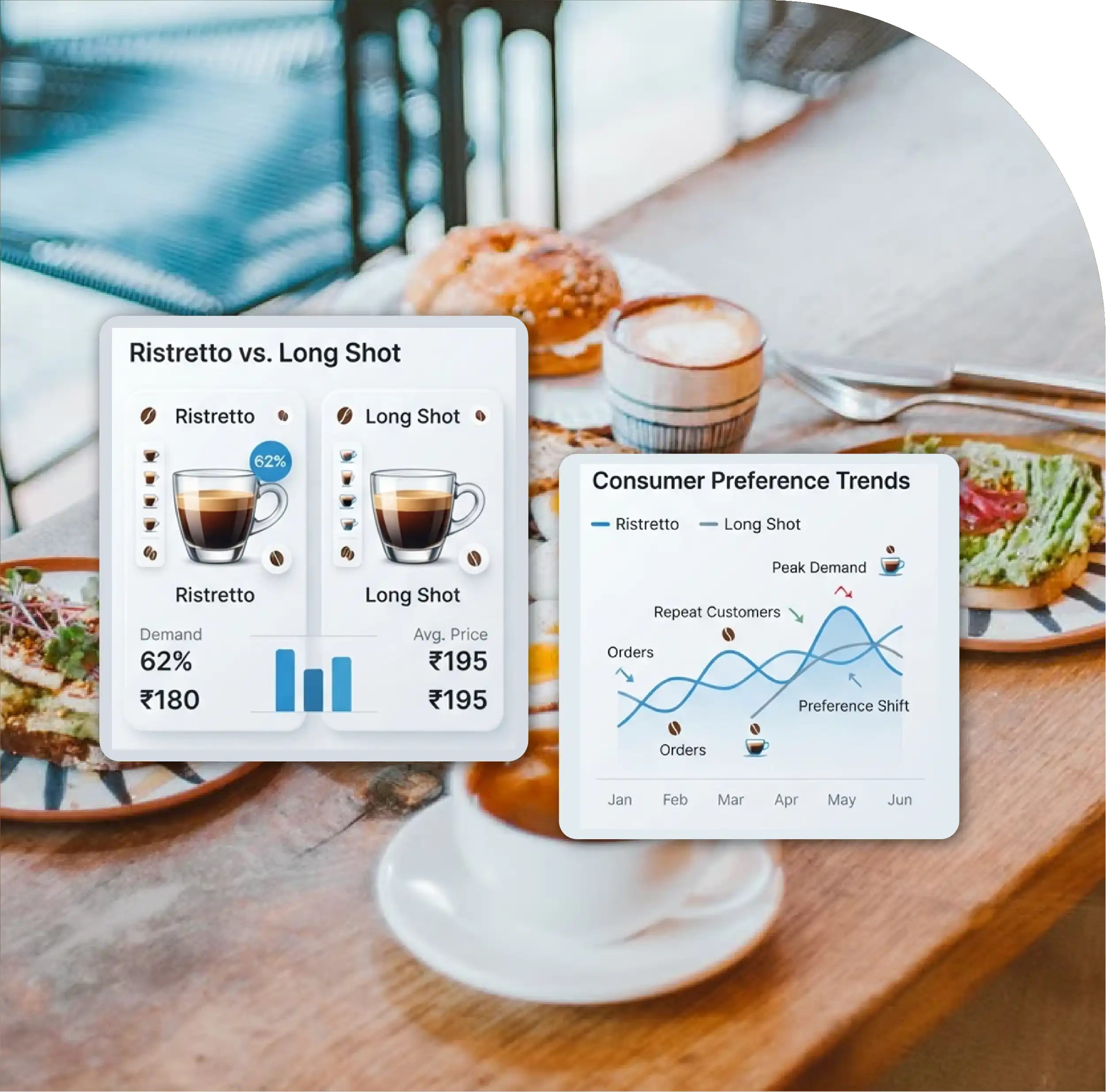
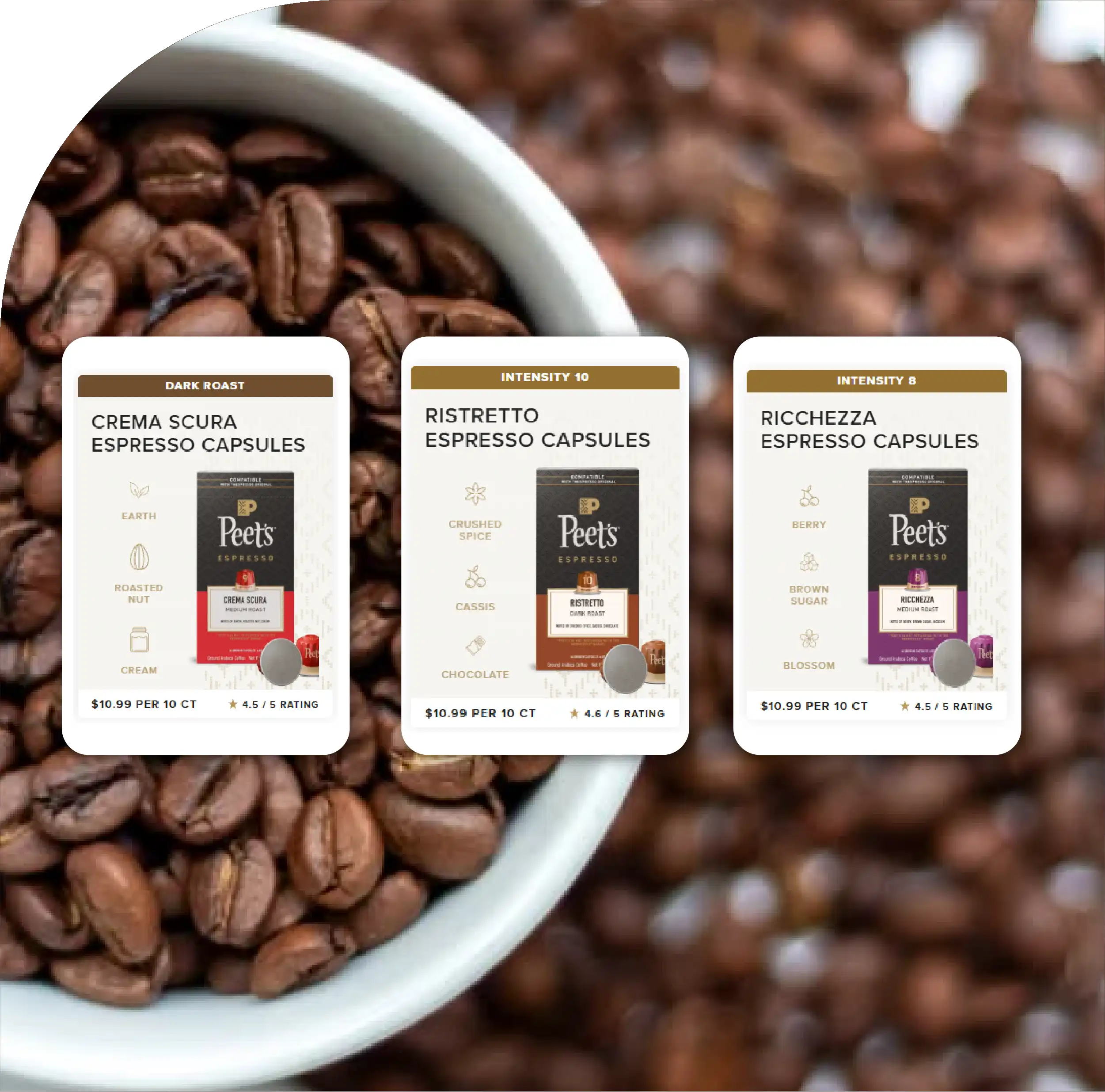
Ristretto vs. Long Shot Demand: Compare consumer interest in shorter, concentrated espresso and longer extraction styles across digital café menus.
Consumer Preference Intelligence: Analyze reviews, ratings, flavor descriptions, and sentiment to understand what customers value in each preparation.
Coffee Pricing Benchmarking: Track competitor prices, promotions, availability, and premium positioning across cafés, cities, and market segments.
Emerging Trend Detection: Monitor menu penetration and product introductions to identify growing specialty coffee preferences and emerging beverage trends.
Market Forecasting & Expansion: Combine real-time and historical coffee data to identify geographic opportunities, forecast demand, and support strategic decisions.

Coffee consumption is becoming increasingly sophisticated. Consumers are no longer choosing between simply coffee and tea; they are exploring roast profiles, origins, extraction methods, serving styles, flavor notes, and customized preparation techniques. This makes Tracking Consumer Demand increasingly important for coffee brands, café operators, roasters, and food-service businesses seeking to understand what customers actually want.
One particularly interesting area is the growing differentiation between ristretto and long-shot espresso. Both are variations of espresso preparation, but they deliver noticeably different experiences. A ristretto uses a shorter extraction and smaller liquid yield, while a long shot, commonly known as a lungo, allows more water to pass through the coffee grounds. These differences influence concentration, flavor, body, serving size, and potentially how consumers perceive value.
For businesses researching this category, ristretto vs long shot consumer demand scraping can provide a practical way to monitor how these products appear across digital menus, restaurant platforms, café websites, reviews, and online ordering channels. When these datasets are organized through a food consumer intelligence platform, businesses can move beyond assumptions and identify measurable changes in consumer interest.
Ristretto and long shot are not simply two names for different cup sizes. They represent different points on the espresso extraction spectrum.
A ristretto is a shorter extraction that produces less liquid from the same coffee dose. It is generally more concentrated and can have a dense, syrupy character. A lungo, or long shot, extends the extraction and produces a larger beverage. The exact recipe varies by café, coffee, machine, and barista, so there is no single universal ratio that defines every commercial preparation.
This distinction is commercially important because consumers interpret coffee characteristics differently.
Some customers may prefer the concentrated experience associated with ristretto, particularly when exploring specialty coffee. Others may prefer a longer espresso because they want greater volume and a more extended drinking experience.
The specialty coffee market provides a strong reason to monitor these micro-preferences. The National Coffee Association's 2026 Specialty Coffee Report found that 47% of American adults consumed specialty coffee in the past day, compared with 42% for traditional coffee. It also reported particularly strong specialty consumption among younger adults.
As specialty coffee becomes more mainstream, preparation details that were once niche can become valuable consumer-demand indicators.
The key to analyzing ristretto and long-shot demand is recognizing that consumers may not be purchasing the same experience.
Ristretto generally delivers a smaller and more concentrated beverage. Because extraction stops earlier, the resulting drink can emphasize intensity, body, sweetness, and distinctive aromatic characteristics. However, taste outcomes depend heavily on the coffee and brewing recipe, so it would be inaccurate to assume that every ristretto will automatically taste sweeter or less bitter.
A long shot extends the extraction and increases the beverage yield. This creates a larger drink with a different balance of extracted compounds and can produce a more pronounced bitter or dry character when pushed too far.
This creates two potentially different consumer profiles.
A specialty-focused customer may be interested in the intensity and flavor complexity associated with a shorter extraction. Another customer may prioritize volume, familiarity, or a longer drinking experience.
For coffee businesses, recognizing these differences can improve menu development and product positioning.
Traditional coffee research often depends on surveys and sales reports. These are valuable, but digital sources can provide additional behavioral signals.
Café websites, online menus, restaurant marketplaces, delivery platforms, coffee reviews, product pages, and search results can reveal how frequently particular preparations appear and how customers respond to them.
Businesses can scrape consumer demand data for coffee brands by collecting information such as product names, preparation methods, menu descriptions, prices, availability, ratings, reviews, locations, and promotional activity.
The objective is not simply to count how many ristretto or long-shot products exist. The real value comes from comparing these signals over time.
For example, if the number of cafés offering ristretto increases consistently within specialty coffee markets, that could indicate growing menu experimentation or consumer interest. If long-shot products remain more prevalent across mainstream cafés, they may represent broader familiarity.
Neither observation alone proves consumer demand. However, combined with review volume, ratings, pricing, availability, and other behavioral indicators, the data becomes much more useful.
One of the strongest applications of automated data collection is trend monitoring.
Businesses can scrape ristretto vs long shot trends across multiple markets and compare how frequently each preparation appears on café menus.
Imagine a dataset tracking 1,000 cafés every month. Analysts could measure:
This turns an isolated menu item into a measurable market indicator.
More importantly, the dataset can reveal direction.
If ristretto listings increase steadily over six months while long-shot listings remain relatively stable, a company may investigate whether specialty coffee positioning is expanding. Conversely, if long shots dominate across multiple regions, they may represent a more established consumer preference.
The important point is that demand should be measured as a trend rather than inferred from a single observation.
Menu data tells businesses what cafés are offering. Reviews can reveal why customers like or dislike those products.
This is where ristretto consumer demand data scraping becomes particularly valuable.
Review text can be analyzed for recurring descriptions such as intense, smooth, rich, bitter, acidic, aromatic, concentrated, balanced, strong, or mild.
Suppose thousands of reviews show that customers repeatedly praise ristretto for its aroma and concentrated flavor but complain about its small serving size. That creates a more useful insight than simply knowing that ristretto appears frequently on menus.
The business can respond by adjusting communication and positioning.
A café might explain the smaller serving as part of the intended espresso experience. A roaster could emphasize flavor concentration. A coffee brand could experiment with complementary beverages that use ristretto as a base.
Similarly, long-shot reviews can reveal whether customers value its larger volume, stronger finish, or longer drinking experience.
This combination of product data and sentiment analysis helps businesses understand consumer motivations rather than merely measuring product availability.
Businesses can also scrape long shot consumer demand data to determine where this preparation performs best.
A useful analysis could compare long-shot availability across specialty cafés, independent coffee shops, restaurant chains, and premium hotel cafés.
Geographic differences can be particularly revealing.
One city might have a strong concentration of specialty cafés offering shorter extraction styles, while another market may show greater demand for longer espresso beverages. Differences could also appear between premium and mainstream establishments.
Price analysis adds another layer.
If long shots are generally priced close to standard espresso, customers may perceive them as a familiar variation rather than a premium specialty product. If ristretto consistently commands a higher price in certain markets, researchers can investigate whether that premium is connected with specialty beans, preparation expertise, or brand positioning.
Pricing is one of the most important dimensions of consumer-demand analysis.
A coffee brand can monitor competitor pricing across locations and determine how preparation style influences the final menu price.
For example, a specialty café may position ristretto as a premium espresso experience, while another café may offer it as a simple customization at no additional cost.
These differences provide important competitive signals.
A pricing dataset can identify average prices, minimum and maximum prices, discounts, bundles, and price differences between competing establishments.
When tracked over time, these observations can also reveal inflation and premiumization.
If specialty coffee prices rise while ratings and review volumes remain strong, businesses may have evidence that customers continue to perceive value in premium offerings.
Consumer preferences are rarely identical across every market.
Coffee brands operating internationally need to understand local preferences rather than assuming that one product strategy will work everywhere.
Geographic demand analysis can compare cities, regions, and countries based on menu penetration, prices, ratings, review activity, and product availability.
For example, a coffee company could discover that ristretto has significantly greater visibility within specialty-focused urban markets, while long shots are more common across broader café categories.
This information can influence expansion decisions.
Instead of launching the same espresso portfolio everywhere, brands can prioritize products according to observed local behavior.
Geographic data can also help identify underserved markets where relatively few cafés offer a particular preparation despite strong consumer interest in specialty coffee.
Collecting data using Coffee & Beverage Data Scraping is only the first stage. The greater opportunity comes from transforming historical observations into forecasting models.
A coffee intelligence system can track changes in menu frequency, pricing, reviews, ratings, and consumer sentiment over weeks or months.
Analysts can then identify patterns such as:
Growing Demand: Increasing product visibility, review activity, and consumer engagement.
Stable Demand: Consistent availability and customer interest over time.
Emerging Demand: Rapid growth from a relatively small starting point.
Declining Demand: Falling menu presence, reduced availability, or weakening consumer engagement.
These signals can help businesses plan product launches, promotional campaigns, inventory, and market expansion.
The same framework can also be extended beyond ristretto and long shot to espresso, cold brew, flat white, cortado, specialty lattes, seasonal beverages, and emerging coffee formats.
The specialty coffee market is changing quickly. The 2026 NCDT Specialty Coffee Report specifically highlights consumer preferences, preparation methods, flavor preferences, and competitive beverage behavior as important areas for understanding specialty coffee consumption.
At the same time, premium coffee is attracting increased commercial attention, with specialty cafes expanding and consumer interest in premium coffee experiences continuing to influence the market.
This environment makes continuously refreshed market data increasingly valuable.
A quarterly report may show what happened three months ago. A continuously updated dataset can help businesses see what is changing now.
That difference can matter when companies are deciding which products to promote, which markets to enter, and which consumer segments to target.
Coffee companies can apply these insights across the entire product lifecycle.
During product development, demand data can identify popular preparation styles and flavor preferences. During pricing, competitor datasets can reveal how much customers are being charged for similar products. During marketing, review analysis can identify the language consumers naturally use when describing their favorite coffee experiences. During expansion, geographic intelligence can highlight markets where specialty coffee demand appears strongest. During competitive monitoring, automated data collection can identify new products, changing prices, disappearing menu items, and emerging preparation trends.
The result is a more responsive coffee strategy built around observed market behavior rather than assumptions.
1. Track Coffee Consumer Preferences
Collect menu, pricing, ratings, reviews, and availability data to identify whether consumers increasingly prefer ristretto, long shots, espresso variations, or emerging specialty coffee beverages.
2. Monitor Competitor Coffee Strategies
Analyze competing cafes, coffee chains, and online menus to compare product offerings, prices, promotions, preparation styles, and positioning across different cities and consumer segments.
3. Identify Emerging Coffee Trends
Continuously monitor digital menus, reviews, and product launches to detect growing interest in specialty preparations, flavor profiles, serving formats, seasonal beverages, and premium coffee experiences.
4. Improve Pricing and Menu Decisions
Use structured food intelligence to benchmark coffee prices, identify profitable product opportunities, evaluate consumer responses, and optimize menus according to competitive market conditions and demand signals.
5. Support Market Forecasting and Expansion
Combine historical and real-time coffee data to identify geographic opportunities, forecast consumer demand, evaluate market potential, and support strategic expansion into promising regions and segments.
Ristretto and long shot may appear to be small variations within the enormous coffee category, but they demonstrate how detailed consumer data can reveal meaningful changes in market behavior. Their differences in extraction, volume, concentration, and sensory experience create distinct opportunities for brands seeking to understand increasingly sophisticated coffee consumers.
The most effective approach combines menu monitoring, pricing intelligence, review analysis, geographic comparisons, and historical trend tracking. Together, these datasets provide a deeper picture of what consumers are ordering, what they value, and how their preferences are changing.
For businesses seeking deeper specialty coffee intelligence, Extract Specialty Coffee Trends Data to support analysis of emerging beverages, preparation styles, pricing patterns, and consumer preferences.
Expanding the same methodology across restaurants and food categories, Scrape Food Data to help businesses build broader food-market intelligence and competitive datasets.
Ultimately, businesses can Scrape Global Coffee Trends for Market Forecasting to monitor international preferences, identify emerging opportunities, benchmark competitors, and build more informed strategies for the evolving global coffee market.
If you are seeking for a reliable data scraping services, Food Data Scrape is at your service. We hold prominence in Food Data Aggregator and Mobile Restaurant App Scraping with impeccable data analysis for strategic decision-making.