Introduction — Why UAE Quick Commerce Pricing Intelligence Matters in 2026
The UAE quick commerce market is one of the most sophisticated 10-minute delivery ecosystems globally — with Talabat (mart), Noon (Now / Minutes), Careem Now, InstaShop, and specialty players competing for the same 10-15 minute delivery slot across every Dubai and Abu Dhabi neighborhood. For MENA digital commerce teams, FMCG brands managing UAE category positioning, and Q-Com operators benchmarking against the market, continuous visibility into per-SKU pricing, promotional overlays, and category dynamics across Talabat, Noon, and Careem Now has moved from a research luxury to an operational requirement.
This is exactly the problem that a modern UAE Quick Commerce Price Intelligence API solves. When MENA digital commerce teams and category managers deploy purpose-built Talabat data scraping services, they gain continuous visibility across every major UAE quick commerce platform — informing pricing decisions, promotional strategy, and category positioning grounded in daily market reality rather than quarterly panel data.
This guide breaks down how leading UAE FMCG brands, Q-Com operators, and pharmaceutical brands build MENA quick commerce data pipeline capability in 2026, with real sample data structures, use cases, and the specific pipeline architecture. Examples reference Dubai and Abu Dhabi as representative UAE metros, with framework extension to KSA and broader GCC.
The 2026 UAE Q-Commerce Landscape — What Changed
Three structural shifts have made continuous UAE Q-Com pricing intelligence essential in 2026, and each one increases the value of a properly designed Noon Grocery price monitoring pipeline.
1. Consolidation has intensified pricing competition. Talabat, Noon, and Careem Now now compete head-to-head on identical category coverage — packaged grocery, fresh produce, dairy, personal care, pharmacy adjacent categories, and household. UAE q-commerce competitor tracking across all three platforms simultaneously has become baseline for any brand or operator.
2. Promotional intensity has become the primary competitive lever. Consumer-facing promotions on UAE Q-Com platforms shift daily — a 25% discount on a leading dairy SKU at Talabat on Monday can move to Noon by Wednesday and Careem Now by Friday. Continuous Careem Now data extraction is the only way to see this fast-cycle promotional rotation.
3. Category-specific pricing corridors have professionalized. UAE 10-minute delivery pricing operates within tight per-category corridors informed by regulatory pricing on essentials, retailer positioning, and platform-specific consumer segment focus. Talabat Noon Careem price comparison across categories reveals patterns single-platform tracking misses.
The UAE quick commerce operators winning in 2026 are those with the fastest, cleanest cross-platform visibility into how their category is actually priced across every major UAE Q-Com touchpoint.
What UAE Quick Commerce Data Delivers
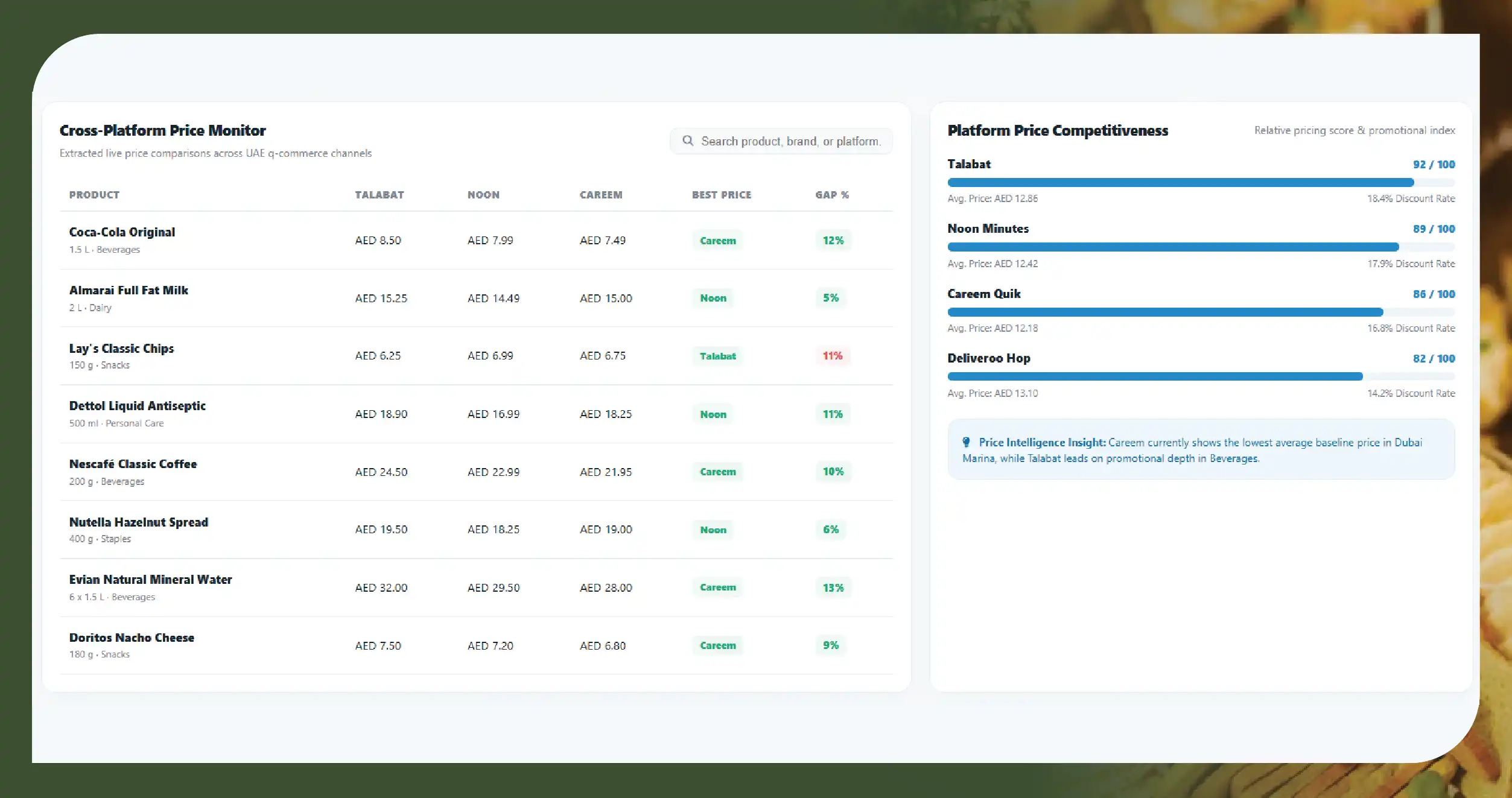
A modern UAE Quick Commerce Price Intelligence API pipeline is a data infrastructure that continuously scrapes product listings, pricing, availability, delivery signals, and promotional overlays from every major UAE Q-Com platform — delivering structured, decision-ready output to the operator's pricing, category, or commercial team.
A well-designed Dubai grocery delivery data pipeline captures:
- Per-SKU shelf price in AED across Talabat, Noon Grocery, Careem Now, and InstaShop
- Promotional overlays (platform discounts, membership prices, category promotions)
- Availability and delivery-time signals per Dubai/Abu Dhabi neighborhood
- Pack size and unit-price normalization
- Category tagging aligned to each platform's merchandising structure
- Neighborhood-level and Emirate-level attribution
- Daily or intraday refresh cadence based on category volatility
- Historical time-series for promotional pattern analysis
- Private-label and imported-brand differentiation
The output plugs directly into the operator's commercial dashboard or category-review workflow — replacing manual competitor audits with continuous UAE FMCG category pricing data.
Sample Data — Real Dubai Q-Commerce Snapshot
Below is a sample of the structured output a properly designed GCC quick commerce intelligence pipeline produces for a UAE FMCG brand tracking 8 SKUs across three major UAE Q-Com platforms in Dubai (Downtown Dubai delivery zone).
Sample 1 — Dubai Multi-Platform UAE Q-Com Snapshot
| SKU | Category | Talabat (AED) | Noon (AED) | Careem Now (AED) | Cheapest | Gap % |
|---|---|---|---|---|---|---|
| Al Marai Fresh Milk 2L | Dairy | 12.50 | 11.90 | 12.75 | Noon | -6.7% vs Careem |
| Almarai Laban 2L | Dairy | 9.50 | 9.25 | 9.75 | Noon | -5.1% vs Careem |
| Al Ain Water 500ml x24 | Beverages | 19.50 | 18.75 | 19.90 | Noon | -5.8% vs Careem |
| Chiquita Bananas 1kg | Produce | 8.90 | 7.95 (25% off) | 8.75 | Noon | -9.1% vs Talabat |
| Nadec Long Life Milk 1L | Dairy | 6.50 | 6.50 | 6.75 | Even | Marginal |
| Lurpak Butter 200g | Dairy | 24.50 | 21.90 (promo) | 24.75 | Noon | -10.6% vs Careem |
| Nescafe Gold 200g | Beverages | 42.50 | 42.50 | 44.90 | Even | Careem premium |
| Kellogg's Corn Flakes 500g | Cereal | 22.50 | 19.90 (promo) | 22.90 | Noon | -11.6% vs Careem |
The sample reveals immediate signals for the FMCG brand's category team: Noon is systematically running promotional pricing on premium branded SKUs (Bananas at 25% off, Lurpak butter promo, Corn Flakes promo) while Talabat and Careem Now hold shelf pricing. The brand's Dubai category manager reading this snapshot immediately understands that Noon is executing an aggressive promotional strategy this week — potentially co-funded by the brand's own trade spend allocation, but potentially platform-absorbed. The 10-11% gaps against Careem Now on promoted SKUs signal a market-share push worth watching closely.
Sample 2 — 4-Week UAE Q-Com Promotional Cadence Panel
| SKU | Wk 1 Cheapest | Wk 2 | Wk 3 | Wk 4 | Pattern |
|---|---|---|---|---|---|
| Lurpak Butter 200g | Noon 21.90 | Talabat 22.50 | Careem 22.75 | Noon 21.90 | Noon bi-weekly |
| Chiquita Bananas 1kg | Noon 7.95 | Talabat 7.50 | Noon 7.95 | Talabat 7.50 | Alternating winners |
| Kellogg's Corn Flakes | Noon 19.90 | Careem 19.50 | Noon 19.90 | Talabat 20.90 | 3-way rotation |
| Al Marai Fresh Milk 2L | Noon 11.90 | Noon 11.90 | Talabat 11.50 | Noon 11.90 | Noon dominance |
| Nescafe Gold 200g | All 42.50 | Talabat 39.90 | All 42.50 | Careem 39.90 | Coordinated promo |
Four weeks reveals distinct competitive patterns: Noon runs bi-weekly promotions on premium branded SKUs; Bananas show alternating price-lead rotation between Talabat and Noon; Corn Flakes rotate across all three platforms weekly; Nescafe Gold shows coordinated month-long shelf holding with occasional single-platform promotional spikes. A UAE category manager reading this snapshot can align brand-deal participation to each platform's actual cadence rather than assuming UAE Q-Com operates uniformly.
The MENA Digital Commerce Case — Regional Category Intelligence
The MENA digital commerce pattern — an FMCG brand or Q-Com operator monitoring 100-500 SKUs across Talabat, Noon, and Careem Now in Dubai, Abu Dhabi, and Sharjah, with framework extension to Riyadh and Jeddah — is a common entry point into MENA quick commerce intelligence deployment.
The UAE Q-Com market combines regulatory context (VAT, essential-goods pricing rules), competitive intensity (three well-funded platforms plus specialty entrants), and consumer behavior (10-minute expectations, membership loyalty models) that require careful daily tracking to fully understand. A category manager tracking 100-500 SKUs across this landscape needs continuous pricing, promotional, and availability visibility to inform every category-team decision.
The UAE Q-Com patterns visible in Dubai — Noon promotional dominance, Talabat's balanced position, Careem Now's premium-lean — appear with local variations across Abu Dhabi, Sharjah, and increasingly across KSA (Riyadh, Jeddah) as GCC operators expand.
How the UAE Q-Com Data Pipeline Architecture Works
FoodDataScrape builds UAE Q-Com pipelines on a five-layer architecture designed for the region's specific data challenges — pipelines built for uae quick commerce pricing strategy 2026 requirements.
Layer 1: Platform and Zone Mapping. For each engagement, the team defines platforms (Talabat, Noon Grocery, Careem Now, InstaShop) and delivery zones (Downtown Dubai, Marina, Business Bay, JLT, Abu Dhabi zones) to monitor.
Layer 2: Cross-Platform SKU Matching. UAE Q-Com SKUs appear with minor naming variations across platforms. An AI matching layer pairs equivalent SKUs across Talabat, Noon, and Careem Now, with private-label detection where applicable.
Layer 3: Continuous Daily Multi-Platform Scraping. Per-platform extractors pull shelf price, promotional overlays, availability, delivery time, and metadata daily. Data is normalized into AED with unit-price standardization.
Layer 4: UAE-Specific Analytics Layer. Raw pricing data is transformed into decision-ready outputs — per-SKU platform-vs-platform gap calculations, per-category promotional cadence, effective-price detection. This is where raw Abu Dhabi grocery data scraping becomes true category intelligence.
Layer 5: Delivery and Integration. REST API, CSV, S3, or direct BI stack integration (Power BI, Tableau, Snowflake).
Build timeline is typically 5-7 weeks for a mid-scope engagement covering 500-2,000 SKUs across 3 platforms and 5+ Dubai/Abu Dhabi delivery zones.
Why UAE Q-Com Operators Choose Continuous Multi-Platform Data
UAE FMCG brands, Q-Com operators, and category teams select continuous UAE Quick Commerce Price Intelligence API pipelines over manual audits for six specific reasons.
- Multi-platform coverage in one feed. Talabat + Noon + Careem Now + InstaShop simultaneously with consistent schema.
- Neighborhood-level zone accuracy. UAE Q-Com pricing varies by delivery zone; a zone-anchored pipeline captures this granularity.
- AED unit-price normalization. UAE regulatory context requires unit-price accuracy; purpose-built layers deliver this.
- Promotional cadence detection. UAE Q-Com promotional rhythms become visible with continuous tracking.
- Category-specific tuning. Dairy, produce, beverages, personal care each require category-tuned matching.
- Middle East food delivery API extension. The same pipeline extends to Deliveroo UAE, Zomato UAE, and specialty platforms.
Key Success Metrics for UAE Q-Com Data Pipelines
Enterprise operators evaluating a UAE Q-Com data intelligence pipeline benchmark deployment success against five specific metrics that separate production-grade programs from prototype-quality feeds. Understanding these metrics before scoping an engagement prevents the common trap of celebrating a working scraper while missing the underlying business signal.
Metric 1: SKU Match Accuracy at Scale. Match accuracy on a 50-SKU proof-of-concept sample is not predictive of match accuracy on a 5,000-SKU production catalog. Best-in-class MENA category-tuned pipelines achieve 95-97% match accuracy at production scale; generic pipelines typically drop to 70-80% once catalog complexity increases. Operators should require match-accuracy testing on a representative production-scale sample before committing to a full engagement.
Metric 2: End-to-End Latency. The gap between data event (a price change on the source platform) and data availability (in the operator's dashboard) determines whether the pipeline supports operational decisions or only retrospective analysis. Production-grade programs target sub-4-hour latency for high-priority SKUs and sub-24-hour latency for the broader catalog.
Metric 3: Missing-Data Rate. Every scraping pipeline occasionally misses SKUs due to platform anti-bot measures, network issues, or category-page restructures. Production programs monitor missing-data rate per platform per city per day and alert operators when rates exceed 3%. Operators should require missing-data rate reporting as a standard deliverable.
Metric 4: Historical Data Integrity. Pattern-detection and elasticity analytics depend on complete historical time-series. Programs that drop data on infrastructure incidents undermine downstream analytical use cases. Best-in-class pipelines preserve 24+ month historical depth with data-quality flags rather than gaps.
Metric 5: Change Adaptation Speed. Source platforms change their category page structures every few months. Production pipelines adapt within 24-48 hours; brittle pipelines break for weeks. Operators should ask potential vendors about their platform-change response cadence over the past year — the answer signals engineering maturity.
Programs monitoring these five metrics as core deliverables — rather than treating them as internal engineering concerns — consistently outperform programs treating scraping as a black-box service.
Sample Use Cases — How UAE Q-Com Operators Actually Use the Data
Use Case 1: FMCG Brand Weekly Category Committee Review. A UAE-based dairy brand's category committee reviews per-platform positioning weekly to inform trade-spend allocation and promotional response.
Use Case 2: Q-Com Operator Competitive Benchmarking. A UAE Q-Com challenger benchmarks their pricing daily against Talabat, Noon, and Careem Now to inform pricing corridor decisions.
Use Case 3: Category Manager Assortment Gap Analysis. A category manager identifies SKUs competitors carry but their platform does not — building a data-anchored assortment expansion roadmap.
Use Case 4: Trade Promotion ROI Measurement. A branded manufacturer measures whether promotional trade spend at Talabat actually translated to shelf-price benefit or was absorbed by the platform.
Use Case 5: KSA Market Entry Preparation. A UAE FMCG brand preparing to enter KSA uses UAE data as baseline plus early-stage KSA benchmarking (Nana, Jahez, HungerStation) for pre-launch pricing calibration.
Getting Started — The 6-Week Roadmap
Getting a UAE Q-Com intelligence engagement live with FoodDataScrape follows a structured process.
Week 1: Scoping and PoC. Client defines SKUs, platforms, zones, refresh cadence. Free PoC delivered within 5 business days.
Weeks 2-5: Production build. Platform-specific extractors, SKU matching, analytics layer, and integration configured.
Week 6: Live production delivery. Daily multi-platform UAE Q-Com intelligence flows into commercial workflows.
Ongoing: Refinement and expansion. Additional platforms, zones, KSA extension, and SKUs added as needs evolve.
Conclusion — Continuous UAE Q-Com Intelligence Is the 2026 Standard
The UAE Q-Com market in 2026 has become too platform-competitive, too promotionally intensive, and too fast-cycle for quarterly audits to serve as reliable pricing intelligence. Operators without continuous multi-platform data are structurally disadvantaged against those that have moved to purpose-built pipelines.
The Dubai 8-SKU pattern is the entry point. Most UAE FMCG brands and Q-Com operators expand within 6-12 months to 2,000-10,000 SKUs across every major UAE and increasingly KSA platform.
FoodDataScrape builds the pipelines that deliver this intelligence — covering Talabat, Noon, Careem Now, InstaShop, and GCC expansion platforms with daily refresh, zone-level accuracy, and dedicated MENA-analytics support.
If you are a UAE FMCG brand, a MENA Q-Com operator, or a category analyst — continuous multi-platform data is the fastest path to closing the 2026 UAE Q-Com visibility gap.
Ready to See Sample Data for Your UAE Category? Tell us your target SKUs, platforms, and zones. Get a free proof-of-concept sample within 5 business days — no commitment required.
Contact FoodDataScrape today for continuous UAE Q-Com intelligence that turns platform complexity into a commercial advantage.
Related Case Studies
- 🇦🇪 UAE QSR Margin +18% — QSR chain — daily competitor pricing.
- 🇦🇪 UAE Q-Commerce SKU — 22% assortment cut · +14% GMV growth.
- 🇦🇪 UAE Menu Engineering +22% — Casual dining — competitor menu benchmarking.
Questions
Frequently Asked Questions
Per-SKU per-platform per-zone pricing, promotional overlays, availability, delivery-time signals, unit-price normalization, private-label detection, category tagging, and historical time-series across Talabat, Noon Grocery, Careem Now, and InstaShop.
Talabat (mart), Noon (Now/Minutes/Grocery), Careem Now, InstaShop, Kibsons, and specialty platforms as required by client scope.
Yes — GCC quick commerce intelligence extends to Nana, Jahez, HungerStation, and other KSA platforms. Most UAE clients extend within 6-9 months.
Every scraped SKU is anchored to a specific delivery zone (Downtown Dubai, Marina, Business Bay, etc.) to preserve the zone-specific pricing accuracy UAE Q-Com platforms exhibit.
Yes — UAE dark store data services capture per-dark-store SKU availability signals where publicly exposed by each platform's delivery-time API.
Yes — sourcing operates within UAE and broader GCC data compliance frameworks.
Get a Free Food Data Sample in 48 Hours.
Tell us your platforms, target markets and required fields — we'll map exactly what's possible with food data scraping, recommend the right approach, and send a working sample so you can verify quality before any commitment.
Request a strategy call
Thanks — our data team will reach out within 48 hours with your sample.