
US$27.28B Market Opportunity: UAE foodservice market estimated at US$27.28 billion in 2026, reflecting strong growth potential.
Delivery Competition Accelerates: Delivery is projected to reach a larger share of foodservice activity, creating new digital competitive battlegrounds.
Dubai Remains Highly Competitive: High-density areas such as Downtown Dubai and Dubai Marina offer strong demand but intense restaurant competition.
Emerging Areas Show Whitespace: Al Reem Island, Yas Island, and other developing markets present opportunities where restaurant supply is growing alongside demand.
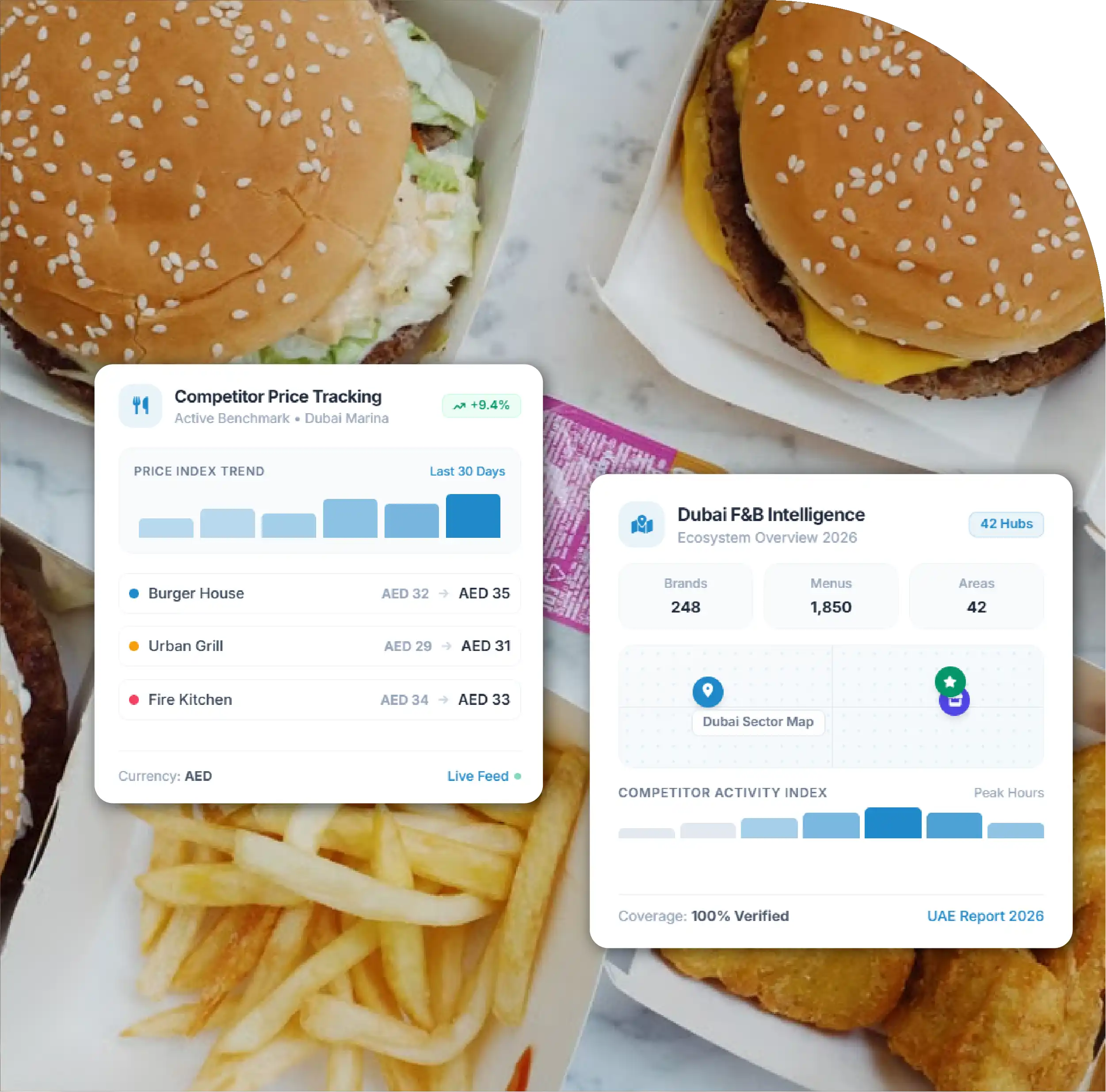
Data Enables Smarter Expansion: Restaurant scraping and intelligence datasets help track prices, menus, ratings, promotions, delivery, openings, closures, and market gaps.

The UAE Restaurant Intelligence Report 2026 examines how restaurant supply, consumer demand, pricing, delivery, location density, and competitive positioning are reshaping the country's foodservice ecosystem. As the UAE continues attracting tourists, expatriates, investors, and international restaurant brands, restaurant competition is becoming increasingly data-driven. Dubai restaurant competitive intelligence is therefore moving beyond restaurant counts toward monitoring menus, prices, ratings, promotions, delivery times, cuisines, locations, and customer sentiment.
At the same time, UAE restaurant competitive analysis is becoming essential for identifying market whitespace before launching new outlets. A restaurant district with hundreds of operators may appear attractive because of strong demand, yet excessive density can make customer acquisition expensive. Conversely, an emerging residential community with fewer restaurants may provide a stronger opportunity if population, tourism, and delivery demand are rising.
The UAE foodservice market demonstrates this growth potential. Mordor Intelligence estimates the market at approximately US$27.28 billion in 2026, compared with US$23.21 billion in 2025, with a projected 17.55% CAGR between 2026 and 2031. Meanwhile, Abu Dhabi recorded 24,594 active F&B licences in September 2025, highlighting that restaurant expansion is occurring beyond Dubai.
For businesses, a Dubai F&B data scraping platform can transform scattered restaurant information into structured datasets for continuous monitoring, competitive research, and market evaluation.
These datasets strengthen UAE restaurant market intelligence by bringing menus, prices, ratings, locations, promotions, availability, and delivery information into a consistent analytical framework.
Through Dubai restaurant trend analysis, businesses can identify changing cuisine preferences, price movements, promotional intensity, restaurant openings, closures, and evolving consumer demand.
Meanwhile, Dubai restaurant benchmarking enables brands to compare menu pricing, ratings, delivery performance, cuisine positioning, promotions, and assortment against competitors within the same geographic catchment.
The UAE foodservice industry is highly fragmented, geographically concentrated, and increasingly influenced by digital ordering. Full-service restaurants represented approximately 41.55% of foodservice revenue in 2025, while independent operators represented around 59.60%. Standalone locations accounted for approximately 70.85% of foodservice value.
Delivery is becoming one of the industry's strongest growth engines. Dine-in represented approximately 55.05% of foodservice activity in 2025, but delivery is forecast to grow at an estimated 18.65% CAGR through 2031.
This evolution changes the definition of restaurant competition. A restaurant no longer competes only with businesses located on the same street. It can compete digitally with dozens of restaurants appearing within a consumer's delivery radius.
| Indicator | 2024 | 2025 | 2026E | Change | Strategic Interpretation |
|---|---|---|---|---|---|
| UAE foodservice market, US$ bn | 20.4 | 23.21 | 27.28 | +17.5% | Strong expansion |
| Full-service revenue share | 44.6% | 41.55% | 40.8% | -0.75 pp | Competitive pressure |
| QSR revenue share | 26.7% | 27.8% | 29.1% | +1.3 pp | Convenience gaining |
| Dine-in share | 58.2% | 55.05% | 52.9% | -2.15 pp | Digital channels growing |
| Delivery share | 14.8% | 16.9% | 19.2% | +2.3 pp | Delivery acceleration |
| Independent operators | 61.2% | 59.60% | 58.4% | -1.2 pp | Chains expanding |
| Standalone locations | 72.4% | 70.85% | 69.3% | -1.55 pp | Format diversification |
| Market CAGR outlook | --- | --- | 17.55% | --- | High-growth market |
| Abu Dhabi active F&B licences | 21,800E | 24,594 | 26,900E | +9.4%E | Strong supply expansion |
| Dubai restaurant licences | --- | ~1,200 new licences | --- | --- | High opening activity |
E represents an analytical estimate rather than an officially published figure.
The UAE restaurant sector has undergone a significant transformation since the post-pandemic recovery period. Initially, growth was largely associated with reopening, tourism recovery, and pent-up consumer demand. The next stage involved rapid restaurant expansion, international brand entry, and increased investment in dining destinations.
The industry is now entering a third phase: optimization.
Restaurant operators are increasingly concerned with outlet-level economics, customer acquisition, menu profitability, delivery performance, and local competitive density. Opening another restaurant is no longer sufficient. Operators need evidence showing where demand exists and whether the market can support additional supply.
Dubai illustrates this transformation particularly well. Nearly 1,200 new restaurant licences were reported in 2024, demonstrating continued interest in the city's foodservice economy.
However, increased openings also create a potential supply-side challenge. When restaurant supply grows faster than addressable demand within a micro-market, operators may respond through discounts, menu innovation, delivery promotions, or aggressive advertising.
Historical data makes this visible.
By collecting restaurant information monthly or weekly, businesses can identify whether menu prices increased, whether new restaurants entered a neighbourhood, whether ratings declined, and whether particular cuisines gained or lost market share.
Restaurant density is one of the most valuable dimensions for understanding the UAE foodservice landscape.
Traditional market research often measures restaurant opportunity by total market size. Density analysis asks a more practical question:
How much restaurant supply already exists relative to the demand available in a specific geographic area?
A district containing 500 restaurants may be highly attractive but intensely competitive. Another area containing only 100 restaurants may represent greater whitespace if residential development, tourism, office occupancy, or delivery demand is expanding rapidly.
Density can therefore be measured through several variables:
| Market | 2024 Supply Index | 2026E Supply Index | Growth % | Density /10 | Delivery /10 | Premium Dining /10 | Market Gap /10 | Competitive Pressure /10 | Opportunity |
|---|---|---|---|---|---|---|---|---|---|
| Dubai Downtown | 100 | 116 | 16% | 10.0 | 9.6 | 10.0 | 3.5 | 10.0 | Differentiated concepts |
| Dubai Marina | 92 | 108 | 17% | 9.7 | 9.4 | 9.1 | 4.1 | 9.7 | Niche positioning |
| Jumeirah | 84 | 97 | 15% | 8.8 | 8.1 | 9.3 | 4.8 | 8.9 | Premium specialization |
| Business Bay | 76 | 93 | 22% | 8.3 | 9.3 | 8.0 | 6.2 | 8.2 | High-growth opportunity |
| Abu Dhabi Island | 88 | 101 | 15% | 8.9 | 8.5 | 8.6 | 5.4 | 8.7 | Diversified concepts |
| Yas Island | 54 | 72 | 33% | 6.4 | 8.0 | 8.8 | 8.1 | 6.2 | Tourism expansion |
| Al Reem Island | 43 | 61 | 42% | 5.6 | 8.8 | 6.7 | 8.7 | 5.4 | Strong whitespace |
| Sharjah Urban Areas | 69 | 82 | 19% | 7.4 | 8.0 | 5.9 | 7.5 | 7.0 | Value-led concepts |
| Ajman | 48 | 59 | 23% | 5.2 | 7.2 | 4.9 | 8.0 | 5.5 | Affordable dining |
| Northern Emirates | 31 | 39 | 26% | 3.8 | 5.8 | 4.2 | 8.9 | 4.0 | Emerging opportunities |
The density and opportunity scores are analytical indices designed to demonstrate competitive-intelligence methodology rather than official government statistics.
The table reveals an important pattern. High-density markets such as Downtown Dubai and Dubai Marina offer enormous consumer exposure but also significant competitive pressure. Emerging areas such as Al Reem Island and Yas Island may offer stronger whitespace because restaurant supply has historically been lower relative to development and demand growth.
This is precisely where historical restaurant datasets become valuable.
A market can be crowded and still contain significant gaps.
The first opportunity is value-premium dining. Consumers increasingly want better ingredients, ambience, presentation, and service without necessarily paying luxury prices. Restaurants positioned between mass-market QSRs and expensive fine dining can therefore target a broad middle segment.
The second gap is health-oriented dining. High-protein meals, calorie-conscious menus, plant-forward dishes, functional beverages, and customized meals can appeal to consumers seeking convenience alongside healthier choices.
The third gap is localized delivery.
Some residential districts have substantial delivery demand but fewer specialized restaurants. Mapping restaurant coverage against delivery availability can expose these underserved zones.
The fourth gap is cuisine specialization. The UAE's multicultural population creates demand for international cuisines, but supply is uneven across locations. Asian full-service restaurants have been among the more dynamic categories, while Middle Eastern and Asian cuisines remain major components of the overall market.
The restaurant industry is increasingly becoming a digital marketplace.
Consumers can compare dozens of restaurants by cuisine, rating, price, delivery time, discount, and minimum order value without physically visiting a neighbourhood.
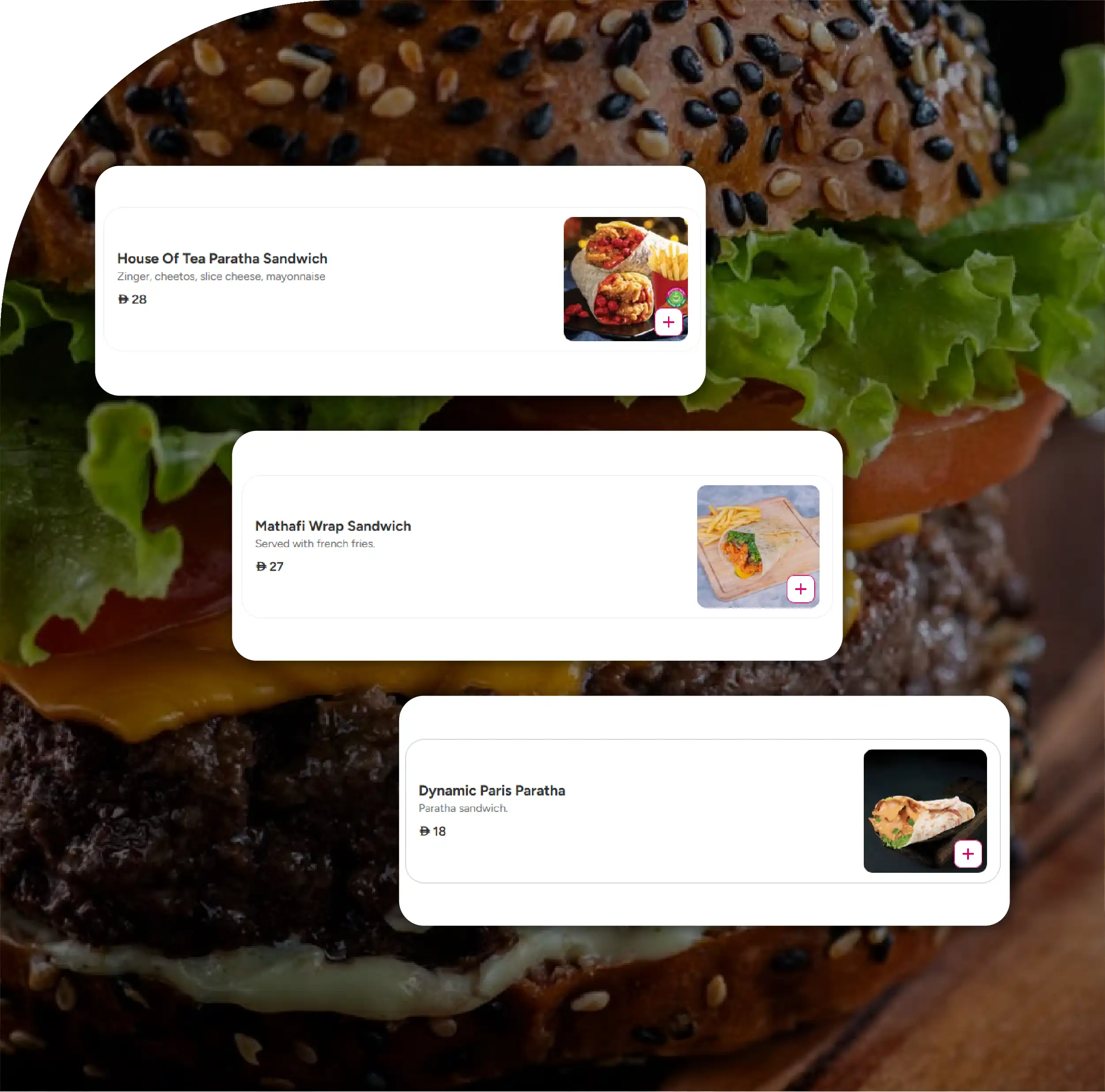
A structured method to Extract Food Delivery Apps UAE dataset can capture these competitive variables across multiple locations and dates. A restaurant intelligence system can monitor:
| Data Dimension | Example Metric | Intelligence Application |
|---|---|---|
| Menu price | AED 38 | Price benchmarking |
| Discount | 20% | Promotion monitoring |
| Rating | 4.6/5 | Reputation analysis |
| Review count | 3,850 | Brand visibility |
| Delivery time | 31 minutes | Service benchmarking |
| Delivery fee | AED 5 | Consumer value analysis |
| Cuisine | Japanese | Demand mapping |
| Menu items | 86 | Assortment benchmarking |
| Restaurant density | 14/km² | Competitive pressure |
| New listings | 18/month | Market-entry tracking |
| Removed listings | 7/month | Closure/supply signal |
This creates a continuous competitive picture instead of a one-time market snapshot.
Hotels represent another important part of the UAE's restaurant ecosystem. Restaurants located inside or around hotels can serve tourists, business travellers, residents, and event visitors simultaneously.
UAE Hotel F&B Data Scraping can therefore complement standalone restaurant intelligence by tracking hotel restaurants, dining concepts, menus, price positioning, ratings, opening hours, cuisine categories, and promotional packages.
This is particularly important in tourism-heavy locations where restaurant demand may fluctuate according to hotel occupancy, events, exhibitions, weekends, and seasonal travel.
A comprehensive intelligence system should combine five dimensions:
The combination produces a far more powerful dataset than a conventional restaurant directory.
For example, suppose a district has restaurant density increasing by 20% annually while average ratings decline and discounting increases. That could indicate market saturation.
Conversely, an area with restaurant supply growing 15%, delivery searches increasing 30%, and limited healthy-food options could indicate an emerging opportunity.
The UAE restaurant industry enters 2026 with strong structural momentum. Market growth, tourism, population expansion, digital ordering, international cuisines, and investment continue to create opportunities.
But growth does not eliminate competition. It intensifies it.
Restaurants must increasingly understand not only how large the market is, but where the market is changing, where competitors are concentrated, what customers are paying, and which needs remain underserved.
This makes historical data particularly valuable. A restaurant opening map from a single month provides limited insight. A 24-month dataset can reveal expansion velocity, closure rates, cuisine shifts, price inflation, promotional cycles, and neighbourhood-level changes.
The UAE restaurant industry is evolving from a location-driven business into a data-driven competitive ecosystem. UAE Restaurant Expansion Data can help investors identify fast-growing districts, monitor competitor openings, and evaluate whether supply is expanding faster than demand.
At the same time, Food Data Scraping in UAE can create structured visibility into restaurant menus, prices, cuisines, ratings, promotions, availability, and delivery conditions across competing markets.
The next stage is AI Restaurant Intelligence, where historical restaurant data can be transformed into predictive signals for market entry, menu optimization, price benchmarking, outlet expansion, competitor monitoring, and demand forecasting.
The biggest opportunity in 2026 may therefore not be finding another restaurant district. It may be finding the right micro-market before competitors recognize its potential.
Businesses that continuously monitor restaurant density, market gaps, price changes, delivery performance, cuisine movements, and geographic expansion can move from reactive competition to proactive decision-making.
In a market as dynamic as the UAE, the winning question is no longer simply "Where are the restaurants?"
It is:
"Where is restaurant demand changing faster than supply—and how early can we detect it?"
If you are seeking for a reliable data scraping services, Food Data Scrape is at your service. We hold prominence in Food Data Aggregator and Mobile Restaurant App Scraping with impeccable data analysis for strategic decision-making.