The Client
The client is a leading retail analytics and market intelligence company serving grocery retailers, FMCG brands, and e-commerce businesses across the United Kingdom. Their primary objective was to build a robust Grocery Price Tracking Platform Using Tesco, Asda, Aldi & Lidl Data to help businesses monitor pricing trends, promotional activities, and product availability across major supermarket chains.
As competition intensified within the UK grocery sector, the client required an automated solution to Scrape Hourly UK Grocery Price Monitoring Data from multiple supermarket websites. Manual data collection was time-consuming, inconsistent, and unable to provide the speed needed for real-time decision-making.
The organization also aimed to strengthen Grocery Competitor Price Monitoring In UK by tracking thousands of products across categories such as fresh produce, dairy, beverages, packaged foods, and household essentials. By leveraging advanced data intelligence, the client sought to deliver actionable insights, improve pricing strategies, optimize promotional campaigns, and help businesses respond quickly to changing market conditions while maintaining a competitive edge.
Key Challenges
-
Fragmented Multi-Retailer Data Collection
The client struggled to gather consistent pricing, promotion, and inventory information from multiple supermarket platforms. Differences in website structures made Tesco Asda Sainsbury's Aldi Lidl Data Scraping complex, resulting in inconsistent datasets, delayed updates, and challenges in maintaining reliable competitor intelligence. -
Lack of Real-Time Market Visibility
Manual tracking processes prevented the client from monitoring frequent grocery price fluctuations across thousands of products. Without automated Web Scraping Grocery Data, the team faced delays in identifying promotional changes, pricing gaps, and stock availability trends affecting business decisions. -
Difficulty Scaling Competitive Price Monitoring
As product catalogs expanded, the client needed a scalable solution to process vast amounts of grocery information efficiently. Existing systems could not support automated extraction through a Grocery Delivery Extraction API, leading to data bottlenecks, reduced accuracy, and limited market responsiveness.
Key Solutions
-
Automated Multi-Supermarket Data Collection
We implemented a large-scale data extraction framework that continuously collected grocery prices, discounts, product details, and stock availability from leading UK supermarkets. The solution eliminated manual monitoring and delivered accurate datasets for advanced Grocery Data Intelligence and market analysis. -
Real-Time Competitive Pricing Analytics
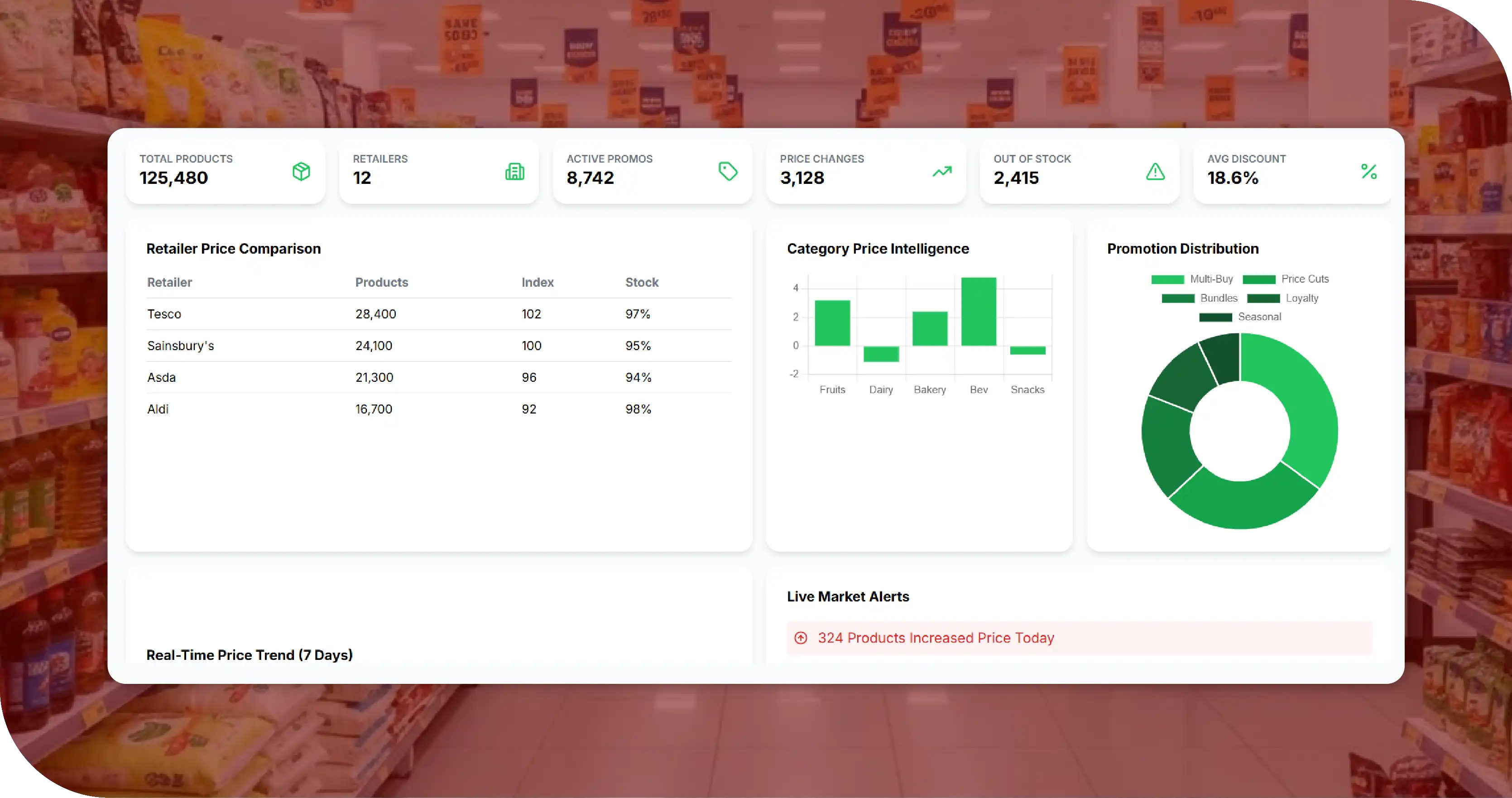
Our team developed automated pipelines that processed and standardized data from multiple retailers into a unified Grocery Price Dashboard. This enabled instant competitor comparisons, promotion tracking, category-level insights, and faster strategic decision-making across thousands of grocery products. -
Interactive Monitoring and Reporting Platform
We created a customizable Grocery Price Tracking Dashboard that provided real-time visibility into price changes, discount movements, availability trends, and retailer performance. The platform empowered stakeholders to identify opportunities quickly and optimize pricing strategies with confidence.
Sample Scraped Grocery Pricing Dataset
| Product Category | Product Name | Retailer | Pack Size | Regular Price (£) | Discount Price (£) | Discount % | Stock Status | Last Updated |
|---|---|---|---|---|---|---|---|---|
| Dairy | Semi-Skimmed Milk | Tesco | 2L | 1.85 | 1.65 | 10.8% | In Stock | 09:00 |
| Dairy | Semi-Skimmed Milk | Asda | 2L | 1.79 | 1.69 | 5.6% | In Stock | 09:00 |
| Bakery | Wholemeal Bread | Aldi | 800g | 0.89 | 0.79 | 11.2% | In Stock | 09:05 |
| Bakery | Wholemeal Bread | Lidl | 800g | 0.85 | 0.75 | 11.8% | In Stock | 09:05 |
| Produce | Bananas | Tesco | 1kg | 1.25 | 1.10 | 12.0% | In Stock | 09:10 |
| Produce | Bananas | Sainsbury's | 1kg | 1.30 | 1.15 | 11.5% | In Stock | 09:10 |
| Beverages | Orange Juice | Asda | 1L | 2.10 | 1.85 | 11.9% | In Stock | 09:15 |
| Beverages | Orange Juice | Tesco | 1L | 2.20 | 1.90 | 13.6% | In Stock | 09:15 |
| Snacks | Potato Crisps | Lidl | 150g | 1.35 | 1.10 | 18.5% | In Stock | 09:20 |
| Snacks | Potato Crisps | Aldi | 150g | 1.29 | 1.05 | 18.6% | In Stock | 09:20 |
Methodologies Used
-
Source Discovery and Mapping
We first identified relevant supermarket sources, product categories, and data fields required by the client. A detailed mapping framework was created to ensure consistent collection of pricing, inventory, promotional, and product specification information across all monitored retailers. -
Automated Data Extraction Framework
Custom extraction workflows were developed to collect information at scheduled intervals. The system handled dynamic web elements, pagination, and product variations efficiently, ensuring comprehensive coverage while maintaining high-speed collection and uninterrupted operational performance. -
Data Cleansing and Standardization
Collected records were validated, deduplicated, and standardized into a unified format. Product names, package sizes, categories, and pricing structures were normalized, enabling accurate cross-retailer comparisons and improving the reliability of downstream analytical processes. -
Real-Time Processing and Validation
Incoming datasets were processed through automated quality checks to identify anomalies, missing values, and inconsistencies. Validation mechanisms ensured high data accuracy while maintaining near real-time visibility into market changes and retailer-specific updates. -
Analytics and Reporting Integration
The processed information was integrated into interactive reporting environments and business intelligence systems. Customized dashboards, alerts, and comparative reports enabled stakeholders to monitor market movements, evaluate competitor activities, and support data-driven pricing decisions.
Advantages of Collecting Data Using Food Data Scrape
-
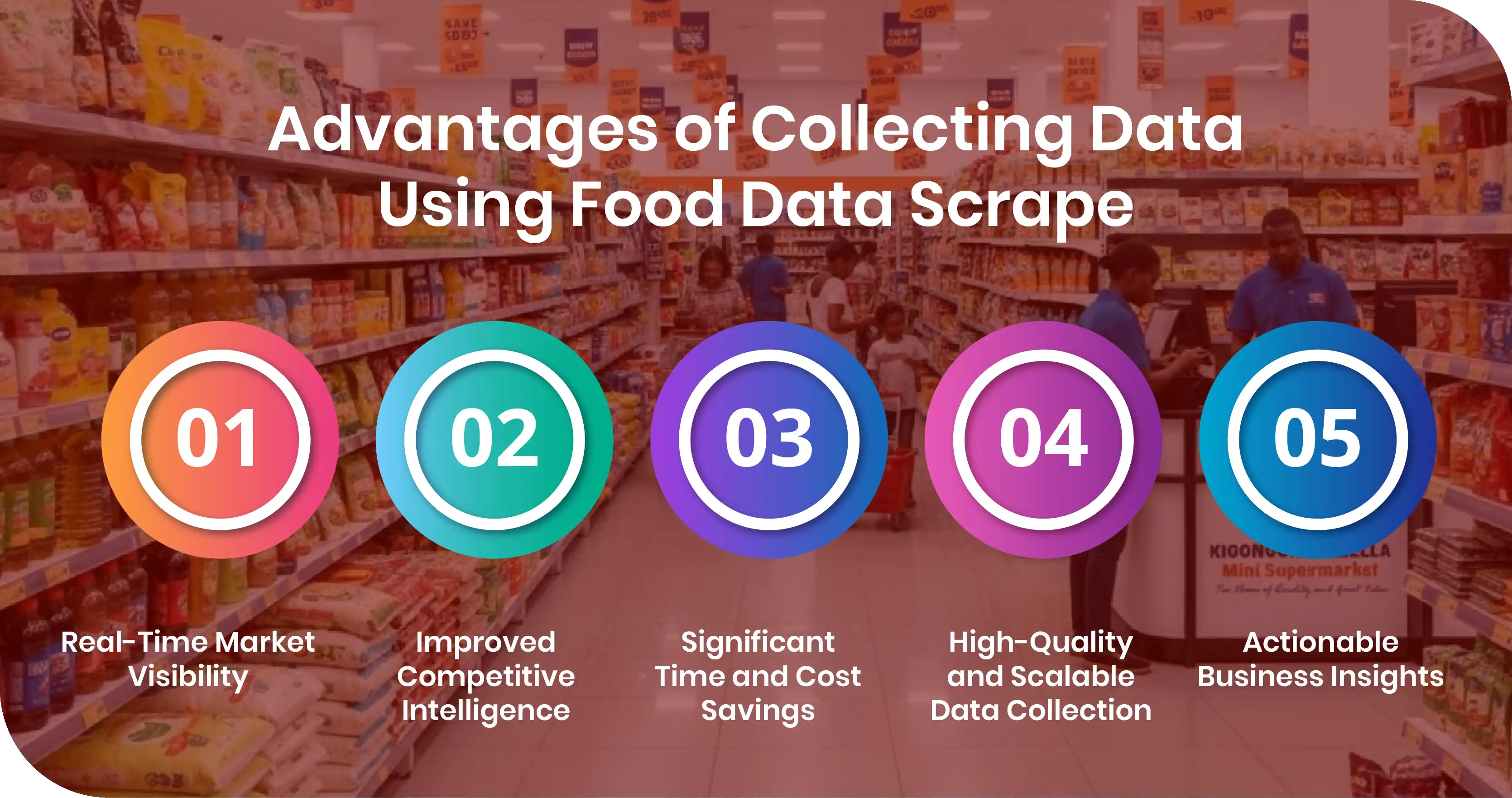
Real-Time Market Visibility
Our data scraping services provide continuous access to pricing, promotions, inventory levels, and product availability. Businesses gain timely market intelligence that enables them to respond quickly to competitor actions, identify emerging trends, and make informed commercial decisions. -
Improved Competitive Intelligence
By collecting and consolidating data from multiple sources, we help organizations monitor competitor strategies more effectively. This visibility supports accurate benchmarking, promotional analysis, assortment comparisons, and strategic planning that strengthens market positioning and improves profitability. -
Significant Time and Cost Savings
Automated data collection eliminates labor-intensive manual research processes. Organizations reduce operational costs, minimize human errors, and free internal teams to focus on analysis, strategic initiatives, and business growth rather than repetitive data gathering activities. -
High-Quality and Scalable Data Collection
Our solutions are designed to handle large volumes of information across numerous products, categories, and retailers. Advanced validation processes ensure data accuracy, consistency, and reliability while supporting growing business requirements without compromising performance. -
Actionable Business Insights
Collected data is transformed into meaningful intelligence through structured reporting and analytics. Stakeholders can uncover pricing opportunities, track market movements, optimize product strategies, improve forecasting accuracy, and make data-driven decisions that generate measurable business value.
Client’s Testimonial
"The data scraping solution delivered exceptional value to our business. We now have real-time visibility into grocery pricing, promotions, and product availability across multiple UK supermarkets. The accuracy, consistency, and speed of the data have significantly improved our competitive analysis and pricing strategies. Their team demonstrated strong technical expertise, responsiveness, and a deep understanding of our requirements throughout the project. The automated data pipeline eliminated countless hours of manual work while providing actionable insights that support faster decision-making. We highly recommend their services to any organization seeking reliable retail market intelligence and scalable data solutions."
— Head of Retail Analytics
Final Outcome
The project successfully transformed the client's grocery market monitoring capabilities by delivering a fully automated and scalable data intelligence solution. The organization gained real-time visibility into product pricing, promotional activities, stock availability, and competitor movements across leading UK supermarkets. Access to accurate and continuously updated Grocery Datasets enabled faster analysis, improved decision-making, and more effective pricing strategies.
The automated system significantly reduced manual effort, improved data accuracy, and increased operational efficiency. Stakeholders could quickly identify market trends, compare retailer performance, and respond proactively to pricing changes. The centralized reporting environment provided actionable insights that strengthened competitive positioning and enhanced business performance.