The Client
The client was a UK-focused grocery market intelligence company supporting retailers, consumer research organizations, pricing analysts, and digital commerce businesses. Its primary objective was to understand supermarket pricing behavior and provide reliable comparisons across major grocery retailers. The company wanted to strengthen its analytical capabilities through UK Supermarket Price Monitoring, enabling its team to identify price fluctuations, promotional changes, and product-level differences across competing supermarkets.
The client also required comprehensive UK Grocery Market Intelligence Data to evaluate retail trends, consumer purchasing patterns, and competitive positioning. Existing manual research processes were time-consuming and struggled to capture frequent pricing updates across extensive product catalogs. The organization therefore sought a scalable data collection solution that could support consistent reporting and structured analysis. Through UK Supermarket Price Comparison Data, the client wanted to compare equivalent products, evaluate grocery basket costs, and identify opportunities for better pricing decisions. Food Data Scrape was selected to design a customized data extraction and processing workflow that aligned with the client's analytical requirements and reporting objectives.
Key Challenges
-
Fragmented Grocery Pricing Information
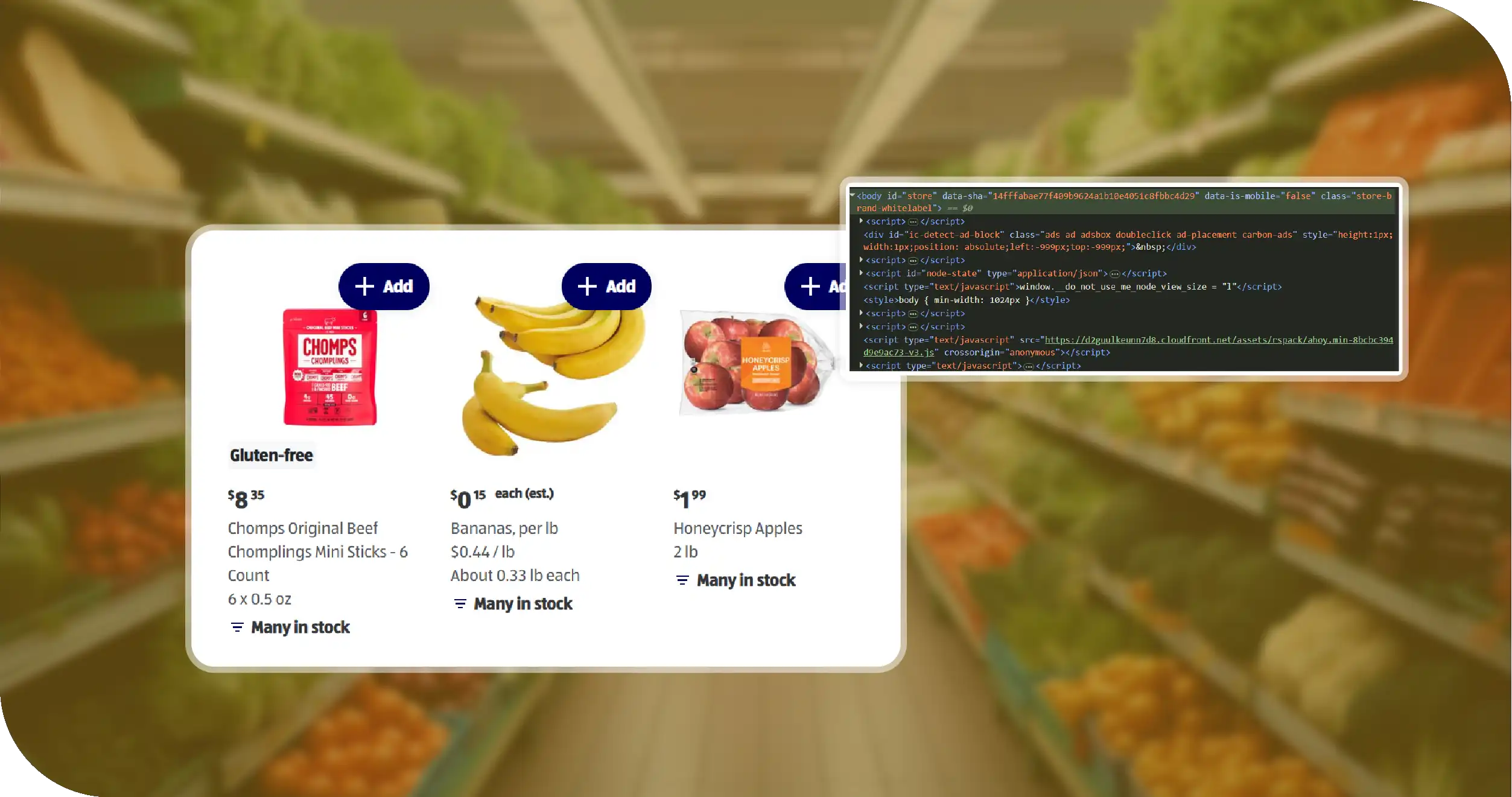
The client needed to Scrape Food Delivery API Data and collect supermarket pricing information from different online sources. Variations in product formats, promotional structures, and delivery conditions created inconsistencies, making reliable comparisons difficult without standardized collection and validation processes. -
Frequent Product and Price Changes
The client wanted to Scrape Online Tesco Grocery Delivery App Data to track product prices, discounts, pack sizes, and availability. Frequent catalog updates and changing promotional offers made manual monitoring inefficient, creating the risk of outdated comparisons and missed pricing opportunities. -
Limited Predictive Market Insights
The absence of consolidated historical pricing records restricted the client's ability to identify trends and evaluate competitor strategies. Implementing AI Grocery Intelligence required consistent, structured, and sufficiently reliable datasets that could support analytical models, anomaly detection, price forecasting, and evidence-based grocery market decisions.
Key Solutions
-
Centralized Grocery Dataset Development
We created structured Grocery Store Datasets containing product names, categories, standard prices, promotional prices, package sizes, availability, and collection timestamps. Standardized records enabled the client to compare grocery products consistently across retailers and prepare analytical reports with fewer data discrepancies. -
Tesco Product Data Extraction
We implemented a customized Tesco Grocery Delivery Scraping API workflow to collect relevant product information from accessible online grocery listings. The solution organized product-level pricing, promotional details, pack sizes, and availability into standardized records, helping the client evaluate Tesco's pricing changes and competitive position. -
ASDA Grocery Pricing Integration
Our ASDA Food Delivery Scraping API workflow captured relevant grocery product information and aligned it with the client's existing dataset structure. Consistent field mapping supported retailer-level comparisons, grocery basket calculations, discount analysis, and consolidated reporting across participating supermarket data sources.
Detailed Grocery Data Collection and Analysis Table
The following table illustrates a representative project data structure and hypothetical operational targets for the proposed solution. These figures are illustrative, not verified client results or measured production volumes.
| Data Metric | Tesco | ASDA | Sainsbury's | Combined Target |
|---|---|---|---|---|
| Product records per collection cycle | 12,000 | 10,000 | 9,000 | 31,000 |
| Product categories monitored | 24 | 22 | 23 | 25 |
| Core pricing fields per record | 6 | 6 | 6 | 6 |
| Promotional fields per record | 4 | 4 | 4 | 4 |
| Availability fields per record | 2 | 2 | 2 | 2 |
| Planned collection frequency per day | 4 | 4 | 4 | 4 |
| Daily record observations | 48,000 | 40,000 | 36,000 | 124,000 |
| Weekly record observations (7 days) | 336,000 | 280,000 | 252,000 | 868,000 |
| Monthly record observations (30 days) | 1,440,000 | 1,200,000 | 1,080,000 | 3,720,000 |
| Data validation target (%) | 98 | 98 | 98 | 98 |
| Required price formats supported | 3 | 3 | 3 | 3 |
| Standard export formats | 2 | 2 | 2 | 2 |
Note: The table presents illustrative design targets for a potential collection workflow. Actual coverage, collection frequency, and validation performance depend on source accessibility, project scope, and implementation results.
Methodologies We Used
-
Source Identification and Coverage Planning
We identified relevant online supermarket sources, product categories, and available listing structures. Coverage planning established which retailers, product attributes, and pricing fields were necessary to support meaningful comparisons while accounting for source accessibility and applicable website requirements. -
Automated Data Extraction
We designed automated collection workflows to retrieve relevant product information from accessible online sources. Extraction rules captured product names, prices, package sizes, promotional labels, and availability, reducing repetitive manual work while supporting consistent collection across large product catalogs. -
Data Cleaning and Standardization
We normalized product names, measurement units, currency formats, and pricing fields to make records comparable across retailers. Validation checks identified missing values, duplicate entries, and inconsistent product attributes before information entered the client's analytical datasets. -
Price Comparison and Historical Tracking
We organized collected records by retailer, product identifier, category, and timestamp. This structure supported repeated price comparisons, historical tracking, promotional analysis, and grocery basket calculations, allowing the client to examine changes across collection periods using consistent measurement criteria. -
Quality Assurance and Data Delivery
We applied validation rules to check field completeness, formatting consistency, duplicate records, and unusual price changes. Approved datasets were prepared in agreed structured formats, allowing the client's analysts to integrate the information into reporting systems, dashboards, and downstream analytical workflows.
Advantages of Collecting Data Using Food Data Scrape
-
Improved Competitive Price Visibility
Structured supermarket datasets help businesses understand how product prices differ across retailers. By comparing equivalent products, pack sizes, and discounts, analysts can identify competitive gaps, evaluate pricing positions, and make better-informed decisions about promotions and assortment strategies. -
Faster Grocery Market Research
Automated data collection reduces the effort required to gather information from multiple online grocery sources. Analysts can spend less time compiling spreadsheets and more time interpreting market trends, examining pricing changes, and preparing actionable insights for retail decision-makers. -
More Consistent Grocery Basket Analysis
Standardized product and pricing records make it easier to calculate the cost of selected household essentials across supermarkets. Businesses can compare comparable basket contents, account for package sizes, and identify retailers offering lower total prices for specified shopping lists. -
Better Promotional Intelligence
Historical observations help analysts examine discount frequency, promotional depth, and price movements over time. This information supports more informed assessments of competitor campaigns, seasonal pricing behavior, and the relationship between promotional activity and changes in advertised product prices. -
Scalable Data-Driven Decision-Making
A structured collection framework can expand to additional retailers, product categories, and reporting periods as business requirements evolve. Food Data Scrape helps organizations establish consistent data pipelines that support retail dashboards, market research, price benchmarking, and analytical applications.
Client's Testimonial
"Food Data Scrape helped us establish a more structured approach to understanding online supermarket pricing across the UK. Previously, our research team spent considerable time collecting product information and preparing comparison spreadsheets manually. The proposed data collection framework brought product prices, promotional information, package sizes, and availability into a consistent structure that better supported our analytical requirements. We particularly valued the emphasis on data standardization and quality checks, which are essential when comparing grocery products across multiple retailers. The resulting framework provides a practical foundation for monitoring price movements, assessing grocery basket costs, and developing more informative market intelligence reports. It also gives our team a scalable approach for expanding retailer coverage and incorporating additional product categories as our business requirements develop."
—Head of Grocery Market Intelligence
Final Outcome
The proposed data scraping framework established a structured foundation for supermarket price comparison, grocery basket analysis, and competitive market research. By organizing product information into consistent records, the client could develop a clearer view of advertised prices, promotional activity, pack sizes, and product availability across participating retailers. The solution also created a repeatable process for tracking changes across collection periods and preparing datasets for dashboards and analytical reporting.
With the ability to Scrape Online Sainsbury's Grocery Delivery App Data, alongside relevant Tesco and ASDA product information, the client could plan broader retailer comparisons using a consistent data model. The framework supported more efficient research workflows, improved data accessibility, and stronger foundations for identifying pricing patterns. Actual business improvements would depend on implementation, source coverage, data quality, and subsequent analytical use.