The Client
The client is a US-based retail intelligence and market research organization specializing in grocery pricing analytics, competitive benchmarking, and consumer purchasing insights. Operating across multiple regional and national supermarket chains, the company helps retailers, brands, distributors, and analytics teams understand market dynamics through real-time pricing intelligence.
With a strong focus on Grocery Price Intelligence for US Retail Chains, the client required a scalable solution capable of collecting and standardizing pricing information from dozens of grocery retailers. Their goal was to improve visibility into competitor strategies, promotional campaigns, and product-level price fluctuations.
By leveraging Grocery SKU Price Tracking & Data Extraction, the organization monitored thousands of products across categories including fresh foods, beverages, household goods, and packaged groceries. This enabled accurate trend analysis and market comparisons.
Through Live Grocery Price Monitoring Across US Supermarkets, the client gained timely insights into regional pricing variations, inventory movements, and discount activity, supporting faster decisions, improved pricing strategies, and stronger competitive positioning in the grocery sector.
Key Challenges
-
Limited Visibility into Weekly Price Changes
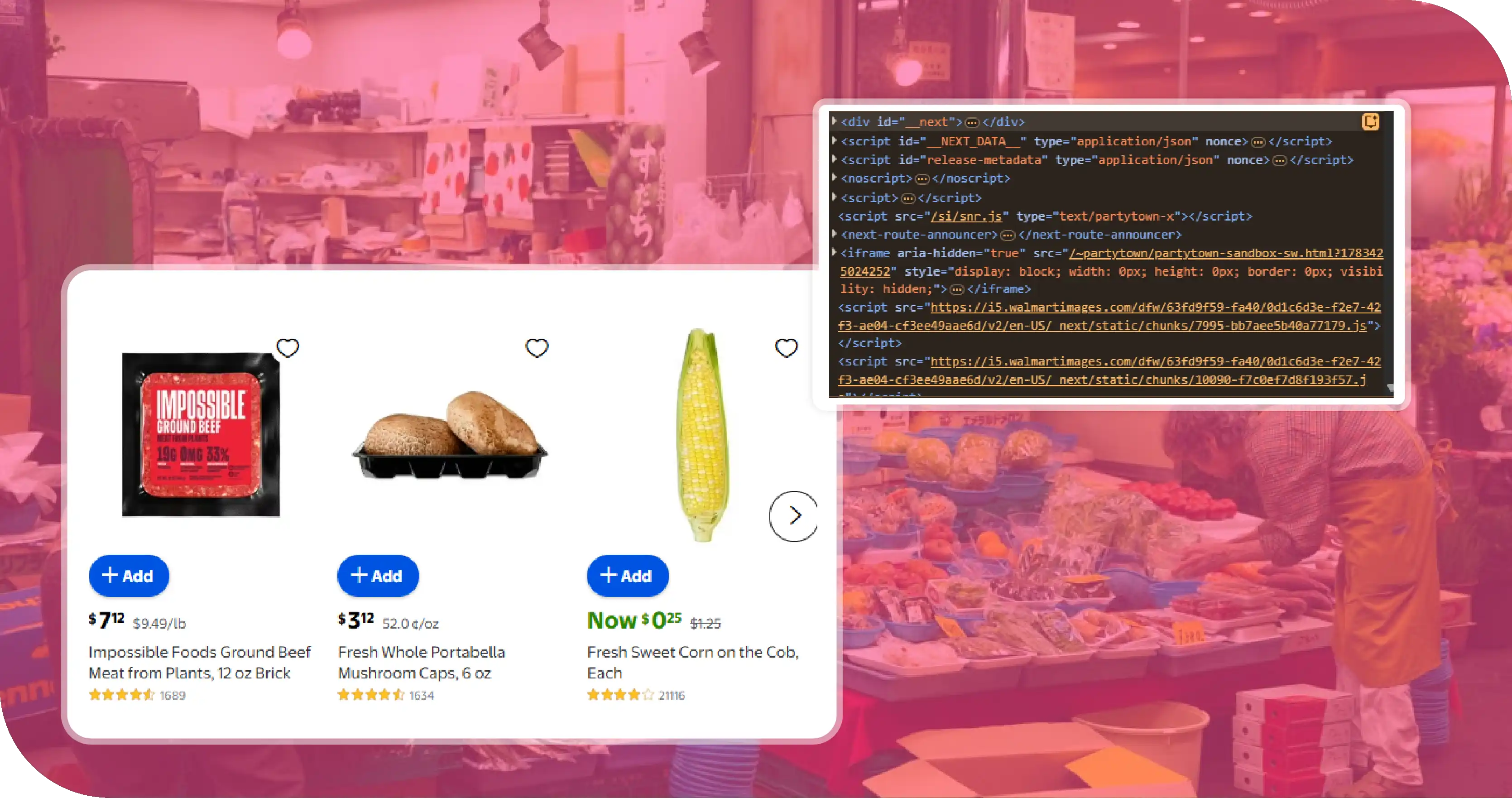
The client struggled to track frequent price fluctuations across dozens of grocery retailers operating in different regions. Without a centralized Weekly Grocery Price Tracking API, collecting and comparing weekly pricing updates required extensive manual effort, resulting in delayed market insights and inconsistent competitive analysis. -
Managing Large-Scale Retail Data Collection
Monitoring thousands of grocery products across multiple supermarket websites created significant operational challenges. Traditional methods could not efficiently support Web Scraping Grocery Data at scale, leading to incomplete datasets, data quality issues, and difficulties identifying real-time promotional and pricing opportunities. -
Inconsistent Product and Delivery Intelligence
The client lacked a unified approach for tracking product availability, delivery coverage, and regional pricing variations. Without a reliable Grocery Delivery Extraction API, obtaining accurate information from numerous grocery delivery platforms was time-consuming, reducing the effectiveness of pricing strategies and market responsiveness.
Key Solutions
-
Centralized Weekly Price Intelligence Platform
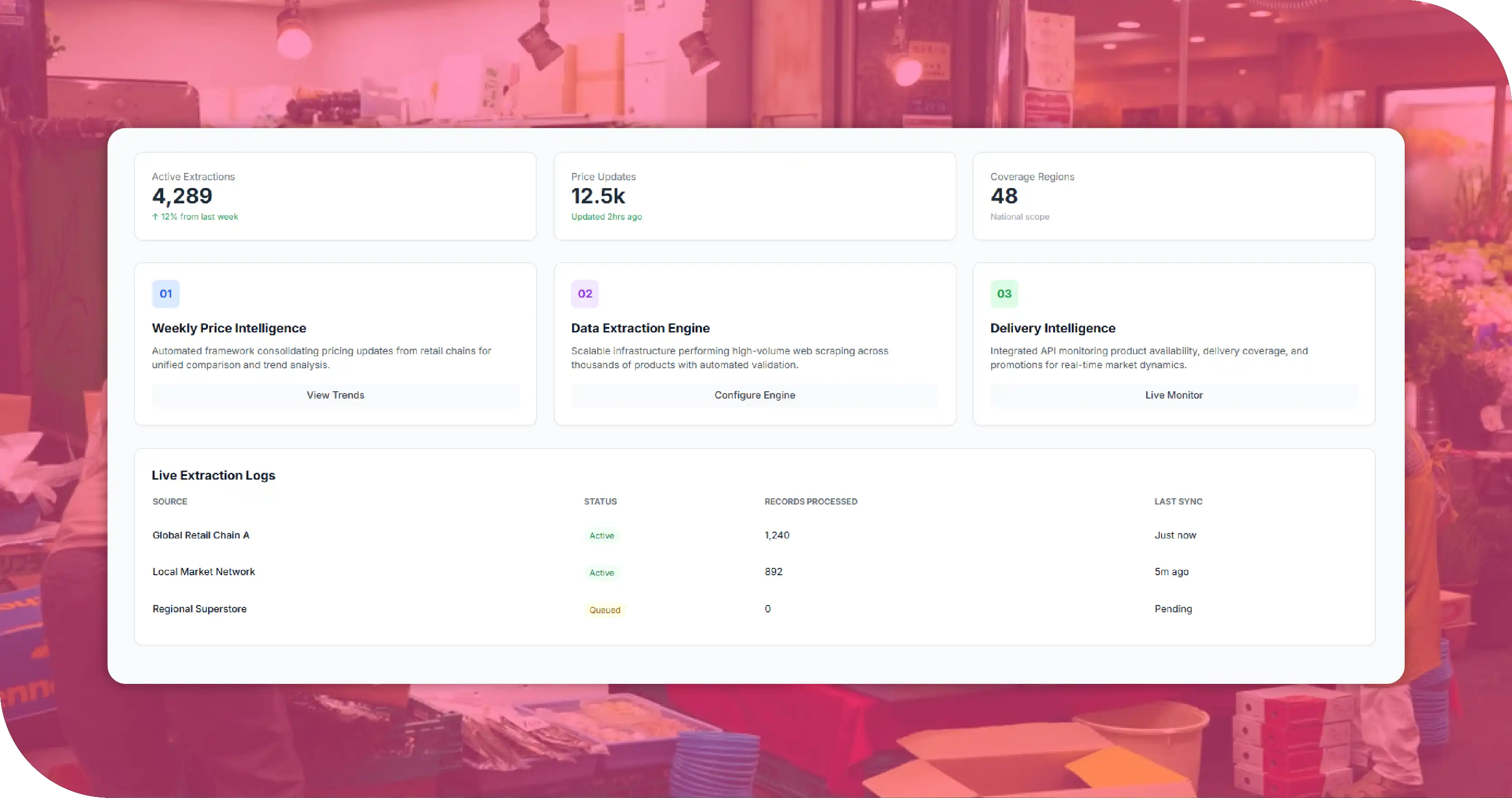
To address weekly pricing visibility issues, we developed an automated data collection framework powered by Weekly Grocery Price Tracking API capabilities. The solution consolidated pricing updates from multiple retail chains into a unified dashboard, enabling faster comparisons, trend analysis, and competitive monitoring across regions. -
Scalable Multi-Retail Data Extraction Engine
We implemented a high-volume retail intelligence infrastructure designed for Web Scraping Grocery Data across thousands of grocery products and categories. Automated extraction workflows ensured accurate, standardized, and continuously updated datasets while eliminating manual collection bottlenecks and improving overall data reliability. -
Unified Product Availability & Delivery Monitoring
To solve fragmented delivery intelligence challenges, we deployed an integrated Grocery Delivery Extraction API solution that captured product availability, delivery coverage, promotional activity, and regional pricing. This enabled the client to monitor market dynamics in real time and improve strategic decision-making.
Sample Scraped Grocery Pricing Dataset
| Retail Chain | Product ID | Product Name | Category | Brand | Package Size | Current Price ($) | Previous Price ($) | Discount % | Availability | Delivery Available | City | State | ZIP Code | Collection Date |
|---|---|---|---|---|---|---|---|---|---|---|---|---|---|---|
| Walmart | SKU10021 | Whole Milk | Dairy | Great Value | 1 Gallon | 3.98 | 4.29 | 7.2 | In Stock | Yes | Dallas | TX | 75001 | 2026-06-20 |
| Kroger | SKU10022 | Eggs Large | Dairy | Simple Truth | 12 Count | 4.49 | 4.99 | 10.0 | In Stock | Yes | Atlanta | GA | 30301 | 2026-06-20 |
| Albertsons | SKU10023 | White Bread | Bakery | Wonder | 20 oz | 2.89 | 3.19 | 9.4 | In Stock | Yes | Phoenix | AZ | 85001 | 2026-06-20 |
| Target | SKU10024 | Orange Juice | Beverages | Tropicana | 52 oz | 4.99 | 5.49 | 9.1 | In Stock | Yes | Chicago | IL | 60601 | 2026-06-20 |
| Safeway | SKU10025 | Bananas | Produce | Fresh | 1 lb | 0.69 | 0.79 | 12.7 | In Stock | Yes | Seattle | WA | 98101 | 2026-06-20 |
| Publix | SKU10026 | Chicken Breast | Meat | Publix | 1 lb | 5.99 | 6.49 | 7.7 | In Stock | Yes | Miami | FL | 33101 | 2026-06-20 |
| Meijer | SKU10027 | Rice | Pantry | Mahatma | 5 lb | 6.79 | 7.29 | 6.9 | In Stock | Yes | Detroit | MI | 48201 | 2026-06-20 |
| H-E-B | SKU10028 | Peanut Butter | Grocery | Jif | 28 oz | 3.99 | 4.49 | 11.1 | In Stock | Yes | Houston | TX | 77001 | 2026-06-20 |
| Costco | SKU10029 | Bottled Water | Beverages | Kirkland | 40 Pack | 5.99 | 6.49 | 7.7 | In Stock | No | San Diego | CA | 92101 | 2026-06-20 |
| Whole Foods | SKU10030 | Organic Apples | Produce | 365 | 3 lb Bag | 6.49 | 6.99 | 7.2 | In Stock | Yes | Denver | CO | 80201 | 2026-06-20 |
Methodologies Used
-
Multi-Source Data Collection Framework
Data was gathered from numerous grocery retailers through automated collection pipelines configured to capture product information, pricing details, promotions, inventory status, and regional variations. The framework ensured broad market coverage while maintaining consistency across diverse retail platforms. -
Data Standardization and Enrichment
Collected information from Grocery Price Dashboard was cleaned, normalized, and mapped into a unified structure. Product names, categories, package sizes, brands, and location attributes were standardized, enabling accurate comparisons across retailers and reducing inconsistencies that could affect analytical outcomes. -
Automated Validation and Quality Assurance
A robust validation process was implemented to identify missing values, duplicate records, pricing anomalies, and formatting inconsistencies. Continuous quality checks improved dataset reliability, ensuring stakeholders received trustworthy information for reporting, benchmarking, and strategic decision-making activities. -
Historical Trend and Market Analysis
Time-series tracking methodologies were applied to monitor changes in pricing, promotions, and product availability over time. Historical datasets enabled detailed trend analysis, helping identify seasonal patterns, competitive movements, and emerging opportunities across different grocery categories. -
Real-Time Intelligence Delivery System
An automated reporting infrastructure delivered refreshed datasets, dashboards, and market insights at scheduled intervals. This approach provided decision-makers with timely visibility into market developments, allowing faster responses to pricing shifts, inventory changes, and competitive activities.
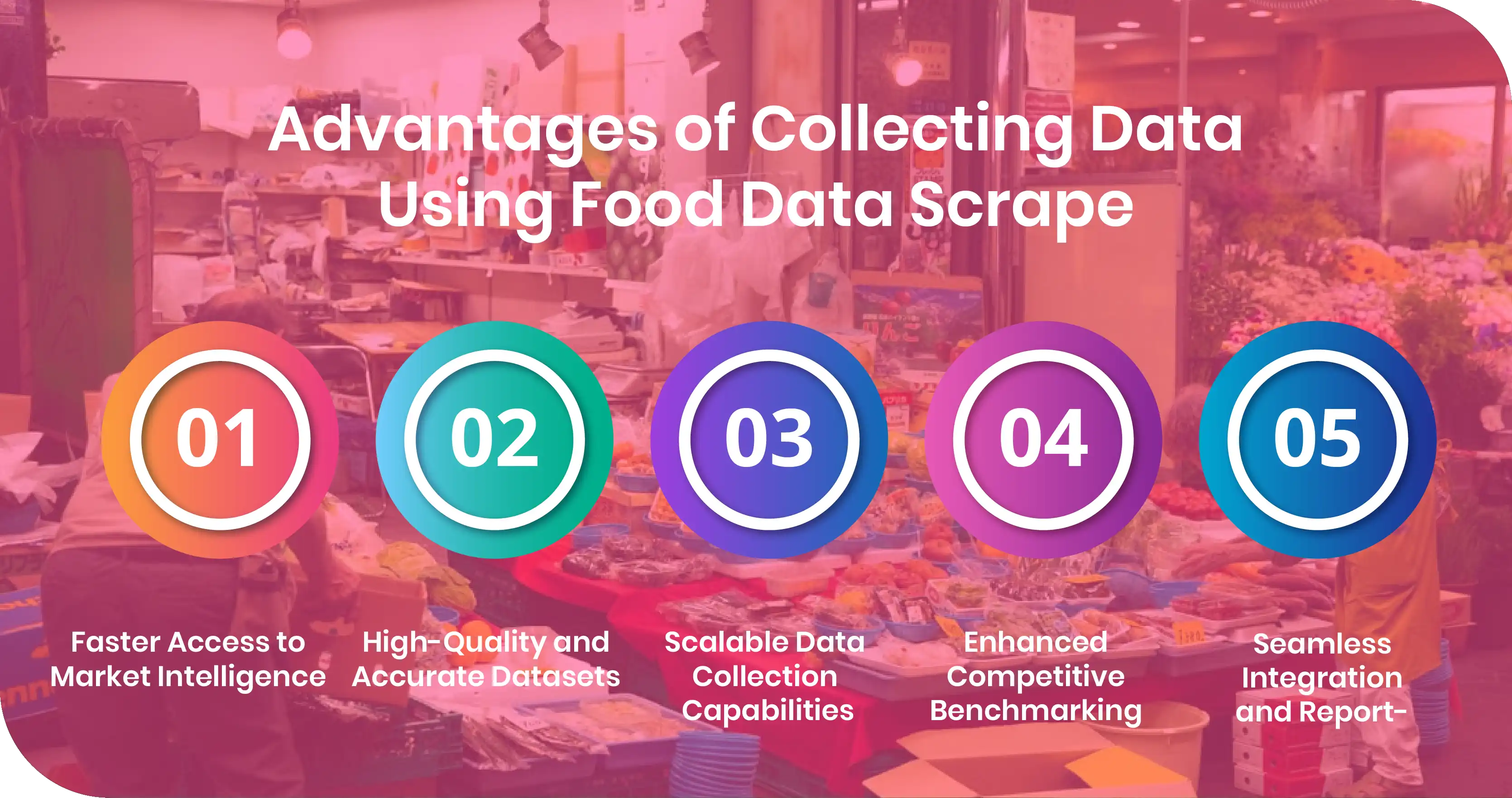
Advantages of Collecting Data Using Food Data Scrape
-
Faster Access to Market Intelligence
Our automated data collection solutions eliminate time-consuming manual research by continuously gathering and updating information from multiple sources. Businesses gain immediate access to current market developments, enabling quicker responses to competitor actions, pricing movements, and changing consumer demand patterns. -
High-Quality and Accurate Datasets
Advanced validation mechanisms ensure collected data remains consistent, structured, and reliable. Automated quality checks remove duplicates, identify anomalies, and standardize information formats, helping organizations make confident business decisions based on dependable datasets and comprehensive market intelligence. -
Scalable Data Collection Capabilities
Our infrastructure is designed to handle large volumes of data across thousands of products, locations, and categories simultaneously. As business requirements expand, the solution scales efficiently without compromising performance, coverage, data freshness, or operational stability. -
Enhanced Competitive Benchmarking
Organizations can continuously monitor competitor activities, promotional campaigns, assortment changes, and pricing strategies. This visibility supports deeper market analysis, improved strategic planning, stronger positioning, and the ability to identify emerging opportunities before competitors react. -
Seamless Integration and Reporting
Collected datasets are delivered in customized formats compatible with analytics platforms, dashboards, and business intelligence tools. Automated reporting workflows streamline information distribution, improve collaboration across teams, and ensure stakeholders receive actionable insights without unnecessary delays.
Client’s Testimonial
"The data scraping solution delivered exceptional value to our retail intelligence operations. Their team helped us automate the collection of pricing, product availability, and promotional data across multiple grocery chains, significantly improving the speed and accuracy of our market analysis. The structured datasets and automated reporting capabilities enabled us to identify pricing trends faster and make more informed business decisions. Their responsiveness, technical expertise, and ability to scale data collection across diverse retail sources exceeded our expectations. We experienced substantial improvements in operational efficiency, competitive benchmarking, and strategic planning. We highly recommend their services for large-scale retail data intelligence projects."
-Director of Retail Analytics
Final Outcome
The project successfully transformed the client's grocery market intelligence operations by automating large-scale data collection across 50 retail chains. Through the implementation of a centralized Grocery Price Tracking Dashboard, stakeholders gained real-time visibility into pricing movements, promotional activities, and product availability trends across multiple regions.
Leveraging advanced Grocery Data Intelligence, the client improved competitive benchmarking, accelerated market analysis, and reduced manual research efforts significantly. Automated monitoring enabled faster responses to pricing changes and enhanced strategic planning capabilities.
The delivery of comprehensive Grocery Datasets provided accurate, standardized, and continuously updated information covering thousands of products and categories. As a result, the client achieved greater operational efficiency, improved decision-making accuracy, enhanced market responsiveness, and stronger competitive positioning within the highly dynamic US grocery retail landscape.