Introduction
The rapid rise of instant commerce in India has pushed brands to deeply analyze hyperlocal demand patterns beyond metro cities. One of the most significant developments in this space is Zepto Data Scraping in Tier-2 and Tier-3 Cities, which enables businesses to understand how quick commerce adoption is evolving in smaller urban clusters.
As consumer behavior diversifies, companies are increasingly relying on Zepto Product Availability Data Insights in Tier-2 & Tier-3 Cities to track which SKUs are consistently stocked, which categories face shortages, and how demand fluctuates across regions.
Alongside this, Zepto Product Data Intelligence in Tier-2 & Tier-3 Cities is becoming a core component for brands aiming to optimize pricing, distribution, and inventory allocation strategies in non-metro markets.
Growing Importance of Tier-2 and Tier-3 Cities in Quick Commerce
Tier-2 and Tier-3 cities such as Patna, Lucknow, Indore, Jaipur, and Bhubaneswar are witnessing rapid digital adoption. With improved logistics infrastructure and smartphone penetration, quick commerce platforms like Zepto are expanding aggressively into these regions.
However, these markets behave differently compared to metros. Demand is highly seasonal, SKU preferences vary widely, and supply chain constraints are more pronounced. This is where data-driven insights from scraping become critical for operational efficiency.
Tracking Real-Time Demand Shifts Across Cities
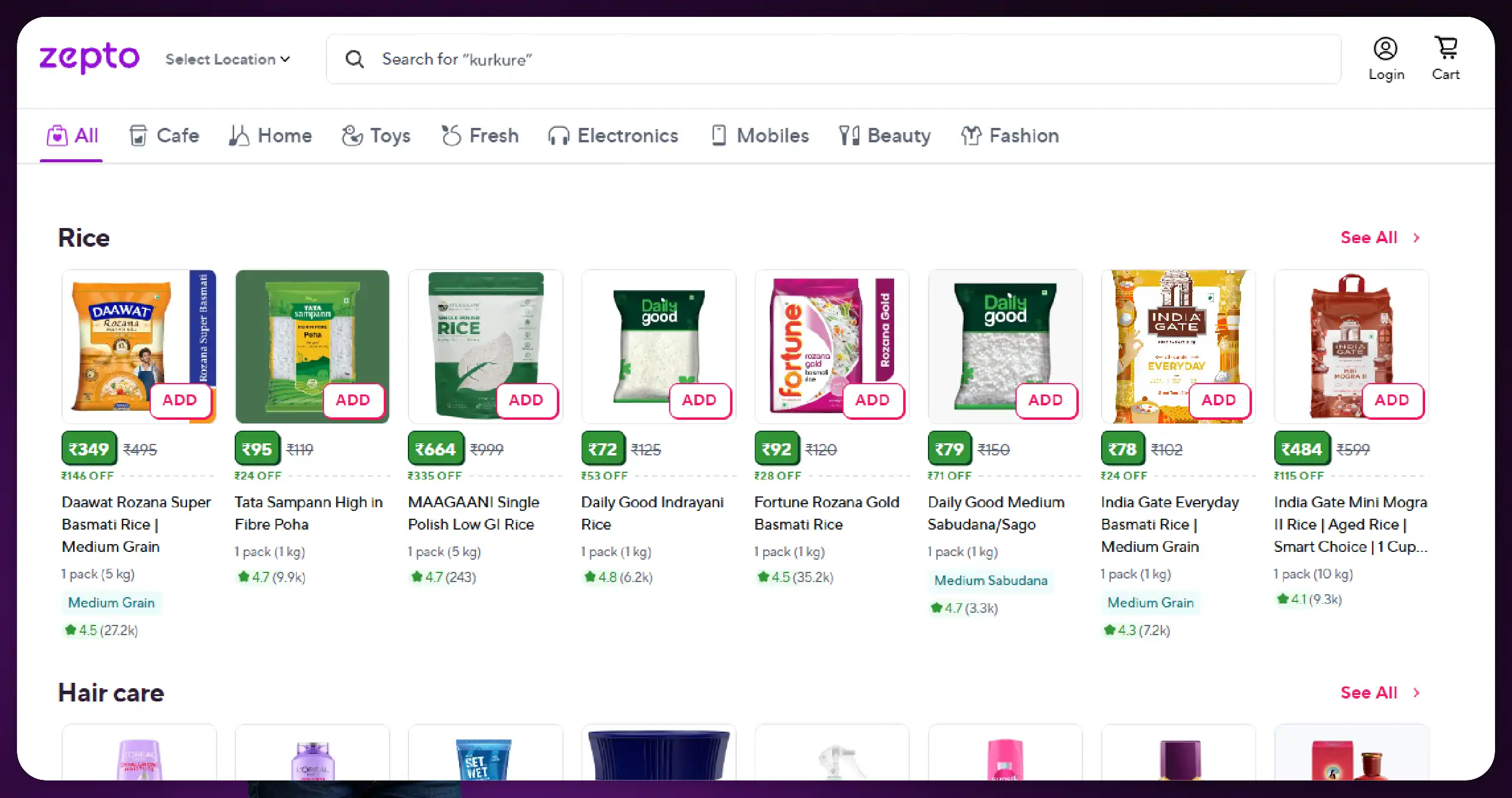
Tracking Zepto Product Data in Tier-2 & Tier-3 Cities allows businesses to monitor real-time product movements, demand spikes, and out-of-stock patterns. For example, during festive seasons, demand for packaged snacks and beverages surges significantly in Tier-2 cities compared to steady metro consumption patterns.
This tracking also helps FMCG companies identify underserved markets where product penetration is still low. By analyzing availability trends, brands can fine-tune distribution networks and reduce lost sales opportunities.
Enhancing Hyperlocal Visibility with Scraper Systems
A major challenge in smaller cities is the lack of consistent retail visibility. Zepto Location & Service Availability Data Scraper helps solve this issue by identifying serviceable pin codes, delivery radius variations, and category-wise availability across different regions.
This type of scraping enables companies to build detailed maps of Zepto’s operational footprint. It also highlights gaps where certain product categories are not available despite high demand potential, allowing brands to collaborate with platforms for better assortment planning.
Building Structured Grocery Intelligence Models
One of the most valuable outputs in this ecosystem is the creation of structured datasets. The Zepto Grocery SKU Dataset provides granular-level information about product listings, including brand, category, pack size, pricing, and stock status.
This dataset can be used by analytics teams to compare regional pricing variations and identify high-performing SKUs. For example, dairy products may show stronger penetration in Tier-2 cities, while packaged ready-to-eat meals might dominate Tier-3 demand clusters.
Such datasets also help in benchmarking against competitors in the quick commerce space and optimizing product catalogs for better conversion rates.
API-Driven Data Extraction for Scalability

Modern businesses require scalable solutions to handle large volumes of data. The Zepto Quick Commerce Data Scraping API enables automated extraction of product listings, pricing changes, and stock updates in real time.
This API-driven approach ensures continuous monitoring without manual intervention. It is particularly useful for FMCG brands, analytics firms, and e-commerce aggregators who require constant updates on inventory fluctuations.
With automation, companies can integrate scraped data directly into dashboards, enabling faster decision-making and predictive analytics for demand forecasting.
Leveraging Quick Commerce Data Ecosystems
The broader ecosystem of Quick Commerce Datasets plays a crucial role in shaping strategic decisions for retail and FMCG businesses. These datasets include information across multiple platforms, allowing cross-platform comparison of product availability, pricing trends, and promotional strategies.
In Tier-2 and Tier-3 cities, such datasets help uncover unique consumption behaviors. For instance, regional snack brands often outperform national brands in smaller cities due to cultural preferences and affordability factors.
By analyzing these datasets, businesses can adjust marketing strategies and inventory distribution more effectively.
Challenges in Tier-Based Quick Commerce Data Collection
While data scraping offers valuable insights, Tier-2 and Tier-3 markets present several challenges. These include inconsistent data updates, fluctuating product availability, and limited digital infrastructure in certain regions.
Additionally, quick commerce platforms frequently update their UI and backend structures, making continuous scraper maintenance essential. Despite these challenges, the value derived from accurate datasets far outweighs the operational complexity.
Companies that invest in robust scraping frameworks are better positioned to capture early market signals and consumer trends.
Business Use Cases and Strategic Applications
The applications of Zepto data scraping in smaller cities are vast:
- FMCG brands use it to optimize product distribution.
- Retail analysts identify demand gaps across regions.
- Startups leverage insights for competitive benchmarking.
- Supply chain teams improve stock replenishment cycles.
- Investors analyze market penetration of quick commerce platforms.
Each of these use cases contributes to a more efficient and responsive retail ecosystem, especially in rapidly evolving non-metro markets.
Future of Quick Commerce Intelligence in Emerging Cities
As digital infrastructure continues to improve, Tier-2 and Tier-3 cities will become major growth engines for quick commerce platforms. The integration of AI with scraped datasets will further enhance predictive capabilities, enabling platforms to forecast demand with higher accuracy.
The evolution of real-time analytics will also lead to more dynamic pricing models and personalized product recommendations tailored to regional preferences.
How Food data Scrape Can Help You?
- Faster Decision-Making with Live Data Feeds
We deliver continuously updated datasets that help businesses react quickly to pricing changes, stock movement, and market fluctuations. - Improved Product Performance Tracking
Our scraping solutions help you monitor how specific products are performing across platforms, regions, and customer segments. - Stronger Demand Forecasting Accuracy
By analyzing historical and real-time data together, we help you predict demand trends more accurately and reduce uncertainty. - Enhanced Business Expansion Strategy
We provide insights into new and emerging markets, especially Tier-2 and Tier-3 cities, to support smarter expansion planning. - Automated Data Collection at Scale
Our systems eliminate manual tracking by automating large-scale data extraction, saving time and increasing operational efficiency.
Conclusion
The expansion of quick commerce in smaller cities is reshaping how businesses think about distribution and consumer engagement. Tools like Web Scraping Quick Commerce Data are enabling organizations to unlock granular insights that were previously inaccessible.
At the same time, solutions such as Quick Commerce Data Scraping API are streamlining data collection at scale, making real-time intelligence more actionable than ever before.
Ultimately, Quick Commerce Data Intelligence Services are becoming the backbone of modern retail analytics, empowering businesses to make smarter, faster, and more localized decisions in India’s rapidly growing Tier-2 and Tier-3 markets.
Are you in need of high-class scraping services? Food Data Scrape should be your first point of call. We are undoubtedly the best in Food Data Aggregator and Mobile Grocery App Scraping service and we render impeccable data insights and analytics for strategic decision-making. With a legacy of excellence as our backbone, we help companies become data-driven, fueling their development. Please take advantage of our tailored solutions that will add value to your business. Contact us today to unlock the value of your data.