Introduction
The food and beverage industry has entered an era where business success depends on data rather than assumptions. Manufacturers, ingredient suppliers, restaurant chains, wholesalers, and retailers are making faster decisions based on market intelligence collected from digital platforms. Instead of relying on quarterly reports, businesses now monitor pricing, menu updates, product launches, and consumer preferences continuously to stay ahead of competitors.
B2B Food Marketing Data Scraping has become a powerful solution for organizations looking to understand market behavior across restaurants, grocery stores, food delivery platforms, and retail websites. It enables businesses to gather structured information that supports pricing strategies, product innovation, category management, and sales planning. At the same time, Menu Pricing Data Scraping helps companies compare prices across multiple brands and regions, allowing them to optimize pricing decisions and improve negotiations with distributors and retailers. Businesses also depend on Real-Time Menu Data Scraping Services to monitor menu changes, promotional campaigns, seasonal launches, and ingredient trends as they happen. This continuous access to market intelligence enables organizations to identify opportunities earlier, reduce business risks, and build stronger commercial partnerships.
Understanding B2B Food Marketing Data Scraping
B2B food marketing focuses on promoting products and services between businesses instead of directly targeting consumers. Food manufacturers sell to retailers, ingredient suppliers work with restaurant chains, distributors collaborate with wholesalers, and technology providers support every stage of the supply chain. Each business decision depends on accurate market information.
Data scraping automates the process of collecting publicly available information from restaurant websites, grocery retailers, online marketplaces, food delivery applications, and brand portals. Instead of manually tracking thousands of products and menus, organizations receive structured datasets that are updated regularly. These datasets provide valuable insights into pricing, menu offerings, promotions, product availability, ingredients, customer ratings, and regional trends.
The ability to analyze this information in near real time helps businesses respond faster to changing market conditions while improving operational efficiency.
Why Data Scraping Matters in B2B Food Marketing?
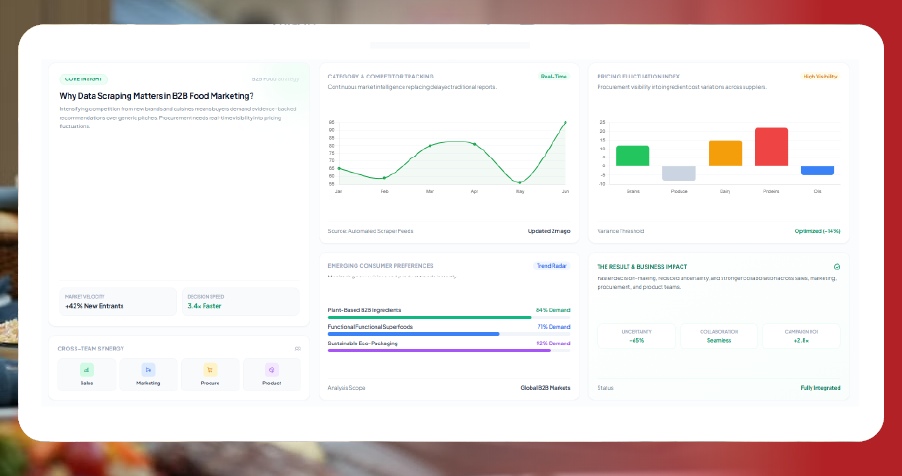
Competition within the food industry continues to intensify as new brands, cuisines, and products enter the market every day. Buyers expect suppliers to provide evidence-backed recommendations rather than generic sales presentations. Marketing teams require current information to develop campaigns, while procurement departments need visibility into pricing fluctuations and supplier performance.
Data scraping bridges these gaps by delivering continuous market intelligence. Organizations can monitor competitor activities, identify emerging consumer preferences, evaluate regional demand, and track category performance without waiting for traditional market research reports.
The result is faster decision-making, reduced uncertainty, and stronger collaboration across sales, marketing, procurement, and product development teams.
Key Business Benefits of Data Scraping
Businesses adopting food data scraping gain advantages across multiple operational areas.
- Monitor competitor menu changes and product launches automatically.
- Compare restaurant and retail pricing across different regions.
- Identify seasonal food trends before they become mainstream.
- Support product development with real market demand insights.
- Improve retailer negotiations using competitive intelligence.
- Strengthen category management through continuous market monitoring.
- Build data-backed sales presentations for distributors and retailers.
- Reduce manual research while improving reporting accuracy.
These advantages help organizations remain competitive in a rapidly changing food marketplace.
Restaurant Menu Intelligence Supports Smarter Decisions
Restaurant menus provide one of the richest sources of commercial intelligence. Every menu update reflects changing customer preferences, ingredient availability, pricing strategies, and seasonal promotions.
Using Restaurant Menu Data Extraction, businesses can collect detailed information including menu categories, product descriptions, ingredients, portion sizes, beverage selections, nutritional details, promotional offers, and limited-time products.
Instead of manually reviewing hundreds of restaurant websites, organizations receive centralized datasets that reveal how menus evolve across cities, regions, or countries. This information helps suppliers identify growing ingredient demand while enabling manufacturers to discover new product opportunities.
Restaurant intelligence also helps foodservice businesses benchmark competitors and understand how menu strategies differ across various market segments.
Product Innovation Driven by Market Evidence
Launching successful food products requires understanding what consumers and businesses are already demanding. Rather than relying solely on intuition, companies increasingly analyze large-scale market data to validate product concepts before investing in production.
Restaurant menus, retail shelves, and delivery platforms collectively reveal changing preferences for healthier ingredients, premium products, regional specialties, plant-based alternatives, and functional foods.
Businesses using market intelligence significantly reduce product development risks because every innovation decision is supported by measurable evidence instead of assumptions.
This approach accelerates research and development while improving the success rate of new product launches.
Retail Intelligence Improves Commercial Partnerships
Retailers expect suppliers to understand category performance beyond their own products. Data scraping enables suppliers to enter buyer meetings with valuable insights about pricing, promotions, assortment gaps, and consumer demand.
Through Food Retail Data Extraction, organizations continuously monitor product catalogs, shelf prices, stock availability, promotional campaigns, package sizes, and category expansion across multiple retail chains.
Retail buyers appreciate suppliers who provide actionable intelligence that supports category growth rather than simply promoting individual products. This creates stronger relationships, improves listing opportunities, and enhances long-term collaboration.
Transforming Raw Data into Actionable Insights
Collecting large amounts of information is only valuable when businesses can convert it into meaningful intelligence. Analytical platforms process millions of records to identify patterns, trends, and opportunities that would otherwise remain hidden.
Using Restaurant Menu Data Analytics, organizations can evaluate ingredient adoption, cuisine popularity, pricing movements, seasonal demand, promotional effectiveness, and regional consumer preferences.
Interactive dashboards enable executives and category managers to visualize market changes quickly, making strategic planning more efficient and evidence-driven.
AI is Changing Food Market Intelligence
Artificial intelligence has transformed the way businesses analyze food industry data. Instead of reviewing spreadsheets manually, AI systems automatically detect pricing anomalies, ingredient trends, menu innovation, and changing consumer preferences.
AI-Driven Menu Data Scraping enables businesses to process vast amounts of structured information from multiple digital sources while identifying relationships between products, pricing, and customer behavior.
AI-powered analytics also improve forecasting, allowing organizations to anticipate market shifts before competitors react. This creates significant advantages in pricing strategy, product development, inventory planning, and marketing execution.
Applications Across the Food Industry
B2B food marketing data scraping supports numerous commercial activities throughout the food ecosystem.
- Competitive benchmarking for restaurant chains and retailers.
- Supplier performance evaluation and procurement planning.
- Product assortment optimization across multiple markets.
- Regional expansion planning using local demand insights.
- Digital shelf monitoring for grocery retailers.
- Consumer trend analysis across cuisines and ingredients.
- Pricing strategy development using market comparisons.
- Market forecasting supported by continuously updated intelligence.
Because the information is collected automatically, businesses spend less time gathering data and more time making strategic decisions.
Turn Food Market Data into Your Competitive Advantage — Unlock real-time restaurant, retail, and pricing intelligence with our advanced data scraping solutions. Contact us today to discover how customized food market data can power smarter decisions, stronger partnerships, and faster business growth.
Building Comprehensive B2B Food Market Intelligence
No single dataset can provide a complete understanding of today's food industry. Organizations achieve stronger outcomes by combining restaurant menus, grocery products, delivery platforms, promotional campaigns, pricing information, and customer feedback into one centralized intelligence system.
This integrated approach creates comprehensive B2B Food Market Intelligence, allowing decision-makers to identify relationships between pricing, menu innovation, retailer performance, consumer demand, and competitive positioning.
Businesses gain a complete market view that supports faster innovation, smarter investments, and stronger commercial planning across every stage of the food supply chain.
Similarly, organizations that Extract Restaurant Menu Data regularly can monitor evolving menu strategies, discover high-performing products, evaluate competitor positioning, and identify opportunities for future product development.
Modern businesses also benefit from Web Scraping Food Delivery Data, which provides insights into delivery pricing, restaurant rankings, promotional campaigns, cuisine popularity, and customer engagement across leading food delivery platforms.
How Food Data Scrape Can Help You?
Comprehensive Restaurant & Retail Data Collection
We collect restaurant menus, grocery catalogs, pricing, promotions, product availability, and competitor updates from multiple digital platforms, delivering structured datasets that support smarter marketing, sales, procurement, and product development decisions.
Real-Time Market & Pricing Intelligence
Our automated scraping solutions continuously monitor menu changes, competitor pricing, seasonal launches, and promotional campaigns, enabling businesses to respond quickly to market shifts and maintain a strong competitive advantage.
AI-Powered Trend & Consumer Insights
We transform large-scale food industry data into actionable intelligence by identifying emerging ingredients, cuisine trends, regional demand patterns, and customer preferences that support innovation and strategic business planning.
Customized Data Delivery & Integration
Our services deliver clean, structured data in CSV, JSON, Excel, APIs, or cloud platforms, allowing seamless integration with your BI tools, analytics dashboards, CRM systems, and enterprise workflows.
Scalable Competitive Intelligence Solutions
Whether tracking hundreds or millions of menu items across restaurants, retailers, and delivery platforms, our scalable scraping infrastructure provides accurate, timely insights for confident B2B food marketing and commercial growth.
Conclusion
The future of B2B food marketing belongs to organizations that transform publicly available market information into actionable business intelligence. Continuous monitoring of restaurant menus, retail pricing, delivery platforms, promotions, and product launches allows businesses to respond faster, innovate confidently, and strengthen relationships with buyers and distributors.
Advanced AI Restaurant Data Intelligence solutions further enhance these capabilities by automatically identifying emerging trends, forecasting demand, and uncovering competitive opportunities hidden within massive datasets. Combined with comprehensive Food Datasets, organizations gain the foundation needed to make informed commercial decisions across product development, sales, procurement, and category management.
As competition continues to grow, businesses that invest in Real-Time Price Monitoring and scalable data scraping solutions will be better positioned to optimize pricing strategies, identify market opportunities early, improve operational efficiency, and achieve sustainable long-term growth in the evolving food industry.
If you are seeking for a reliable data scraping services, Food Data Scrape is at your service. We hold prominence in Food Data Aggregator and Mobile Restaurant App Scraping with impeccable data analysis for strategic decision-making.