The Client
The client is a rapidly growing grocery retail analytics company serving supermarkets, FMCG distributors, and quick-commerce platforms across India. The organization specializes in delivering actionable retail intelligence that helps businesses optimize inventory, pricing, and customer engagement strategies. Their primary objective was to improve supply chain visibility and identify shifting buying patterns across urban and semi-urban markets.
Using Real-Time Grocery Demand Monitoring, the client tracked category-wise purchasing behavior, seasonal demand spikes, and product availability trends. This enabled retailers to reduce stockouts and improve replenishment efficiency during high-demand periods.
The company further strengthened operations with BigBasket Consumer Demand Analytics, helping brands understand consumer preferences, regional product demand, and pricing sensitivity across multiple grocery segments.
To improve forecasting accuracy, the client integrated AI-powered grocery forecasting tools that transformed raw retail data into predictive insights, supporting smarter procurement planning, operational efficiency, and long-term business growth in India’s evolving digital grocery ecosystem.
Key Challenges
- Inconsistent Demand Visibility
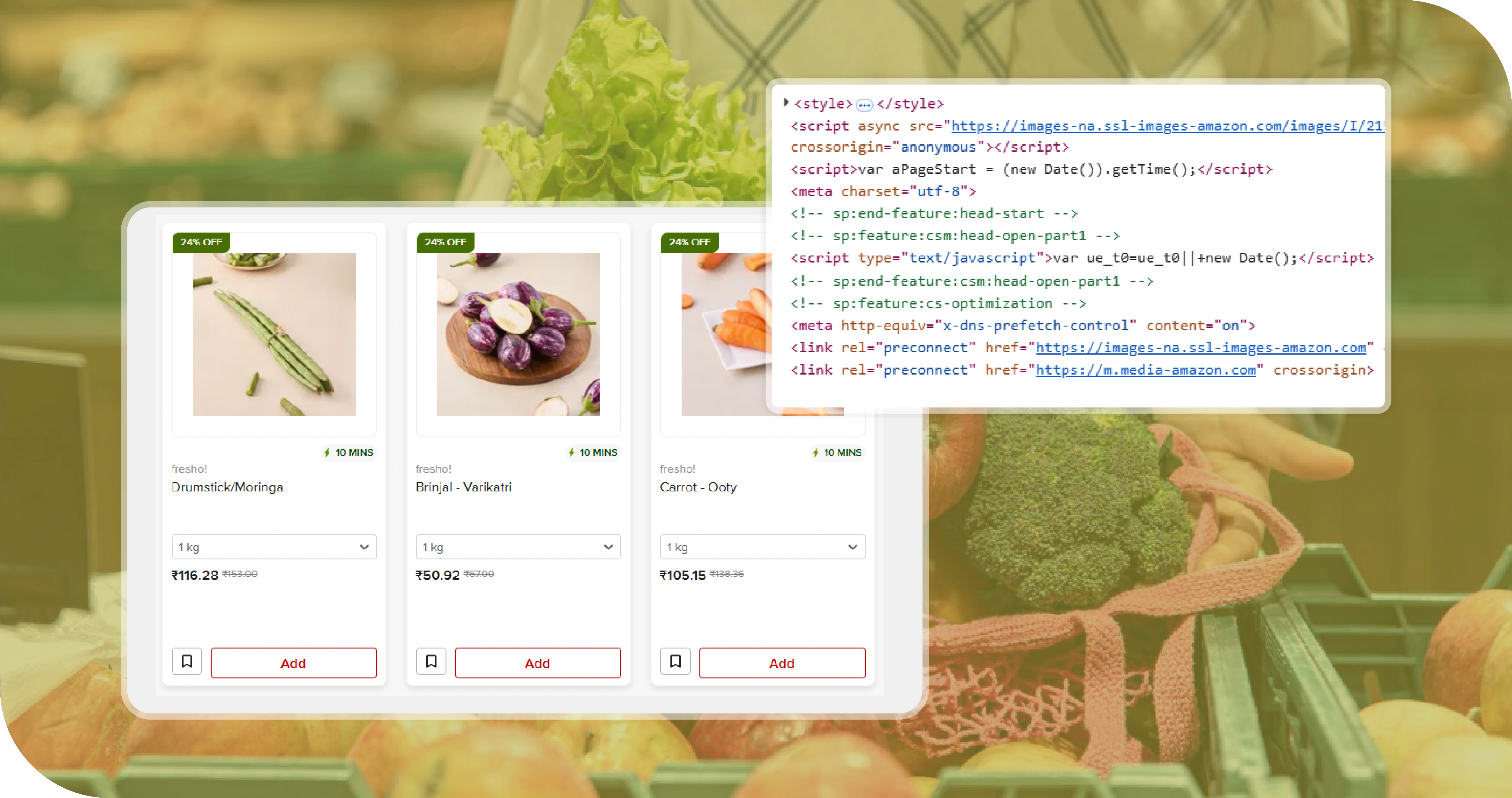
The client struggled to monitor fluctuating grocery demand across regions, causing inaccurate inventory planning and delayed replenishment decisions. Managing large-scale retail intelligence through the Bigbasket Grocery Dataset became difficult because category-level demand patterns changed rapidly during promotions, festivals, and seasonal buying periods. - Difficulty Tracking Dynamic Pricing
Frequent product price changes, discount campaigns, and availability fluctuations created challenges in maintaining competitive pricing intelligence. The absence of a centralized Big Basket Grocery Delivery Scraping API limited the client’s ability to collect structured, real-time pricing data required for accurate forecasting and retail benchmarking strategies. - Managing Large-Scale Retail Data
The company faced operational inefficiencies while handling millions of grocery records from multiple locations and product categories. Traditional methods of Web Scraping Grocery Data lacked scalability, resulting in delayed analytics, inconsistent datasets, duplicate records, and slower decision-making across procurement and supply chain management operations.
Key Solutions
- Automated Demand Data Collection
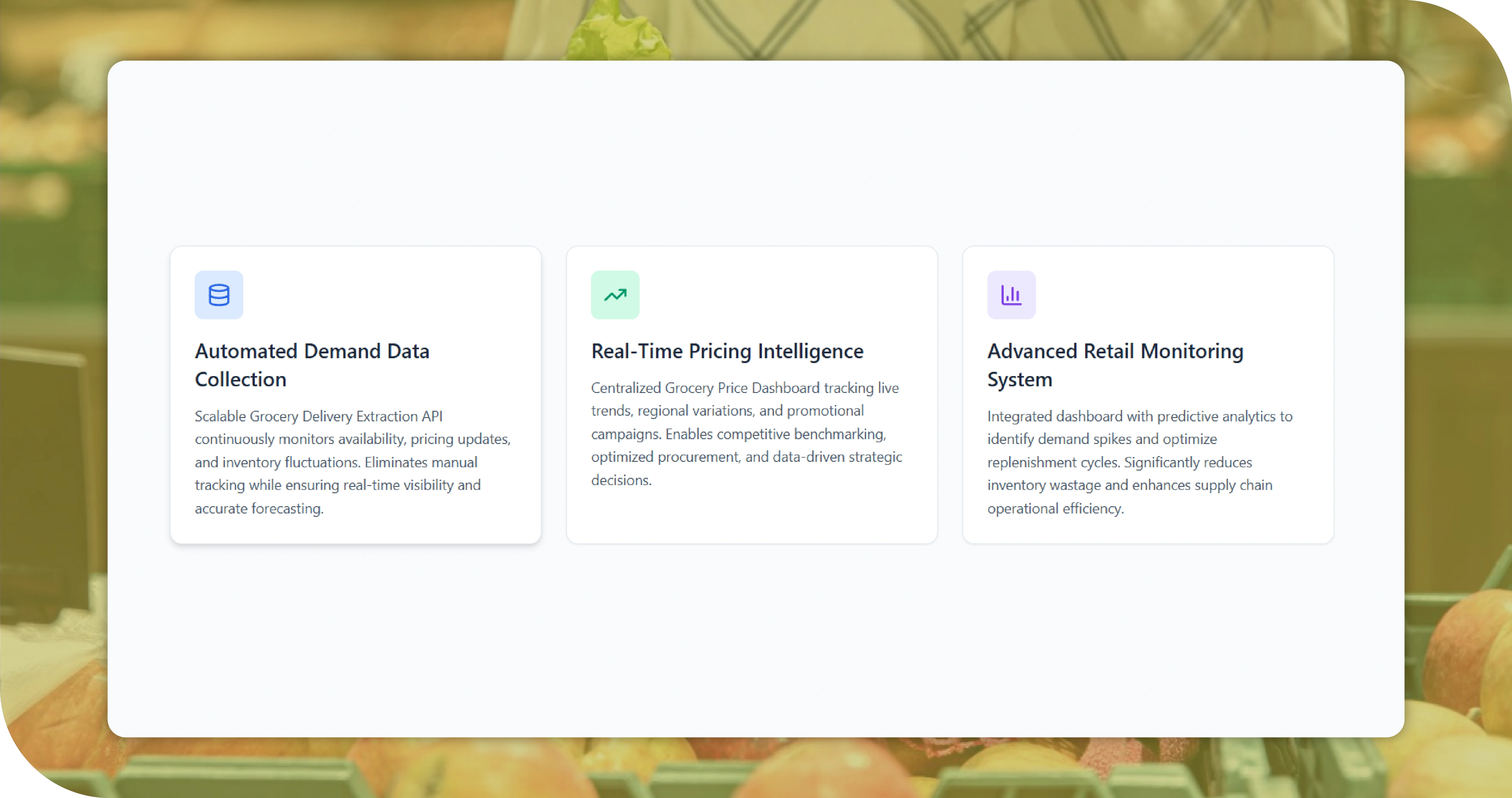
We implemented a scalable Grocery Delivery Extraction API that continuously collected product availability, pricing updates, category trends, and inventory fluctuations from grocery delivery platforms. This automated system eliminated manual tracking challenges while improving data consistency, real-time visibility, and forecasting accuracy across retail operations. - Real-Time Pricing Intelligence
Our team developed a centralized Grocery Price Dashboard that enabled the client to monitor live grocery pricing trends, discounts, regional price variations, and promotional campaigns. The dashboard provided actionable analytics for competitive benchmarking, procurement optimization, and faster strategic decision-making across multiple retail categories. - Advanced Retail Monitoring System
We delivered a highly interactive Grocery Price Tracking Dashboard integrated with predictive analytics and automated reporting features. The solution helped the client identify demand spikes, monitor fast-moving products, optimize replenishment cycles, reduce inventory wastage, and improve operational efficiency throughout the grocery supply chain ecosystem.
Sample Data
| Region | Product Category | Average Daily Records Collected | Pricing Updates Tracked | Demand Accuracy Improvement | Stockout Reduction | Forecasting Efficiency Increase | Retail Insight Generated |
|---|---|---|---|---|---|---|---|
| Mumbai | Dairy Products | 120,000 | 18,500 | 34% | 28% | 40% | High |
| Delhi | Packaged Foods | 145,000 | 22,000 | 38% | 31% | 45% | High |
| Bengaluru | Fresh Vegetables | 132,000 | 19,300 | 36% | 30% | 43% | Very High |
| Hyderabad | Snacks & Beverages | 118,500 | 17,200 | 32% | 26% | 39% | Medium |
| Chennai | Household Essentials | 126,400 | 18,900 | 35% | 29% | 41% | High |
| Pune | Frozen Foods | 109,700 | 15,600 | 30% | 24% | 36% | Medium |
| Kolkata | Personal Care | 97,500 | 13,400 | 28% | 22% | 33% | Medium |
| Ahmedabad | Grocery Staples | 116,800 | 16,900 | 33% | 27% | 38% | High |
Methodologies Used
- Multi-Source Data Aggregation
Our team collected structured retail information from multiple grocery platforms, regional marketplaces, and digital commerce sources. This approach ensured broader market coverage, improved data consistency, and enabled accurate comparison of product availability, customer demand behavior, and price movement trends across cities and categories. - Real-Time Data Processing
We implemented automated pipelines capable of processing millions of records continuously throughout the day. The system filtered duplicate entries, standardized product attributes, validated pricing updates, and delivered near real-time analytics that improved operational responsiveness and accelerated inventory management decisions for retail stakeholders. - Predictive Demand Modeling
Advanced forecasting models were developed using historical purchasing patterns, seasonal buying trends, and consumer behavior analysis. These predictive systems identified future demand fluctuations, optimized replenishment planning, minimized overstocking risks, and improved supply chain coordination for fast-moving grocery and household product categories. - Dynamic Pricing Intelligence
A comprehensive pricing intelligence framework tracked promotional campaigns, regional price variations, and competitor discount strategies. This methodology enabled retailers to analyze market positioning, improve pricing competitiveness, and identify revenue optimization opportunities while maintaining customer retention and enhancing overall retail profitability. - Scalable Analytics Infrastructure
We designed a scalable cloud-based analytics ecosystem capable of handling high-volume retail datasets efficiently. The infrastructure supported automated reporting, centralized monitoring, and faster data visualization while ensuring data reliability, operational scalability, and seamless integration with enterprise-level retail intelligence and forecasting platforms.
Advantages of Collecting Data Using Food Data Scrape
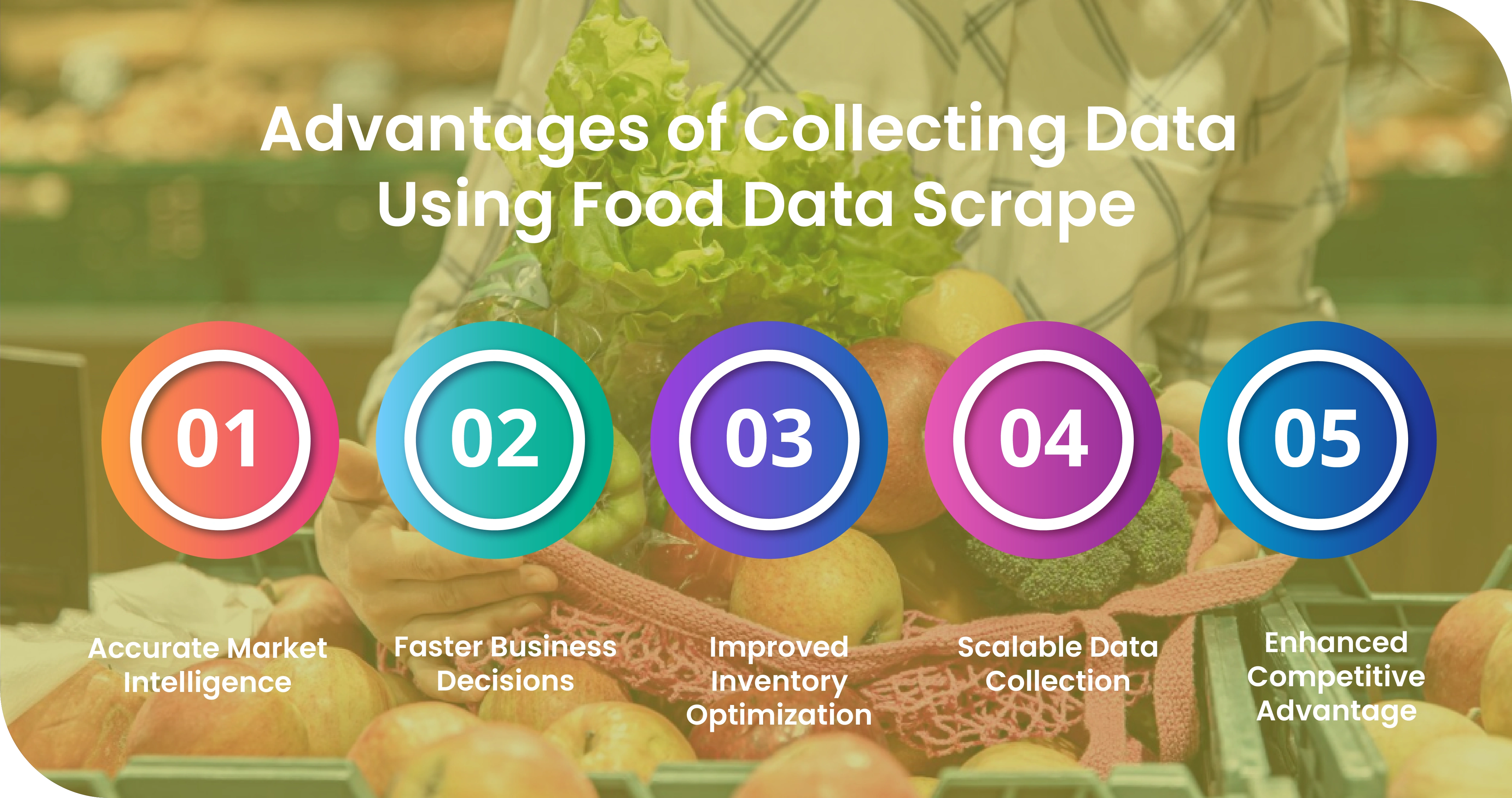
- Accurate Market Intelligence
Our data extraction solutions provide highly accurate and structured market insights from multiple digital retail platforms. Businesses gain reliable visibility into product trends, consumer preferences, inventory movement, and pricing behavior, enabling smarter strategic planning and more confident operational decision-making across competitive grocery markets. - Faster Business Decisions
Real-time analytics and automated monitoring systems help businesses respond quickly to changing market conditions. Companies can identify demand fluctuations, track competitor activities, and optimize pricing strategies faster, allowing decision-makers to improve agility, reduce delays, and strengthen overall retail performance in dynamic environments. - Improved Inventory Optimization
Our services help businesses maintain balanced inventory levels by identifying high-demand and slow-moving products efficiently. Retailers can minimize stock shortages, reduce overstocking risks, improve replenishment planning, and ensure better product availability while lowering operational costs throughout the supply chain management process. - Scalable Data Collection
We offer scalable extraction systems capable of processing millions of retail records daily without compromising speed or accuracy. The infrastructure supports multi-location operations, high-volume datasets, automated workflows, and seamless integration with existing analytics platforms, helping enterprises expand operations with greater efficiency and reliability. - Enhanced Competitive Advantage
Businesses gain deeper visibility into competitor pricing, promotional campaigns, and customer buying patterns through advanced analytics solutions. These insights support better revenue optimization, stronger customer engagement, improved forecasting accuracy, and more effective long-term growth strategies within the rapidly evolving grocery and retail industry landscape.
Client’s Testimonial
“Working with this data analytics team completely transformed our grocery demand forecasting and retail intelligence operations. Their automated extraction systems delivered highly accurate pricing, inventory, and consumer demand insights in real time. The customized dashboards helped us improve forecasting precision, reduce stock shortages, and optimize procurement planning across multiple cities. Their scalable infrastructure and advanced analytics significantly improved our operational efficiency and decision-making speed. The team was responsive, technically strong, and capable of handling large-scale retail datasets seamlessly. We achieved measurable business growth and stronger market competitiveness through their data-driven solutions. Their expertise played a critical role in modernizing our retail analytics ecosystem.”
— Director of Retail Analytics
Final Outcome
The case study highlights how advanced retail analytics and automated extraction technologies can transform grocery demand forecasting and operational planning. By leveraging real-time insights, the client successfully improved inventory management, reduced stock shortages, optimized pricing strategies, and strengthened supply chain responsiveness across multiple regions. The integration of predictive analytics enabled faster business decisions and improved overall retail efficiency in a highly competitive market environment.
The project demonstrated the strategic value of Grocery Data Intelligence in identifying consumer behavior trends, monitoring demand fluctuations, and supporting data-driven retail operations. With scalable infrastructure and automated analytics systems, the client achieved stronger forecasting accuracy and improved profitability.
The use of structured Grocery Datasets further enhanced reporting quality, market visibility, and long-term business planning, helping the organization adapt quickly to changing customer preferences and evolving grocery commerce trends across India’s expanding digital retail ecosystem.