Why BigBasket Data Is Uniquely Valuable
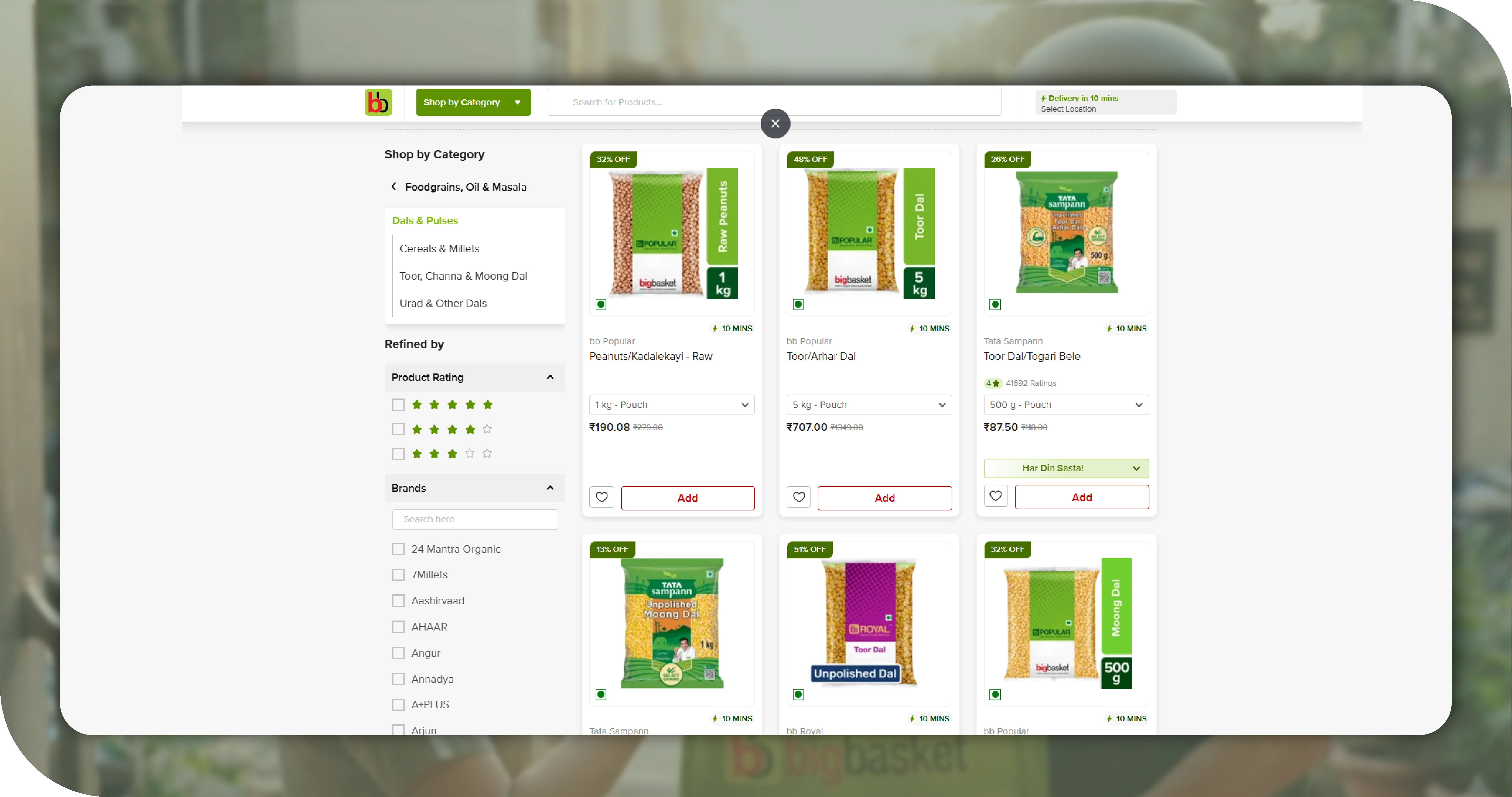
BigBasket's catalog depth and dual delivery model make it a data source with characteristics the quick-commerce-only platforms do not share.
- Unmatched assortment depth. BigBasket carries a far larger SKU universe than a dark-store-limited platform, which makes it the best single source for mapping the full breadth of a category.
- Two delivery models in one catalog. Scheduled delivery and BB Now quick commerce coexist, so the data captures both planned large-basket behaviour and instant-delivery behaviour.
- Strong private label. BigBasket's own brands are a significant shelf presence, making the own-label price gap a key competitive signal for national brands.
- City-level pricing and availability. Prices and stock vary by city and serviceable area, so a national average hides the reality a brand competes in.
The commercial question is never "what is my price on BigBasket?" in the abstract. It is "where do I stand across BigBasket's cities and delivery modes, against the competitors and own-label products on the same shelf?" That question needs an API, not a screenshot.
What the API Returns
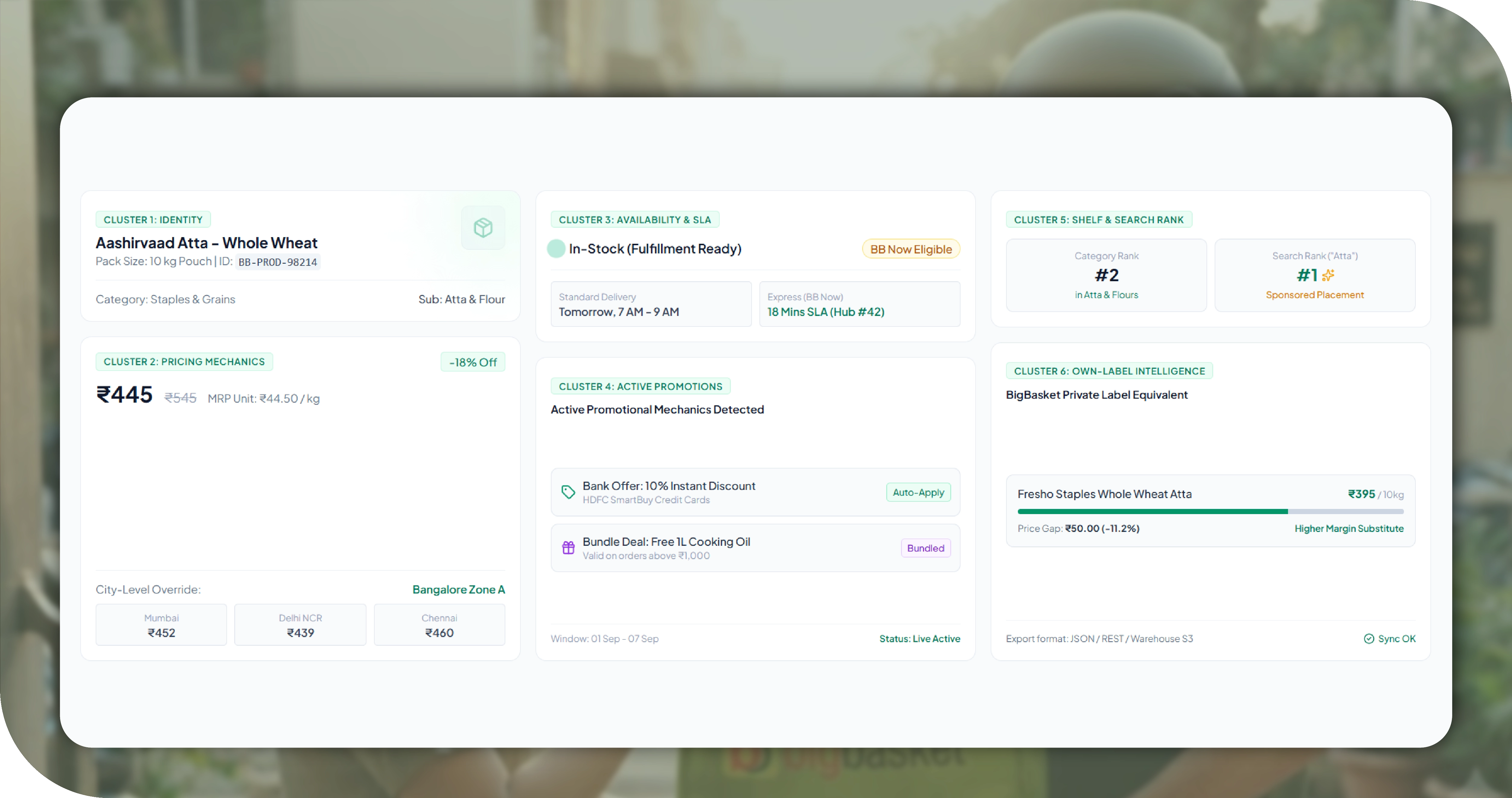
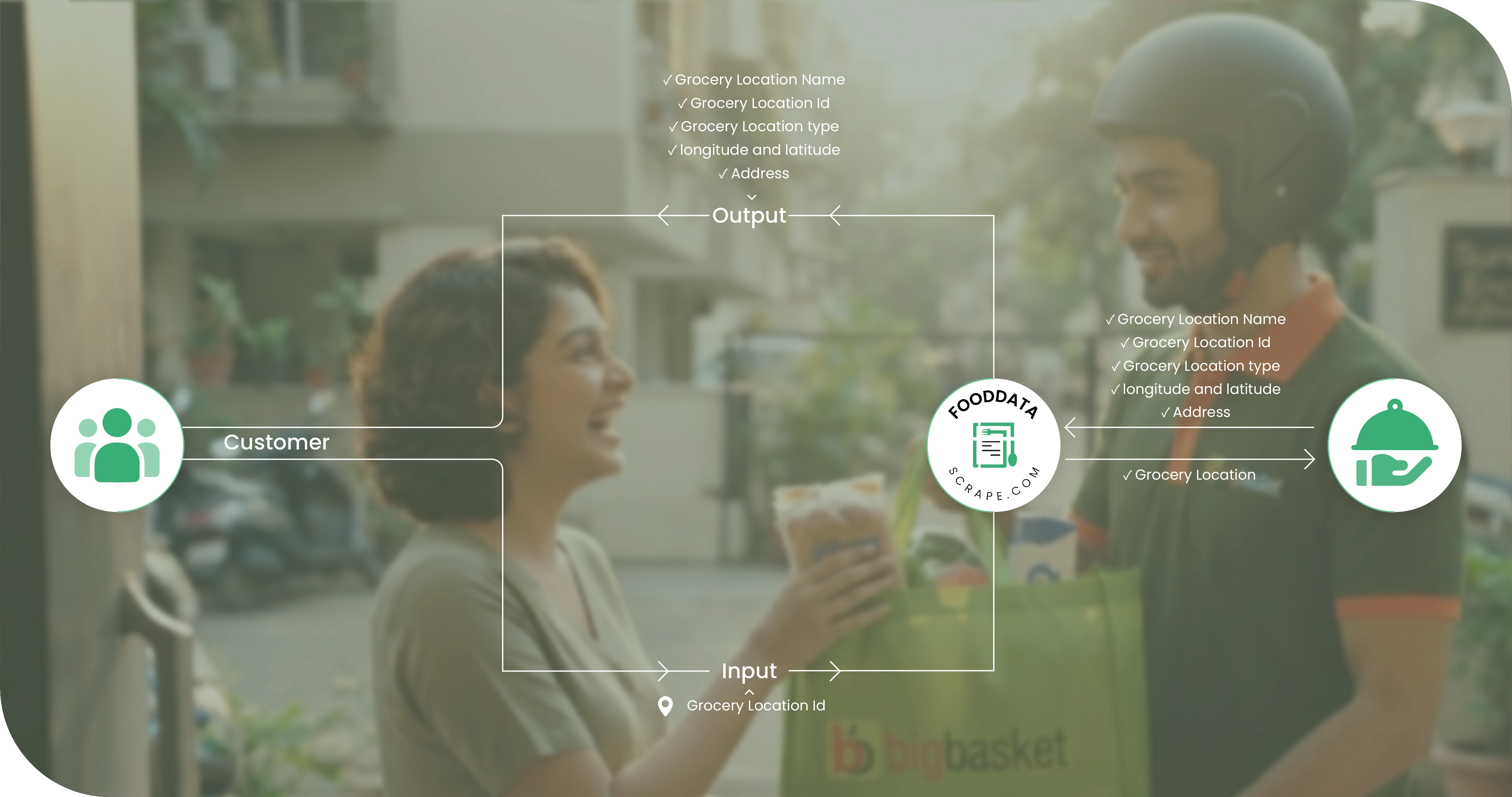
Everything a shopper can see on BigBasket's public catalog is available through the API, structured and refreshable. The fields cluster into six groups.
- Product identity. Product name, brand, normalized name, category and sub-category, pack size, variant, product identifiers, and images.
- Pricing. Selling price, MRP, discount depth, unit price, and promotional or bundle pricing — per city or serviceable area.
- Availability. In-stock or out-of-stock status by city and delivery mode, including BB Now where applicable.
- Promotions. Active offers, discount depth, promotional mechanics, and promotion start and end detection.
- Shelf and search position. Category rank and search rank for defined terms, and sponsored placement detection where publicly labeled.
- Own-label context. BigBasket's own-brand equivalents, their prices, and the price gap to the branded product.
Delivered through a REST API with JSON responses, the data can also arrive as bulk export or scheduled files into a warehouse — matched to how the consuming team works.
Sample Data: A BigBasket Product Record
The structure below reflects an API response from the BigBasket feed. Values are illustrative.
{
    "product_name": "Example Brand Toor Dal 1kg",
    "brand": "Example Brand",
    "retailer": "BigBasket",
    "category": "Staples",
    "sub_category": "Dals & Pulses",
    "pack_size": "1kg",
    "city": "Bengaluru",
    "delivery_mode": "Scheduled",
    "mrp_inr": 189,
    "selling_price_inr": 159,
    "discount_pct": 15.9,
    "unit_price_inr_per_kg": 159,
    "in_stock": true,
    "category_rank": 6,
    "own_label_equivalent_inr": 132,
    "own_label_price_gap_pct": -17.0
}
The own_label_price_gap_pct field is the one that changes strategy conversations. BigBasket's own-label equivalent priced 17% below the branded product, on the same shelf, is a direct substitution pressure — and in a commodity staple like toor dal, where shoppers are highly price-sensitive, that gap is decisive. It is invisible to the brand unless the shelf is being watched.
Sample Data: The Same SKU Across Cities and Delivery Modes
Product: Example Brand Toor Dal 1kg — Retailer: BigBasket
| City | Delivery Mode | Selling Price (Rs) | In Stock | Category Rank |
|---|---|---|---|---|
| Bengaluru | Scheduled | 159 | Yes | 6 |
| Bengaluru | BB Now | 165 | Yes | 5 |
| Mumbai | Scheduled | 155 | Yes | 4 |
| Delhi | Scheduled | 162 | No | 8 |
| Hyderabad | BB Now | 169 | Yes | 7 |
Same product, same retailer, same day — a Rs 14 spread across cities and delivery modes, an out-of-stock in Delhi, and a category rank ranging from 4th to 8th. Notice that BB Now prices run above scheduled delivery for the same SKU in the same city, a quick-commerce premium that only shows up when both modes are tracked together. A national view of "BigBasket price" would miss all of it.
Sample Data: Own-Label Threat Tracking
Category: Dals & Pulses — Retailer: BigBasket
| Tier | Product | Price (Rs) | Unit Price (per kg) | Gap vs Brand |
|---|---|---|---|---|
| Value own-label | bb Popular Toor Dal 1kg | 119 | 119 | -25% |
| Core own-label | BB Royal Toor Dal 1kg | 132 | 132 | -17% |
| Your brand | Example Brand 1kg | 159 | 159 | — |
| Competitor brand | Competitor Toor Dal 1kg | 152 | 152 | -4% |
| Premium own-label | BB Select Toor Dal 1kg | 149 | 149 | -6% |
BigBasket runs a full own-label ladder in staples, and here three own-label tiers sit below the brand, with the value tier 25% cheaper per kilogram. In a commodity category, that ladder is engineered to capture every price-sensitivity segment beneath the national brand — and tracking it is one of the most important functions of any BigBasket dataset.
What Developers and Businesses Build With It
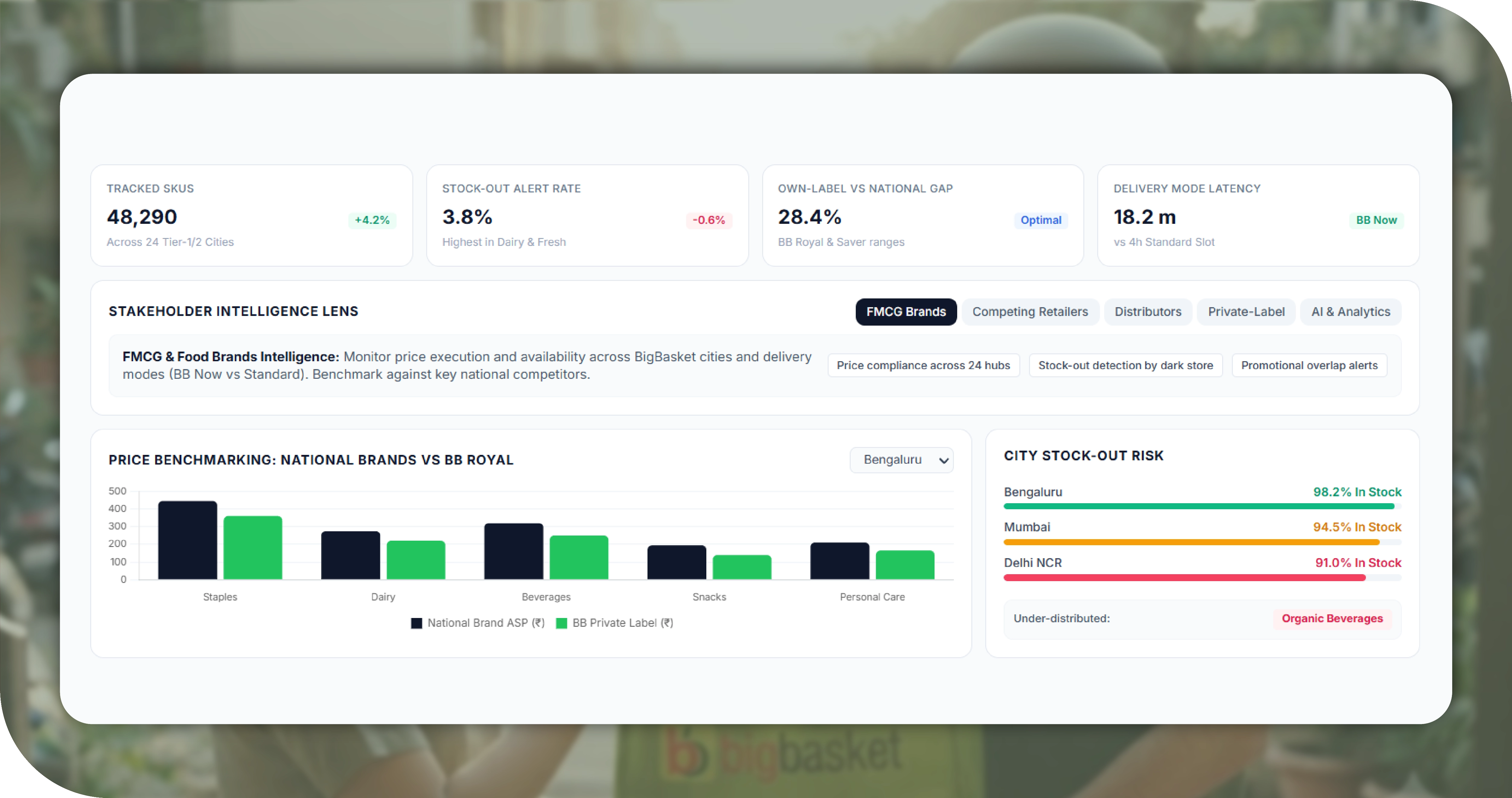
- FMCG and food brands monitor price and availability across BigBasket cities and delivery modes, benchmark against competitors and own-label, and detect stock-outs.
- Grocery and price-comparison apps power a live BigBasket price and availability layer, using its catalog depth as a broad reference source.
- Competing retailers and platforms benchmark BigBasket's assortment, pricing and own-label strategy to inform their own range decisions.
- Distributors and brokers identify cities where a brand they represent is under-distributed or out of stock on BigBasket.
- Private-label manufacturers track how BigBasket's own brands are priced and laddered against the national brands they substitute.
- Analytics and AI products use BigBasket's deep catalog as structured training and reference data for grocery models.
The FoodDataScrape BigBasket Data Model
- Product identity: product name, brand, normalized name, category and sub-category, pack size, variant, product identifiers, images
- Geography and mode: city, serviceable area, delivery mode (scheduled and BB Now)
- Pricing: selling price, MRP, discount depth, unit price, promotional and bundle pricing, price history
- Availability: in-stock or out-of-stock status per city and mode, stock-out events, stock-out duration
- Position: category rank, search rank for defined terms, sponsored placement detection where publicly labeled
- Own-label context: BigBasket own-brand tier mapping, own-label price, price gap to the branded product
- Change tracking: new listings, delistings, price movements, rank changes, stock-out events
Delivered via REST API with JSON responses, bulk export (CSV, JSON, Parquet), or scheduled files into a warehouse, normalized so the same product resolves to a single entity.
Methodology and Compliance
- We collect publicly accessible catalog, price and availability information only. No authenticated content, no private data, no personal consumer data.
- Collection is at the city and delivery-mode level, because a national average conceals the variance that makes the data valuable.
- Products are normalized so the same SKU resolves to a single entity across cities and modes, and cross-retailer comparison is like-for-like.
- Unit price is computed, enabling true comparison across differing pack sizes.
- Price and availability are captured together, since a price on an out-of-stock item is not a price a shopper can act on.
- Crawlers are rate-limited and engineered not to degrade the platform we collect from.
Conclusion
BigBasket's catalog is one of the deepest and most complete pictures of Indian grocery available anywhere — a full-range assortment across two delivery models, with a private-label ladder engineered to sit beneath every national brand. All of it is public, all of it is current, and none of it is usable from inside a shopping interface built for filling a basket.
A BigBasket Grocery Data Scraping API makes it usable: structured, city-level, across delivery modes, with own-label gaps quantified and every change tracked, delivered where your software can actually consume it.
FoodDataScrape crawls 220M+ pages of food and grocery data every week so that the BigBasket data your product or your pricing depends on arrives as a clean feed, not a browsing exercise.