Why the Gulf market forces this (context — real, cited)
Saudi Arabia's food-delivery market was valued at roughly $10 billion in 2024, growing ~15–18% a year (Tech Buzz China, Jan 2026). As of 2026, HungerStation leads with ~50% share in major cities, Jahez holds ~30–33%, and Meituan-backed Keeta ~10–11% (deonde.co, 2026).
The disruptive event is Keeta: Meituan's international arm reached ~10% order-volume share within four months of its late-2024 Saudi launch — becoming the country's third-largest platform — using waived delivery fees and sign-up vouchers (Rest of World / Redseer, 2025). That subsidy war makes competitor promo intensity spike unpredictably. The market is also consolidating and going multi-vertical: Jahez bought Snoonu for ~$320M (Jul 2025), and HungerStation now runs grocery dark stores alongside food (Mordor Intelligence, 2025).
Cross-border adds a layer: in the UAE, Kuwait and Qatar, Talabat's share sits above 50% and in places above 70% (Tech Buzz China, Jan 2026) — so a group across KSA and UAE faces a different competitive set and promo rhythm in each market.
The problem: multiple brands, multiple platforms, no single picture
A multi-brand QSR group ran five brands across four platforms in two countries. Each brand team checked rivals by hand, per emirate, on its own schedule. When Keeta's fee-waiver push hit Riyadh, promo intensity spiked overnight — but by the time it surfaced in a weekly review it was two weeks stale, and Dubai looked nothing like Riyadh.
The solution
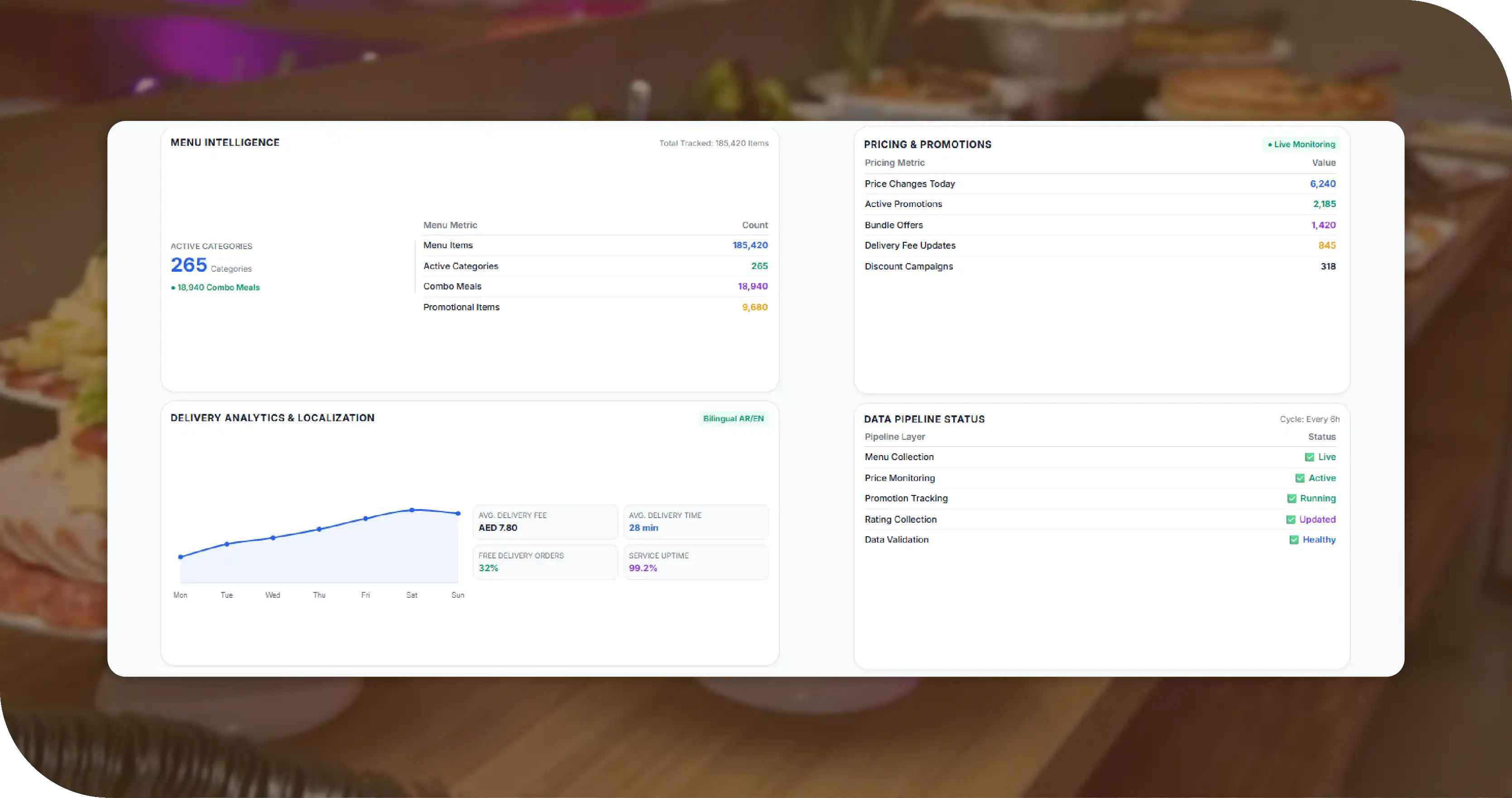
One cross-platform pipeline, one schema: own listings + 12 competitor brands, menu items, prices, bundles, promos, delivery fees, ratings — per city/district, bilingual (AR/EN) capture, refreshed every 6 hours. Delivered as a live dashboard per brand team + weekly leadership rollup + feed into Power BI.
What changed
1. Promo response in days, not weeks. A competitor's 30%-off voucher across three Riyadh districts was matched selectively within 3 days — only on the two brands and zones affected, not blanket across KSA.
2. Menu engineering with market context. Item-level positioning vs the local set per district replaced gut feel — a mid-tier combo was repriced up in Jeddah where it was under-priced, with no volume loss.
3. Keeta strategy grounded in coverage data. Where Keeta's supply overlapped the group's trade zones, listing and promo decisions came from the numbers, not headlines.