Insights
Blog Case Studies Reports & Ebooks White Papers Newsletter Podcast Infographics Videos
Developer Guides
How to Scrape Restaurant Menus How to Scrape Grocery Stores How to Scrape Alcohol Prices Anti-blocking Best Practices API Integration Guides
Company
Our Story FAQs Contact Us Careers
Legal & Trust
Privacy Policy Terms & Conditions
Free 2026 Food Data Report

50+ pages · 1,000+ data points. Trusted by 500+ companies.

Download free →
Join 5,000+ Subscribers

Monthly insights on food & AI.

Subscribe →
Book a Demo →

You'll receive the case study on your business email shortly after submitting the form.

Home Case Study

D2C Food Brand: Reviews & Sentiment at Scale

D2C Food Brand: Reviews & Sentiment at Scale

What 1.2M BigBasket and Swiggy reviews told a D2C food brand that its sales data couldn't.

  • 1.2M reviews scored: own brand + 5 competitors across BigBasket, Swiggy Instamart, Amazon
  • Sentiment scoring at 91% accuracy (hand-labeled sample of 2,000)
  • 7 recurring complaint themes; #1 drove a packaging fix
  • Rating recovery: 3.9 → 4.4 on BigBasket within 3 months
  • Competitor insight: identified freshness-on-arrival as the driver of a rival's premium ratings
D2C Food Brand: Reviews & Sentiment at Scale

Why review scale is the point (context — real, cited)

Review corpora on India's grocery platforms are now large enough to be a real signal source. BigBasket receives over 15 million orders a month (GrabOn, Mar 2026), while Swiggy Instamart holds ~24–27% of a quick-commerce market running ~7.8 million orders a day (Startupfeed / Redseer, 2026). Blinkit, Zepto and BigBasket each draw millions of monthly visits (GrabOn, Feb 2026).

At that volume a brand generates thousands of reviews a month — far more than anyone can read by hand. Sales data tells you what happened; reviews tell you why. That gap is where this engagement lives.

The problem: ratings falling, nobody knew why

A D2C food brand watched its BigBasket star average drift from 4.3 toward 3.9 over a quarter. Dashboards confirmed the dip but couldn't explain it, and thousands of new reviews a month made manual reading a biased sample. An average rating is lossy — a 4.1 hiding “5-star taste, 2-star packaging” is only visible with aspect-level scoring at full corpus scale.

The solution
The solution

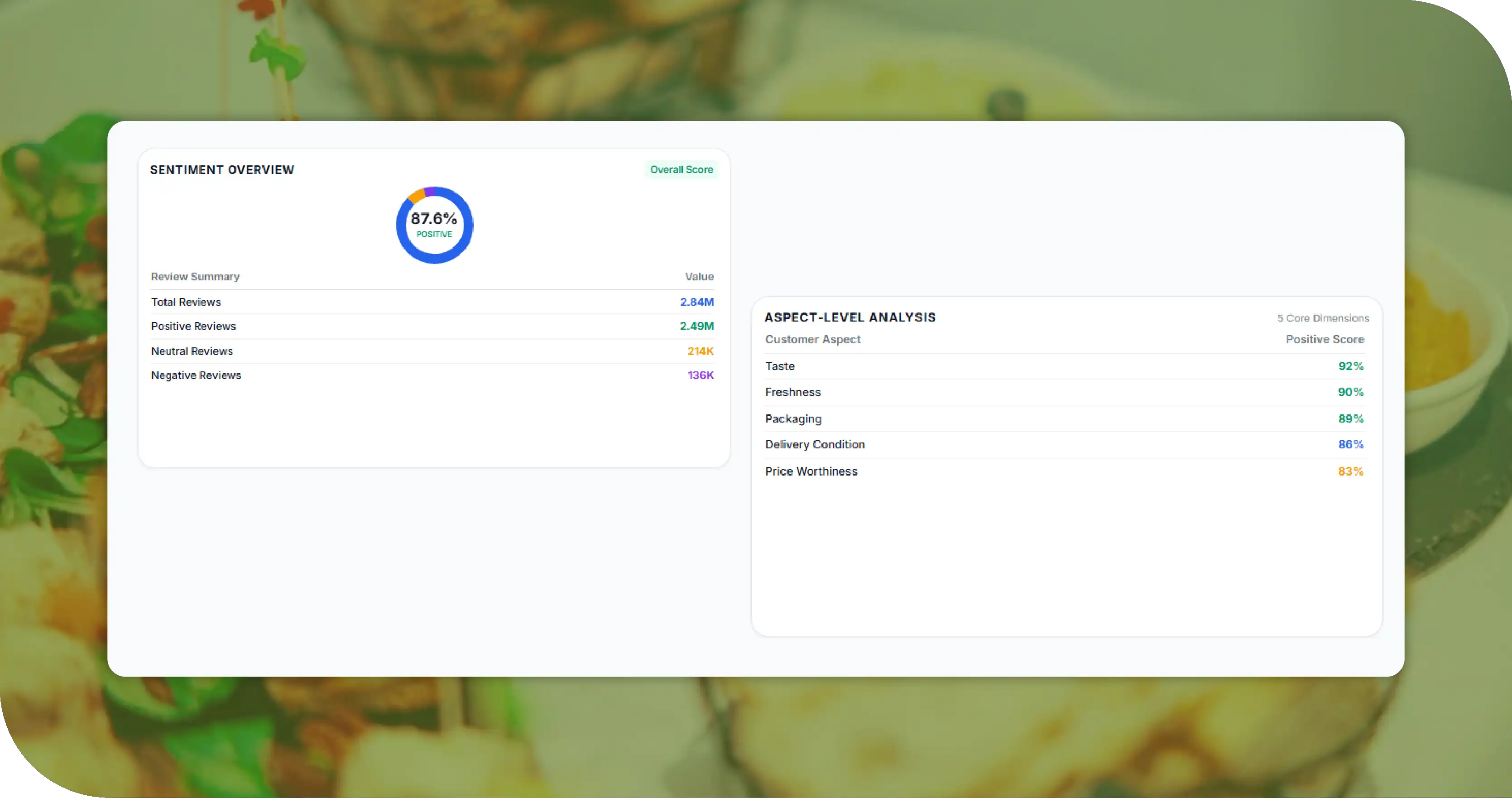
Full-corpus collection (own + competitor SKUs) → dedupe/QA → aspect-level sentiment scoring across taste, packaging, delivery condition, price-worthiness and freshness → a monthly theme report + live dashboard.

What changed

1. The packaging finding. Aspect scoring isolated packaging-in-transit as the #1 complaint (in ~1 in 5 negative reviews), well ahead of taste. A revised seal shipped; the BigBasket average recovered 3.9 → 4.4 in three months.

2. Positioning against the leader. A rival's praise concentrated on freshness-on-arrival — so the brand repositioned copy and creative around its own strongest attribute (taste), which reviews already validated.

3. Reviews became a monthly leadership input. A one-page aspect-trend report now goes to founders and the product lead each month.
FAQs

FAQ 1: Which platforms’ reviews can be analyzed?
BigBasket, Swiggy, Zomato, Amazon, Blinkit/Zepto ratings, ShopeeFood and other public review surfaces — own and competitor products, public data only.
FAQ 2: How accurate is AI sentiment scoring on food reviews?
Aspect-level models validated against hand-labeled samples; accuracy is reported per engagement rather than promised generically [state your real validated range if stable].
FAQ 3: Can competitor reviews be included?
Yes — competitor corpora are usually where the positioning insights live; the collection method is identical since reviews are public.
FAQ 4: How many reviews are needed for reliable themes?
Themes stabilize quickly at category scale; even a few thousand reviews per SKU-set yield reliable top-5 complaint/praise themes, refreshed monthly.