
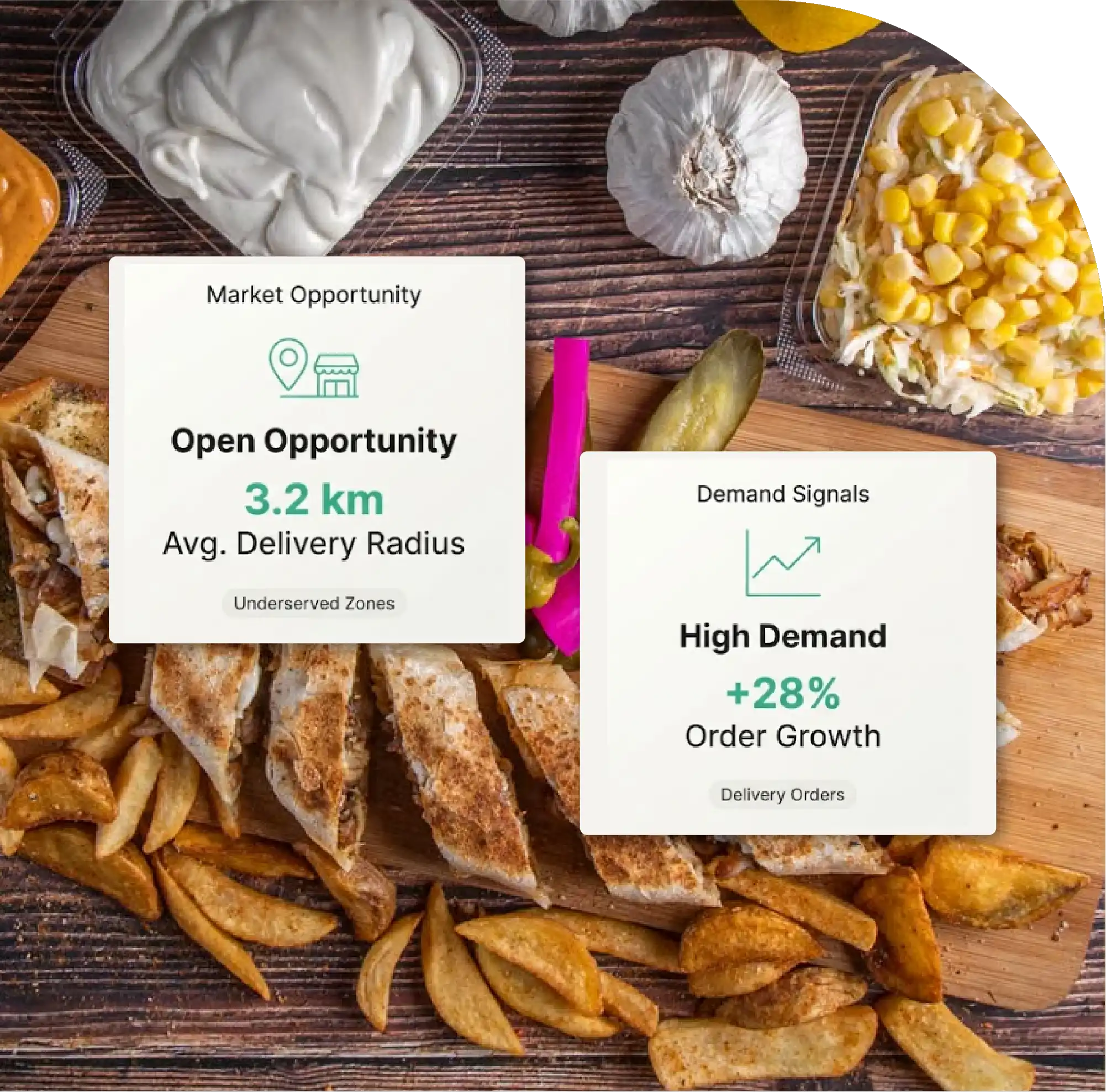
Market Growth: Dubai cloud kitchens experience sustained expansion through increasing digital food delivery demand.
Demand Insights: Consumer preferences reveal significant opportunities across healthy and premium cuisine categories.
Competitive Analysis: Data intelligence identifies pricing, promotions, and competitor performance across delivery platforms.
Gap Opportunities: Underserved neighbourhoods present strong investment potential for specialised cloud kitchen concepts.
Strategic Intelligence: Advanced analytics improve forecasting, operational efficiency, profitability, and long-term business sustainability.

Dubai has emerged as one of the fastest-growing cloud kitchen markets in the Middle East, driven by rapid urbanisation, increasing digital food ordering, and changing consumer lifestyles. The city's diverse population, thriving tourism sector, and widespread adoption of food delivery applications have encouraged restaurants and entrepreneurs to invest in delivery-only business models. Cloud Kitchen Market Gap Analysis In Dubai enables businesses to identify underserved customer segments, optimise operational strategies, and uncover profitable investment opportunities. Furthermore, Cloud Kitchen Data Scraping In Dubai helps organisations gather structured information on restaurant listings, menu pricing, delivery coverage, customer ratings, and promotional activities across multiple food delivery platforms. Through comprehensive Cloud Kitchen Demand Analysis, businesses can forecast regional demand, analyse customer preferences, improve kitchen placement, and maximise return on investment.
Unlike traditional restaurants, cloud kitchens eliminate expensive dining spaces while focusing entirely on food preparation and delivery efficiency. This operational flexibility allows brands to launch multiple virtual concepts from a single production facility, reducing capital expenditure and improving scalability. However, increasing competition has also created several operational and strategic gaps that require continuous market intelligence and data-driven decision-making.
Dubai's cloud kitchen ecosystem has expanded rapidly over the past few years due to strong smartphone penetration, growing reliance on online ordering platforms, and increasing consumer demand for convenience. Delivery-only restaurants now operate across residential communities, commercial districts, and business hubs, serving customers through multiple food delivery applications.
Growing customer expectations for faster deliveries, personalised offers, healthier menu options, and consistent food quality continue reshaping the competitive landscape. Operators increasingly depend on advanced analytics to optimise pricing strategies, monitor competitors, evaluate cuisine demand, and identify emerging business opportunities.
Dubai Cloud Kitchen Market Intelligence provides comprehensive insights into customer behaviour, restaurant performance, delivery efficiency, regional demand, pricing trends, and competitor activities, enabling businesses to make informed operational and investment decisions.
The Dubai cloud kitchen industry demonstrates strong growth across multiple operational indicators. Increasing order frequency, expanding virtual restaurant brands, and rising customer retention collectively indicate a healthy and scalable digital food ecosystem.
Table 1: Dubai Cloud Kitchen Market Performance Indicators (2026 Estimates)
| Performance Indicator | 2024 | 2025 | 2026 |
|---|---|---|---|
| Active Cloud Kitchens | 1,860 | 2,170 | 2,485 |
| Virtual Restaurant Brands | 2,980 | 3,450 | 3,960 |
| Monthly Online Orders | 7,420,000 | 8,610,000 | 9,840,000 |
| Daily Average Orders | 247,000 | 287,000 | 328,000 |
| Average Order Value (AED) | 74 | 78 | 82 |
| Average Delivery Time (Minutes) | 35 | 33 | 31 |
| Customer Satisfaction (%) | 88 | 90 | 91 |
| Repeat Purchase Rate (%) | 42 | 45 | 48 |
| Digital Payment Usage (%) | 89 | 92 | 94 |
| Mobile Ordering Share (%) | 94 | 96 | 97 |
| Average Menu Items | 102 | 111 | 118 |
| Peak Evening Orders (%) | 51 | 54 | 56 |
| Weekend Order Growth (%) | 22 | 25 | 28 |
| Average Customer Rating | 4.28 | 4.35 | 4.41 |
| Average Monthly Revenue per Kitchen (AED) | 198,000 | 221,000 | 246,000 |
The data indicates consistent market expansion supported by increasing consumer confidence in online food delivery. Average order values continue to rise while delivery times improve through enhanced logistics and better kitchen placement. These improvements create favourable conditions for new market entrants while simultaneously increasing competition among existing operators.
Competition within Dubai's cloud kitchen market has intensified considerably as international restaurant brands, regional operators, and independent entrepreneurs continue launching virtual food concepts. Most competition currently exists within burgers, pizzas, fried chicken, and fast-food categories, whereas specialised cuisines remain comparatively underserved.
Cloud Kitchen Competitor Data Scraping enables businesses to continuously monitor menu updates, promotional campaigns, pricing adjustments, customer reviews, cuisine expansion, delivery coverage, and competitor rankings across multiple digital platforms. These insights help restaurant operators benchmark performance and identify opportunities for differentiation.
Similarly, Restaurant Delivery Data Scraping In Dubai allows businesses to analyse delivery times, restaurant availability, service quality, seasonal demand fluctuations, customer engagement, and promotional effectiveness across leading food delivery applications.
Despite rapid industry growth, several significant market gaps continue to exist across Dubai's cloud kitchen ecosystem. Many residential communities remain underserved for healthy meal subscriptions, premium dining delivery, organic food concepts, breakfast brands, and late-night food delivery services.
Consumer feedback also highlights recurring issues related to menu repetition, inconsistent food quality, lengthy delivery times during peak hours, and excessive dependence on promotional discounts for customer acquisition. Businesses capable of addressing these operational challenges can significantly improve customer retention and long-term profitability.
Organisations increasingly Scrape Cloud Kitchen Market Data to evaluate cuisine saturation, customer demand, pricing competitiveness, delivery performance, promotional effectiveness, and regional growth opportunities. Continuous market monitoring enables faster strategic decisions while reducing business risks associated with rapidly changing consumer behaviour.
Additionally, Cloud & Dark Kitchen Tracking supports businesses by monitoring new kitchen launches, virtual restaurant expansion, delivery partnerships, operational performance, geographic coverage, and competitor movement throughout Dubai.
Customer demand varies considerably between cuisine categories and residential locations. While fast food continues generating high order volumes, healthier alternatives, premium meal concepts, vegan offerings, and subscription-based meal services are experiencing faster year-over-year growth.
Table 2: Dubai Cloud Kitchen Demand Gap Analysis by Category
| Cuisine Segment | Active Brands | Monthly Demand | Monthly Orders | Supply Gap (%) | Average Revenue (AED) |
|---|---|---|---|---|---|
| Healthy Meals | 295 | 615,000 | 182,000 | 29 | 34,600,000 |
| Vegan Cuisine | 88 | 174,000 | 49,000 | 41 | 8,900,000 |
| Organic Foods | 48 | 104,000 | 27,000 | 47 | 4,800,000 |
| Breakfast Brands | 91 | 216,000 | 64,000 | 37 | 10,800,000 |
| Premium Dining | 83 | 186,000 | 52,000 | 35 | 12,100,000 |
| Meal Subscription | 57 | 139,000 | 38,000 | 44 | 7,300,000 |
| Indian Cuisine | 341 | 748,000 | 245,000 | 12 | 45,200,000 |
| Chinese Cuisine | 219 | 502,000 | 152,000 | 18 | 28,300,000 |
| Arabic Cuisine | 176 | 386,000 | 118,000 | 24 | 21,400,000 |
| Japanese Cuisine | 124 | 269,000 | 81,000 | 26 | 16,900,000 |
| Desserts | 301 | 664,000 | 203,000 | 17 | 30,700,000 |
| Seafood Delivery | 77 | 182,000 | 51,000 | 31 | 10,900,000 |
| Kids Meals | 61 | 127,000 | 34,000 | 39 | 5,900,000 |
| Late Night Delivery | 69 | 211,000 | 61,000 | 43 | 11,600,000 |
The numerical assessment highlights that healthy meals, vegan concepts, subscription-based dining, premium food delivery, and organic cuisine present the highest supply-demand imbalance. These categories offer substantial opportunities for investors seeking relatively less competitive yet rapidly expanding market segments.
As cloud kitchens continue expanding, businesses require accurate and real-time market information to maintain competitive advantages. Automated data collection technologies enable organisations to analyse thousands of restaurants simultaneously across multiple food delivery platforms.
Food Data Scraping in the UAE helps businesses collect structured information including restaurant names, menu items, pricing, discounts, delivery fees, customer ratings, reviews, cuisine categories, operating hours, and service coverage. This information supports dynamic pricing strategies, menu optimisation, customer segmentation, and regional expansion planning.
Furthermore, Web Scraping Food Delivery Data enables continuous monitoring of market trends, competitor pricing, promotional campaigns, seasonal demand fluctuations, and consumer purchasing behaviour. These insights improve forecasting accuracy while supporting evidence-based operational decisions.
Dubai's cloud kitchen industry is expected to experience continued expansion as consumer dependence on online food delivery increases. Future growth will likely be driven by artificial intelligence, predictive demand forecasting, automated kitchen operations, hyperlocal delivery optimisation, and personalised customer experiences.
Businesses capable of integrating advanced analytics with operational efficiency will be better positioned to identify underserved locations, optimise kitchen capacity, improve customer retention, and enhance profitability. Demand for niche cuisines, healthier food options, premium delivery experiences, and subscription-based meal services is also expected to accelerate over the coming years.
Dubai's cloud kitchen market remains one of the most dynamic food delivery ecosystems in the region. While competition continues increasing across mainstream cuisine categories, substantial opportunities remain within specialised food concepts, underserved residential communities, and premium delivery services. Continuous market monitoring supported by Restaurant Data Intelligence enables businesses to evaluate competitor strategies, customer behaviour, operational performance, and emerging market opportunities with greater accuracy. The integration of Food delivery Intelligence further strengthens pricing optimisation, demand forecasting, and delivery network planning, allowing businesses to improve operational efficiency and customer satisfaction. Leveraging comprehensive Food Datasets provides organisations with actionable insights that support long-term strategic planning, competitive benchmarking, investment analysis, and sustainable growth within Dubai's rapidly evolving cloud kitchen industry.
If you are seeking for a reliable data scraping services, Food Data Scrape is at your service. We hold prominence in Food Data Aggregator and Mobile Restaurant App Scraping with impeccable data analysis for strategic decision-making.
Questions
A cloud kitchen market gap analysis identifies underserved customer segments, cuisine categories, and geographic areas where delivery-only restaurant supply does not meet consumer demand, helping businesses discover profitable investment opportunities.
Data scraping automates collection of restaurant listings, menu pricing, delivery coverage, customer ratings, and promotional activities across food delivery platforms, providing structured datasets for demand forecasting and competitor benchmarking.
Healthy meals, vegan cuisine, organic foods, breakfast brands, premium dining, subscription-based meal services, and late-night delivery concepts show the highest supply-demand gaps and strongest growth potential in Dubai's cloud kitchen market.
By analysing delivery coverage data, competitor presence, population density, order frequency, and consumer demand patterns across different residential communities and commercial districts using automated market intelligence tools.
Common challenges include high competition in mainstream categories, delivery time optimisation during peak hours, menu differentiation, customer retention, promotional cost management, and maintaining consistent food quality across multiple virtual brands.