Introduction
The food delivery industry has transformed into one of the most data-rich digital ecosystems. Every day, customers browse thousands of restaurants, compare menu prices, evaluate ratings, check delivery times, and respond to discounts across multiple platforms. Behind this constantly changing environment lies an enormous stream of commercial information that businesses can use for market research, competitive analysis, pricing intelligence, menu optimization, and strategic planning. However, collecting this information responsibly requires a strong understanding of legal, ethical, technical, and operational considerations.
Compliance in Food Delivery Data scrape has therefore become an important consideration for companies building restaurant intelligence solutions. Data collection is not simply about extracting as many records as possible. Businesses must understand what information is publicly available, how it can be collected, what restrictions apply to specific platforms, and how the resulting dataset will be stored and used.
Modern food delivery app data scraping can capture useful information such as restaurant names, cuisines, menus, prices, discounts, ratings, delivery fees, operating hours, locations, and availability. Yet responsible collection requires organizations to distinguish publicly displayed business information from private or sensitive personal information.
Similarly, restaurant data scraping compliance involves developing processes that respect applicable laws, platform policies, technical restrictions, privacy expectations, and intellectual property considerations. A well-designed data strategy allows companies to gain valuable insights without treating compliance as an afterthought.
Why Compliance Matters in Food Delivery Data Scraping?
Food delivery platforms continuously change their menus, prices, restaurant listings, promotions, and availability. This makes automated collection attractive for companies that need timely intelligence. However, high-volume automation without appropriate controls can create unnecessary operational and compliance risks.
Compliance should begin before technical development starts. Businesses should define their purpose, identify required data fields, determine the sources they intend to access, and establish appropriate collection boundaries.
For example, a restaurant pricing intelligence project may only require restaurant names, menu items, prices, discounts, delivery charges, ratings, and timestamps. Collecting customer phone numbers, delivery addresses, payment information, account credentials, or other unnecessary personal information would provide little additional commercial value while potentially increasing risk.
responsible food delivery data scraping therefore emphasizes data minimization. The objective should be to collect the smallest amount of information necessary to accomplish a legitimate business purpose.
This principle also improves dataset quality. When a project focuses on relevant commercial information instead of attempting to capture everything available, storage, processing, validation, and analytics become significantly easier.
Understanding Publicly Available Information
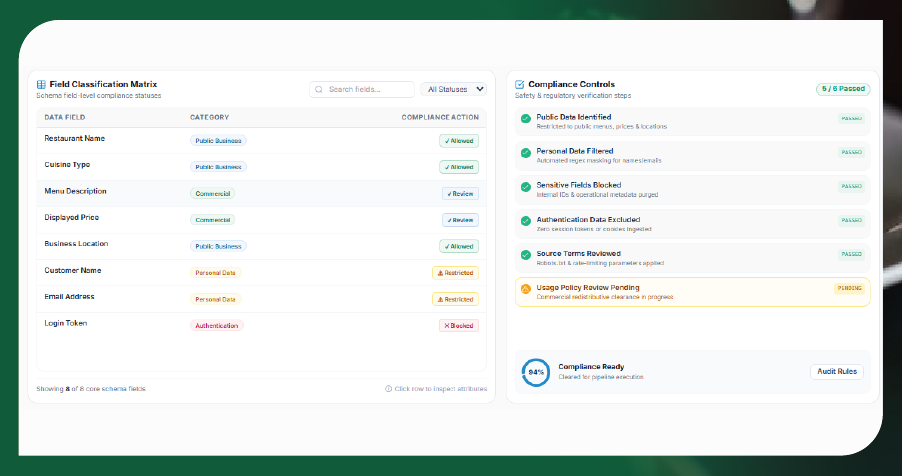
One of the most important concepts in responsible scraping is the distinction between publicly accessible information and private information.
Restaurant names, cuisine types, menu descriptions, displayed prices, business locations, ratings, operating hours, and promotional information may be presented publicly on food delivery platforms. Such information can support competitive analysis and market research.
However, public accessibility does not automatically mean that every form of automated collection or every subsequent use is unrestricted. Businesses must consider the source's terms, applicable regulations, intellectual property issues, privacy requirements, and intended use of the information.
Data teams should therefore classify fields before extraction. Commercial business information can be separated from personal information, sensitive information, authentication-related information, and unnecessary fields.
This field-level classification makes compliance easier to manage because developers know precisely what should and should not enter the pipeline.
Reviewing Platform Policies
food delivery data scraping compliance requires attention to the rules governing each individual source.
Food delivery platforms can have different terms, access mechanisms, technical controls, APIs, licensing arrangements, and restrictions. A strategy that may be appropriate for one source cannot automatically be assumed to be appropriate for another.
Before building a large-scale collection system, organizations should review the relevant terms and technical documentation. If an official API, licensed feed, partnership arrangement, or authorized data access mechanism exists, it may provide a clearer route for obtaining structured information.
Source policies can also change. Therefore, compliance should be treated as an ongoing process rather than a one-time review.
Maintaining a source registry can help organizations document the platforms they access, the data fields collected, the collection method, the date of the latest policy review, and any applicable restrictions.
Get Started with Compliant Food Delivery Data Intelligence Turn complex restaurant marketplace information into structured, reliable, and actionable insights with responsible data collection. Contact Food Data Scrape today to discuss your requirements for restaurant pricing, menus, availability, promotions, historical datasets, and competitive intelligence.
Responsible Technical Implementation
Technical architecture plays an important role in responsible data collection.
A well-designed crawler should avoid generating unnecessary traffic. Rate limiting, request scheduling, caching, retries, concurrency controls, and incremental collection can significantly reduce the number of requests required.
For example, if a restaurant menu has not changed, repeatedly downloading the same page provides little analytical value. A system can store the previous observation and retrieve new information according to a controlled schedule.
Caching also improves efficiency. Instead of requesting identical resources repeatedly, previously collected information can be reused until a refresh becomes necessary.
compliant restaurant data scraping should also avoid attempting to circumvent authentication systems, access controls, CAPTCHAs, paywalls, or other technical safeguards. Responsible automation is about efficient collection of permitted information rather than defeating restrictions.
Protecting Personal and Sensitive Information
Privacy should remain a major component of food delivery data governance.
Restaurant intelligence generally does not require customer-level information. Therefore, businesses should avoid collecting unnecessary customer names, phone numbers, delivery addresses, payment details, account identifiers, or other personally identifiable information.
If personal information is legitimately required for a specific authorized project, appropriate privacy and security controls should be established based on applicable requirements.
Data minimization can substantially reduce risk. If a field does not contribute to the project's objective, the safest approach is usually not to collect it.
Organizations should also consider access controls. Not every employee working with restaurant intelligence needs unrestricted access to the complete underlying dataset.
Restaurant Pricing Data and Compliance
Pricing is one of the most valuable categories within food delivery intelligence. Restaurants frequently adjust menu prices, launch promotions, modify delivery fees, introduce bundles, and change discounts.
restaurant pricing data scraping compliance becomes particularly important when businesses build systems that continuously monitor these changes.
A properly designed pricing dataset can record restaurant names, item names, listed prices, promotional prices, discounts, delivery charges, availability, and collection timestamps. This enables businesses to identify price movements and competitive differences.
Historical observations are particularly valuable. A single price snapshot tells a business what an item costs today. Hundreds of timestamped observations can reveal whether prices are increasing, declining, fluctuating, or responding to promotional cycles.
However, the collection process should remain consistent with applicable source requirements. Data should also be used for legitimate analytical purposes and handled according to the organization's governance policies.
Building a Strong Data Governance Framework
Food Data Scraping should be integrated into a broader data governance framework.
Governance begins with clearly documented objectives. Every project should answer basic questions: What information is being collected? Why is it needed? Which sources provide it? Who will use it? How long will it be retained? Will it be redistributed?
The answers can then become part of a formal data collection policy.
A governance framework should also include data validation. Incorrect prices, duplicate restaurants, outdated menus, broken links, and missing fields can undermine the value of the entire dataset.
Timestamping every observation is another important practice. A timestamp allows analysts to distinguish current information from historical information and provides useful provenance for future investigations.
Monitoring and Auditing Data Collection
A responsible scraping program should be continuously monitored.
Organizations can track request volumes, failed requests, source changes, data completeness, extraction errors, duplicate records, and unusual traffic patterns.
Audit logs can record when a collection job ran, what source it accessed, which fields were processed, and whether errors occurred. This creates a transparent record of data operations.
Regular reviews are also important because websites, regulations, business requirements, and platform policies can change.
An automated monitoring system can alert teams when a source's structure changes or when extraction behavior becomes abnormal. This prevents broken crawlers from repeatedly generating unnecessary traffic.
Scaling Food Delivery Data Operations
Food Delivery App Data Scraping Services can help businesses manage large-scale restaurant intelligence projects by combining structured extraction, data processing, validation, normalization, and delivery workflows.
Scalability should not mean unlimited traffic. Instead, it should mean the ability to collect the required information efficiently and systematically.
Incremental extraction is one effective approach. Rather than downloading an entire restaurant catalog every time, a system can focus on new, changed, or relevant records.
Cloud storage, databases, APIs, scheduled pipelines, and structured output formats can further improve usability. Depending on business requirements, data can be delivered in formats such as CSV, JSON, Excel, databases, or API-ready structures.
Why Historical Food Delivery Intelligence Matters?
Food delivery markets change quickly. Restaurant menus evolve, prices increase, discounts appear and disappear, businesses open or close, and customer preferences shift.
Historical datasets allow companies to understand these changes over time.
For example, a restaurant chain can analyze how its competitors adjusted prices during peak seasons. A market research company can study promotional behavior across neighborhoods. A food-tech startup can evaluate the relationship between delivery fees and menu pricing. An investment team can identify broader market trends.
The value of historical information increases when every record includes accurate timestamps and source information.
Retention policies should nevertheless be clearly defined. Organizations should retain information for as long as it serves a legitimate purpose rather than storing everything indefinitely.
How Food Data Scrape Can Help You?
1. Competitive Intelligence
Food Data Scrape can organize restaurant menus, prices, ratings, promotions, locations, and availability into structured intelligence, helping businesses compare competitors and identify market opportunities efficiently.
2. Pricing Monitoring
Food Data Scrape can track restaurant menu prices and promotional changes over time, enabling businesses to identify pricing movements, competitive gaps, discount patterns, and potential revenue opportunities.
3. Market Research
Food Data Scrape can consolidate restaurant information across locations and cuisines, helping researchers understand market density, assortment changes, restaurant expansion, pricing behavior, and competitive positioning.
4. Historical Analytics
Food Data Scrape can maintain timestamped observations that support long-term analysis of restaurant pricing, promotions, availability, menu changes, and evolving consumer-facing marketplace conditions.
5. Scalable Intelligence
Food Data Scrape can transform large volumes of restaurant information into structured datasets for dashboards, business intelligence systems, forecasting models, competitive monitoring platforms, and analytical applications.
Conclusion
Compliance should be treated as a foundation of modern food delivery intelligence rather than an obstacle to data collection. Businesses can build stronger and more sustainable data programs by defining clear objectives, minimizing unnecessary information, reviewing applicable source requirements, controlling automated traffic, protecting sensitive information, maintaining audit trails, and regularly reviewing collection practices.
Organizations looking to Scrape Online Food Delivery Data can benefit from structured collection strategies designed around business objectives and responsible data practices.
Building Historical Food Delivery Data provides even greater analytical value by allowing companies to understand restaurant pricing, promotions, menu evolution, availability, and competitive changes over time.
Ultimately, Web Scraping Food Delivery Data is most effective when technology, analytics, security, and governance operate together. A responsible approach can help businesses obtain actionable restaurant intelligence while creating a more transparent, controlled, and sustainable data ecosystem.