Introduction
The digital shelf has become the new battleground for brands and retailers. Consumers increasingly discover products through grocery apps, marketplaces, retailer websites, quick-commerce platforms, and online stores rather than walking through physical aisles. This makes understanding What Is the Digital Shelf intelligence essential for businesses that want to protect visibility, improve conversions, and outperform competitors.
For modern FMCG companies, digital shelf monitoring for brands provides continuous visibility into product listings, prices, promotions, ratings, reviews, availability, search rankings, images, and content quality. At the same time, digital shelf analytics for FMCG brands turns this information into actionable insights that help teams understand how products perform across digital channels.
Digital Shelf Intelligence combines data collection, monitoring, analytics, and competitive intelligence to create a complete view of a brand's online product presence. Instead of relying on occasional manual checks, businesses can continuously track what shoppers see and identify changes that may affect sales.
What Is Digital Shelf Intelligence?
Digital Shelf Intelligence is the process of collecting and analyzing online product information to understand how products are presented, discovered, priced, promoted, and purchased across digital retail channels.
Think of it as a virtual version of walking through hundreds of supermarket aisles every day. Instead of checking physical shelves, businesses monitor digital shelves across Amazon, Walmart, Instacart, grocery websites, quick-commerce applications, and other marketplaces.
A digital shelf intelligence system can capture information such as:
- Product names and descriptions
- Prices and discounted prices
- Product availability
- Stock status
- Product ratings and reviews
- Search rankings
- Images and videos
- Promotions and offers
- Pack sizes and variants
- Categories and attributes
- Seller information
- Delivery estimates
- Competitor products
The real value comes from comparing this information over time. A single price tells a business what a product costs today. Historical digital shelf intelligence reveals whether the price is rising, falling, remaining stable, or changing more frequently than competitors.
Why Digital Shelf Intelligence Matters?
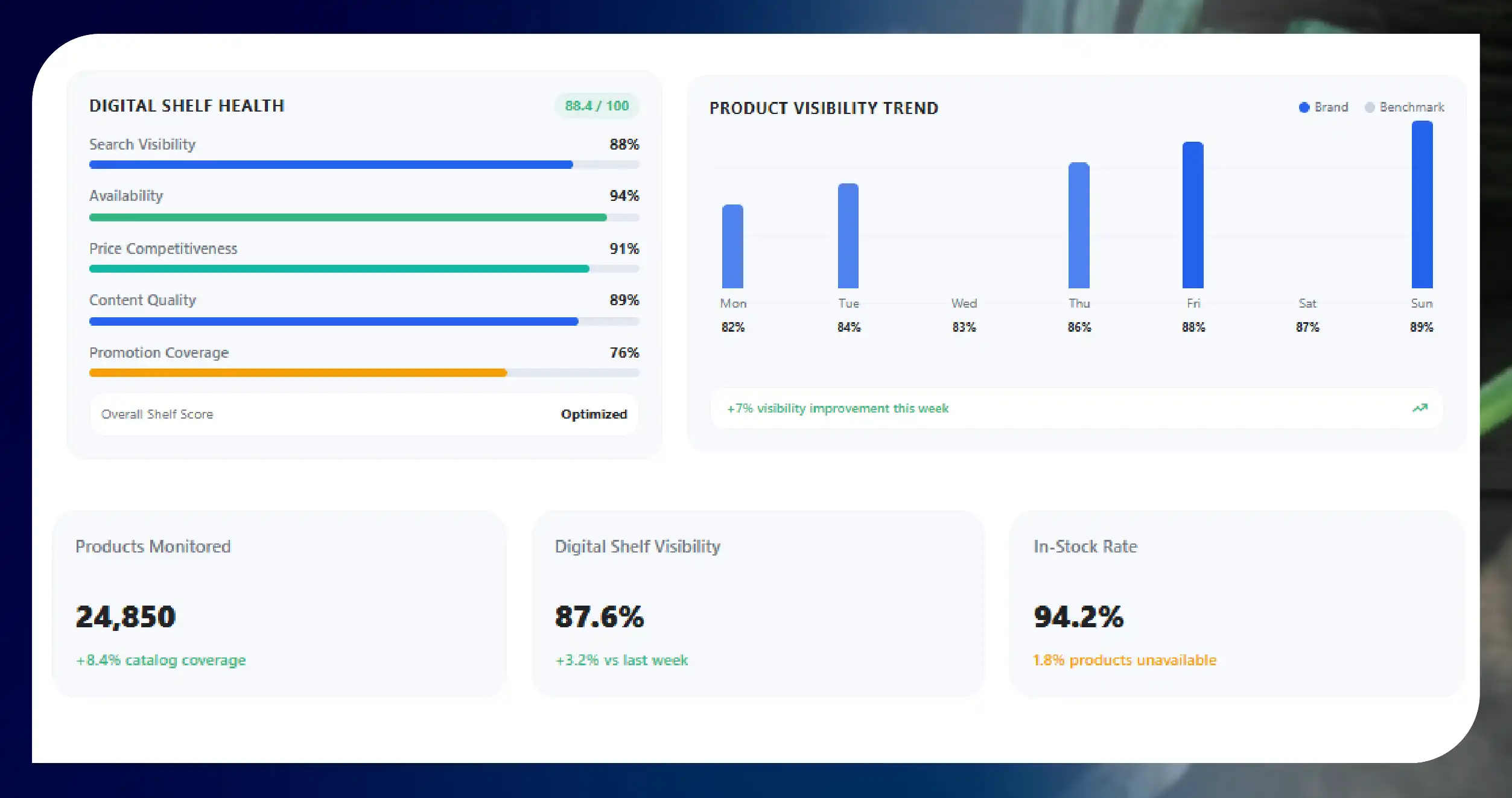
Online retail environments change constantly. A product that ranks highly in the morning can lose visibility later in the day. A competitor may launch a promotion, reduce its price, improve its product content, or gain better availability.
Without continuous monitoring, brands may discover these changes only after sales decline.
Digital Shelf Intelligence helps businesses move from reactive decision-making to proactive optimization. Teams can identify pricing gaps, availability problems, content weaknesses, promotional opportunities, and competitive movements before they become major problems.
For FMCG companies with thousands of products across multiple retailers, this becomes particularly important. Manually checking every product every day is slow, inconsistent, and difficult to scale.
Automated data collection makes it possible to monitor large product catalogs and multiple digital channels systematically.
How Digital Shelf Monitoring Works?
Understanding how digital shelf monitoring works begins with automated data collection.
First, relevant retail websites, marketplaces, grocery platforms, and applications are identified. Product URLs, categories, search results, locations, and competitor listings become the foundation of the monitoring process.
Next, automated scraping systems collect product information according to predefined schedules. Depending on business requirements, monitoring may occur hourly, daily, weekly, or at another customized frequency.
The collected data is then cleaned and standardized. Product names, SKUs, pack sizes, prices, categories, and retailer information can be normalized so that products can be compared accurately.
The final stage involves analytics and reporting. Dashboards can show price movements, stock changes, rankings, promotions, assortment differences, and competitor activity.
This creates a continuous feedback loop:
Collect → Clean → Compare → Analyze → Alert → Optimize
For example, if a brand discovers that one of its best-selling products has become unavailable on a major grocery platform, an automated alert can notify the relevant team. The business can then investigate the issue instead of waiting for customers or sales reports to reveal it.
Key Elements of Digital Shelf Intelligence
Digital Shelf Intelligence covers multiple dimensions of online retail performance.
Product Availability
Availability is one of the most important digital shelf metrics. A highly visible product cannot generate sales if customers cannot purchase it.
Monitoring stock status across retailers helps brands identify out-of-stock patterns, regional availability problems, and retailer-specific supply issues.
Price Intelligence
Prices can differ significantly between retailers, marketplaces, locations, and time periods. Monitoring these changes helps brands understand competitive positioning and identify unauthorized or unexpected price movements.
Historical price data can also reveal promotional cycles and pricing patterns.
Content Quality
Product titles, descriptions, images, specifications, ingredients, nutritional information, and other attributes influence shopper confidence.
A product with incomplete or inconsistent content may lose potential customers even when its price is competitive.
Digital shelf monitoring helps brands identify missing information and inconsistencies across retailers.
Search Visibility
Being listed online is not enough. Products must also be discoverable.
Monitoring search rankings for important keywords helps brands understand how frequently their products appear and how competitors perform for the same searches.
Changes in ranking can provide early signals that content, availability, pricing, reviews, or marketplace algorithms may be affecting visibility.
Ratings and Reviews
Ratings and reviews strongly influence purchasing decisions. Tracking them helps brands understand customer sentiment and identify recurring complaints.
Review analytics can reveal issues involving packaging, quality, delivery, product expectations, or product functionality.
Digital Shelf Intelligence for Retailers
While manufacturers use digital shelf intelligence to protect their brands, retailers can use it to optimize their entire assortment.
Digital shelf intelligence for retailers helps businesses compare assortment, pricing, availability, promotions, and product content across competing retailers.
A grocery retailer could identify products that competitors offer but its own platform does not. It could also determine whether its prices are consistently higher for important categories.
Retailers can use these insights to improve assortment decisions, pricing strategies, supplier negotiations, promotional planning, and customer experience.
Digital Shelf Optimization for Brands
Collecting data is only the beginning. The next objective is turning insights into measurable improvements.
Digital shelf optimization for brands involves improving every factor that affects product visibility and conversion.
Brands can optimize product titles for search, improve descriptions, update images, correct missing attributes, monitor availability, evaluate promotions, and maintain competitive pricing.
Optimization becomes more effective when businesses measure the results over time. If a product's search visibility improves after content changes, historical data can help demonstrate that impact.
Digital Shelf Competitive Intelligence
Competition in online retail is increasingly dynamic. Brands are no longer competing only against products displayed beside them in physical stores. They compete against every relevant product appearing in digital search results.
Digital shelf competitive intelligence enables businesses to understand competitors' movements across prices, promotions, assortment, content, ratings, availability, and rankings.
For example, a brand may discover that a competitor repeatedly discounts a particular product every weekend. Another competitor may have significantly better product content or stronger ratings.
These patterns can help businesses develop more informed pricing, promotional, and content strategies.
Benefits Across FMCG Categories
Digital Shelf Intelligence is valuable across beverages, packaged foods, snacks, dairy, personal care, household products, frozen foods, beauty products, and other FMCG categories.
A beverage manufacturer may monitor pack sizes and promotional pricing across grocery marketplaces. A personal-care brand may compare ratings and content completeness. A packaged-food company may track competitor assortment and regional availability.
The same framework can be adapted to different product categories and geographic markets.
From Data Collection to Actionable Intelligence
The strongest digital shelf programs do not simply produce large spreadsheets. They create decision-ready intelligence.
Businesses can establish dashboards containing KPIs such as average selling price, price index, availability rate, share of search, promotion frequency, assortment coverage, rating performance, and content completeness.
Automated alerts can highlight significant events, including:
- Competitor price reductions
- Product stockouts
- New competitor listings
- Promotional launches
- Ranking changes
- Rating fluctuations
- Product delistings
- Availability gaps
This allows category managers, e-commerce teams, brand managers, revenue teams, and executives to focus on decisions rather than manually gathering information.
Why Automation Is Critical?
The digital shelf operates at a speed that manual monitoring cannot easily match. Retailers update prices, inventory, promotions, and product information continuously.
Automation makes Real-Time Online Shelf Monitoring more scalable and consistent. Large catalogs can be tracked across multiple websites and locations while historical datasets allow businesses to identify patterns that individual snapshots cannot reveal.
Businesses can also integrate collected data with dashboards, databases, business intelligence platforms, or internal analytics systems.
The result is a stronger foundation for forecasting, competitive analysis, pricing decisions, and e-commerce growth.
How Food Data Scrape Can Help You?
1. Track Product Availability
Food Data Scrape can monitor grocery and food products across digital retailers, helping brands identify stockouts, availability gaps, regional differences, and recurring inventory issues before they impact customer demand.
2. Compare Competitor Prices
Automated food product data collection enables businesses to compare prices, discounts, pack sizes, and promotions across competing retailers, supporting smarter pricing decisions and stronger competitive positioning.
3. Analyze Digital Assortment
Businesses can analyze thousands of food products across categories and retailers to identify assortment gaps, emerging products, private-label expansion, and opportunities for portfolio optimization.
4. Monitor Product Performance
Tracking ratings, reviews, rankings, availability, and promotional activity helps food brands understand digital performance and recognize changing customer preferences across marketplaces and grocery delivery platforms.
5. Build Actionable Dashboards
Structured food retail datasets can power customized dashboards that transform complex product information into practical insights for pricing, assortment planning, competitive intelligence, inventory management, and strategic decisions.
Conclusion
Digital Shelf Intelligence gives brands and retailers a clearer view of what is happening across the online shopping environment. It connects product visibility, pricing, availability, content, promotions, ratings, rankings, and competitive movements into one actionable intelligence framework.
As digital commerce continues expanding, businesses need more than periodic market research. They need continuous visibility into changing digital shelves. Retail Shelf Data Scraping can provide the underlying product information required to build that visibility, while Digital Shelf Share Tracking helps organizations understand their presence relative to competitors.
For food and grocery businesses, Food Data Scraping can further strengthen this process by delivering structured information from online retailers, marketplaces, grocery platforms, and quick-commerce channels.
The organizations that consistently monitor, analyze, and optimize their digital shelves will be better positioned to protect market share, improve product discoverability, respond to competitors, and convert more online shoppers.
Ready to turn online retail data into actionable digital shelf intelligence? Partner with Food Data Scrape to collect, monitor, and analyze product data at scale.
If you are seeking for a reliable data scraping services, Food Data Scrape is at your service. We hold prominence in Food Data Aggregator and Mobile Restaurant App Scraping with impeccable data analysis for strategic decision-making.