Introduction
The online food delivery industry generates valuable information about restaurant listings, menus, pricing, customer ratings, cuisine preferences, delivery availability, and promotional offers. For food brands, restaurant chains, market researchers, and analytics companies, understanding this information can reveal competitive opportunities, customer demand patterns, and changing market conditions. Businesses that systematically collect and analyze this information can make more informed decisions about menu development, pricing strategies, geographic expansion, and digital visibility.
The ability to Extract all restaurant data from Uber Eats provides businesses with a structured view of restaurant performance across relevant locations and categories. Through Uber Eats Restaurant Data Scraping, organizations can gather publicly accessible restaurant listing information, menu details, prices, ratings, delivery estimates, and promotional information, subject to platform access restrictions and applicable requirements.
Furthermore, Uber Eats Menu Price Data Extraction helps businesses compare similar dishes, evaluate price differences between neighborhoods, monitor menu changes, and identify promotional patterns. When this information is collected consistently and organized into a reliable dataset, it becomes a practical resource for competitive benchmarking, restaurant market research, and food delivery analytics.
1. What Is Uber Eats Restaurant Data Extraction?
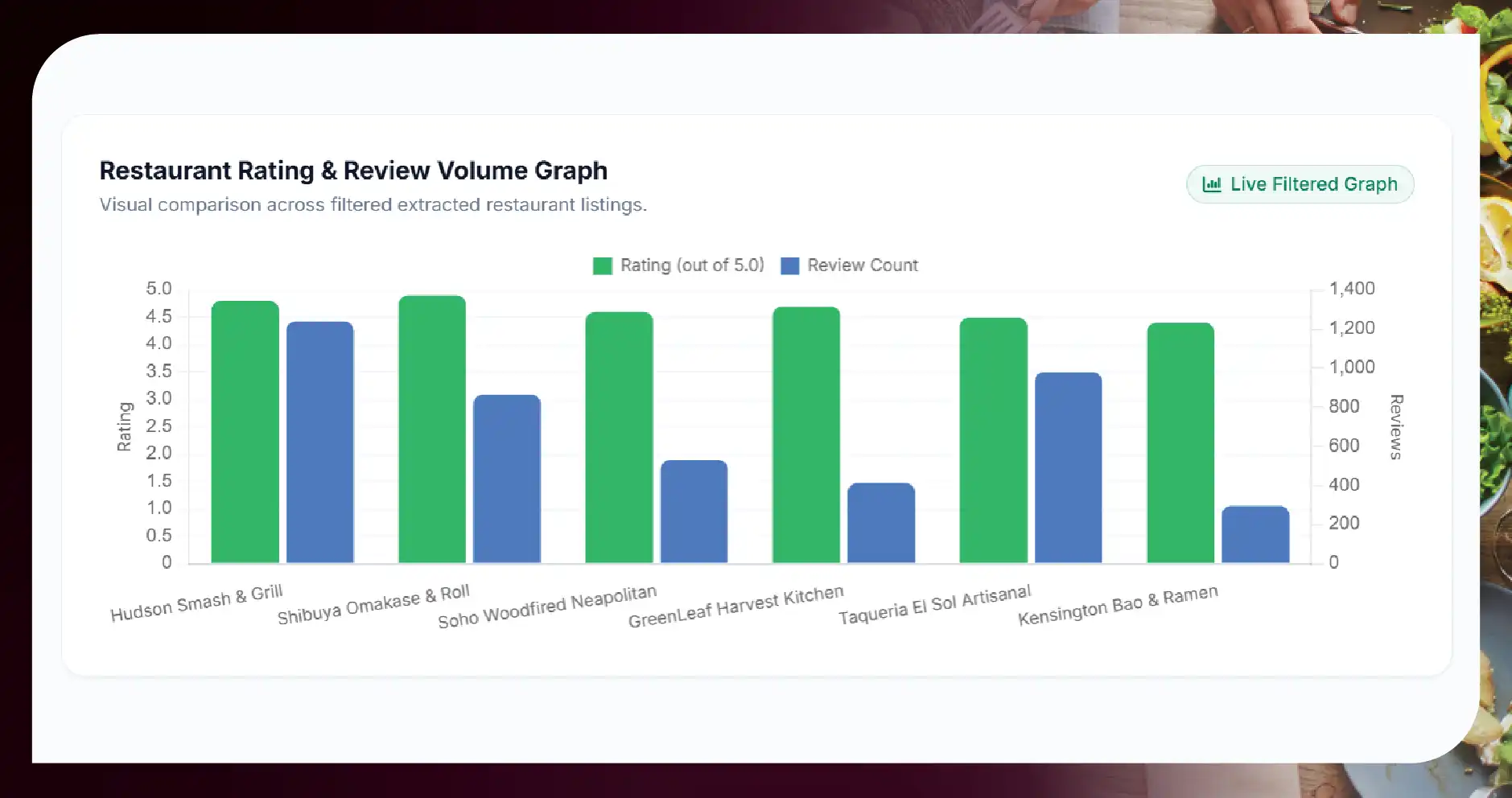
Uber Eats restaurant data extraction is the process of collecting relevant restaurant and menu information from the platform and converting it into structured, analysis-ready records. Instead of manually checking individual restaurant pages, businesses can use approved data access methods, permitted collection workflows, or authorized integrations to organize information at scale.
The scope of collection depends on the selected market, available listings, access permissions, and the data fields exposed by the platform. Not every restaurant or attribute will necessarily be accessible, and availability can vary by delivery address, time, device, and other conditions.
A comprehensive restaurant dataset may include:
- Restaurant name and unique listing identifier, where available.
- Cuisine category and restaurant type.
- Restaurant address or displayed service location.
- Menu item names, descriptions, and categories.
- Listed prices, currency, and applicable item variations.
- Restaurant ratings and review counts, where displayed.
- Delivery fees, estimated delivery times, and minimum order requirements, where available.
- Promotions, discounts, and displayed offers.
- Opening hours and ordering availability.
- Listing URLs and collection timestamps.
Combining these fields creates a more useful dataset than collecting restaurant names alone. Businesses can connect menus with locations, compare similar products, and examine how prices and availability differ across market segments.
2. Why Uber Eats Restaurant Data Matters for Businesses?
Restaurant delivery platforms reflect more than food ordering activity. Their listings provide insight into how restaurants position themselves digitally, organize menus, price products, and compete for customer attention.
For restaurant operators, this information supports competitor monitoring and menu optimization. For food manufacturers and consumer research teams, it can help identify popular categories, emerging dishes, and opportunities for product development. For market intelligence providers, it creates a foundation for tracking the structure and evolution of local food delivery markets.
Uber Eats Restaurant Market Intelligence can help businesses examine competitive density, cuisine distribution, price positioning, and promotional activity across selected locations. For example, a research team comparing restaurant listings in several neighborhoods may discover that premium burger offerings are concentrated in certain areas, while affordable meal combinations are more common elsewhere.
These findings can support location planning, customer segmentation, partnership evaluation, and regional marketing strategies. However, platform listings represent the restaurants and offers visible under specific collection conditions; they should not automatically be treated as a complete representation of every restaurant operating in a market.
3. Essential Restaurant and Menu Data Fields
The usefulness of restaurant data depends on selecting fields that directly support business objectives. A dataset designed for price benchmarking may require different information from one intended for cuisine research or delivery coverage analysis.
Restaurant identification data
Restaurant names, listing identifiers, cuisine labels, addresses, and listing URLs help distinguish businesses and connect their records across collection periods. Where reliable identifiers are unavailable, carefully designed matching rules can help identify duplicate listings without incorrectly combining separate restaurant branches.
Menu and product information
Menu records should capture item names, descriptions, categories, displayed prices, portion sizes where listed, and available variations. Options such as small, regular, and large portions should remain distinguishable because their prices may not be directly comparable.
Restaurant Menu Data Scraping can also capture meal combinations, add-ons, beverages, desserts, and other menu components where accessible. Organizing these details consistently helps analysts compare equivalent items and evaluate differences in menu breadth.
Pricing and promotional information
Restaurant prices may differ by location, menu variation, and collection time. Discounts, promotional bundles, and displayed offers can further complicate comparisons. A reliable dataset should preserve the original listed price and record promotional prices separately whenever both are available.
Analysts should also distinguish menu prices from delivery fees, service fees, taxes, and other checkout charges. These amounts represent different cost components, and not all are necessarily visible on a restaurant listing page.
Ratings and operational information
Displayed ratings, review counts, estimated delivery times, operating hours, and ordering status can help explain differences in restaurant visibility and customer experience. These attributes should be recorded with timestamps because they can change frequently.
Delivery estimates are contextual rather than guaranteed performance measures. Comparing them fairly requires similar locations, observation periods, and ordering conditions.
4. How the Restaurant Data Collection Process Works?
A structured workflow improves data quality, consistency, and repeatability.
Step 1: Define the research scope
Begin by identifying the target cities, neighborhoods, restaurant categories, and business questions. A project might focus on pizza restaurants in major metropolitan areas, affordable lunch menus, or the competitive positioning of premium dining brands.
Clear boundaries prevent unnecessary collection and make the resulting dataset easier to analyze.
Step 2: Identify permitted data sources
Determine which approved sources, platform-provided interfaces, licensed datasets, or authorized collection methods are available. Review applicable platform terms, privacy requirements, intellectual property considerations, and technical restrictions before beginning.
Collection should respect access controls and avoid circumventing authentication, security mechanisms, or other restrictions.
Step 3: Capture relevant fields
Collect the fields required by the project, preserving source values and their associated context. Restaurant records and menu-item records should be stored separately when practical, with consistent identifiers linking each menu to its restaurant.
This structure makes it easier to analyze thousands of menu items without repeatedly duplicating restaurant-level information.
Step 4: Clean and standardize records
Raw data may contain inconsistent capitalization, missing descriptions, duplicate listings, mixed currencies, or different naming conventions. Data preparation should standardize formats while retaining original values for verification.
Prices should be stored numerically alongside currency codes. Dates should use a consistent format, and missing values should remain explicitly identifiable rather than being replaced with misleading assumptions.
Step 5: Validate and maintain the dataset
Validation checks can identify missing prices, duplicate menu items, invalid timestamps, and unexpected changes. Comparing selected records against their permitted source pages helps establish whether the collection process is working correctly.
Recurring collection should follow an appropriate schedule based on business needs and authorized access. Menu prices may require more frequent observation than restaurant addresses or cuisine classifications.
5. Advanced Menu Price and Cuisine Analysis
Once restaurant information has been collected and standardized, businesses can transform individual listings into actionable market insights.
Menu price benchmarking
Extract Uber Eats Menu Price Data to compare equivalent dishes across restaurants, locations, and price segments. Analysts can calculate median listed prices, identify unusually expensive or inexpensive items, and examine price differences between independent restaurants and national chains.
Fair comparisons require consistent item definitions. A basic burger should not automatically be compared with a premium double burger, and a family meal should not be treated as equivalent to an individual serving.
Cuisine demand and market coverage
Uber Eats Cuisine Data Scraping helps analysts examine how restaurant categories are distributed across target markets. The resulting data can reveal areas with strong representation of particular cuisines and neighborhoods where selected categories appear less common.
Cuisine labels should be standardized carefully because the same restaurant may appear under multiple categories or use different labels across listings. These patterns indicate platform-visible supply, not necessarily actual customer demand. Demand conclusions become stronger when restaurant listings are combined with reliable order, survey, or transaction data.
Promotional and competitive monitoring
Businesses can examine displayed discounts, bundle prices, and promotional frequency to understand how restaurants compete for customer attention. Tracking these changes over time may reveal seasonal campaigns or shifts in pricing strategies.
However, a displayed promotion does not prove that customers used it or that it increased sales. Sales and conversion outcomes require separate evidence.
6. Using Restaurant Analytics to Support Decisions
Uber Eats Restaurant Analytics turns collected records into measurable indicators that support strategic decisions.
Restaurant groups can benchmark their menu prices against comparable competitors, identify categories with limited representation, and assess whether their listed offers remain competitive. Food brands can investigate which menu categories are represented across different regions and use these findings to guide partnership research.
Market researchers can measure restaurant density by cuisine, compare entry-level and premium pricing, and examine the distribution of ratings among visible listings. Delivery businesses may use accessible operational fields to study displayed delivery estimates and service coverage.
Useful analytical indicators include:
- Median listed price by cuisine and location.
- Percentage of restaurants displaying promotions.
- Average number of listed menu items per restaurant.
- Distribution of restaurants across price bands.
- Frequency of menu price changes between observations.
- Share of listings with complete and validated data.
- Distribution of displayed ratings among eligible records.
These indicators should be interpreted within the limitations of the collected sample. A high menu price does not necessarily indicate higher profitability, and a high rating does not independently establish restaurant quality or sales performance.
7. Common Challenges in Uber Eats Data Collection
Restaurant data collection involves several practical challenges that require ongoing attention.
- Changing menus: Restaurants frequently update item names, prices, descriptions, and availability. Timestamped records and change-detection processes help distinguish genuine changes from collection errors.
- Location-dependent listings: Search results and restaurant availability may vary according to the delivery address. Analysts should document the geographic scope and avoid treating one location's results as universally representative.
- Duplicate records: Restaurant branches, renamed listings, and similar menu items can complicate comparisons. Matching should consider identifiers, addresses, names, and other available evidence rather than relying on names alone.
- Incomplete information: Some listings may omit descriptions, prices, or other attributes. Quality checks should quantify missing data and communicate limitations to downstream users.
- Access and compliance: Platform rules and technical interfaces can change. Businesses should use permitted access methods, protect any personal information encountered, and reassess compliance requirements as projects evolve.
- Data freshness: A dataset can become less useful when menus or restaurant availability change. Collection frequency should reflect the rate of change, the business objective, and the permitted access conditions.
8. Turning Restaurant Data into a Scalable Business Asset
A scalable restaurant intelligence system requires more than collection scripts. It needs reliable data architecture, clear field definitions, quality controls, secure storage, and repeatable delivery.
Restaurant-level information can be maintained in a master dataset, while menu items, prices, promotions, and observations are stored in related records. This structure allows analysts to track historical changes without overwriting every previous observation.
Businesses should also document collection dates, source context, currency, geographic coverage, missing fields, and known limitations. These details make the data easier to audit and reduce the risk of misleading comparisons.
Where permitted, datasets can be delivered as CSV files, spreadsheets, JSON records, or database tables. APIs can support downstream applications that need structured updates, while dashboards can help business teams explore pricing patterns and competitive positioning.
Security and governance remain important throughout the process. Access should be limited to authorized users, retention policies should be defined, and the dataset should contain only the information needed for its stated purpose.
How Food Data Scrape Can Help You?
1. Competitive Price Benchmarking
Food Data Scrape helps businesses compare restaurant menu prices, meal combinations, and promotional offers across selected markets, supporting informed pricing decisions and more consistent competitor benchmarking.
2. Restaurant Market Research
Structured restaurant listings help teams assess cuisine coverage, restaurant density, and visible market positioning, enabling more focused expansion research and better-informed regional food service strategies.
3. Menu Intelligence
Organized menu records reveal differences in dish availability, categories, portion options, and pricing, helping restaurants evaluate menu structures and identify opportunities for differentiation across competing food delivery listings.
4. Historical Change Tracking
Timestamped observations help businesses monitor menu updates, listed price movements, and changing promotions, making it easier to identify patterns and investigate competitive changes over time.
5. Scalable Data Integration
Validated datasets can support dashboards, research workflows, and internal analytics systems, allowing teams to work with consistent restaurant information while improving reporting efficiency and repeatability.
Conclusion
Extracting restaurant information from Uber Eats can provide valuable insights into menu pricing, cuisine distribution, restaurant positioning, and visible competitive activity. The strongest results come from a clearly defined research scope, reliable data validation, consistent field structures, and careful interpretation of platform-visible information.
With Uber Eats Restaurant Data Scraping, businesses can organize restaurant listings and menu information into datasets that support market research, price benchmarking, and ongoing competitive analysis. An authorized Uber Eats Food Delivery Scraping API or other permitted data access method may help integrate structured information into existing business systems, depending on availability and applicable platform requirements.
Well-maintained Food Delivery Datasets can further support historical comparisons, regional analysis, and reporting across selected markets. By combining responsible collection practices with meaningful analytics, organizations can turn restaurant and menu information into a practical resource for better-informed decisions in the evolving food delivery industry.
If you are seeking for a reliable data scraping services, Food Data Scrape is at your service. We hold prominence in Food Data Aggregator and Mobile Restaurant App Scraping with impeccable data analysis for strategic decision-making.
Get a Free Food Data Sample in 48 Hours.
Tell us your platforms, target markets and required fields — we'll map exactly what's possible with food data scraping, recommend the right approach, and send a working sample so you can verify quality before any commitment.