Introduction
Cheese is no longer simply a staple dairy product. Consumers are increasingly choosing cheese based on flavor, convenience, texture, price, nutrition, cooking application, and product format. Within this competitive landscape, American cheese and Cheddar occupy very different positions, making their comparison particularly valuable for food manufacturers, retailers, restaurants, grocery platforms, and market intelligence teams.
Extract American vs Cheddar Cheese Consumer Demand Data to help businesses understand which product attracts stronger consumer interest, where demand is increasing, what prices shoppers are willing to pay, and which applications are driving purchases. Meanwhile, American vs Cheddar Market Data Extraction can bring together product listings, retail prices, package sizes, reviews, promotions, menus, and consumer signals to create a more complete view of the market.
The comparison is especially relevant because Cheddar has a much stronger position within natural cheese, while American cheese remains closely associated with processed formats, burgers, sandwiches, grilled cheese, and convenience-oriented meals. USDA-linked dietary research found that natural cheese such as Cheddar represented 75% of cheese consumed by U.S. adults by weight, compared with 17% for processed cheese such as American.
At the same time, recent consumer intelligence indicates that American cheese can show faster momentum in consumer conversation despite Cheddar maintaining a considerably larger share.
Understanding American Cheese and Cheddar Demand
American cheese and Cheddar may appear similar because both are widely used in sandwiches, burgers, snacks, sauces, and prepared meals. However, consumer motivations are different.
American cheese is strongly associated with melting performance, convenience, affordability, familiarity, and fast-food applications. Its smooth texture and consistent melting behavior make it particularly useful for burgers, grilled cheese sandwiches, breakfast sandwiches, and other prepared foods.
Cheddar has a broader identity. Consumers purchase it as sliced cheese, shredded cheese, blocks, snack portions, specialty varieties, and cooking ingredients. Mild, medium, sharp, and extra-sharp varieties also allow brands to target different taste preferences.
Current market data reinforces Cheddar's strength. In the 52 weeks ending May 17, 2026, Cheddar represented approximately 23.2% of the U.S. natural cheese market.
American vs Cheddar Consumer Trend Analytics can therefore reveal not only which cheese sells more, but also why consumers choose each product.
Why Extracting Consumer Demand Data Matters?
Traditional market research often provides periodic snapshots. Digital demand data can provide a much more dynamic perspective.
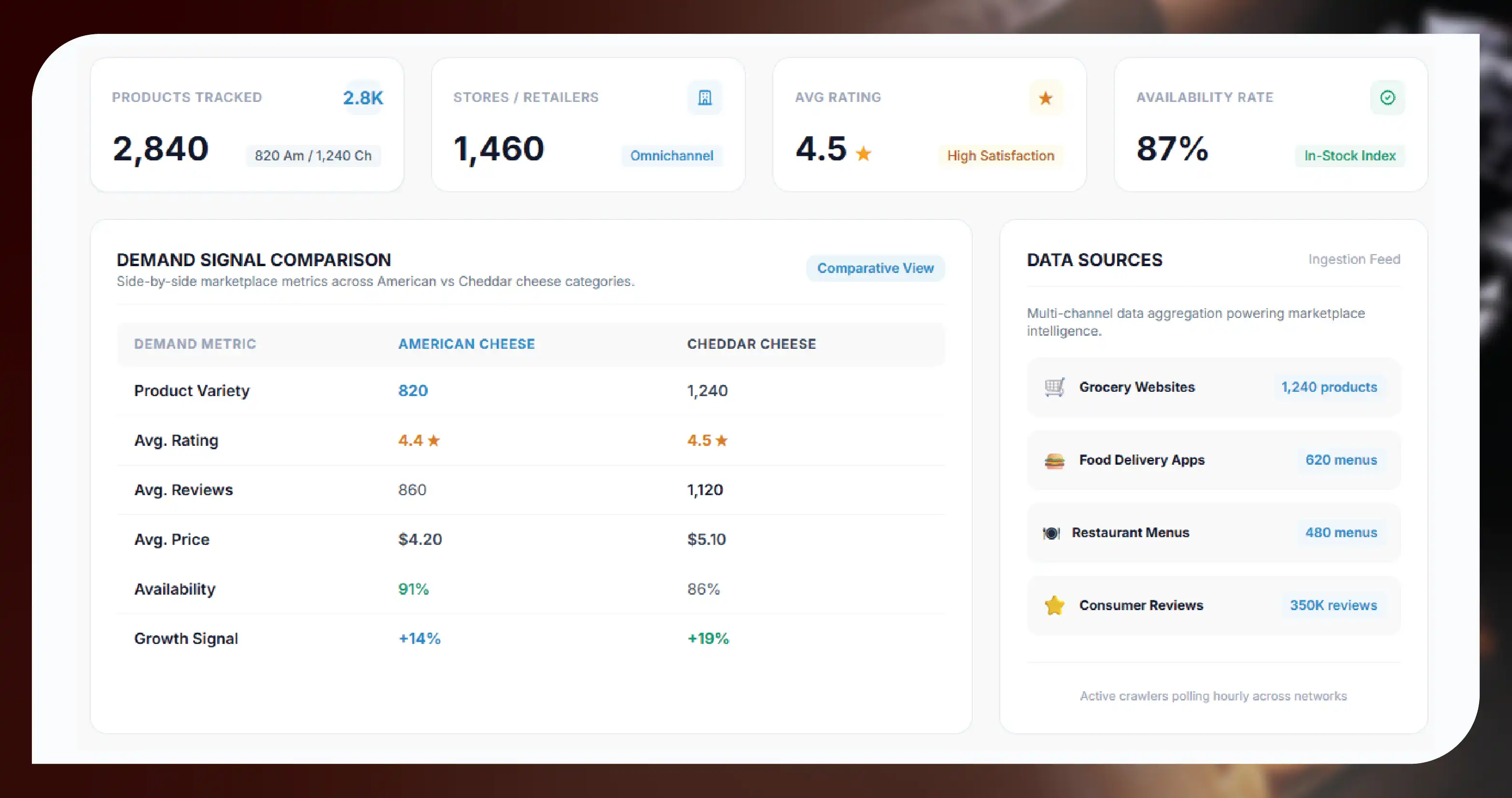
Businesses can collect information from grocery websites, food-delivery platforms, restaurant menus, consumer reviews, promotional pages, and product catalogs. These sources can reveal changes in product availability, pricing, package sizes, ratings, consumer language, and promotional intensity.
For example, a retailer may discover that Cheddar has significantly greater product variety, while American cheese receives stronger demand around burger-related products. A restaurant operator may find that American cheese dominates cheeseburger menus while Cheddar appears more frequently in sandwiches, breakfast items, salads, and specialty dishes.
This distinction is important because demand does not necessarily mean the same thing as market share.
A product may have lower overall volume but higher growth. Conversely, an established product can have enormous volume while experiencing slower growth.
American vs Cheddar: Consumer Demand Comparison
The first major difference is market positioning.
Cheddar is a mainstream natural cheese with applications extending from household cooking to foodservice and packaged foods. Historical USDA-based data has consistently placed Cheddar among the leading American-type natural cheeses. In 2024, U.S. per-capita Cheddar consumption was approximately 10.9 pounds, down from 11.4 pounds in 2023.
American cheese is more concentrated around convenience and prepared-food applications.
This gives Cheddar an advantage in product versatility, while American cheese has an advantage in application-specific performance.
The second difference is flavor.
Cheddar can range from mild and creamy to sharp and intense. Its flavor profile allows manufacturers to develop multiple products targeting different consumer preferences. American cheese generally emphasizes smoothness, mildness, creaminess, and meltability.
The third difference is format.
Cheddar is available as blocks, slices, shreds, cubes, snack portions, spreads, and flavored varieties. American cheese is particularly prominent in individually wrapped slices and foodservice formats.
The fourth difference is consumer perception.
Natural cheese is increasingly associated with authenticity, quality, flavor, and premium positioning. Processed cheese can instead compete strongly on convenience, consistency, affordability, and functionality.
Recent industry reporting suggests consumers are increasingly trading up toward higher-quality cheeses, while natural cheese generally commands a higher price per pound than processed cheese.
American vs Cheddar Retail Price Monitoring
American vs Cheddar Retail Price Monitoring can reveal another important competitive dimension.
Retailers can track American and Cheddar products across supermarkets, grocery marketplaces, online retailers, and delivery platforms. The resulting dataset can capture:
- Product price
- Price per ounce or pound
- Package size
- Brand
- Private-label status
- Discount percentage
- Promotional price
- Multi-buy offers
- Product availability
- Store or geographic location
- Product format
Scrape American Cheese Demand Data to help identify whether lower prices correspond with increased visibility, higher ratings, stronger promotional activity, or greater product availability.
For Cheddar, price analysis can become even more detailed because the category includes mild, sharp, organic, aged, specialty, shredded, sliced, and private-label products.
This creates an opportunity to identify price elasticity. If Cheddar demand remains stable while prices rise, consumers may demonstrate greater willingness to pay. If American cheese demand spikes whenever discounts appear, price sensitivity may be stronger.
Ready to uncover actionable cheese demand insights? Connect with us today to extract, analyze, and compare American vs Cheddar consumer data at scale.
Scrape Cheese Consumer Insights Data
Consumer reviews provide another powerful source of demand intelligence.
Scrape Cheese Consumer Insights Data to help identify the attributes customers repeatedly mention when discussing American and Cheddar products.
For American cheese, common themes can include:
- Meltability
- Creaminess
- Burger compatibility
- Texture
- Saltiness
- Convenience
- Nostalgia
- Value
For Cheddar, consumer conversations can emphasize:
- Sharpness
- Flavor intensity
- Freshness
- Authenticity
- Texture
- Aging
- Meltability
- Package convenience
Research into shredded Cheddar has similarly found that consumers consider characteristics such as meltability, color, absence of clumping, resealability, and desirable Cheddar flavor when evaluating products.
Sentiment analysis can transform these comments into measurable indicators. Businesses can calculate the percentage of positive, neutral, and negative reviews and identify which product attributes have the strongest relationship with customer satisfaction.
Tracking Menu and Foodservice Demand
Foodservice is another area where American and Cheddar demonstrate different strengths.
American cheese has a particularly strong connection with burgers and grilled sandwiches. Cheddar, meanwhile, can appear across burgers, sandwiches, breakfast foods, salads, appetizers, pasta, Mexican-inspired dishes, and snack products.
Menu data extraction can therefore identify how frequently each cheese appears, which dishes use it, and how restaurants position it.
For example, a restaurant launching a premium burger may prefer aged or sharp Cheddar because it communicates stronger flavor and premium positioning. A quick-service restaurant may prefer American cheese because its consistent melting properties support standardized preparation.
The data can also reveal regional patterns. American cheese could dominate particular fast-food categories, while Cheddar may demonstrate broader usage across full-service restaurants and retail products.
Demand Forecasting for Food
Once historical pricing, product availability, reviews, menu presence, promotions, and consumer sentiment have been collected, businesses can move toward Demand Forecasting for Food.
Forecasting models can examine variables such as:
- Historical sales signals
- Search activity
- Product availability
- Price changes
- Promotions
- Seasonal demand
- Consumer sentiment
- Menu penetration
- Product launches
- Competitor activity
For example, rising searches for sharp Cheddar combined with increasing product reviews and stable pricing could indicate growing consumer interest.
Similarly, increasing mentions of American cheese in burger-related products could signal an opportunity for foodservice suppliers or restaurant chains.
The objective is not simply to predict how much cheese consumers will purchase. It is to understand which format, price point, flavor profile, package size, and application is most likely to generate demand.
Product Innovation Opportunities
The American-versus-Cheddar comparison can also support new product development.
Cheddar manufacturers can experiment with sharper flavors, aged varieties, organic positioning, reduced-fat products, convenient shredded formats, snack packs, and premium blends.
American cheese manufacturers can focus on melt-focused positioning, better ingredient profiles, premium slices, foodservice formats, and products designed specifically for burgers and sandwiches.
Recent innovation trends indicate that cheese remains important across snacks, sauces, frozen foods, bakery, and other categories, while consumers continue to show interest in both comforting and more distinctive cheese flavors.
This creates opportunities for businesses to combine consumer demand signals with product innovation data.
Building a Competitive Cheese Intelligence Strategy
A strong American-versus-Cheddar intelligence system should combine multiple datasets rather than relying on one source.
Retail data can reveal prices and availability. Menu data can show foodservice adoption. Review data can reveal customer satisfaction. Promotional data can reveal pricing strategies. Product data can reveal package sizes, ingredients, nutrition claims, and brand positioning.
Together, these sources create a much richer competitive picture.
The comparison also demonstrates why businesses should separate volume leadership from growth momentum. Cheddar remains a powerful natural-cheese category, while American cheese can generate strong demand in specific convenience and foodservice applications.
Recent industry data also shows broader cheese consumption remains substantial, even as domestic demand has experienced periods of softness.
How Food Data Scrape Can Help You?
1. Consumer Demand Tracking
Food Data Scrape helps you monitor American and Cheddar cheese demand across retailers, marketplaces, menus, reviews, and delivery platforms, revealing changing preferences and purchasing patterns.
2. Price Intelligence
Track cheese prices, discounts, package sizes, promotions, and regional variations to identify competitive pricing opportunities and understand how consumers respond to American and Cheddar price changes.
3. Product & Competitor Analysis
Compare brands, product formats, flavors, ingredients, ratings, availability, and positioning to identify competitors' strengths, product gaps, emerging opportunities, and potential areas for differentiation.
4. Consumer Sentiment Insights
Analyze customer reviews and feedback to discover preferences for taste, texture, meltability, freshness, packaging, nutrition, and value, helping you develop products aligned with consumer expectations.
5. Demand Forecasting & Strategy
Combine historical prices, demand signals, reviews, promotions, and availability data to forecast category trends, optimize inventory, support product launches, and develop stronger food-market strategies.
Conclusion
American cheese and Cheddar compete for some of the same consumers, but their demand drivers are substantially different. American cheese benefits from convenience, meltability, familiarity, and strong prepared-food applications. Cheddar benefits from broader product variety, natural-cheese positioning, flavor diversity, and extensive household and foodservice applications.
Businesses that monitor both categories can identify gaps in pricing, product availability, consumer sentiment, menu adoption, and promotional activity. Combining these signals provides a stronger foundation for category management, product development, retail strategy, and forecasting.
Modern Food Data Scraping Services can help organizations continuously collect structured information from grocery stores, foodservice menus, marketplaces, and consumer-facing platforms to build this intelligence at scale.
Likewise, Food Delivery Datasets can reveal which cheese-based dishes are appearing across delivery platforms, how prices differ between restaurants, and which menu applications are gaining visibility.
Finally, Nutrition & Allergen Compliance data can help food businesses monitor ingredient statements, allergen declarations, nutritional information, and labeling requirements as products evolve.
Ultimately, the American-versus-Cheddar comparison is not simply about deciding which cheese is more popular. It is about understanding where, why, when, and at what price consumers choose each cheese—and turning those signals into actionable market intelligence.
If you are seeking for a reliable data scraping services, Food Data Scrape is at your service. We hold prominence in Food Data Aggregator and Mobile Restaurant App Scraping with impeccable data analysis for strategic decision-making.
Get a Free Food Data Sample in 48 Hours.
Tell us your platforms, target markets and required fields — we'll map exactly what's possible with food data scraping, recommend the right approach, and send a working sample so you can verify quality before any commitment.
Request a strategy call
Thanks — our data team will reach out within 48 hours with your sample.