Introduction
The food industry is evolving rapidly as brands, retailers, restaurants, and distributors compete for consumer attention, shelf space, and market growth. In this highly competitive environment, businesses need accurate insights to understand consumer preferences, pricing movements, product innovations, and changing market trends. Companies that Extract B2B Food Marketing Data can identify emerging opportunities, optimize sales strategies, and create stronger partnerships across the food ecosystem.
Modern CPG manufacturers and retail businesses are no longer relying only on traditional market research. They are adopting advanced data-driven approaches to understand category performance, competitor activities, consumer demand, and purchasing behavior. Through B2B Food Marketing Data Scraping, organizations can collect structured information from multiple digital sources, including food marketplaces, restaurant platforms, retail websites, online menus, and promotional channels.
Businesses looking to expand their presence must also Extract CPG and retail market data to analyze product availability, pricing strategies, promotional campaigns, and consumer engagement patterns. This intelligence enables food brands, suppliers, and retailers to make informed decisions and build effective B2B marketing strategies.
Understanding B2B Food Marketing Data
B2B food marketing data refers to business-focused information collected from food manufacturers, retailers, restaurants, wholesalers, distributors, and digital food platforms. Unlike consumer-focused datasets, B2B food intelligence helps companies understand commercial relationships, market positioning, product performance, and category opportunities.
For CPG companies, this data provides visibility into how products perform across different retail channels. Brands can monitor competitor launches, evaluate pricing changes, identify promotional trends, and understand which product attributes are gaining market attention.
Retailers use B2B food marketing intelligence to improve assortment planning, optimize category management, and identify products that can increase customer engagement. Restaurants and food delivery businesses also leverage this information to analyze menu trends, pricing structures, customer preferences, and regional demand patterns.
The ability to collect and analyze accurate market information has become essential for companies that want to improve sales performance and maintain competitive advantages.
Importance of Data-Driven Food Marketing Strategies
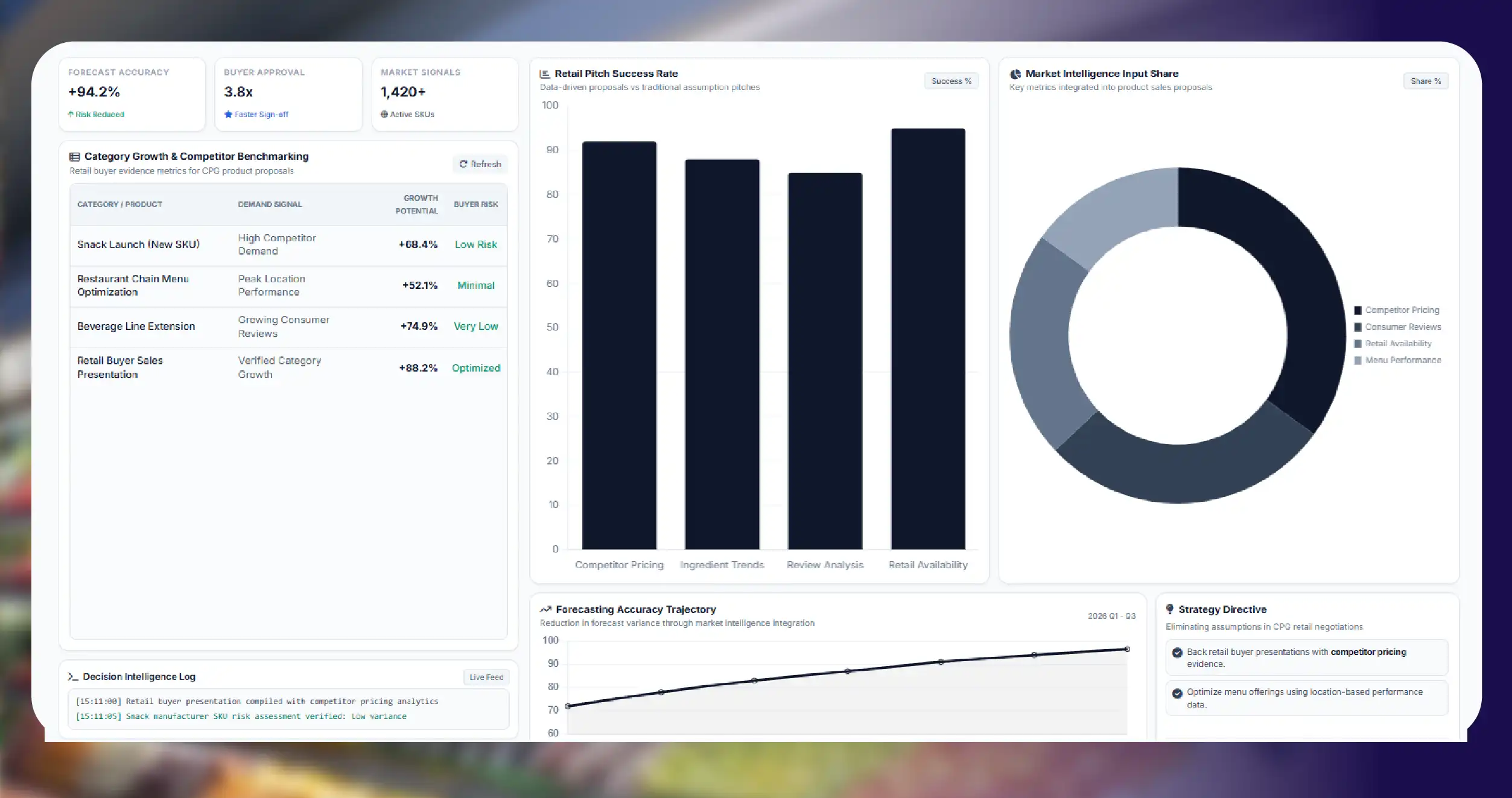
The relationship between CPG brands and retailers has become increasingly dependent on measurable insights. Retail buyers are no longer evaluating products based only on brand reputation. They want evidence demonstrating category growth potential, consumer demand, and revenue opportunities.
Data-driven food marketing strategies allow brands to create stronger product presentations and sales proposals. Instead of presenting assumptions, businesses can showcase real market trends, competitor comparisons, pricing analysis, and customer preferences.
For example, a snack manufacturer planning a new product launch can analyze competitor pricing, ingredient trends, consumer reviews, and retail availability before entering the market. Similarly, a restaurant chain can evaluate menu performance across locations to identify high-demand dishes and optimize offerings.
Businesses that integrate market intelligence into their decision-making processes can reduce risks, improve forecasting accuracy, and respond faster to changing consumer expectations.
Role of B2B Food Marketing Data Scraping
Data scraping has become a powerful technology for collecting large-scale food industry information from online sources. B2B Food Marketing Data Scraping enables companies to automatically gather valuable information from websites, digital marketplaces, restaurant platforms, and retail portals.
Through automated data extraction, businesses can collect information such as:
- Product names and categories
- Brand details
- Pricing information
- Discounts and promotions
- Retail availability
- Restaurant menus
- Customer ratings and reviews
- Location-based product trends
- Competitor offerings
This information helps businesses understand market dynamics without depending on slow and expensive manual research processes.
Food manufacturers can track competitor activities, retailers can optimize product assortment, and restaurant businesses can monitor menu innovations. Data scraping creates a continuous flow of actionable intelligence that supports strategic planning.
Unlock powerful food market insights with our B2B data scraping solutions today.
How Retail Market Data Scraping Supports Food Businesses?
The retail food sector operates in a highly competitive environment where pricing, promotions, and product placement directly influence purchasing decisions. Retail Market Data Scraping helps brands and retailers monitor market activities across multiple sales channels.
Retail businesses can analyze competitor pricing strategies, identify promotional opportunities, and measure product performance across categories. CPG brands can understand how their products compare with competing items and identify opportunities for improving visibility.
Retail intelligence also supports:
- Category management improvements
- Pricing optimization
- Competitor benchmarking
- Promotional effectiveness analysis
- Inventory planning
With accurate retail data, businesses can identify market gaps and develop strategies aligned with customer expectations.
Extracting CPG Pricing and Promotion Intelligence
Pricing plays a critical role in consumer purchasing decisions. Brands and retailers need continuous visibility into competitor pricing, discount strategies, and promotional campaigns.
Businesses that Scrape CPG pricing and promotion data gain valuable insights into market positioning and pricing fluctuations. This enables companies to evaluate whether their pricing strategies remain competitive.
For example, a beverage manufacturer can monitor competitor discounts during seasonal campaigns. A grocery retailer can compare prices across different platforms to maintain competitive pricing while protecting margins.
Promotion intelligence also helps companies understand:
- Which products receive frequent discounts
- How competitors attract customers
- Which promotional periods generate higher demand
- How pricing changes affect consumer behavior
This information supports smarter marketing decisions and improves revenue opportunities.
B2B Food Industry Data Extraction for Market Growth
The food industry includes multiple stakeholders, including manufacturers, distributors, retailers, restaurants, and online marketplaces. Each participant requires different types of information to improve operational performance.
Through B2B food industry data extraction, companies can gather insights from multiple sources and convert raw information into strategic intelligence.
Food businesses can use extracted data to:
- Identify new market opportunities
- Analyze competitor strategies
- Improve product positioning
- Monitor industry trends
- Understand customer preferences
For emerging food brands, this intelligence provides a foundation for entering new markets and developing products that match consumer demand.
CPG and Retail Market Data Extraction for Competitive Advantage
Successful food brands understand that retail growth depends on continuous market awareness. CPG & Retail Market Data Extraction allows companies to monitor product movements, consumer interests, and competitive changes across multiple channels.
This data supports innovation teams by identifying emerging categories and product opportunities. Marketing teams can create targeted campaigns based on real consumer behavior, while sales teams can develop stronger retailer presentations.
By combining market data with business strategies, companies can improve decision-making and strengthen relationships with retail partners.
Using Food Data for Demand Forecasting and Innovation
Understanding demand patterns is one of the biggest challenges for food businesses. Consumer preferences change quickly due to health trends, seasonal influences, economic conditions, and lifestyle shifts.
Analyzing Fast Food Demand Data helps restaurants, suppliers, and food brands identify popular categories and forecast future opportunities. Businesses can understand which cuisines, ingredients, and product formats are gaining popularity.
Similarly, companies can Extract Restaurant Menu Data to analyze menu innovations, pricing structures, customer preferences, and regional food trends. This information helps restaurants optimize menus and improve customer satisfaction.
Food delivery platforms and restaurant aggregators also benefit from a Food Delivery Scraping API that enables automated collection of menu, pricing, availability, and restaurant performance information.
Building a Strong Food Intelligence Framework
A successful food intelligence strategy combines data collection, analysis, and business application. Companies should focus on collecting accurate information from relevant sources and transforming it into actionable insights.
A comprehensive intelligence framework helps businesses:
- Understand competitors
- Identify consumer trends
- Improve pricing decisions
- Optimize product launches
- Strengthen retail partnerships
With increasing competition in the food sector, businesses that use real-time intelligence gain a significant advantage over companies relying only on traditional research methods.
How Our Data Scraping Services Can Help You
1. Comprehensive Market Data Collection
Our data scraping services help businesses collect large-scale food industry information from multiple digital platforms, enabling brands to analyze competitors, monitor market changes, and discover new commercial opportunities.
2. Real-Time Pricing and Promotion Monitoring
We help companies track competitor pricing, discounts, promotional campaigns, and product availability to support better pricing decisions and improve retail competitiveness across different food categories.
3. Advanced Consumer Demand Analysis
Our solutions collect valuable demand indicators from food platforms, menus, reviews, and marketplaces, helping businesses understand customer preferences and identify profitable product opportunities.
4. Customized Food Intelligence Solutions
We provide tailored scraping solutions designed around specific business requirements, allowing CPG companies, restaurants, and retailers to access relevant datasets for strategic decision-making.
5. Scalable Data Extraction Infrastructure
Our services support continuous data collection from multiple sources while delivering structured datasets that businesses can integrate into analytics platforms, dashboards, and forecasting systems.
Conclusion
In the modern food ecosystem, data has become a critical resource for improving marketing strategies, strengthening retail relationships, and identifying growth opportunities. Companies that invest in accurate market intelligence can better understand consumer behavior, optimize product decisions, and compete effectively.
Advanced Restaurant Data Intelligence enables businesses to analyze menus, pricing, customer preferences, and competitive positioning across food channels. Monitoring the Fast Food Demand Trend helps brands identify emerging opportunities and adjust strategies according to changing consumer expectations. Reliable Food Datasets provide the foundation for building smarter forecasting models, improving operations, and creating successful B2B food marketing strategies.
By leveraging automated data extraction and advanced analytics, food businesses can transform complex market information into actionable insights that drive sustainable growth.
If you are seeking for a reliable data scraping services, Food Data Scrape is at your service. We hold prominence in Food Data Aggregator and Mobile Restaurant App Scraping with impeccable data analysis for strategic decision-making.