Introduction
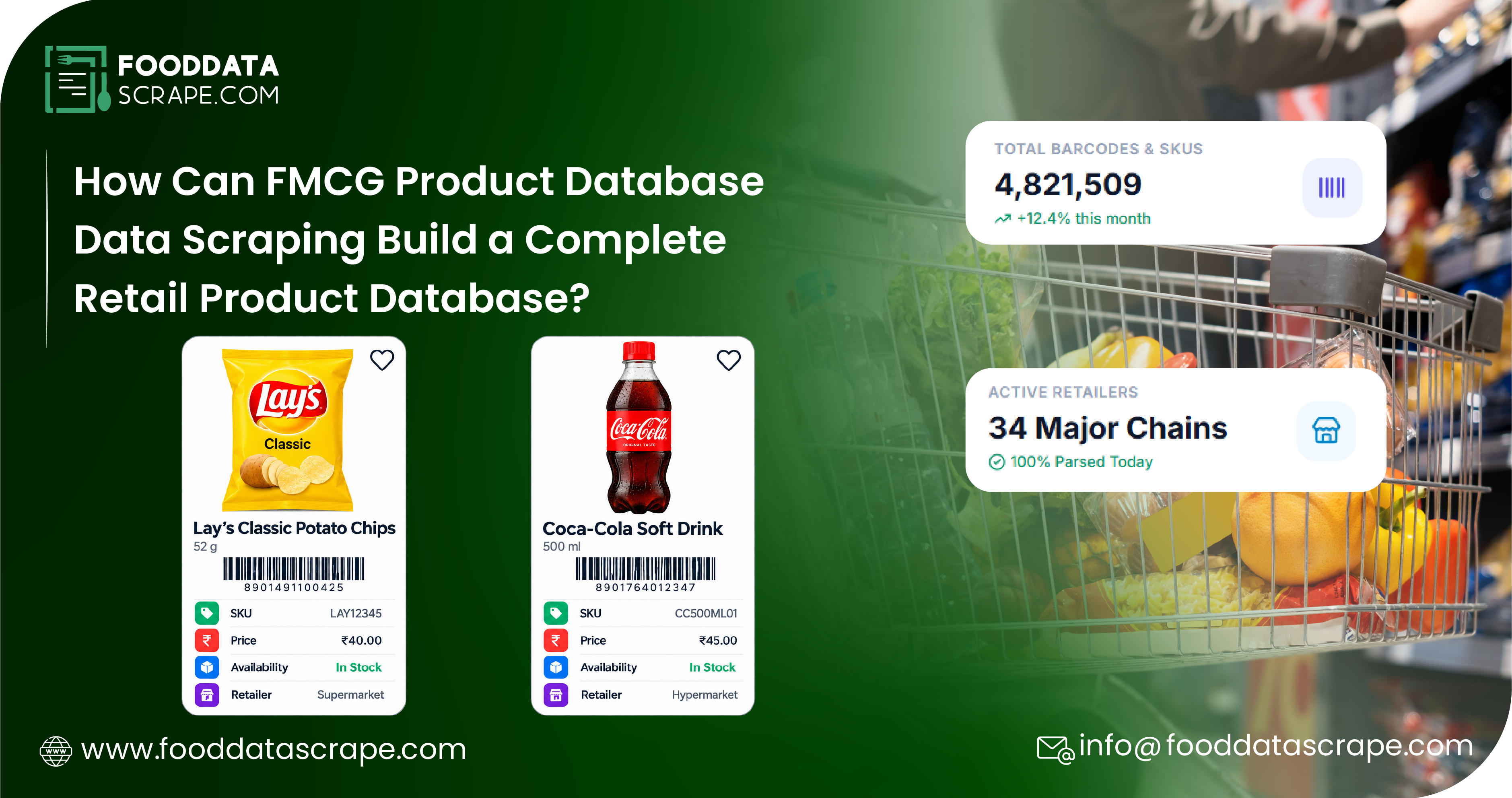
The FMCG industry operates on enormous volumes of products, SKUs, brands, prices, pack sizes, and retail locations. A barcode may identify a product, but turning that single identifier into a complete, actionable product record requires much richer information. FMCG Product Database Data Scraping enables businesses to connect barcode-level identifiers with product names, categories, brands, prices, pack sizes, descriptions, images, availability, and retailer information.
Modern retailers and FMCG brands can combine Barcode To FMCG Product Data Extraction with digital shelf intelligence to understand how products move across marketplaces, grocery websites, supermarkets, and quick-commerce platforms. Similarly, FMCG SKU And Barcode Data Scraping helps create structured databases that connect individual SKUs with UPCs, EANs, GTINs, retail listings, pricing, and availability.
The result is a complete product intelligence layer that goes beyond simply recognizing a barcode. It creates a bridge between the physical shelf and the digital retail environment.
Why Barcode Data Alone Is Not Enough?
A barcode is fundamentally an identifier. By itself, it does not necessarily reveal everything a retailer, brand, distributor, or analytics team needs to know about a product.
A useful FMCG database can connect the barcode with:
- Product name and variant
- Brand and manufacturer
- SKU and product ID
- UPC, EAN, or GTIN
- Category and subcategory
- Pack size and unit count
- Product description
- Ingredients and nutritional information
- MRP and selling price
- Promotional price
- Product images
- Retailer and marketplace
- Store or delivery location
- Stock status
- Product ratings and reviews
- Listing URL
- Date and time of collection
This structure transforms barcode information into a commercially valuable product record.
For FMCG companies, the objective is not merely to identify what a product is. The bigger objective is to understand where the product is listed, how it is priced, whether it is available, how competitors position similar products, and how shelf-level conditions change over time.
From Barcode to Complete Product Record
The journey from barcode to shelf intelligence can be viewed as a connected data pipeline.
The barcode acts as the starting point. Product information is then matched across available retail listings and structured into standardized fields. Additional attributes can be connected to create a unified SKU profile.
For example, a product record might contain:
| Data Attribute | Example Value |
|---|---|
| Barcode | 8901234567890 |
| Brand | Example Foods |
| Product | Premium Tomato Ketchup |
| Category | Sauces |
| Pack Size | 500 g |
| MRP | ₹150 |
| Selling Price | ₹129 |
| Discount | 14% |
| Availability | In Stock |
| Retailer | Online Grocery Store |
| Rating | 4.4 |
| Reviews | 2,845 |
| Product Type | Vegetarian |
| Image | Product Image URL |
| Collection Date | September 2026 |
Once standardized, thousands or millions of such records can become a searchable FMCG product database.
Building an FMCG SKU Intelligence Layer
One of the biggest challenges in FMCG analytics is SKU fragmentation. The same product may appear differently across retailers because of differences in naming conventions, descriptions, pack sizes, promotional labels, or product IDs.
A structured database can normalize these variations.
For instance, "500g Tomato Ketchup," "Tomato Ketchup 500 Gram," and "Premium Ketchup — 500g" may represent the same underlying product. Matching systems can use barcode identifiers, brand, pack size, product attributes, and other signals to create a unified product identity.
This makes the need to Extract FMCG Product Catalog Data particularly valuable for organizations managing large catalogs.
A normalized database can support:
- SKU deduplication
- Product matching
- Category standardization
- Brand mapping
- Pack-size comparison
- Retailer assortment analysis
- Competitor tracking
- Price benchmarking
- Product lifecycle analysis
Instead of maintaining disconnected spreadsheets, businesses gain a continuously structured view of their FMCG assortment.
Ready to turn barcode data into powerful FMCG product intelligence? Partner with Food Data Scrape today to build accurate product databases, monitor prices and availability, and unlock actionable retail insights at scale.
FMCG Product Database Scraping for Retail Intelligence
Retail websites and grocery marketplaces continuously change their product catalogs. New products appear, old products disappear, prices fluctuate, and promotional campaigns alter product visibility.
FMCG Product Database Scraping can help capture these changes at scale and organize them into historical datasets.
Historical records are particularly important because a single product snapshot cannot explain market behavior.
Consider a packaged snack SKU. Its price may remain at ₹50 for several weeks before dropping to ₹42 during a promotional campaign. It may then become unavailable in one location while remaining available elsewhere.
Tracking these events over time helps businesses identify:
- Promotional cycles
- Price volatility
- Assortment changes
- Stock patterns
- Seasonal demand
- Retailer-specific pricing
- Product launches
- Product discontinuations
This creates a foundation for FMCG Product Market Intelligence, where product-level data becomes a source of strategic decision-making.
Connecting Digital Listings With Physical Shelves
The concept of "barcode to shelf" becomes especially powerful when digital product information is connected with physical retail observations.
A product can exist in a manufacturer catalog but be unavailable at a specific supermarket. It may appear online but show as out of stock for a particular pincode. Another retailer may have the same SKU available at a different price.
By connecting product identifiers with retail availability signals, companies can develop a more complete picture of distribution.
This can help answer questions such as:
- Which retailers carry a specific SKU?
- Which locations have the product available?
- Which products are consistently out of stock?
- Are competitor products occupying more shelf or digital visibility?
- Which pack sizes have the broadest distribution?
- Where are new SKUs gaining traction?
- Which products disappear from listings during high-demand periods?
The database therefore becomes a bridge between product identity and retail execution.
FMCG Shelf Availability Monitoring
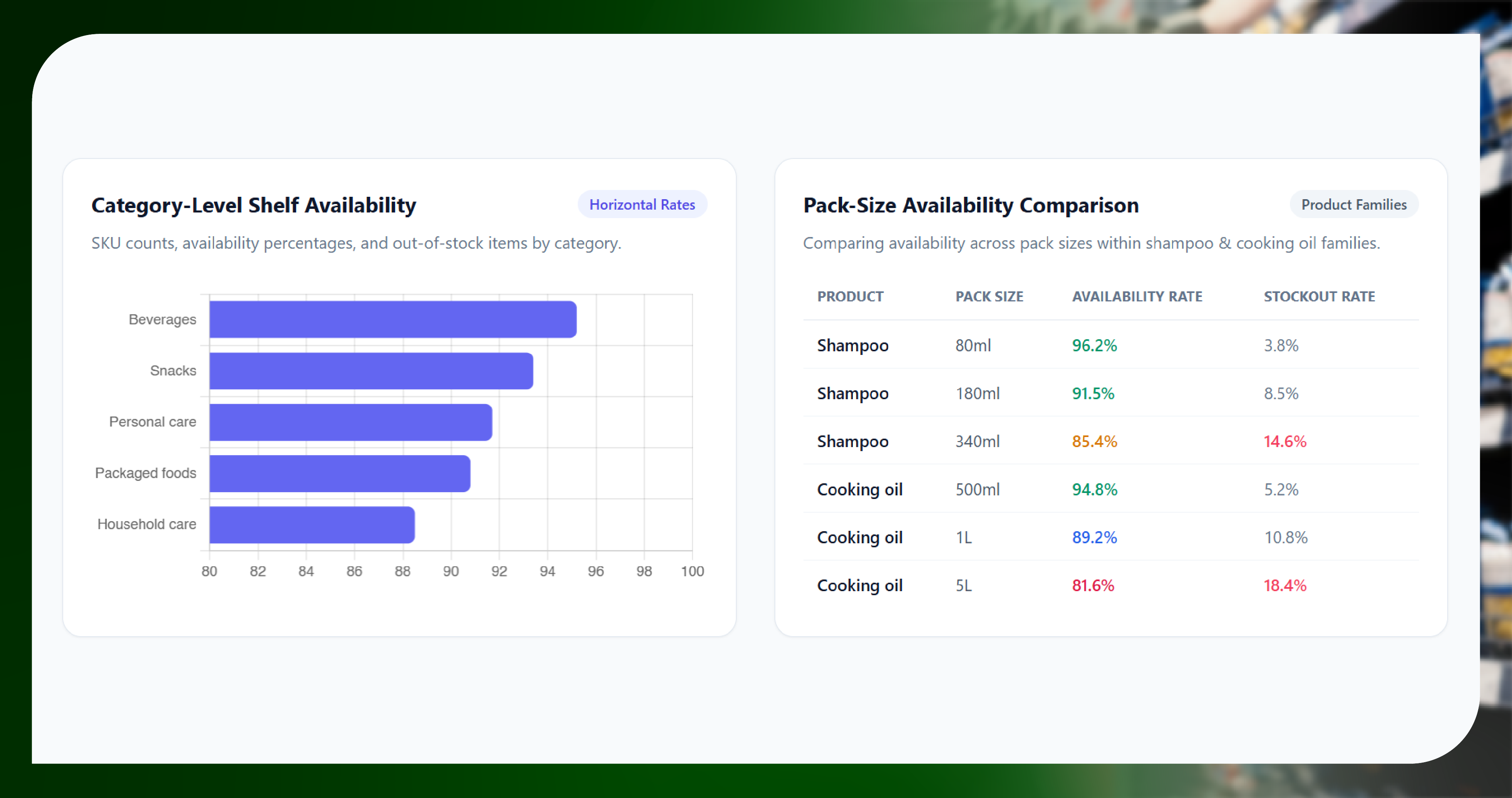
Availability is one of the most important dimensions of FMCG performance. A product cannot generate sales if customers cannot find it.
FMCG Shelf Availability Monitoring can combine SKU identification, retail listings, location-level information, and historical availability records to reveal distribution gaps.
For example, an FMCG brand could monitor 2,000 SKUs across 50 retail locations and discover that 8% of its products repeatedly become unavailable during weekends. Another analysis might show that specific pack sizes experience more frequent stockouts than smaller variants.
These insights can help organizations investigate potential inventory and replenishment issues.
Availability monitoring can also support:
Distribution analysis: Identify retailers or locations where products have limited presence.
Competitor monitoring: Compare the availability of competing brands across the same retail environments.
Launch tracking: Measure how quickly newly introduced SKUs appear across targeted retailers.
Regional intelligence: Identify differences in product availability across cities, regions, or pincodes.
Retail execution: Detect locations where expected assortment does not match actual availability.
Product Attributes Create Deeper Intelligence
Barcode information becomes significantly more valuable when enriched with additional product attributes.
A modern FMCG database can capture nutritional values, ingredients, dietary claims, package dimensions, flavor, color, size, product type, and promotional information where available.
This enables more advanced analysis.
A retailer could identify fast-growing low-sugar products. A brand could compare organic product assortments. A distributor could examine pack-size demand. A consumer intelligence team could track the expansion of functional beverages or plant-based packaged foods.
Product images can also provide useful catalog intelligence, particularly when businesses need to monitor packaging changes, label redesigns, or variant differentiation.
Pricing and Promotion Intelligence
Price is another essential connection between the barcode and the shelf.
A barcode-based database can track regular prices, promotional prices, discounts, bundle offers, and retailer-specific variations.
Suppose the same 1-liter beverage SKU is listed at ₹95 on one platform, ₹89 on another, and ₹85 during a promotional campaign elsewhere. A historical database can preserve these changes rather than treating each price as an isolated observation.
Brands can use this intelligence to evaluate:
- Price positioning
- Promotional frequency
- Discount depth
- Competitor pricing
- Retailer pricing differences
- Pack-size economics
- Regional price variation
The same framework can be extended across thousands of SKUs, making manual price comparison significantly less practical than automated data collection.
Turning Product Data Into Business Decisions
The real value of an FMCG database comes from the decisions it enables.
Sales teams can identify assortment gaps. Marketing teams can understand promotional positioning. Category managers can compare competitive products. Supply-chain teams can investigate availability patterns. Product teams can monitor new launches.
Executives can also use dashboards to track broader market movements.
A well-designed dashboard could display:
- Total active SKUs
- New products detected
- Discontinued products
- Average selling price
- Discount percentage
- Availability rate
- Competitor SKU count
- Retailer assortment
- Regional availability
- Category growth
- Promotional activity
This transforms millions of raw product observations into concise business intelligence.
The Future of Barcode-Driven FMCG Intelligence
The next evolution will involve combining barcode databases with machine learning, computer vision, location intelligence, and automated retail analytics.
AI systems can help identify duplicate products, classify categories, match equivalent SKUs, detect unusual price movements, and recognize changes in product packaging.
Computer vision can potentially complement structured barcode information by analyzing shelf images and identifying product presence, facings, placement, and visual availability.
This creates a broader intelligence framework in which a barcode is no longer simply a number printed on packaging. It becomes a persistent product identity connecting manufacturers, retailers, marketplaces, pricing, availability, and consumer-facing information.
How Food Data Scrape Can Help You?
1. Build Comprehensive FMCG Product Databases
Food Data Scrape can collect barcode-linked product names, brands, categories, SKUs, pack sizes, prices, descriptions, images, and availability, creating structured FMCG databases for scalable analysis.
2. Track Product Prices and Promotions
Capture FMCG prices, discounts, offers, and promotional changes across multiple retail platforms to help brands benchmark competitors, identify pricing patterns, and make informed pricing decisions.
3. Monitor Shelf and Product Availability
Track product availability across retailers, locations, and digital shelves to identify stockouts, assortment gaps, distribution issues, and regional availability differences affecting FMCG sales performance.
4. Enrich Barcode and SKU Intelligence
Connect UPC, EAN, GTIN, barcode, and SKU identifiers with detailed product attributes, enabling businesses to standardize catalogs, identify duplicate listings, and improve product matching accuracy.
5. Deliver Actionable FMCG Market Intelligence
Transform continuously collected product, pricing, availability, and catalog data into structured datasets and dashboards that support competitive intelligence, assortment planning, retail strategy, and market analysis.
Conclusion
A complete FMCG product database starts with reliable product identifiers but becomes truly valuable when those identifiers are connected with catalog attributes, pricing, availability, retailers, locations, promotions, and historical changes.
For organizations seeking scalable product intelligence, AI Grocery Intelligence can turn large volumes of SKU and retail observations into actionable insights.
Likewise, Grocery Data Scraping Services can support structured collection of product catalogs, prices, availability, and competitive retail information across multiple digital channels.
Ultimately, Product Barcode & UPC Data provides the foundation for connecting individual products with the broader retail ecosystem. From barcode identification to digital catalog enrichment and shelf availability monitoring, this approach enables FMCG companies to build a more accurate, dynamic, and decision-ready view of their products and markets.
Are you in need of high-class scraping services? Food Data Scrape should be your first point of call. We are undoubtedly the best in Food Data Aggregator and Mobile Grocery App Scraping service and we render impeccable data insights and analytics for strategic decision-making. With a legacy of excellence as our backbone, we help companies become data-driven, fueling their development. Please take advantage of our tailored solutions that will add value to your business. Contact us today to unlock the value of your data.
Get a Free Food Data Sample in 48 Hours.
Tell us your platforms, target markets and required fields — we'll map exactly what's possible with food data scraping, recommend the right approach, and send a working sample so you can verify quality before any commitment.