Introduction
The food delivery ecosystem is becoming increasingly data-driven, with restaurants, aggregators, cloud kitchens, franchises, and technology companies relying on accurate digital information to make faster decisions.
Food Aggregators API Integration 2026 helps businesses connect restaurant marketplace information with internal databases, analytics platforms, dashboards, applications, and operational systems.
Modern restaurant businesses need more than basic menu information. They need structured access to prices, discounts, availability, ratings, delivery fees, restaurant locations, cuisine categories, operating hours, and promotional information.
Food Aggregators API Integration For Restaurant Chains can help centralize information from multiple outlets and platforms, allowing corporate teams to monitor marketplace performance from one standardized environment.
Restaurant Chain API Integration can further connect aggregator information with restaurant databases, POS systems, CRM platforms, pricing systems, and business intelligence tools.
The result is a connected data ecosystem where restaurant information can move efficiently from permitted sources into structured business workflows.
Why Food Aggregator API Integration Is Important in 2026?
Food aggregator platforms continuously update restaurant information. Prices can change, dishes can become unavailable, discounts can start or expire, and delivery charges can vary according to location and conditions.
Manual monitoring becomes increasingly difficult when a restaurant brand operates hundreds of outlets.
A centralized integration framework can help businesses automate repetitive data operations while creating standardized records for analysis.
Key benefits include:
- Automated data collection
- Centralized restaurant information
- Faster menu monitoring
- Price comparison
- Outlet-level visibility
- Historical data analysis
- Promotion tracking
- Availability monitoring
- Structured reporting
- Scalable data processing
Instead of maintaining separate spreadsheets for different marketplaces, businesses can build a common data layer that brings information together.
Unlock smarter restaurant data management with Food Data Scrape's scalable API integration and real-time food aggregator intelligence solutions—connect, analyze, and optimize your restaurant operations today.
What Data Can Food Aggregators Provide?
Depending on the source, permissions, and available interfaces, restaurant platforms can provide numerous data attributes.
| Data Category | Example Information | Business Application |
|---|---|---|
| Restaurant | Name, ID, address | Restaurant identification |
| Outlet | Location, operating hours | Outlet monitoring |
| Menu | Item, category, description | Menu management |
| Pricing | Original and selling price | Price benchmarking |
| Discount | Offer, coupon, percentage | Promotion analysis |
| Availability | Available, unavailable | Menu monitoring |
| Rating | Score, review count | Reputation analysis |
| Delivery | Fee, ETA, minimum order | Customer experience |
| Cuisine | Cuisine type, category | Market segmentation |
| Images | Restaurant and food images | Content management |
When these attributes are collected consistently, they can become a valuable restaurant intelligence dataset.
Building a Unified Restaurant Data Pipeline
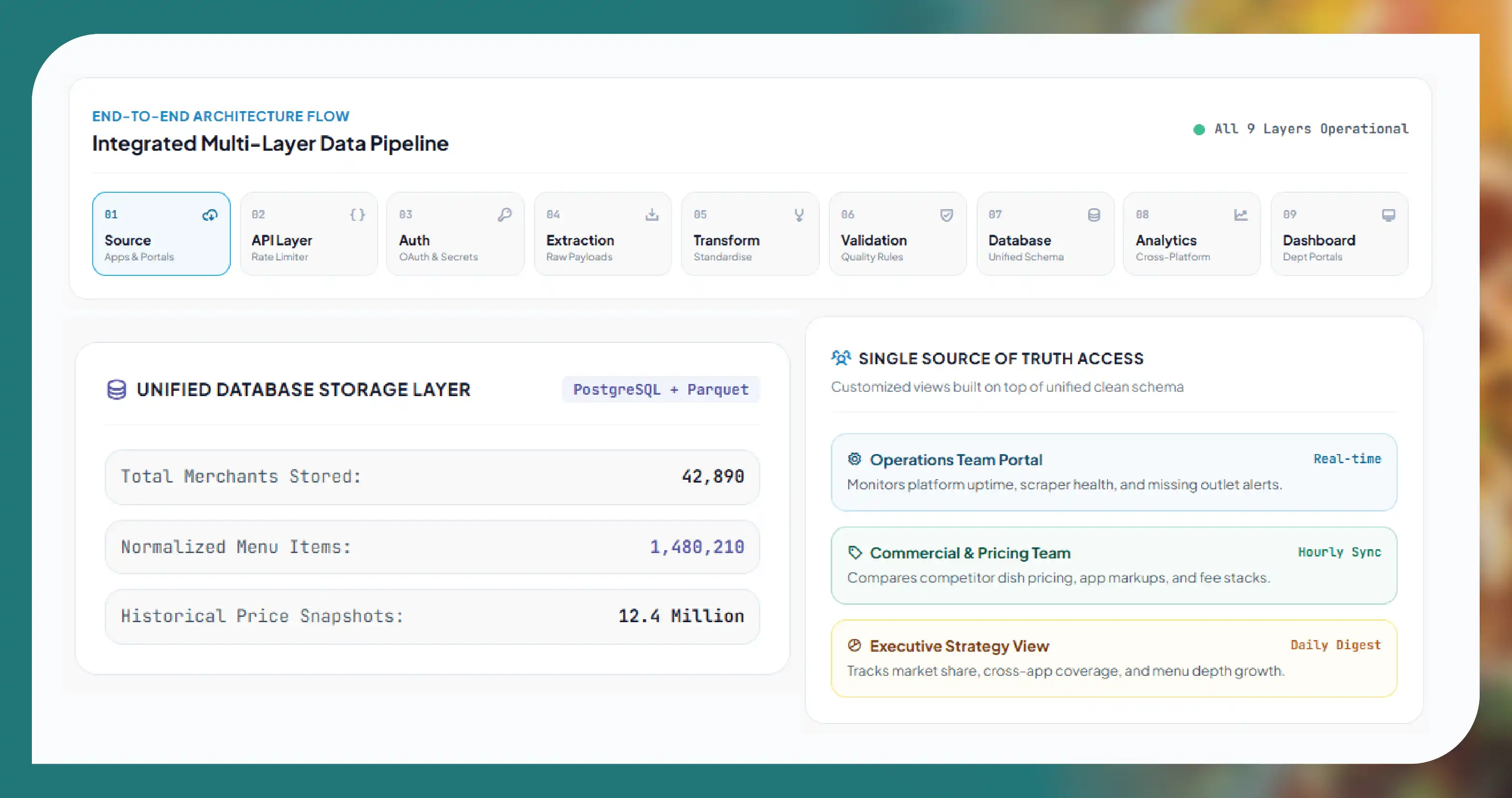
A successful integration starts with a clearly defined data architecture.
The general workflow can include:
Source → API/Collection Layer → Authentication → Extraction → Transformation → Validation → Database → Analytics → Dashboard
- The extraction layer retrieves permitted information.
- The transformation layer standardizes inconsistent formats.
- The validation layer identifies missing, duplicate, or invalid records.
- The database stores structured historical information.
- The analytics layer converts the information into reports and dashboards.
- This architecture allows different departments to work with the same underlying dataset.
How to Scrape Food Aggregator Menu Data
Scrape Food Aggregator Menu Data to structure publicly accessible restaurant information where such collection is permitted and compliant with applicable terms and laws.
The objective is not simply to collect webpage content. A useful system converts restaurant information into structured records.
For example:
| Restaurant | Outlet | Menu Item | Price | Discount | Availability | Rating |
|---|---|---|---|---|---|---|
| Burger Hub | Central | Chicken Burger | ₹229 | 10% | Available | 4.3 |
| Burger Hub | Central | Veg Wrap | ₹179 | 5% | Available | 4.2 |
| Burger Hub | Central | French Fries | ₹119 | 0% | Sold Out | 4.3 |
| Burger Hub | East | Chicken Burger | ₹239 | 15% | Available | 4.1 |
Historical snapshots can then reveal changes in prices, discounts, availability, and menu composition.
Multi-Outlet Restaurant API Integration
Multi-Outlet Restaurant API Integration becomes especially useful for restaurant groups operating across multiple cities.
A chain may have hundreds of outlets listed across several food platforms. Each marketplace can use different outlet identifiers and menu structures.
An internal mapping system can create one standardized identity for each outlet.
For example:
| Internal Outlet ID | City | Platform A ID | Platform B ID | Platform C ID |
|---|---|---|---|---|
| REST-1001 | Delhi | 82931 | 67281 | 91822 |
| REST-1002 | Mumbai | 82932 | 67282 | 91823 |
| REST-1003 | Pune | 82933 | 67283 | 91824 |
| REST-1004 | Bengaluru | 82934 | 67284 | 91825 |
This prevents duplicate outlet records and makes cross-platform analysis easier.
Corporate teams can monitor menu consistency, pricing, promotional campaigns, ratings, availability, and operating hours from one system.
Creating a Food Aggregator Data Extraction API
Food Aggregator Data Extraction API infrastructure can transform collected restaurant information into reusable data endpoints.
Possible endpoint structures may include:
- /restaurants
- /restaurants/{id}/menu
- /restaurants/{id}/pricing
- /restaurants/{id}/availability
- /restaurants/{id}/promotions
- /restaurants/{id}/ratings
Applications can request specific datasets without processing an entire restaurant database.
A reliable API architecture should include authentication, pagination, validation, logging, rate controls, error management, and versioning.
This makes restaurant data easier to connect with applications, dashboards, warehouses, and analytical systems.
Restaurant Chain Data Intelligence
Restaurant Chain Data Intelligence enables businesses to move from raw marketplace information toward structured analysis.
For example, a restaurant chain with 300 outlets could identify:
- Outlets with inconsistent menu pricing
- Frequently unavailable products
- Platform-specific discounts
- Missing menu items
- Changes in customer ratings
- Differences between platforms
- Delivery-fee variations
- Location-level pricing patterns
Historical data makes these insights even more valuable.
Instead of viewing a restaurant listing as a static record, businesses can analyze it as a continuously changing data point.
API Integration and Data Normalization
Different platforms rarely use identical schemas.
One source may provide a discount as a percentage.
Another may display a fixed rupee discount.
Another may include the offer inside a promotional text field.
A normalization layer converts these different structures into consistent fields.
| Raw Information | Standardized Field |
|---|---|
| Restaurant title | restaurant_name |
| Store number | outlet_id |
| Dish title | menu_item |
| Current price | selling_price |
| Original price | regular_price |
| Promotional amount | discount |
| Customer score | rating |
| Delivery time | delivery_eta |
| Availability status | availability |
This standardized structure makes downstream reporting and analysis considerably easier.
Real-Time and Scheduled Data Integration
Not every restaurant dataset requires continuous real-time updates.
Real-time or near-real-time processing may be valuable for:
- Menu availability
- Flash promotions
- Dynamic pricing
- Delivery estimates
- Limited-time offers
Scheduled collection can be appropriate for:
- Menu catalogs
- Restaurant directories
- Historical pricing
- Ratings
- Competitive benchmarking
A hybrid architecture can therefore balance freshness, infrastructure requirements, and processing costs.
Security and Reliability
API-based restaurant data infrastructure needs appropriate security and quality controls.
Important considerations include:
- Secure credentials
- Authentication
- Encryption
- Rate-limit management
- Data validation
- Error handling
- Duplicate detection
- Monitoring
- Access controls
- Audit logging
Businesses should also review platform documentation, applicable access restrictions, terms of service, and relevant laws before implementing third-party data collection or integration workflows.
API Integration Guides can help development teams understand endpoint structures, authentication, pagination, response formats, webhooks, error handling, and data transformation.
Competitive Restaurant Data Analysis
Food Aggregator Data Scraping can support competitive market analysis when conducted through permitted and compliant collection methods.
Businesses can build datasets covering restaurants within specific cities, neighborhoods, cuisines, or price segments.
Potential comparison metrics include:
- Average menu price
- Menu size
- Discount frequency
- Restaurant rating
- Review volume
- Delivery fee
- Availability
- Cuisine category
- Promotional frequency
- Operating hours
For example, a restaurant brand could compare 500 competing outlets across 10 cities and identify differences in pricing and promotional activity.
Restaurant Data for Pricing Intelligence
Pricing is one of the most valuable applications of aggregator data.
A restaurant can compare its menu prices with comparable offerings while monitoring promotional activity across different platforms.
Consider a simplified dataset:
| Menu Category | Brand Price | Competitor Average | Discount Frequency | Availability |
|---|---|---|---|---|
| Burgers | ₹249 | ₹239 | 42% | 96% |
| Pizza | ₹399 | ₹389 | 48% | 94% |
| Wraps | ₹199 | ₹189 | 37% | 97% |
| Desserts | ₹149 | ₹139 | 51% | 91% |
Historical snapshots can help analysts identify whether price changes are temporary promotions or longer-term adjustments.
Restaurant Menu Monitoring
Menu accuracy directly affects the digital customer experience.
An automated monitoring system can identify situations such as:
- Missing menu items
- Incorrect prices
- Outdated descriptions
- Incorrect images
- Unavailable products remaining listed
- Incorrect categories
- Missing customization options
Restaurant teams can then prioritize corrections instead of manually checking every marketplace listing.
Applications Across Restaurant Businesses
API integration can support different teams within a restaurant organization.
Operations Teams
Operations teams can monitor outlet availability, opening hours, menus, and delivery information.
Pricing Teams
Pricing teams can analyze menu pricing and promotional changes.
Marketing Teams
Marketing teams can monitor marketplace offers and campaign visibility.
Franchise Teams
Franchise managers can compare outlet-level marketplace information.
Data Teams
Data teams can integrate structured information into warehouses and analytics systems.
Management
Executives can access consolidated dashboards for marketplace performance and restaurant operations.
Measuring Integration Performance
Businesses should establish clear KPIs to measure the effectiveness of their data infrastructure.
Important metrics include:
- Number of outlets monitored
- Number of menu records processed
- Data completeness
- Data accuracy
- Refresh frequency
- API response time
- Error rate
- Duplicate rate
- Price-change detection
- Processing cost
The objective is not simply to collect large amounts of information.
The objective is to produce reliable, structured, usable information that supports measurable business decisions.
How Food Data Scrape Can Help You?
Automated Collection
Food Data Scrape can develop structured workflows for permitted restaurant data collection, reducing repetitive manual research and supporting consistent datasets across multiple sources.
Multi-Platform Monitoring
Businesses can consolidate restaurant menus, prices, promotions, ratings, and availability into standardized datasets for easier marketplace and outlet-level monitoring.
Historical Analysis
Historical snapshots can help identify menu changes, pricing movements, promotional patterns, and availability fluctuations across restaurants and locations over time.
Custom Data Delivery
Food Data Scrape can organize processed restaurant information into customized datasets and API-ready formats suitable for dashboards, applications, databases, and analytics systems.
Scalable Infrastructure
From individual restaurants to large multi-outlet chains, scalable data workflows can support expanding datasets while maintaining structured schemas, validation processes, and reporting consistency.
Conclusion
Food aggregator integration is becoming an important part of modern restaurant technology infrastructure. Connecting permitted data sources with internal databases, analytics platforms, dashboards, and applications enables businesses to create a centralized view of their digital restaurant presence.
Restaurant Menu Data Scraping can provide structured information for menu monitoring, pricing analysis, availability tracking, and competitive research.
Restaurant Intelligence can turn this information into useful operational and strategic insights across individual outlets and large restaurant networks.
Scrape Restaurant API Data to further support automated data pipelines, provided collection follows applicable permissions, platform requirements, and legal considerations.
The long-term opportunity is to transform fragmented restaurant marketplace information into clean, standardized, historical, and accessible data that supports smarter restaurant operations in 2026 and beyond.
If you are seeking for a reliable data scraping services, Food Data Scrape is at your service. We hold prominence in Food Data Aggregator and Mobile Restaurant App Scraping with impeccable data analysis for strategic decision-making.
Get a Free Food Data Sample in 48 Hours.
Tell us your platforms, target markets and required fields — we'll map exactly what's possible with food data scraping, recommend the right approach, and send a working sample so you can verify quality before any commitment.