Introduction
The food delivery industry has evolved from a convenience service into a massive source of market intelligence. Every order, menu update, delivery fee, restaurant listing, rating, promotion, and estimated arrival time can reveal how consumers behave and how businesses compete. For investors, this information provides a valuable lens for understanding market momentum before relying solely on financial reports or company announcements.
Food Delivery Data for Investment & Market analysis can help investors examine restaurant density, pricing patterns, geographic expansion, customer demand, competitive positioning, and operational performance. Similarly, food delivery data for investment analysis provides structured evidence for evaluating market attractiveness, identifying growth opportunities, and assessing potential risks across cities, restaurant categories, and delivery platforms.
Why Food Delivery Data Matters to Investors?
Investment decisions depend heavily on understanding markets before committing capital. Traditional research often relies on company presentations, industry reports, surveys, and historical financial statements. While useful, these sources may not capture fast-moving changes in local restaurant markets.
Food delivery platforms provide a continuously changing view of market conditions. Investors can observe how many restaurants operate within a specific geography, what cuisines are growing, how menu prices change, which brands are expanding, and how delivery economics differ between competitors.
This makes delivery data especially valuable for private equity firms, venture capital investors, hedge funds, investment banks, restaurant groups, and market research organizations.
By combining historical and real-time datasets, analysts can transform individual restaurant-level observations into broader market signals.
Understanding Restaurant Market Structure
One of the first questions investors ask is whether a market has room for additional growth. Restaurant and delivery data can help answer that question by mapping the competitive structure of a city, neighborhood, or cuisine segment.
Restaurant market data for investors scraping can capture restaurant names, locations, cuisine types, menu categories, prices, ratings, reviews, promotional offers, delivery availability, and operating hours. When collected repeatedly, these fields create a historical picture of how the market changes.
For example, an investor researching a fast-growing city could compare restaurant openings and closures over twelve months. Increasing restaurant density may indicate rising consumer demand, while excessive competition could signal market saturation.
Investors can also identify underserved areas. If a neighborhood has strong delivery demand but relatively few restaurants offering particular cuisines, that gap could represent an expansion opportunity.
Measuring Competitive Positioning
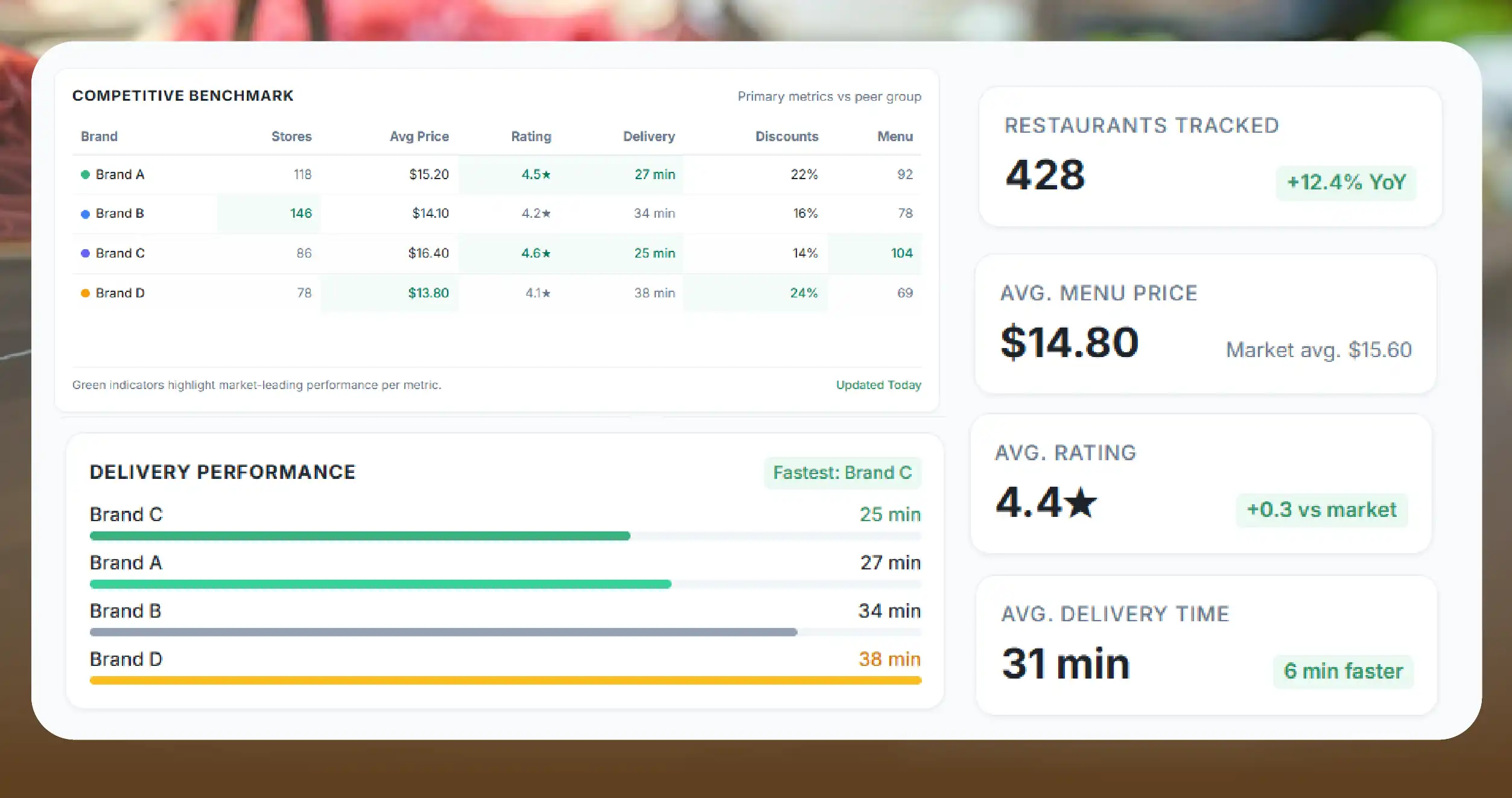
Competition is rarely determined by restaurant count alone. Pricing, promotions, menu variety, ratings, delivery speed, and availability can significantly influence consumer choices.
food delivery data for competitive analysis enables investors to benchmark restaurants and brands against direct competitors. Analysts can compare average menu prices, discount frequency, delivery charges, estimated delivery times, ratings, review volumes, and product assortment.
Suppose two restaurant chains operate in the same city. One may have a larger footprint, but the other may achieve stronger ratings and maintain faster delivery times. Looking only at store count could therefore produce an incomplete investment thesis.
Competitive datasets allow investors to examine these differences systematically rather than relying on anecdotal observations.
Analyzing Restaurant Pricing
Pricing provides another powerful indicator of market health. Restaurant prices can change because of inflation, ingredient costs, labor expenses, competition, promotions, and consumer willingness to pay.
Restaurant pricing data for investment analysis allows analysts to monitor price movements across restaurants, cuisines, locations, and time periods.
A recurring dataset could track the prices of standardized menu items. Analysts could then calculate monthly or quarterly price changes and identify restaurants that consistently raise prices without experiencing significant rating deterioration.
Price dispersion can also reveal market segmentation. Premium restaurants may maintain higher prices and ratings, while value-focused operators compete through discounts and bundled meals.
For investors, these patterns can help assess pricing power and the sustainability of restaurant margins.
Tracking Demand and Consumer Preferences
Consumer preferences change quickly. A cuisine that appears niche today can become mainstream within a few years. Delivery data can expose these changes through menu assortment, restaurant launches, order-related signals where legally and contractually available, ratings, review volumes, and platform visibility.
Restaurant market analysis using delivery data can identify growing cuisine categories, popular meal types, changing consumer preferences, and geographic demand clusters.
For example, analysts could track the number of restaurants offering healthy meals, plant-based products, regional cuisines, desserts, breakfast menus, or premium dining options. Comparing these categories across different periods can reveal emerging trends.
Investors can use these signals when evaluating restaurant concepts, food brands, ghost kitchens, franchise opportunities, and food-tech businesses.
Building Food Delivery Market Intelligence
Investment research becomes more powerful when delivery datasets are combined with external economic indicators. Population growth, income levels, tourism activity, real estate development, employment trends, and demographic information can provide additional context.
Food delivery market intelligence for investors can bring these datasets together to create market-level dashboards.
A dashboard might display restaurant growth, average prices, cuisine distribution, delivery fees, ETA trends, ratings, promotions, and geographic coverage. Investors can filter the information by city, restaurant category, brand, platform, or time period.
This enables faster comparisons between markets.
Instead of asking whether a food delivery market is growing, an investor can investigate where growth is happening, which categories are expanding, and which operators appear best positioned to capture demand.
Monitoring Delivery Economics
Delivery economics can have a significant impact on restaurant profitability. A restaurant may generate strong consumer demand but struggle with high delivery costs, platform commissions, discounts, or operational inefficiencies.
Delivery Fee & ETA Intelligence can help analysts monitor how delivery charges and estimated arrival times vary across restaurants, locations, platforms, and time periods.
Consistently high delivery fees may discourage price-sensitive customers, while longer ETAs could indicate capacity constraints or geographic limitations. Conversely, restaurants offering competitive delivery times and reasonable fees may have stronger positioning.
Investors can use these indicators alongside menu prices and promotions to understand the customer proposition rather than evaluating restaurants based solely on revenue potential.
Using Food Delivery App Data Scraping
Modern food delivery platforms frequently update menus, restaurant availability, prices, promotions, and interface structures. As a result, investment datasets require consistent collection and validation.
Food Delivery App Data Scraping can automate the collection of publicly accessible or appropriately authorized information from relevant digital platforms. A structured pipeline can capture restaurant details, menu information, pricing, ratings, delivery estimates, promotions, and location-level information.
A reliable workflow should include data validation, duplicate detection, timestamping, schema management, monitoring, and historical storage. This ensures that analysts can distinguish genuine market changes from temporary website or application variations.
The objective is not simply collecting large volumes of data. The real value comes from producing consistent datasets that can support repeatable investment analysis.
Tracking Market Trends Over Time
A single snapshot can show what a market looks like today. A historical dataset can explain where that market is heading.
Tracking Food Delivery Trends enables investors to identify restaurant expansion, contraction, pricing changes, promotional intensity, cuisine growth, and shifting competitive dynamics.
For example, if restaurant counts increase steadily while average discounts decline, the market could be demonstrating stronger demand and reduced dependence on promotions. If restaurants increasingly offer discounts while competition rises, investors may need to investigate whether customer acquisition costs or margin pressure are increasing.
Time-series analysis can therefore transform raw delivery observations into indicators of market direction.
Turn food delivery data into actionable investment intelligence—identify market opportunities, track competitors, and make data-backed decisions with confidence.
Identifying Investment Opportunities
The strongest investment opportunities often emerge where multiple signals align.
A market with increasing restaurant density, rising prices, strong ratings, growing cuisine demand, and improving delivery efficiency may present a compelling growth story. Meanwhile, a market experiencing closures, heavy discounting, declining ratings, and rising delivery fees may require deeper due diligence.
Investors can also identify acquisition targets by screening restaurant brands based on geographic footprint, pricing position, ratings, menu breadth, and competitive presence.
For private equity firms, this approach can support target sourcing. For venture capital firms, it can reveal emerging categories and scalable restaurant concepts. For strategic investors, it can highlight markets suitable for expansion.
Turning Scraped Data Into Investment Signals
Raw data does not automatically produce an investment thesis. Analysts need a framework for converting observations into measurable indicators.
Useful metrics can include restaurant growth rate, average menu price, price inflation, cuisine share, restaurant density, promotional frequency, rating distribution, delivery fee averages, ETA averages, and geographic expansion.
These metrics can then be compared across cities, brands, categories, and time periods.
Machine learning models can further identify unusual patterns, forecast demand, segment markets, and flag potential opportunities. Visualization tools can turn complex datasets into dashboards that investment teams can interpret quickly.
The key is to connect every metric to an investment question: Is demand growing? Is competition intensifying? Is pricing power improving? Are customers becoming more price sensitive? Is a restaurant category reaching saturation?
How Food Data Scrape Can Help You?
Market Mapping: Food data scrape reveals restaurant density, cuisine distribution, pricing structures, and geographic gaps, helping investors identify attractive markets, underserved neighborhoods, and competitive saturation before making expansion decisions.
Competitive Tracking: Continuous food data scrape monitors competitors' menus, prices, promotions, ratings, and delivery performance, enabling investment teams to recognize strategic changes and emerging threats across markets.
Trend Detection: Food data scrape creates historical datasets that expose changing cuisines, pricing movements, restaurant growth, and consumer preferences, helping analysts distinguish temporary fluctuations from meaningful market trends.
Opportunity Screening: Food data scrape supports systematic screening of brands, locations, and categories, allowing investors to discover expansion opportunities, potential acquisition targets, underserved segments, and attractive market entry points.
Risk Assessment: Food data scrape provides measurable evidence around competition, pricing pressure, restaurant closures, discount dependence, delivery performance, and market saturation, strengthening investment decisions with timely operational intelligence.
Conclusion
Food delivery platforms have become valuable sources of granular market intelligence. When collected systematically, restaurant listings, menus, prices, promotions, ratings, delivery fees, ETAs, and geographic information can reveal market dynamics that traditional research may overlook.
For investors, the opportunity extends beyond monitoring restaurants. Delivery datasets can support market sizing, competitive benchmarking, investment screening, pricing analysis, expansion planning, due diligence, and portfolio monitoring.
Private Equity Food Deals Tracker for Investment can use delivery signals to complement deal research and identify restaurant markets or brands worth deeper investigation. Meanwhile, B2B Food Marketing Data Scraping can help businesses build structured prospect and market datasets for targeted commercial strategies.
Finally, Delivery Fee & ETA Intelligence adds an operational dimension to investment research by showing how customer experience and delivery economics vary across markets.
The ultimate advantage comes from combining frequent data collection with historical analysis. Instead of viewing food delivery as merely a transaction channel, investors can treat it as a continuously updating market intelligence layer—one capable of revealing competitive shifts, pricing power, consumer trends, and emerging opportunities before they become obvious.
If you are seeking for a reliable data scraping services, Food Data Scrape is at your service. We hold prominence in Food Data Aggregator and Mobile Restaurant App Scraping with impeccable data analysis for strategic decision-making.