Introduction
Food delivery platforms have transformed how consumers discover restaurants, compare menus, evaluate prices, and order meals. Platforms such as Uber Eats, Postmates, and iFood provide valuable insights into restaurant performance, consumer preferences, menu trends, delivery coverage, and competitive pricing. For restaurants, food brands, market researchers, and technology companies, analyzing this information can support smarter decisions and more effective business strategies.
Food Delivery Platform Data Scraping helps businesses collect publicly accessible information from food delivery websites and authorized data sources, transforming scattered listings into structured, analysis-ready datasets. Companies can monitor menu prices, promotions, restaurant ratings, delivery charges, customer feedback, and product availability across selected locations.
Through Food Delivery Restaurant Data Extraction, businesses can organize restaurant names, cuisines, menu categories, item descriptions, prices, ratings, and operating information into consistent formats. This makes it easier to benchmark competitors, identify popular food categories, and evaluate differences between local markets.
Meanwhile, Food Delivery Availability Data provides insights into restaurant visibility, delivery coverage, operating hours, and whether particular menu items appear available at the time of collection. When collected responsibly and analyzed regularly, these datasets help organizations understand a rapidly changing food delivery ecosystem.
A well-designed crawler does more than gather listings. It creates a reliable foundation for competitive intelligence, menu optimization, location planning, pricing analysis, and market expansion.
What Is a Food Delivery Platform Crawler?
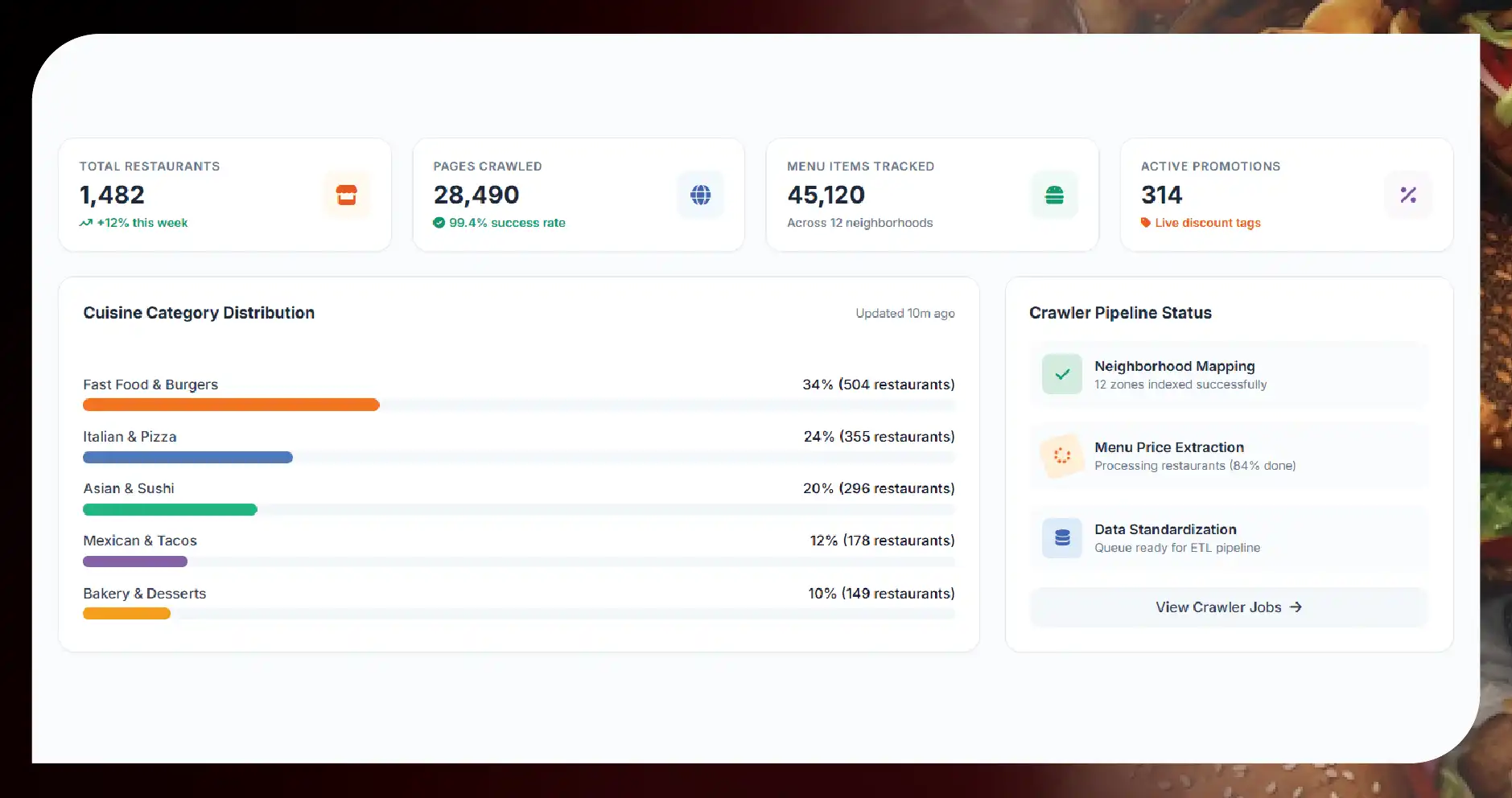
A food delivery platform crawler is an automated data collection system that navigates permitted website pages, approved interfaces, or authorized application data sources to identify relevant information and organize it into structured records.
Unlike manual research, which requires employees to visit individual restaurant listings and record information separately, automated crawling can process large numbers of eligible pages using repeatable workflows. The collected data can then be validated, standardized, and delivered to analytics platforms, databases, dashboards, or business intelligence systems.
For example, a restaurant consultancy comparing food delivery markets may need information about hundreds of restaurants across multiple neighborhoods. A crawler can help collect available restaurant details, cuisine categories, listed menu prices, promotional offers, customer ratings, and delivery estimates, subject to platform permissions and technical access restrictions.
The resulting dataset enables analysts to compare restaurants consistently rather than relying on isolated observations.
How Uber Eats, Postmates, and iFood Data Collection Works?
Platform access and available fields depend on geography, account permissions, platform policies, and authorized collection methods.
1. Uber Eats Restaurant Intelligence
Uber Eats provides restaurant listings, menus, cuisine classifications, prices, ratings, and delivery-related information in supported markets.
Businesses can analyze permitted data to understand menu positioning, restaurant density, competitive offers, and local food preferences. For example, a restaurant chain entering a new city could compare the listed prices of pizza, burgers, salads, and regional dishes across selected neighborhoods.
Uber Eats Restaurant Data Scraping can support this analysis when collection is conducted through authorized sources and methods. Researchers can standardize restaurant records and compare them over time to identify changes in menu offerings, promotional activity, and competitive positioning.
Postmates, also associated with Uber's delivery business, should not automatically be treated as an independent, separately operating marketplace in every location. Its historical data and brand-specific coverage may differ from current Uber Eats availability.
2. Postmates Marketplace Data
Postmates has historically provided delivery services for restaurants and local merchants, particularly in the United States.
Historical or otherwise authorized Postmates data can help researchers examine restaurant assortment, menu pricing, delivery service patterns, and marketplace development. However, analysts should verify whether a specific dataset represents historical Postmates listings, current Uber Eats listings, or a distinct authorized source.
This distinction matters when evaluating long-term trends. Combining records without identifying their source and observation dates can create misleading conclusions about restaurant growth, market share, or changes in consumer access.
3. iFood Restaurant and Menu Data
iFood is a major food delivery marketplace in Brazil, making its available data relevant to businesses studying Brazilian restaurants and food commerce.
Researchers may examine permitted restaurant listings, cuisine categories, menu prices, discounts, ratings, and location-level availability. Regional comparisons can reveal how menu offerings and pricing differ between cities or neighborhoods.
An iFood Food Delivery Scraping API may refer to an authorized API-based collection workflow or a service that delivers processed iFood-related data. It should not be assumed that an unrestricted public API exists for every desired field. Access must be verified against the platform's current developer terms, permissions, and applicable requirements.
Key Data Fields to Collect from Food Delivery Platforms
The value of a crawler depends on the quality and relevance of its collected fields. A useful dataset should capture enough information to answer specific business questions without collecting unnecessary personal information.
| Data category | Important fields | Business application |
|---|---|---|
| Restaurant details | Name, cuisine, location identifier, listing status | Competitor mapping |
| Menu information | Item name, category, description, portion size | Menu benchmarking |
| Pricing | Listed price, currency, item-level discount | Price comparisons |
| Delivery information | Displayed fee, estimated delivery time, service availability | Service analysis |
| Customer feedback | Public rating, review count, permitted review attributes | Reputation monitoring |
| Promotions | Listed offer, discount conditions, observation date | Campaign benchmarking |
| Availability | Listing visibility, operating status, item availability | Local demand and coverage analysis |
| Data provenance | Source, collection timestamp, market, record identifier | Auditing and trend analysis |
Not every platform exposes every field, and some information may be personalized, account-specific, or restricted. A robust project documents which fields are accessible, how they are defined, and when they were collected.
Benefits of Food Delivery App Data Extraction
1. Competitive Price Monitoring
Food delivery prices can vary by restaurant, location, menu selection, and promotional campaign. A structured Food Delivery App Data Extraction system helps businesses compare listed prices for similar meals across markets and identify positioning opportunities.
For example, a burger chain could compare the listed prices of comparable meal combinations in different neighborhoods. Analysts can distinguish regular menu prices from temporary discounts, where that information is available, and evaluate how promotional activity changes over time.
Reliable price monitoring also helps businesses recognize pricing gaps, evaluate value propositions, and develop localized menu strategies without relying on occasional manual checks.
2. Restaurant Discovery and Market Mapping
Restaurant discovery data helps businesses understand the competitive landscape in specific geographic areas. Analysts can group listings by cuisine, price range, restaurant type, and location to identify market concentrations and underserved categories.
Food Delivery Restaurant Analytics can reveal whether a neighborhood has many pizza restaurants but fewer healthy meal providers, specialty cafés, or regional food outlets. Restaurant groups can use these insights to evaluate possible expansion locations and determine which cuisine categories deserve further research.
These findings should be interpreted alongside population characteristics, customer demand, rental costs, and other market indicators rather than treated as definitive evidence of demand.
3. Menu Trend Analysis
Menus reflect changes in consumer preferences, ingredient costs, seasonal demand, and restaurant innovation. Tracking permitted menu information over time can help analysts identify emerging food categories, changing portion sizes, new product launches, and shifts in menu positioning.
A food manufacturer, for example, could monitor the presence of plant-based meals, protein-rich bowls, low-sugar beverages, or regional specialties across selected restaurant categories.
When Food Delivery Market Intelligence combines menu observations with reliable market research, businesses can identify potential product opportunities, prepare restaurant partnership proposals, and assess which categories warrant additional investigation.
4. Delivery Coverage and Availability Insights
A restaurant may appear in one delivery zone but remain unavailable in another. Operating hours, service coverage, temporary closures, and item-level availability can all influence what consumers see when searching for food.
A carefully designed collection process can capture authorized availability indicators at defined observation times and locations. Comparing these observations can help researchers identify coverage differences and recurring service gaps.
However, an unavailable listing does not automatically mean that a restaurant is permanently closed or that a dish is discontinued. It may reflect delivery distance, time of day, temporary operating conditions, or account-specific settings.
5. Promotion and Discount Evaluation
Promotions are an important part of food delivery competition. Restaurants may offer meal bundles, percentage discounts, free delivery, limited-time deals, or category-specific offers.
By collecting permitted promotional details with timestamps and applicable conditions, analysts can compare campaign patterns across restaurants and markets. This supports research into promotional frequency, discount positioning, and the relationship between offers and listed prices.
Businesses should distinguish advertised discounts from actual transaction prices. Taxes, service charges, minimum order values, and eligibility conditions can affect the final amount paid by a customer.
How to Build an Effective Food Delivery Crawler?
Developing a useful crawler requires more than extracting information from individual pages. The collection workflow must account for data quality, source permissions, changing website structures, and the needs of the final analysis.
Step 1: Define the Business Objective
Begin by identifying the questions the dataset should answer. A restaurant group might prioritize menu prices and competitor locations, while a market research company may need cuisine distributions, rating patterns, and market-level coverage.
Clear objectives prevent unnecessary collection and help determine which fields, markets, and observation frequencies are appropriate.
Step 2: Identify Authorized Data Sources
Review the platform's current terms, developer documentation, licensing requirements, and available access methods before collecting information. Approved partner integrations, merchant-authorized feeds, licensed datasets, and documented APIs can provide appropriate routes to relevant data.
For example, Uber Eats documents marketplace integrations for store management, menu synchronization, and order processing, with access potentially requiring written approval. Its API terms also restrict scraping and other uses unless explicitly permitted.
Similarly, iFood's developer terms describe limited, purpose-specific API access for application integrations. Access credentials and permitted uses must be respected.
Do not assume that public visibility grants permission for automated extraction or commercial redistribution.
Step 3: Collect and Standardize Relevant Fields
Once access is authorized, collect only the information required for the project. Standardize currencies, location identifiers, menu categories, timestamps, and price formats so records can be compared consistently.
For instance, a dataset covering several cities should distinguish local currency values rather than comparing raw numbers across markets. Restaurant names may also require normalization to avoid treating the same business as multiple competitors because of spelling variations.
Step 4: Validate and Deduplicate Records
Data validation is essential because listings may contain missing fields, duplicated restaurants, inconsistent menu descriptions, or outdated information.
A quality-control workflow should check required fields, identify duplicates, validate price formats, and flag unexpected changes. Source identifiers and collection timestamps help analysts trace individual observations and distinguish genuine changes from collection errors.
Step 5: Store and Deliver the Dataset
The final data can be organized into CSV files, JSON records, databases, cloud storage, or business intelligence pipelines, depending on the project requirements.
For recurring projects, scheduled authorized updates can refresh relevant records and preserve historical snapshots. This makes it possible to analyze changes over time instead of relying on a single collection event.
Challenges in Food Delivery Data Collection
Dynamic Content and Changing Interfaces
Food delivery platforms frequently update page layouts, menu structures, and application functionality. Collection workflows that depend on fixed page elements can become unreliable after a redesign.
A maintainable solution needs monitoring, validation, and documented recovery procedures. Authorized APIs and stable data feeds may reduce some interface-related challenges, although their available fields and update schedules can still change.
Location-Specific Results
Listings, prices, delivery estimates, and promotional offers may differ by delivery address or service zone. A dataset collected from one location should not be presented as representative of an entire city or country without supporting evidence.
Researchers should document their sampling locations and collection conditions. Where permitted, repeated observations across selected locations can provide a more useful picture of geographic differences.
Incomplete or Time-Sensitive Information
Restaurants may change operating hours, suspend selected dishes, or update promotions throughout the day. Data that was accurate when collected may no longer reflect the current marketplace.
To manage this limitation, teams should record observation timestamps, define refresh schedules according to business needs, and flag stale records. Availability should be described as an observation at a specific time, not a guarantee of future service.
Privacy, Licensing, and Compliance
Food delivery data projects must respect platform terms, applicable privacy laws, intellectual property rights, and contractual restrictions. Personal customer details, private account information, authentication tokens, and restricted transaction data should not be collected without an appropriate legal basis and authorization.
Before production deployment, businesses should establish access controls, retention policies, permitted-use documentation, and a review process for sharing or redistributing datasets. Compliance should be built into the collection design rather than treated as a final administrative check.
How Food Data Scrape Can Help You?
1. Build Competitive Intelligence
Food Data Scrape helps businesses organize permitted restaurant listings, menu prices, ratings, and promotions into structured datasets, supporting competitor benchmarking and more informed decisions across selected food delivery markets.
2. Improve Menu Pricing Strategies
By analyzing web scraping food delivery data, businesses can compare listed meal prices, promotional patterns, and menu variations, helping teams evaluate pricing opportunities and develop market-specific strategies using validated observations.
3. Understand Customer Preferences
Food Data Scrape organizes relevant menu categories, public ratings, and restaurant attributes, helping researchers identify popular cuisines, emerging food trends, and potential product opportunities across different delivery locations.
4. Monitor Application-Based Market Changes
Mobile app scraping for food supports authorized collection workflows where permitted, helping businesses examine changing menu listings, restaurant visibility, and availability indicators while respecting access controls and platform requirements.
5. Support Scalable Data Analysis
Food Data Scrape transforms validated restaurant information into reusable datasets, enabling analysts to compare markets, maintain historical records, automate reporting, and support expansion decisions through consistent data management.
Conclusion
A crawler for food delivery platforms can provide valuable business intelligence when its collection scope, data quality, and intended use are clearly defined. By analyzing restaurant listings, menus, prices, promotions, and availability indicators, businesses can better understand competitive positioning and changing food delivery markets.
Uber Eats Restaurant Data Scraping can support restaurant benchmarking and menu analysis when the required data is obtained through authorized methods. Companies should verify applicable access permissions and platform restrictions before implementing any automated workflow.
An iFood Food Delivery Scraping API solution can help organize authorized data flows for businesses researching Brazil's food delivery ecosystem, subject to iFood's developer terms, available permissions, and approved integration purposes.
Well-structured Food Delivery Datasets can ultimately help restaurant chains, food manufacturers, analysts, and market research teams compare competitors, explore new opportunities, and make evidence-based decisions. The strongest solutions combine reliable data collection with consistent validation, transparent sourcing, appropriate refresh schedules, and responsible data governance.
When these foundations are in place, food delivery intelligence becomes more than a collection of restaurant listings: it becomes a practical resource for understanding markets, evaluating business opportunities, and supporting long-term strategic planning.
If you are seeking for a reliable data scraping services, Food Data Scrape is at your service. We hold prominence in Food Data Aggregator and Mobile Restaurant App Scraping with impeccable data analysis for strategic decision-making.
Get a Free Food Data Sample in 48 Hours.
Tell us your platforms, target markets and required fields — we'll map exactly what's possible with food data scraping, recommend the right approach, and send a working sample so you can verify quality before any commitment.