Introduction
Every big food fair publishes a list of who is exhibiting. For an exporter, distributor or importer, that list is a ready map of the market. Turning it into a clean trade show exhibitor database, though, takes more than copying a web page.
The short answer: a trade show exhibitor database is a structured file of the companies exhibiting at food fairs such as Gulfood, SIAL Paris and Anuga. It holds company-level public data only: name, country, hall and stand, product categories, website and description. It is cleaned, de-duplicated and enriched, and it excludes personal contacts.
This guide covers why F&B teams use exhibitor data, which shows matter, the fields to collect, how to clean and enrich them, the compliance basics, and when to build in-house or buy.
Why do F&B companies use exhibitor lists?
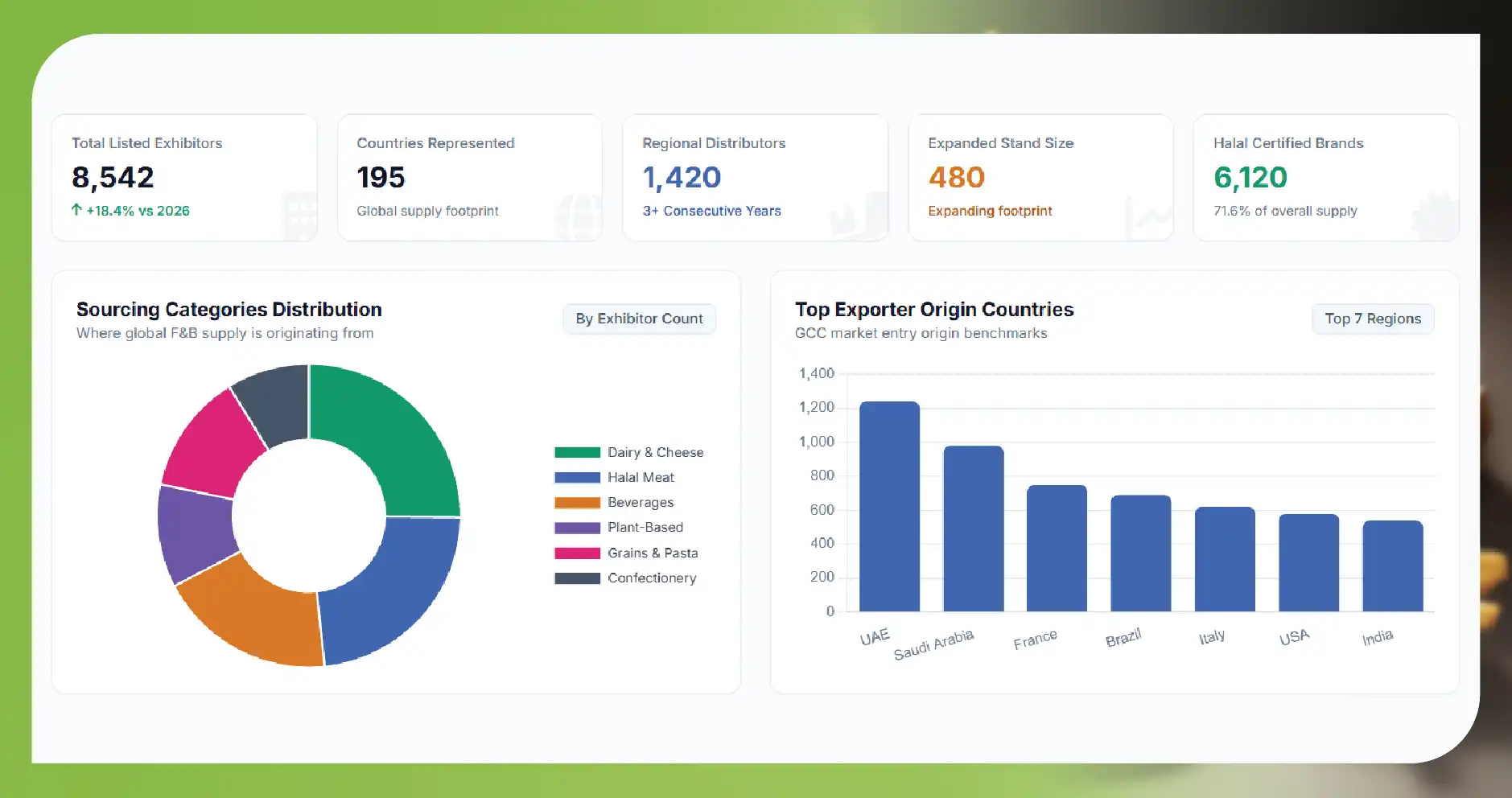
Trade shows gather thousands of food companies in one place. The next Gulfood runs 15–19 March 2027 across Dubai World Trade Centre and the Dubai Exhibition Centre, and the organiser lists 8,500+ exhibitors from 195 countries. That is a large, current sample of who sells food into the Gulf.
- GCC market entry: a brand entering the UAE or Saudi Arabia can see which competitors already exhibit, from which countries, and in which sectors.
- Distributor and importer search: exporters shortlist regional distributors and trading companies that show up year after year.
- Sourcing: retail and foodservice buyers find new suppliers by category, such as dairy, halal meat or plant-based products.
- Competitor tracking: category managers see which brands launched or expanded their stands compared with the last edition.
- Market research: analysts count exhibitors by country or sector to see where supply is coming from.
The value comes from structure. A brochure or a scrolling web directory is hard to filter; a CSV with consistent columns can be sorted, joined and loaded into a CRM or BI tool.
Timing matters too. Exhibitor lists grow in the months before a show and are often replaced by the next edition afterwards. Capturing the list at a few points, such as three months out, one month out and show week, gives you a fuller and better-dated picture.
Which food trade shows publish exhibitor directories?
Most major food fairs publish a searchable online directory. The table below summarises the shows F&B teams ask about most. Dates and fields change each edition, so check the official site before you plan a project.
| Show | City | Typical month | Directory fields shown publicly |
|---|---|---|---|
| Gulfood | Dubai (DWTC + Dubai Exhibition Centre) | Jan–Mar (2027: 15–19 March) | Company name, hall, stand, description, address, website, social links, logo; separate product listings |
| Gulfood Manufacturing | Dubai (DWTC) | November (2026: 3–5 Nov) | Company name, hall, stand, country, sector, product categories, profile text, website |
| Saudi Food Show | Riyadh | Typically spring | Company name, stand, country, sector, product categories, website |
| SIAL Paris | Paris Nord Villepinte | October (2026 edition) | Company name, hall, stand, country, product categories, description, website |
| Anuga | Cologne | October, biennial (next: 2027) | Company name, hall, stand, country, product categories, description, website |
| Summer Fancy Food Show | New York | June | Company name, booth, country, product categories, description, website |
Official organiser pages are the source for show dates, scale and directory fields. Re-check them before every project, because listings change right up to show week.
What data fields should a trade show exhibitor database include?
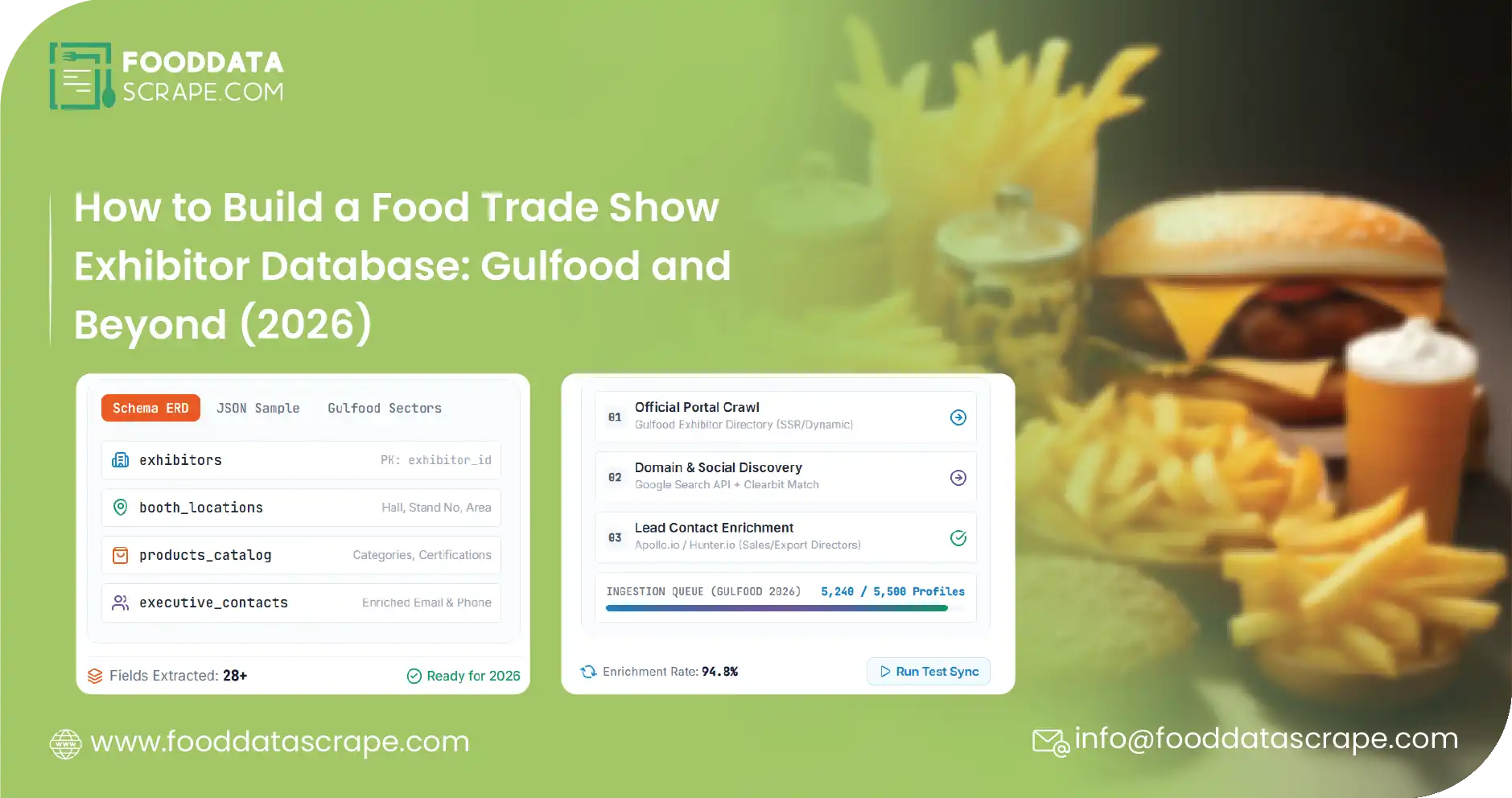
Keep the schema at company level. On a live Gulfood exhibitor profile we checked today, the public fields were company name, hall, stand, description, address, logo, website and social links, plus a contact form. The form is for messaging the company, not data to collect.
- Company name. The exhibiting brand or legal name as shown, plus a cleaned version for matching.
- Country. Country of the exhibitor or its national pavilion. Pavilions need care, because one stand can host many firms.
- Hall and stand. Useful for event planning and for spotting national pavilions.
- Product categories / sector. The show's own taxonomy, mapped to a standard list such as dairy, beverages, meat and poultry, bakery or ingredients.
- Company website. The key for de-duplication and enrichment.
- Public company description. The profile text, kept as written, with the source URL.
- Show, edition and capture date. So you can compare 2026 with 2027 and know how fresh each row is.
How do you collect, clean and de-duplicate exhibitor data?
A reliable pipeline has five steps. The same steps work whether you build a reusable script or use a managed food data scraping service.
- Read the rules first. Check the directory's terms of use and robots.txt. If the organiser offers an official export, an exhibitor list for sale or an API, prefer that.
- Collect politely. Use only public, logged-out pages, at low request rates, during off-peak hours. Do not bypass logins, CAPTCHAs or access controls.
- Normalise. Trim spaces, fix capitals, strip legal suffixes (LLC, FZE, GmbH, Ltd) into a separate column, and turn country names into ISO codes.
- De-duplicate. Match on website domain first, then on cleaned company name plus country. Keep one master row and list every stand or show where the company appeared.
- Validate. Spot-check a sample against the live directory, flag rows without a website, and record a capture date for every row.
De-duplication is where most projects fail. National pavilions, parent and brand names, and Arabic or Chinese transliterations can make one company look like three. Domain matching solves most cases; the rest need a short manual review.
Agree the output early. Most teams want one CSV or Excel file with one row per company, a second file with one row per company per show, and a short data dictionary. If you plan to repeat the work every edition, keep the script, the category map and the dedup rules under version control so each year's file lines up with the last.
How can you enrich exhibitor records with public company data?

An exhibitor list tells you who was there. Enrichment tells you who they are. Use public, company-level sources only:
- Company website. Product range, export markets, certifications such as halal or organic, and whether the firm is a manufacturer, brand owner or distributor.
- Category tags. Map free-text descriptions to a fixed category list so you can filter, for example, all frozen bakery exhibitors from Turkiye.
- Repeat presence. Join several editions and shows to see which firms exhibit every year, a useful signal of commitment to a region.
- Retail presence. For the GCC, check whether the brand is already listed on regional grocery platforms. Our UAE food data work covers that side.
- Company databases. Combine exhibitor rows with a wider food and beverage company database for firms that did not exhibit. Sales teams that also target restaurants and caterers can link the result to foodservice lead intelligence, still at business-listing level.
What are the legal and compliance basics?
Exhibitor directories are public, but that does not make every use acceptable. Follow these rules:
- Respect directory terms. Many organisers limit automated access or commercial reuse. Read the terms, honour robots.txt and keep request rates low.
- Company-level data only. Do not collect names, emails or phone numbers of individual staff. Under the EU GDPR and the UAE Personal Data Protection Law (Federal Decree-Law No. 45 of 2021), personal data needs a lawful basis that a scraped list usually lacks.
- No bulk contacting. Do not use the list for mass unsolicited email or messages through the show's contact forms.
- Keep sources and dates. Store the source URL and capture date so you can answer questions and remove records on request.
- Check before sharing. If you resell or publish the data, take legal advice for each market.
Used this way, a trade show exhibitor database is a research and planning tool, not a spam list.
Should you build or buy an exhibitor dataset?
A one-off list for a single show can be a small in-house job. Several shows, repeated every year with enrichment, is a data product.
| Factor | Build in-house | Buy or outsource |
|---|---|---|
| Best for | One show, one-off list | Several shows, every edition |
| Upfront effort | Script, testing, QA | Scoping call and sample review |
| Maintenance | Fix the script when the directory layout changes | Provider maintains collectors |
| Dedup and enrichment | Manual rules you write | Matching across shows and editions included |
| Compliance review | Your team | Shared, with documented method |
| Cost | Staff time | Per show or subscription, quoted per project |
When comparing providers, ask how they handle directory terms, whether they exclude personal data, how they match companies across shows, and how fresh each row is.
Get a free sample dataset. Tell us which food shows and categories you need, and we will send a sample of clean, company-level exhibitor data.
Questions
Frequently Asked Questions
The official site offers a searchable online directory. Check whether the organiser sells or shares an export; otherwise a compliant collection of public profile fields can produce a CSV.
It depends on the directory's terms and local law. Collect only public, company-level data, respect robots.txt and rate limits, and avoid personal contact details.
The organiser lists 8,500+ exhibitors from 195 countries for Gulfood, with the next edition on 15–19 March 2027 in Dubai.
We do not include personal names or emails of staff. A public company website and general business details are the safe limit.
Match on website domain first, then on cleaned company name plus country, and keep one master row with a list of shows attended.
Get a Free Food Data Sample in 48 Hours.
Tell us your platforms, target markets and required fields — we'll map exactly what's possible with food data scraping, recommend the right approach, and send a working sample so you can verify quality before any commitment.
Request a strategy call
Thanks — our data team will reach out within 48 hours with your sample.