Introduction
Consumer demand for frozen food continues to evolve as shoppers prioritize convenience, healthier meal options, premium ingredients, and affordable pricing. Retailers and manufacturers are increasingly relying on Frozen Food Trends Data Analysis to understand changing buying patterns, identify emerging product categories, and optimize pricing strategies across supermarkets and online grocery platforms.
Modern businesses also leverage Frozen Food Consumer Trends Scraping to monitor customer reviews, product ratings, shopping preferences, and seasonal demand shifts. These insights help brands respond quickly to evolving consumer expectations.
Another critical capability is Frozen Food Data Scraping, which enables organizations to collect structured product information, pricing, promotions, availability, and assortment data from multiple retail sources for deeper market intelligence.
Why Frozen Food Analytics Matters More Than Ever?
The frozen food market has become highly competitive, with supermarkets introducing new products almost every week. Consumers compare brands based on price, nutrition, convenience, package size, ingredients, and sustainability before making purchasing decisions.
Real-time analytics allows businesses to understand changing market conditions instead of relying on outdated reports. Companies can identify fast-growing categories, evaluate competitor performance, and react quickly to market changes.
Continuous data collection also supports better merchandising decisions, ensuring retailers stock products that align with customer demand.
Understanding Consumer Purchase Behavior
Today's frozen food shoppers leave valuable digital signals across grocery websites and delivery platforms. Reviews, ratings, search frequency, wishlist activity, and repeat purchases provide measurable insights into consumer preferences.
Businesses analyze these behaviors to understand:
- Preferred meal categories
- Popular package sizes
- Health-focused purchasing
- Seasonal buying trends
- Family-oriented products
- Premium food demand
- Organic product growth
These insights improve product development while reducing the risks associated with launching new products.
Monitoring Market Pricing
Pricing plays a critical role in influencing purchasing decisions within the frozen food industry. Even small price changes can affect consumer demand, brand preference, and overall sales performance. Frozen Food Price Monitoring enables businesses to continuously track product prices across supermarkets, grocery delivery apps, and online retail platforms. Companies can analyze regular prices, promotional discounts, limited-time offers, loyalty rewards, bundle deals, and regional pricing differences from a single dashboard. Historical pricing data further helps identify seasonal trends, inflationary impacts, and competitor pricing strategies. These insights support smarter pricing decisions, improved promotional planning, stronger competitive positioning, and increased profitability in a rapidly evolving frozen food market.
Tracking Emerging Product Trends
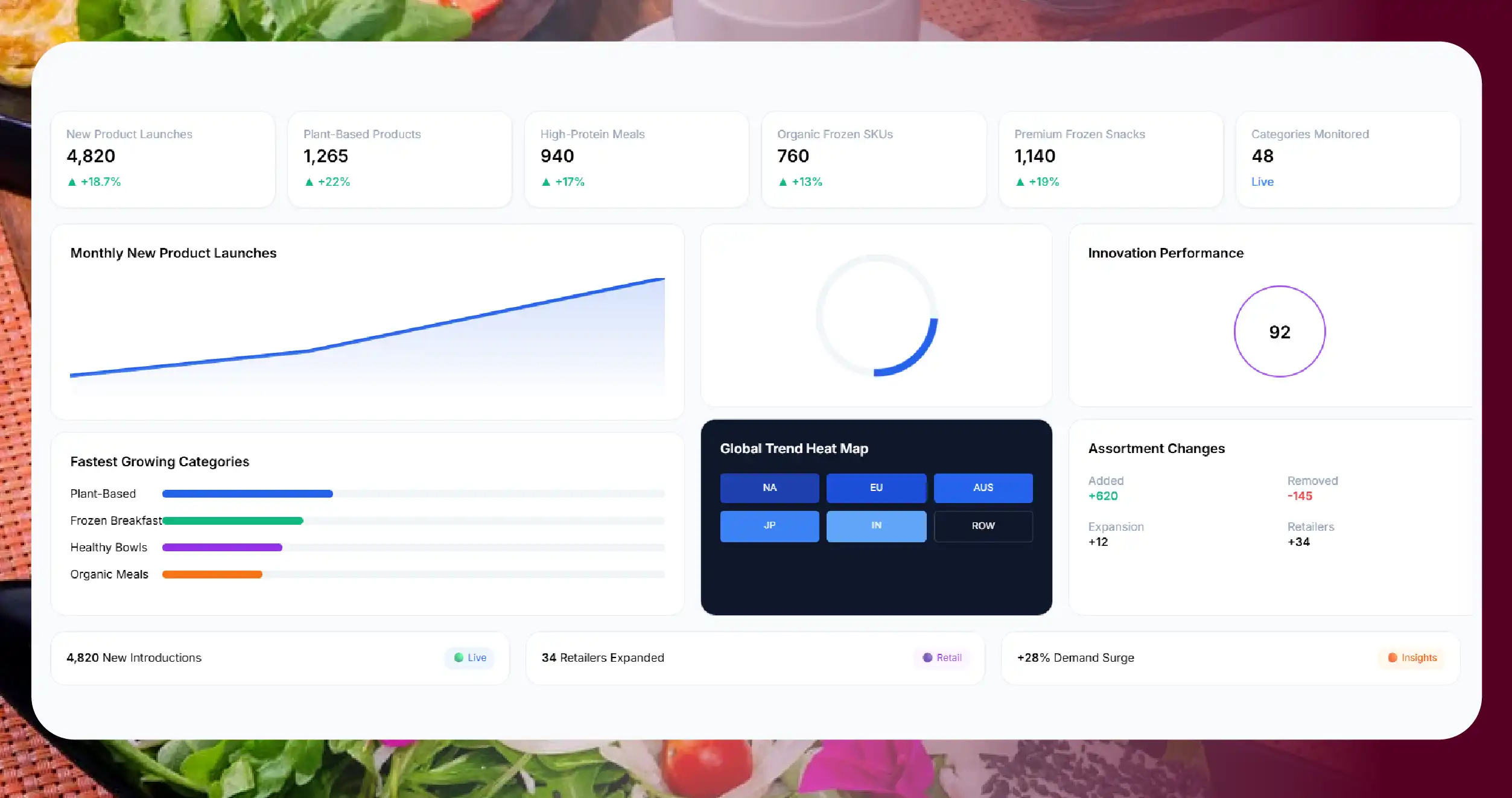
Consumer preferences in the frozen food market continue to evolve as shoppers seek healthier, convenient, and innovative meal options. New product launches, plant-based alternatives, high-protein meals, organic offerings, and premium frozen snacks regularly reshape category performance. Businesses that Scrape Frozen Food Trends Data gain continuous visibility into product introductions, discontinued items, assortment changes, retailer expansion strategies, and category growth across different markets. Monitoring these developments helps manufacturers identify emerging opportunities, evaluate competitor innovation, and respond faster to changing customer demands. Early trend detection supports successful product development, optimized merchandising strategies, and stronger market competitiveness through data-driven decision-making.
Building Smarter Pricing Strategies
Retail pricing decisions require far more than competitor comparison.
Using Frozen Food Pricing Data Intelligence, businesses evaluate pricing elasticity, promotional effectiveness, competitor reactions, regional price gaps, and profitability across thousands of products
These insights help optimize pricing without sacrificing customer demand.
Supermarket Intelligence at Scale
Large supermarket chains continuously update product catalogs, promotional campaigns, and inventory levels.
Supermarket Frozen Food Data Scraping automates the collection of product information, nutritional details, images, package sizes, prices, availability, and promotional offers from multiple retailers.
Automated data collection significantly improves reporting accuracy while reducing manual effort.
Turn frozen food market data into smarter business decisions with our real-time data scraping solutions—contact our experts today to unlock actionable insights, optimize pricing, and stay ahead of the competition.
SKU-Level Performance Analysis
Individual products often perform differently even within the same category.
SKU-Level Frozen Food Data Analytics provides detailed visibility into every product variation by monitoring availability, pricing history, promotions, customer ratings, assortment changes, and regional distribution.
Granular SKU insights enable more accurate assortment planning and inventory optimization.
Benefits Across the Supply Chain
Frozen food analytics supports every stakeholder throughout the supply chain.
- Manufacturers improve product innovation and pricing.
- Retailers optimize assortment and promotions.
- Distributors enhance inventory planning.
- Investors evaluate market growth opportunities using measurable competitive intelligence.
The result is faster decision-making supported by reliable market data.
Future of Frozen Food Intelligence
Artificial intelligence and machine learning continue transforming frozen food analytics by identifying hidden demand patterns, predicting future sales, detecting emerging product categories, and optimizing inventory decisions.
Businesses adopting predictive analytics gain a significant competitive advantage by responding proactively instead of reactively to market changes.
How Food Data Scrape Can Help You?
1. Monitor Competitor Pricing in Real Time
Track frozen food prices, discounts, promotional campaigns, and bundle offers across
supermarkets and online grocery platforms. Gain continuous visibility into competitor pricing
strategies to improve profitability and maintain a competitive market position.
2. Analyze Consumer Buying Trends
Collect customer reviews, ratings, search behavior, and product popularity across multiple
retail channels. Transform consumer insights into actionable strategies for product development,
category expansion, assortment optimization, and targeted marketing campaigns.
3. Optimize Product Assortment Decisions
Access SKU-level product intelligence, including availability, packaging, flavors, sizes, and
inventory changes. Identify high-performing products, detect assortment gaps, and improve
merchandising strategies using comprehensive retail data analytics.
4. Generate Actionable Market Intelligence
Extract structured data from leading supermarkets, grocery marketplaces, and quick-commerce
platforms. Build customized dashboards that support competitive benchmarking, pricing analysis,
demand forecasting, and strategic business decision-making across regions.
5. Power AI-Driven Business Growth
Deliver clean, real-time datasets that integrate seamlessly with business intelligence tools and
AI models. Enable predictive analytics, inventory optimization, pricing automation, and smarter
planning for sustainable growth in frozen food markets.
Conclusion
The frozen food industry is becoming increasingly data-driven as retailers, manufacturers, and distributors compete on pricing, assortment, and customer experience.
Organizations combining Food Data Scraping with advanced analytics gain deeper visibility into consumer behavior, competitive pricing, and product performance across multiple retail channels.
Comprehensive Food Datasets enable businesses to build more accurate market models and improve strategic decision-making.
Modern AI Demand Forecasting further strengthens inventory planning, pricing optimization, and category management by predicting future purchasing patterns with greater accuracy.
When integrated with Restaurant Data Intelligence, frozen food businesses can also identify emerging menu trends, ingredient demand, and evolving consumer preferences across the broader food ecosystem.
If you are seeking for a reliable data scraping services, Food Data Scrape is at your service. We hold prominence in Food Data Aggregator and Mobile Restaurant App Scraping with impeccable data analysis for strategic decision-making.