Introduction
The food and beverage industry is entering an era where consumer preferences evolve faster than traditional market research can measure them. Among all consumer groups, Gen Z has become the strongest force influencing product innovation, restaurant menus, retail merchandising, and digital marketing strategies. Born between 1997 and 2012, this generation discovers food through social platforms, shares experiences instantly, and expects brands to respond with speed and authenticity.
Businesses can no longer rely on quarterly reports or historical sales data alone. They need continuous access to consumer conversations, menu updates, recipe trends, influencer content, and retail pricing intelligence. This is where Gen Z Food Trends Data Scraping becomes a strategic advantage. Companies that Scrape Gen Z Consumer Data from multiple digital sources gain visibility into emerging preferences before they become mainstream. Modern Food Trend Data Extraction enables brands to transform millions of digital interactions into actionable business intelligence, helping them launch products that match real consumer demand instead of assumptions.
Why Gen Z Is Reshaping the Food Industry?
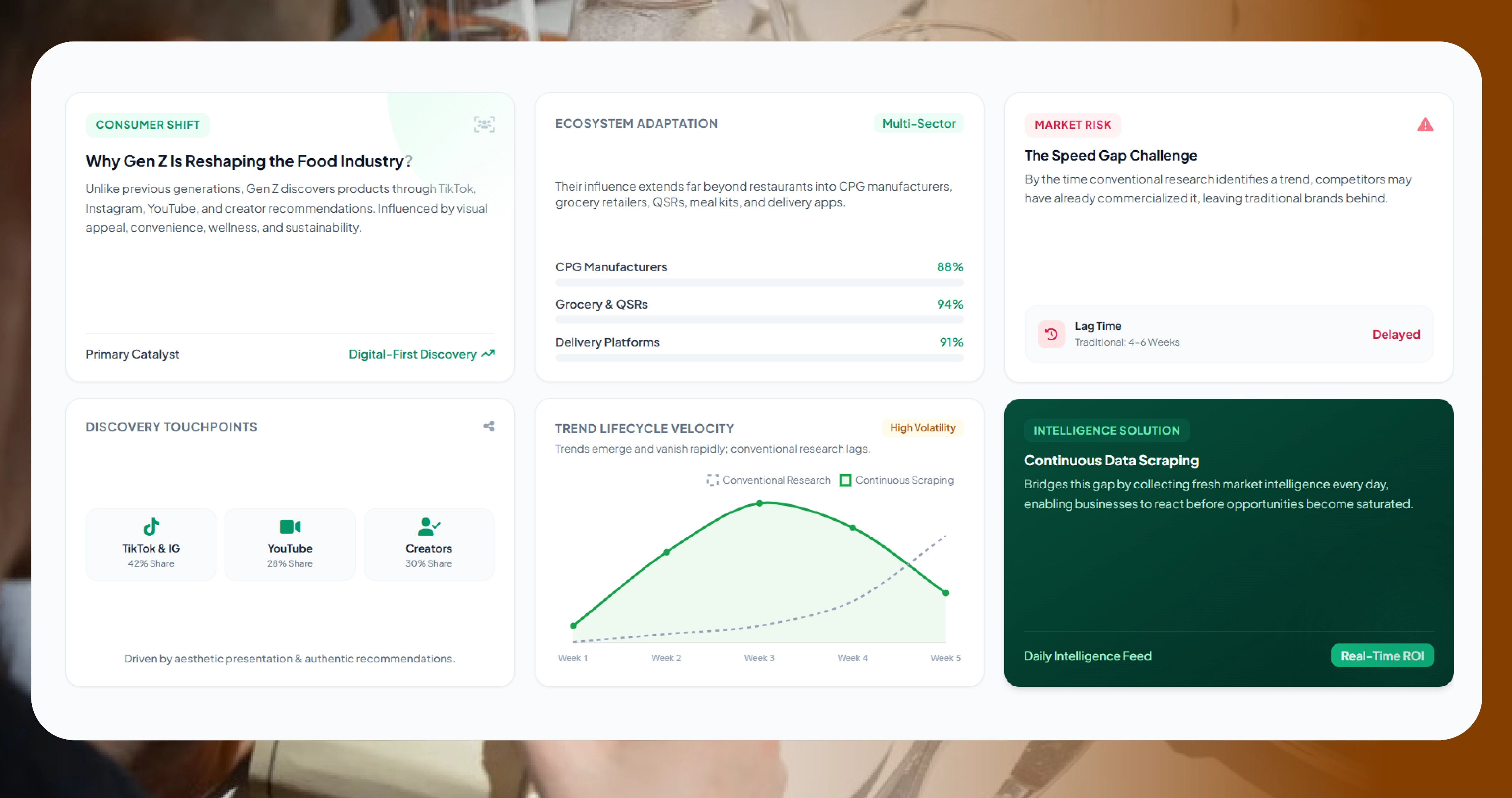
Unlike previous generations, Gen Z makes purchasing decisions after discovering products through TikTok, Instagram, YouTube, restaurant menus, creator recommendations, and online communities. Their food choices are influenced by visual appeal, convenience, wellness benefits, sustainability, and cultural relevance.
Their influence extends far beyond restaurants. Consumer packaged goods (CPG) manufacturers, grocery retailers, quick-service restaurants, meal kit providers, and food delivery platforms continuously adapt their offerings to align with changing Gen Z preferences.
The challenge for brands is that these trends emerge rapidly and often disappear just as quickly. By the time conventional research identifies a trend, competitors may have already commercialized it.
Continuous data scraping bridges this gap by collecting fresh market intelligence every day, enabling businesses to react before opportunities become saturated.
The Growing Importance of Food Trend Intelligence
Food trends are no longer driven solely by celebrity chefs or seasonal recipes. Social media creators, niche communities, food bloggers, restaurant launches, and consumer-generated content collectively shape purchasing behavior.
Businesses need visibility across multiple digital ecosystems, including:
- Restaurant menus
- Food delivery apps
- Grocery marketplaces
- Recipe platforms
- Social media discussions
- Product review websites
- Online retail stores
This comprehensive Food Trends Data Scraping approach provides a unified view of changing consumer demand, allowing brands to identify emerging ingredients, cuisines, flavors, packaging preferences, and wellness claims.
Instead of reacting months later, companies gain the ability to innovate while trends are still growing.
How Data Scraping Captures Emerging Consumer Behavior?
Every online interaction creates valuable market intelligence.
When thousands of consumers begin searching for protein-rich snacks, commenting about mushroom coffee, ordering Korean-Mexican fusion dishes, or reviewing functional beverages, these actions generate measurable demand signals.
Advanced scraping platforms collect information from various public sources, including:
- Consumer reviews
- Restaurant menus
- Recipe databases
- Food blogs
- Retail product listings
- Social media discussions
- Delivery platforms
- Online grocery stores
After collection, machine learning models organize this information into structured datasets that identify trend velocity, consumer sentiment, ingredient popularity, and regional demand patterns.
This allows companies to detect opportunities much earlier than traditional surveys.
AI-Powered Consumer Intelligence for Modern Brands
Raw information alone offers limited value.
Businesses increasingly combine scraping technologies with AI Consumer Insights Data to identify meaningful patterns hidden within millions of consumer interactions.
Artificial intelligence helps organizations answer critical questions such as:
- Which flavors are growing fastest?
- Which ingredients are losing popularity?
- What functional claims resonate with Gen Z?
- Which restaurant innovations are becoming mainstream?
- Which regions adopt trends first?
Rather than manually analyzing enormous datasets, AI automatically highlights commercially significant opportunities, enabling faster decision-making across marketing, innovation, and merchandising teams.
Supporting Research and Development Through Data
Product innovation has become increasingly expensive.
Launching unsuccessful products wastes research budgets, manufacturing resources, marketing investments, and valuable shelf space.
Continuous Food Trend Data Collection for R&D enables product development teams to validate concepts before entering expensive formulation stages.
Instead of guessing future demand, R&D teams evaluate:
- Consumer interest growth
- Ingredient popularity
- Flavor combinations
- Functional nutrition claims
- Regional adoption patterns
- Competitive product launches
This evidence-based approach significantly reduces innovation risk while increasing launch confidence.
Accelerating Product Innovation
Successful food innovation depends on understanding both current preferences and emerging opportunities.
Companies increasingly Scrape Food Innovation Data from restaurant launches, startup brands, grocery retailers, and foodservice operators to identify concepts gaining momentum.
Examples include:
- Protein-enriched desserts
- Functional beverages
- Adaptogenic snacks
- Korean-inspired sauces
- Fusion ramen dishes
- Plant-based convenience meals
Monitoring these innovations across thousands of businesses provides early signals before products become widely available.
Organizations can benchmark competitors while identifying whitespace opportunities that remain underserved.
Unlock Real-Time Gen Z Food Intelligence—Partner with us to transform emerging consumer trends into successful products with advanced data scraping solutions.
Extracting Consumer Demand Signals Using AI
Traditional market research often depends on questionnaires completed by relatively small sample groups.
Modern businesses instead Extract AI Consumer Data for Food Trends from millions of naturally occurring consumer interactions.
Consumers reveal genuine preferences through:
- Purchase behavior
- Menu selections
- Online reviews
- Recipe searches
- Social engagement
- Product ratings
- Restaurant visits
Unlike surveys, behavioral data reflects actual consumer actions rather than stated intentions.
This produces more reliable insights for commercial planning.
Predictive Demand Forecasting
One of the greatest advantages of continuous data collection is forecasting future demand.
Instead of analyzing only historical sales, organizations use AI Demand Forecasting models that combine multiple real-time datasets including social activity, menu changes, retail launches, seasonal demand, and consumer engagement.
These predictive systems estimate:
- Ingredient demand
- Product category growth
- Flavor adoption
- Regional expansion
- Consumer purchasing cycles
- Emerging wellness trends
Forecasting helps businesses optimize inventory, production planning, procurement strategies, and product launch timing while minimizing operational risks.
Restaurant Menus Reveal Tomorrow's Retail Trends
Restaurants frequently introduce culinary innovations long before grocery stores.
Many successful packaged products originate from restaurant experimentation.
Businesses increasingly Extract Restaurant Menu Data to monitor:
- New dishes
- Seasonal menus
- Limited-time offers
- Ingredient usage
- Portion trends
- Cuisine evolution
- Premium pricing strategies
Restaurant intelligence provides valuable insight into consumer acceptance before products transition into retail environments.
Monitoring thousands of menus enables manufacturers to identify scalable opportunities much earlier than competitors relying solely on retail sales reports.
Key Business Benefits of Food Trend Data Scraping
Organizations adopting automated food trend intelligence gain several competitive advantages.
Faster Product Development
Real-time consumer intelligence enables businesses to validate ideas before investing in product development, reducing failure rates and accelerating commercialization.
Improved Marketing Strategy
Marketing teams create campaigns based on actual consumer conversations instead of demographic assumptions, resulting in higher engagement and improved campaign effectiveness.
Competitive Benchmarking
Businesses monitor competitor launches, menu innovations, promotional strategies, pricing changes, and consumer responses across multiple markets simultaneously.
Better Retail Planning
Retailers understand emerging demand before products achieve mainstream popularity, improving assortment planning and inventory optimization.
Stronger Consumer Personalization
Behavioral intelligence enables brands to create targeted experiences tailored to Gen Z preferences across digital channels.
Applications Across the Food Industry
Food trend data scraping supports numerous business functions.
- CPG manufacturers monitor emerging flavors before launching new products.
- Restaurant chains identify successful menu concepts across competing brands.
- Retailers optimize product assortments using evolving consumer demand.
- Food delivery platforms analyze ordering behavior to recommend trending meals.
- Ingredient suppliers identify growing formulation opportunities among manufacturers.
- Market research firms generate competitive intelligence reports using continuously updated datasets.
- Private equity firms evaluate food startups by measuring real consumer traction rather than marketing claims.
Across every segment, data-driven decision-making becomes faster, more accurate, and significantly less risky.
Best Practices for Successful Data Collection
Organizations should approach food trend intelligence strategically.
- Collect information from multiple trusted sources rather than relying on a single platform.
- Update datasets frequently because Gen Z preferences evolve rapidly.
- Use AI models to classify ingredients, cuisines, dietary claims, and consumer sentiment automatically.
- Maintain standardized data formats for easier integration into business intelligence platforms.
- Validate findings using multiple independent signals before making large commercial investments.
Integrating restaurant, retail, social, and consumer data creates a far more reliable market view than analyzing isolated datasets.
How Food Data Scrape Can Help You?
Track Emerging Gen Z Food Trends
Our data scraping solutions continuously monitor social platforms, restaurant menus, recipes, and retail channels to identify emerging Gen Z food trends, helping brands respond faster with data-backed product innovation and marketing strategies.
Monitor Consumer Preferences
Capture real-time consumer discussions, ingredient popularity, flavor preferences, and purchasing behaviors from multiple digital sources, enabling your business to understand evolving demand and make confident strategic decisions.
Strengthen Product Innovation
Access structured food trend datasets that support R&D teams in validating product concepts, identifying whitespace opportunities, reducing innovation risks, and accelerating successful product launches across competitive food markets.
Benchmark Competitors Effectively
Monitor competitor menu updates, product launches, pricing changes, promotional campaigns, and customer feedback to uncover market opportunities, optimize positioning, and maintain a competitive advantage with actionable intelligence.
Enable Predictive Market Intelligence
Leverage AI-ready food datasets for demand forecasting, consumer trend analysis, retail planning, and strategic decision-making, empowering your organization to anticipate future market shifts before competitors recognize emerging opportunities.
Conclusion
Gen Z continues to redefine how food products are discovered, discussed, purchased, and shared. Businesses that understand these evolving behaviors can innovate faster, reduce product launch risks, and build stronger consumer relationships. Modern AI Restaurant Data Intelligence empowers brands to monitor restaurant innovation, menu evolution, and emerging culinary concepts with exceptional accuracy. Combined with comprehensive Food Data Intelligence, organizations can transform millions of digital interactions into strategic business decisions. High-quality Food Datasets further strengthen forecasting models, product development, marketing strategies, and competitive benchmarking, enabling food businesses to stay ahead in an increasingly fast-moving marketplace where consumer preferences change every day.
If you are seeking for a reliable data scraping services, Food Data Scrape is at your service. We hold prominence in Food Data Aggregator and Mobile Restaurant App Scraping with impeccable data analysis for strategic decision-making.