Introduction
Germany's foodservice industry is undergoing one of its fastest transformations in recent years. Consumer preferences are shifting beyond traditional quality indicators toward convenience, freshness, emotional wellbeing, and modern dining experiences. Germany Menu Trends Data Scraping 2026 enables restaurants, food brands, delivery platforms, and market researchers to capture these evolving trends through continuous monitoring of restaurant menus, pricing strategies, ingredient adoption, and regional consumer preferences.
As restaurants rapidly adjust their offerings to changing demand, the need to Scrape Germany Menu Trends 2026 initiatives provide organizations with real-time visibility into menu innovation across cafés, quick-service restaurants, fine dining establishments, cloud kitchens, and food delivery platforms. Combined with Germany Menu Data Scraping, businesses can understand not only what consumers are ordering but also how restaurant operators are adapting menus to remain competitive.
Germany's Foodservice Industry Is Entering a New Growth Phase
Recent consumer trend analysis indicates that Germany's restaurant market is no longer centered solely on organic positioning. Instead, restaurants experiencing stronger customer engagement are emphasizing portability, fresh ingredients, comfort-oriented meals, and convenient dining formats.
Consumer behavior data demonstrates that "to-go" dining now reaches approximately 11.2% of consumers while growing by 39% year over year. Practical meal solutions account for 8.2% consumer reach with annual growth exceeding 42%. Fresh food preferences have expanded by 47%, reflecting increasing demand for meals that combine convenience with perceived quality.
These behavioral shifts are encouraging restaurants to redesign menus around everyday eating occasions rather than traditional meal structures. The focus has moved toward food that can easily fit into busy lifestyles without compromising freshness or taste.
Why Menu Data Has Become a Critical Business Asset?
Restaurant menus are constantly evolving through seasonal launches, promotional campaigns, ingredient substitutions, pricing adjustments, and regional customization. Businesses relying on occasional market research often struggle to identify these rapid changes before competitors do.
Continuous Germany Menu Pricing Data Scraping provides visibility into thousands of restaurant listings, allowing companies to monitor pricing fluctuations, promotional offers, new menu launches, and category expansion as they occur.
Such intelligence enables restaurant chains, food manufacturers, grocery suppliers, delivery platforms, and investment firms to evaluate market performance with significantly greater precision than traditional survey-based research.
Convenience Is Driving Restaurant Menu Innovation
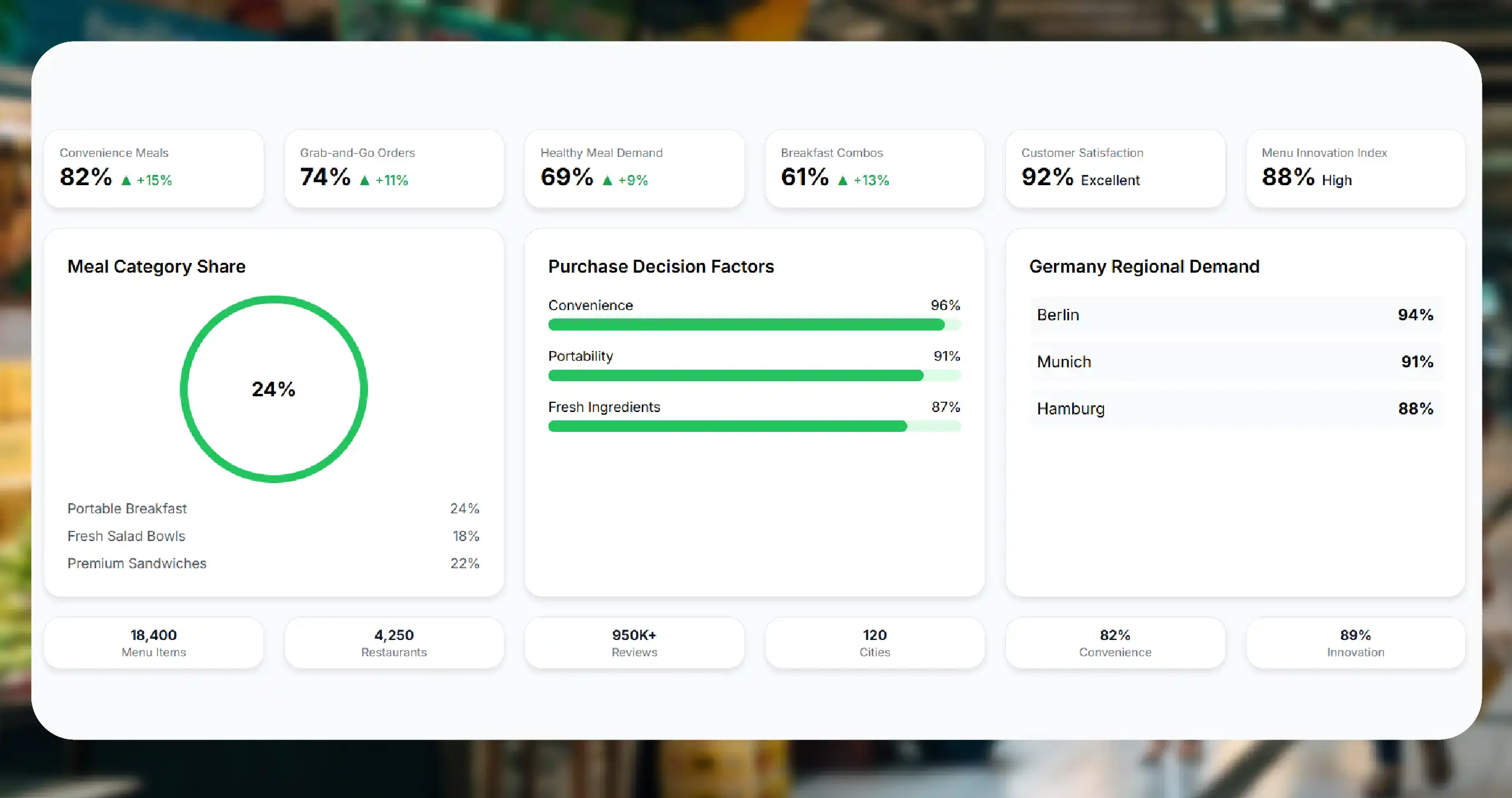
Convenience has emerged as Germany's strongest dining trend, influencing nearly every restaurant category. Rather than replacing traditional dining experiences, convenience has expanded the number of consumption occasions throughout the day.
Restaurants are increasingly introducing portable breakfast combinations, fresh salad bowls, premium sandwiches, snack-sized meals, ready-to-eat lunch options, and compact comfort foods designed for consumers with limited time.
This evolution reflects a structural shift rather than a temporary trend. Customers increasingly select meals based on how well they fit into daily routines before considering individual recipes or cuisines.
Restaurant operators responding successfully are designing menu formats around portability, ease of consumption, and minimal preparation time while maintaining premium ingredient quality.
Ingredient Trends Are Redefining German Menus
One of the greatest advantages of Germany Food Trend Data Extraction is identifying high-growth ingredients before they become saturated across the market.
Current restaurant menu analysis highlights several standout ingredients experiencing significant momentum.
| Ingredient | Consumer Reach | Annual Growth | Market Status |
|---|---|---|---|
| Matcha | 0.74% | +74% | Rapid Expansion |
| Yogurt | 0.43% | +63% | Trending |
| Berries | 1.30% | +31% | High Adoption |
| Strawberry | 0.49% | +41% | Growing |
| Sourdough Bread | --- | +77% | Emerging |
| Döner Kebab | 0.29% | +64% | Strong Growth |
| Schnitzel | 0.32% | +33% | Stable Growth |
Matcha has expanded beyond beverages into bakery products, desserts, smoothies, breakfast bowls, and premium café offerings. Its strong growth combined with relatively low market penetration presents significant opportunities for menu innovation.
Yogurt is also becoming increasingly versatile, appearing in savory sauces, healthy meal bowls, Mediterranean-inspired dishes, and functional snacks. Restaurants are leveraging its freshness while responding to growing consumer interest in balanced and comforting foods.
Traditional German favorites such as Döner Kebab, Schnitzel, and sourdough bread continue evolving through premium ingredients, healthier preparations, and modern presentation styles that appeal to younger consumers.
Emotional Wellness Is Influencing Restaurant Choices
One of the most significant developments across Germany's restaurant market is the increasing relationship between food and emotional wellbeing.
Consumers are no longer selecting meals exclusively based on nutrition or certification labels. Instead, many seek dining experiences associated with relaxation, comfort, calmness, and stress reduction.
This shift is evident across multiple consumer motivation indicators.
| Consumer Motivation | Annual Growth |
|---|---|
| Stress Relief | +102% |
| Calming Foods | +98% |
| Cozy Dining | +65% |
| Fresh Eating | +47% |
| Protein-Rich Meals | +46% |
| Metabolism Support | +49% |
Restaurants are responding by developing menus that emphasize comforting flavors, balanced nutrition, lighter preparations, and familiar ingredients presented in modern formats. These emotional positioning strategies increasingly influence menu descriptions, promotional campaigns, and product naming conventions.
Organic Positioning Is Becoming Less Dominant
Although organic certification continues to maintain credibility within Germany's food industry, recent market data suggests it is no longer the primary growth driver.
Consumer interest in organic products remains stable, yet growth has shifted toward convenience, freshness, and emotional wellness. Restaurants achieving stronger customer engagement increasingly combine quality ingredients with practical meal solutions rather than relying exclusively on organic branding.
This changing landscape encourages restaurant operators to focus on overall dining experiences instead of individual product certifications.
Regional Restaurant Intelligence Supports Smarter Expansion
Restaurants rarely perform uniformly across Germany. Consumer preferences often vary significantly between major cities, creating opportunities for localized menu optimization.
Germany Dining Trends Data Analytics enables businesses to compare restaurant performance across Berlin, Munich, Hamburg, Frankfurt, Cologne, Stuttgart, Düsseldorf, and Leipzig by monitoring menu composition, pricing structures, promotional frequency, ingredient usage, and cuisine popularity.
Regional intelligence allows organizations to identify underserved markets, understand local pricing expectations, evaluate competitive positioning, and optimize future expansion strategies using actual market behavior rather than assumptions.
Data-Driven Pricing Is Becoming Essential
Restaurant pricing continues to evolve in response to ingredient costs, seasonal demand, delivery platform commissions, labor expenses, and competitive activity.
Organizations investing in continuous Restaurant Data Intelligence gain access to historical pricing trends that reveal how competitors adjust prices during holidays, promotional campaigns, tourism peaks, and inflationary periods.
This level of pricing transparency enables restaurants to make informed decisions regarding premium positioning, promotional timing, bundle creation, and long-term revenue optimization while maintaining competitiveness within regional markets.
Unlock real-time Germany restaurant menu insights with our advanced data scraping solutions—contact us today to stay ahead of emerging food trends, pricing shifts, and market opportunities.
Supporting Business Growth Through Food Intelligence
Modern restaurant analytics extends beyond monitoring menus alone. Businesses increasingly integrate pricing intelligence, ingredient tracking, customer preferences, promotional analysis, and regional comparisons into comprehensive decision-making systems.
Germany Food Market Intelligence empowers restaurants, food manufacturers, investors, delivery aggregators, and retailers to identify emerging opportunities before they become mainstream. By combining menu monitoring with consumer behavior analysis, organizations can improve product development, optimize pricing, anticipate demand shifts, and strengthen competitive positioning across Germany's evolving foodservice landscape.
Similarly, Food Data Scraping technologies automate the collection of structured restaurant information from thousands of websites, food delivery platforms, digital menus, and online ordering applications. This automated approach provides consistent, large-scale datasets that support forecasting models, competitive benchmarking, and strategic planning.
How Food Data Scrape Can Help You?
1. Real-Time Restaurant Menu Monitoring
Our team continuously tracks restaurant menus across Germany, collecting updates on new dishes, seasonal launches, discontinued items, ingredient changes, and menu categories. This enables businesses to react quickly to evolving market trends and competitor activity.
2. Competitive Pricing Intelligence
We monitor menu prices, promotional offers, combo meals, discounts, and delivery pricing across restaurants. These insights help businesses benchmark competitors, optimize pricing strategies, improve profitability, and respond effectively to changing market conditions.
3. Consumer Trend and Ingredient Analysis
Our solutions capture emerging food trends, popular ingredients, cuisine preferences, and regional dining behaviors. Businesses can identify high-growth opportunities, forecast consumer demand, and develop products aligned with Germany's rapidly changing food landscape.
4. Customized Food Market Intelligence
We deliver tailored datasets covering restaurant menus, cuisine categories, pricing, customer ratings, location intelligence, and promotional activities. These structured insights support market research, expansion planning, investment analysis, and strategic business decisions.
5. Scalable Data Delivery and Integration
Our automated scraping infrastructure provides accurate, regularly updated datasets in formats compatible with business intelligence platforms, CRM systems, analytics dashboards, and cloud databases, enabling seamless integration into existing operational workflows.
Conclusion
Germany's restaurant market in 2026 is increasingly defined by convenience-first dining, portable meal formats, emotional wellness, fresh ingredients, and modern interpretations of traditional cuisine. Rapid growth in matcha, yogurt, berries, and comfort-oriented foods demonstrates how quickly consumer expectations continue to evolve.
Businesses that Extract Restaurant Menu Data gain continuous visibility into menu innovation, pricing movements, ingredient adoption, and regional consumer preferences. High-quality Food Datasets generated through automated analytics provide the foundation for accurate forecasting, competitor benchmarking, and product innovation. As restaurant competition intensifies, investing in Food Data Scraping in the Germany market enables businesses to make faster, evidence-based decisions while remaining aligned with the country's rapidly changing dining landscape.
If you are seeking for a reliable data scraping services, Food Data Scrape is at your service. We hold prominence in Food Data Aggregator and Mobile Restaurant App Scraping with impeccable data analysis for strategic decision-making.