Introduction
For consumer packaged goods (CPG) brands, promotions can create dramatic sales spikes—but a sales spike does not automatically mean a successful promotion. Discounts, displays, coupons, bundles, and retailer-funded campaigns can increase volume while simultaneously reducing margins, shifting demand between products, or creating costly stock-outs. That is why Grocery Data for CPG has become increasingly important for brands seeking more predictable and profitable promotion outcomes.
Trade Promotion Optimization (TPO) gives CPG companies a structured way to evaluate promotional investments, understand what actually drives incremental sales, and allocate budgets toward the campaigns, products, retailers, and markets that generate the strongest returns.
Instead of relying only on internal sales reports, brands can combine retailer pricing, promotions, assortment, availability, product, and competitive information to understand the market from the shopper's perspective. This creates a much richer foundation for CPG trade promotion optimization using grocery data, enabling businesses to move beyond assumptions and make promotion decisions based on observable market signals.
At the same time, trade promotion intelligence for CPG brands can reveal how competitors are discounting, which products receive promotional visibility, how frequently promotions occur, and whether retailers are supporting campaigns consistently.
Why Trade Promotion Optimization Matters for CPG Brands?
Trade promotions represent a major investment for many CPG companies. Brands spend heavily on temporary price reductions, retailer promotions, end-cap placements, digital advertisements, coupons, loyalty offers, multi-buy deals, and seasonal campaigns.
The challenge is determining whether those investments generate incremental demand or simply subsidize purchases that would have happened anyway.
For example, imagine a snack brand offering a 20% discount during a major shopping weekend. Sales increase by 35%, which initially appears successful. However, competitor products may have increased by 30% during the same period, while the promoted product experienced lower margins and significant out-of-stock periods.
Without broader grocery market data, the brand may incorrectly classify the campaign as highly successful.
With structured grocery data, the company can examine:
- Promotional depth and duration
- Regular versus promotional prices
- Competitor discounts
- Product availability
- Retailer participation
- Store or geographic differences
- Category-level promotional activity
- Product rankings and visibility
- Promotion frequency
- Pre- and post-promotion sales patterns
This enables a more realistic understanding of promotion effectiveness.
Building a Data-Driven Promotion Intelligence Layer
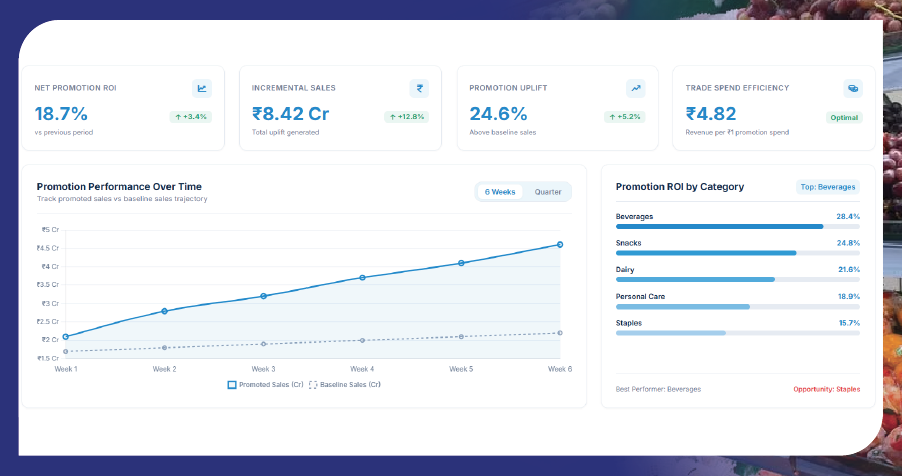
A successful TPO strategy depends on collecting consistent information from multiple retail environments. Grocery data can provide a near-real-time view of what shoppers encounter across online grocery stores, quick-commerce platforms, supermarket websites, retailer applications, and other digital channels.
A structured dataset can include product names, brands, categories, pack sizes, regular prices, discounted prices, promotional labels, coupon values, availability, ratings, retailer information, and timestamps.
When collected repeatedly, these individual observations become a historical intelligence layer.
That historical layer can help CPG teams identify whether a promotion is genuinely unusual or simply part of a retailer's normal promotional cycle.
For instance, a 10% discount may look attractive in isolation. But if competitors routinely offer 15–20% discounts in the same category, the brand may actually be under-promoting. Conversely, a 25% discount could be unnecessarily aggressive if competitors are maintaining regular prices.
Measuring Promotion Effectiveness Across Retailers
Different retailers can produce dramatically different promotional outcomes.
A promotion that performs well on one platform may underperform on another because of differences in shopper demographics, pricing structures, competition, assortment, delivery fees, visibility, or retailer merchandising.
This makes trade promotion performance analysis particularly valuable.
Brands can Scrape Retail and CPG and compare promotional performance across retailers, locations, product categories, pack sizes, and campaign types. They can also evaluate whether promotional frequency is producing sustainable growth or encouraging customers to wait for discounts.
For example, a CPG company might discover that:
- Deep discounts generate high short-term volume but weak profitability.
- Smaller discounts produce better revenue efficiency.
- Promotions on larger packs deliver stronger basket expansion.
- Certain retailers generate stronger responses to bundle offers.
- Promotions during specific weeks produce greater incremental demand.
- Some products perform better with visibility than with price reductions.
These insights can help teams redesign promotion calendars around measurable outcomes rather than historical habits.
Understanding Competitive Promotional Activity
Promotions do not happen in isolation. A CPG brand competes for the same shopper, shelf space, search visibility, and wallet share as other brands.
That makes competitor promotion tracking for CPG brands an essential component of modern trade intelligence.
By continuously monitoring competing products, brands can identify changes in:
- Discount percentages
- Promotional frequency
- Multi-buy offers
- Bundle promotions
- Coupon availability
- Promotional duration
- Product assortment
- Retailer participation
- Price gaps
- Promotional positioning
Suppose Brand A normally sells at ₹120 while Brand B sells at ₹115. During a campaign, Brand A drops to ₹99 while Brand B drops to ₹89. Brand A may believe it has launched an aggressive promotion, but its relative price position has actually weakened.
Competitive data makes that difference visible.
Grocery Promotion Trends Benchmarking
Promotional strategy also varies by category.
Staples may have different promotional patterns from snacks, beverages, personal care, frozen foods, dairy, or household products. Some categories experience frequent discounts, while others depend more heavily on seasonal events.
Grocery promotion trends benchmarking helps CPG companies compare their promotional behavior against broader category patterns.
Brands can evaluate whether they are:
- Discounting more frequently than competitors
- Offering unusually deep promotions
- Missing major promotional periods
- Overusing particular promotional mechanics
- Maintaining excessive promotional dependency
- Losing visibility during important shopping events
Benchmarking can also support annual planning. If historical data shows that a category consistently becomes highly promotional during specific months, brands can prepare inventory, budgets, pricing strategies, and retailer negotiations in advance.
Detecting Stock-Outs During Promotions
A promotion cannot generate sales if shoppers cannot purchase the product.
This is why monitoring stock-outs during promotions is critical to trade promotion optimization.
Stock-outs can distort campaign analysis. A product may appear to have generated disappointing sales when the real problem was insufficient inventory.
For example, a retailer could promote a beverage at a substantial discount, driving shopper interest and search demand. If the product becomes unavailable halfway through the campaign, potential sales disappear.
By tracking availability alongside promotional activity, brands can distinguish between:
Weak promotion performance and lost sales caused by insufficient inventory.
This distinction is essential for post-promotion analysis.
Stock-out monitoring can also help identify retailers or locations where replenishment planning needs improvement. When promotional calendars are synchronized with availability intelligence, supply-chain and commercial teams can collaborate more effectively.
Creating a Promotion Performance Scorecard
A strong TPO framework should not evaluate promotions using sales volume alone.
A comprehensive scorecard can combine:
| Metric | What It Reveals |
|---|---|
| Regular Price | Baseline pricing position |
| Promotional Price | Actual shopper offer |
| Discount Depth | Promotion aggressiveness |
| Promotion Duration | Campaign exposure |
| Availability | Ability to convert demand |
| Competitor Price | Relative market position |
| Competitor Promotion | Competitive pressure |
| Product Visibility | Potential shopper exposure |
| Promotion Frequency | Discount dependency |
| Category Benchmark | Performance against market norms |
These metrics can be transformed into dashboards for commercial teams, category managers, revenue managers, and executives.
Instead of reviewing isolated spreadsheets, decision-makers can monitor promotion performance continuously and identify opportunities faster.
From Historical Reporting to Predictive Promotion Planning
One of the biggest advantages of collecting grocery data continuously is the ability to build historical datasets.
Once several months or years of pricing and promotional observations are available, brands can begin identifying recurring patterns.
They can examine which products respond most strongly to promotions, which retailers repeatedly run similar campaigns, how competitor actions affect demand, and how promotional activity changes around holidays or major shopping periods.
This creates opportunities for predictive planning.
A brand could estimate which promotional mechanics are likely to deliver stronger results, identify categories approaching promotional saturation, and determine where competitive pressure is increasing.
The objective is not simply to collect more data. It is to transform raw market observations into actionable commercial intelligence.
Scaling Grocery Data Collection Across Retail Channels
Manual monitoring quickly becomes difficult when a brand operates across dozens of retailers, thousands of products, and multiple geographic markets.
Automated Grocery Data Scraping can provide a scalable way to collect structured information repeatedly.
A data collection workflow can capture product and promotional information at scheduled intervals, standardize retailer-specific fields, identify price changes, track availability, and maintain historical records.
Brands can then integrate this information into business intelligence platforms, data warehouses, pricing systems, or internal analytics environments.
The result is a continuously refreshed market dataset rather than a one-time snapshot.
How CPG Teams Can Use Promotion Intelligence?
Trade promotion intelligence can support multiple business functions simultaneously.
Sales teams can use retailer-level insights during negotiations. Category managers can identify promotional opportunities. Pricing teams can monitor competitive price gaps. Supply-chain teams can anticipate demand around major campaigns. Marketing teams can evaluate promotional visibility.
Finance teams can also benefit by comparing promotional activity against revenue and profitability objectives.
The broader advantage is organizational alignment. Instead of different teams working from separate data sources, everyone can work from a consistent market intelligence layer.
How Food Data Scrape Can Help You?
1. Build Comprehensive Grocery Promotion Datasets
Food Data Scrape can collect product prices, promotional offers, discounts, availability, pack sizes, categories, and retailer information to create structured datasets for continuous CPG promotion analysis.
2. Track Competitor Promotions Across Retailers
Brands can monitor competitor pricing, discounts, bundles, promotional frequency, and availability across multiple grocery platforms, helping commercial teams identify pricing gaps and competitive opportunities.
3. Identify Promotion and Stock Availability Patterns
Combining promotional observations with availability data can help brands identify stock-outs, supply constraints, inconsistent retailer execution, and potential lost-sales situations during important promotional campaigns.
4. Benchmark Category-Level Promotional Performance
Historical grocery data can reveal promotional frequency, discount depth, seasonal patterns, and retailer behavior, helping CPG teams benchmark their strategies against competitors and broader category trends.
5. Support Data-Driven Trade Promotion Decisions
Structured market intelligence can help CPG companies optimize promotion calendars, improve retailer negotiations, prioritize profitable campaigns, and develop stronger pricing strategies using continuously refreshed grocery market observations.
Conclusion
Trade promotion optimization is becoming increasingly data-driven as CPG brands face tighter margins, intense competition, fragmented retail channels, and increasingly sophisticated shoppers. Grocery data provides the visibility needed to understand what promotions are actually happening in the market, how competitors are responding, and whether products remain available when campaigns go live.
With automated data collection and historical benchmarking, brands can move from reactive promotion reporting toward proactive commercial decision-making. Scrape CPG Trends Data 2026 to help organizations understand emerging promotional patterns, competitive behavior, and category movements.
Likewise, Web Scraping Grocery Product Pricing Data enables brands to monitor price changes and promotional positioning across retailers, while the method to Scrape Retail Sales Panel Data for CPG Brands can complement market observations with broader sales intelligence for deeper analysis.
Ultimately, the goal is simple: spend promotion budgets where they create measurable value, reduce avoidable inefficiencies, and make every retailer campaign more intelligent.
Ready to turn grocery pricing, promotion, and availability signals into actionable CPG intelligence? Partner with Food Data Scrape to build a scalable grocery data solution tailored to your trade promotion optimization needs.
Are you in need of high-class scraping services? Food Data Scrape should be your first point of call. We are undoubtedly the best in Food Data Aggregator and Mobile Grocery App Scraping service and we render impeccable data insights and analytics for strategic decision-making. With a legacy of excellence as our backbone, we help companies become data-driven, fueling their development. Please take advantage of our tailored solutions that will add value to your business. Contact us today to unlock the value of your data.
Get a Free Food Data Sample in 48 Hours.
Tell us your platforms, target markets and required fields — we'll map exactly what's possible with food data scraping, recommend the right approach, and send a working sample so you can verify quality before any commitment.
Request a strategy call
Thanks — our data team will reach out within 48 hours with your sample.