Introduction
Grocery delivery fee data is a structured record of what an online grocery order costs on top of the shelf price: delivery fee, service fee, bag fee, minimum basket charge, free-delivery threshold and slot price, captured by retailer, postcode, date and time window. It shows the true cost of the same basket in each area.
Online grocery keeps growing, so fees now matter to more shoppers. Brick Meets Click survey data reported by The Shelby Report (15 Oct 2026) put US e-grocery sales up 20.7% year on year in Q3 2026, with a record 20.9% share of grocery spending. Delivery grew more than 30% and drove about three-quarters of that gain.
This guide covers which fees to track, the data fields that matter, how to collect them from public, logged-out postcode checks, how the US, UK and Canada differ, and when to build or buy a feed.
Why do delivery fees change the true basket cost?
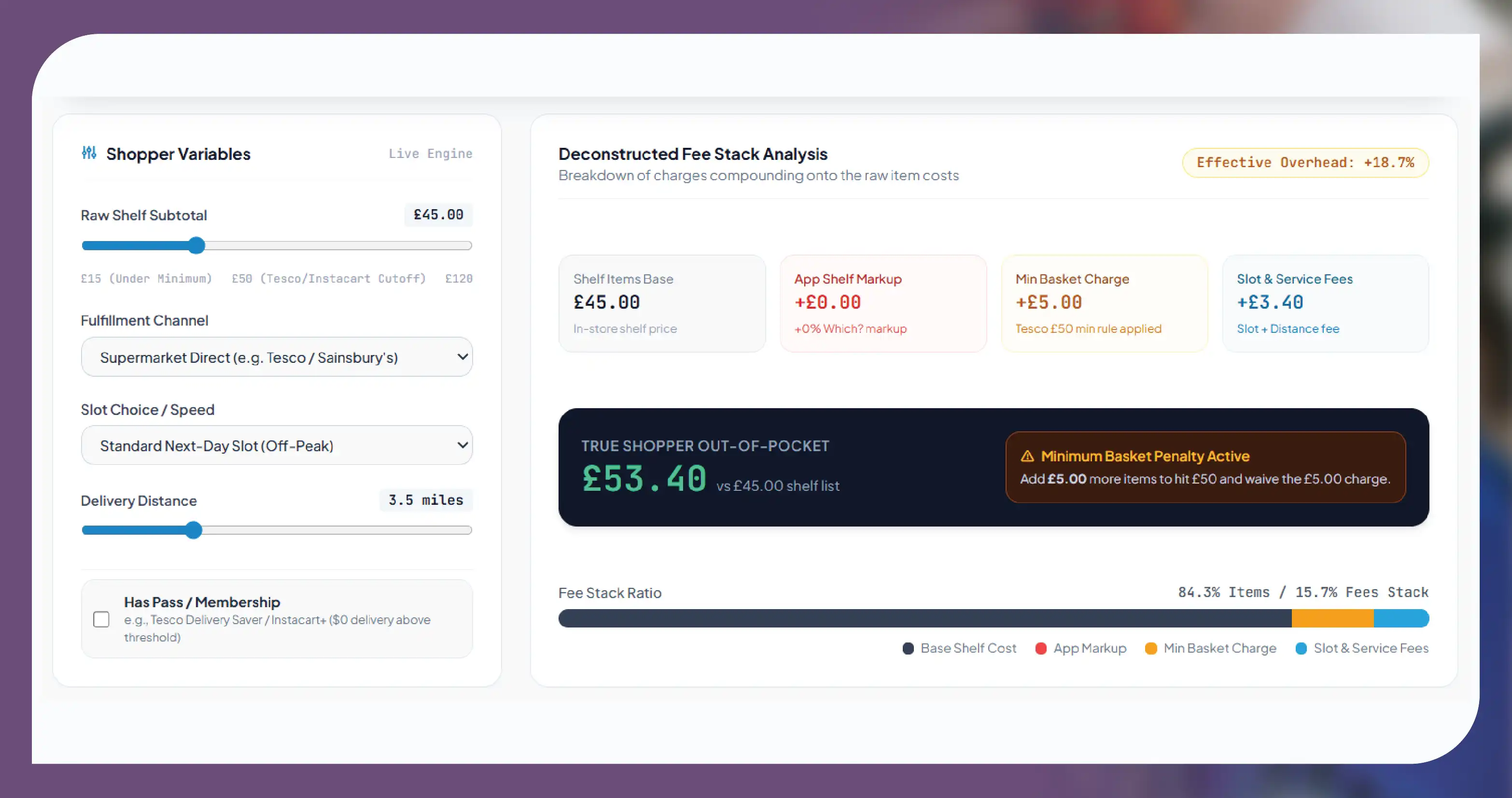
Two shoppers can buy the same 20 items at the same shelf prices and still pay very different totals. The difference sits in the fee stack, and that stack changes with the postcode, the day, the hour and the basket size.
- Minimum basket rules: Tesco sets a £50 minimum for grocery home delivery and adds a £5 charge below it, according to its own grocery terms. A £45 basket costs more than a £50 one.
- Slot pricing: Sainsbury's says its delivery charges vary by slot, and the charge is confirmed before checkout. Same-day slots cost more than next-day slots.
- Percentage service fees: On DoorDash, the service fee varies with distance and order size, and is 15% of the subtotal for most orders in some excluded US markets.
- Membership thresholds: Instacart+ members get $0 delivery fees only on eligible orders of $35 or more, according to Instacart's help centre.
- App mark-ups: Item prices can differ too. A 2023 Which? basket check reported by Grocery Gazette found Sainsbury's items 28% dearer on delivery apps than on the supermarket's own site, before any fees.
Fees also move over time. Tesco raised its delivery minimum from £40 to £50 and its below-minimum charge from £4 to £5 in May 2023, as Which? reported. Amazon moved its Prime free-delivery threshold for Amazon Fresh to $150 and then back to $100 within a year, according to Supermarket News (Oct 2023). A one-off price check misses changes like these. A time series catches them.
What grocery delivery fee data fields should you capture?
A good schema keeps every fee as its own column, so analysts can rebuild the checkout total for any basket size. These are the fields we recommend as a starting point:
| Field | Description | Format / example |
|---|---|---|
| retailer | Retailer or app name, plus the store or banner serving the postcode | text – e.g. Tesco, Instacart (store name) |
| postcode | ZIP, UK postcode district or Canadian FSA used for the check | text – e.g. a US ZIP, a UK district, a Canadian FSA |
| slot_date | Delivery date offered | ISO date |
| slot_window | Start and end time of the slot, and slot type (standard, saver, express) | text – e.g. 1-hour, 4-hour saver, express |
| delivery_fee | Fee for the slot shown before checkout | decimal, local currency |
| service_fee | Service or basket fee, flat or percentage, with the rule if shown | decimal or % + rule text |
| bag_fee | Bag or packaging charge if shown | decimal or null |
| min_basket | Minimum order value and the charge applied below it | decimal + charge |
| free_delivery_threshold | Basket value that unlocks $0 or reduced delivery | decimal or null |
| membership_required | Whether the price needs a pass or membership, and its name | boolean + plan name |
| surge_flag | Busy-time, weather or peak pricing label shown publicly | boolean + label text |
| captured_at | Timestamp of the check, with time zone | ISO datetime |
Most teams add a few helper fields: fulfilment type (delivery, click-and-collect, rapid), currency, a link to the public fee page, and a rule-text column that keeps the retailer's own wording. The rule text matters when a fee changes and you need to show why.
How do grocery delivery fees compare across the US, UK and Canada?
Each market prices delivery differently. The table summarises what retailers' own public pages and named reports said when we checked on 21 October 2026. Where a figure came from a third party or an older article, we label it, and where it could not be confirmed it reads "varies by location".
| Market | Retailer / app | Minimum basket | Delivery and service fees | Membership | Source |
|---|---|---|---|---|---|
| US | Instacart | $0 delivery for Instacart+ members on orders $35+; non-members from $3.99; service fees apply (2026) | Delivery and service fees vary; reduced member service fees ended 1 Mar 2025 | Instacart+: $0 delivery on eligible orders of $35+ | Instacart help |
| US | Walmart | $35 minimum for free delivery with Walmart+ (Oct 2026) | Members pay a $10 Express (fast) fee; non-members pay $17.95–$19.95 for Express (Oct 2026) | Walmart+ | Walmart+ |
| US | Amazon Fresh | Free for Prime on orders over $100 (May 2026) | Prime "service fees" below $100: $6.95 ($50–$100), $9.95 (under $50); non-Prime $4.95–$13.95 by basket (May 2026) | Prime | About Amazon, May 2026 |
| US | DoorDash (grocery and convenience) | Small order fee below a threshold | Merchant-set delivery fee; variable service fee; regulatory, weather and long-distance fees may apply | DashPass | DoorDash help |
| UK | Tesco | £50 home delivery (£5 charge below); £25 Click+Collect | Charge at the rate shown for the slot | Delivery Saver | Tesco terms |
| UK | Sainsbury's | £25 | Under £50: £7.50 next-day, £9.50 same-day; over £50: £1–£5.50 next-day, £6–£7.50 same-day | Delivery Pass (£50 spend needed) | Sainsbury's help |
| UK | Asda | £40 (third-party, Mar 2025 – not shown on Asda's own page) | Up to £8.50, plus £3 below minimum (third-party, Mar 2025) | Delivery Pass | lovemoney, Mar 2025 |
| UK | Ocado | £40 shown on terms page | Depends on order value, date, time and address | Smart Pass | Ocado terms |
| Canada | Walmart Canada | No minimum; $7.97 small order fee under $35 | Same Day $8.97; Express $11.97–$14.97 in select areas | Walmart+ (no price on page) | Walmart.ca help |
| Canada | Instacart Canada | $0 delivery for Instacart+ members on orders $35+; non-members from $3.99; service fees apply (2026) | Varies by location | Instacart+ | Loblaw–Instacart help, 2026 |
| Canada | PC Express | Varies by location | Pickup $1; delivery $1 + $4.99–$8.99 by slot (third-party, Milesopedia, Dec 2025) | PC Express Pass $9.99/mo or $99.99/yr (third-party, Dec 2025) | Milesopedia, Dec 2025 |
| Canada | Voilà | Minimum order $35 (third-party, aging 2022–23) | Around $7.99 delivery, varies by slot (third-party, Savvy New Canadians, 2022–23) | Voilà Delivery Pass from $9.99/mo (midweek) or $14.99/mo (anytime) | Savvy New Canadians, 2022–23 |
Three patterns stand out. UK grocers lean on minimum baskets and slot-based prices. US platforms lean on service fees and membership thresholds. Canadian retailers mix small order fees with speed-based tiers. A useful dataset has to capture all three models in the same schema.
How do you collect grocery delivery fee data by postcode?
Fee data is location-specific, so collection is built around a postcode panel, not a product list. We use only publicly visible, logged-out information. That means no account logins, no checkout completion, and no bypassing of CAPTCHAs, paywalls or other access controls.
- Build the postcode panel. Pick ZIPs, UK postcode districts or Canadian FSAs that reflect your question: urban and rural, high and low income, or your own store catchments.
- Read public fee pages first. Help centres and terms pages give the rules, such as minimums, small order fees and thresholds. Store the rule text and the page URL with a date.
- Run logged-out postcode checks. Where a retailer shows slots and charges before sign-in, record each slot's window and price for the postcode. Where it doesn't, keep only the published rules.
- Standardise the fee stack. Map each retailer's wording to the shared fields: delivery_fee, service_fee, bag_fee, min_basket, free_delivery_threshold, membership_required and surge_flag.
- Calculate a true basket cost. Apply the rules to standard baskets (for example under-minimum, mid and large) so you can compare totals, not just headline fees.
Cadence depends on the question. Weekly snapshots suit fee-inflation tracking. Several checks a day suit slot and surge analysis, because slot prices can change between morning and evening. We schedule requests at a modest rate, respect robots.txt and each site's terms, and keep a log of when every value was seen.
Who uses grocery delivery fee data?
- Price comparison apps: Show shoppers the full checkout total by postcode, not just shelf prices, and flag when a basket is close to a minimum or free-delivery threshold.
- Retail pricing and e-commerce teams: Benchmark your own delivery charges, minimums and passes against rivals in the same postcodes and slots.
- Analysts and researchers: Track fee inflation over time, compare urban and rural access, and measure how often thresholds change.
- Marketplaces and delivery start-ups: Size the fee gap before launching in a new city, and test where a lower minimum basket could win orders.
- FMCG and category teams: Understand how basket-size rules nudge shoppers toward bulk packs or multi-buys.
Demand for this data is real. An older public freelance project asked for crawlers across five Canadian grocery delivery apps to capture prices, delivery fees, minimum orders and barcodes by location. Our own recent inquiries include a request for multi-category grocery product data for a marketplace, and grocery and quick commerce remains our most-asked-about topic.
Is it legal to collect grocery delivery fee data?
Delivery fees, minimums and slot prices that a retailer shows to any visitor are public business information. Collecting them carefully is a common competitive-intelligence practice, but the method matters. This is general guidance, not legal advice.
- Public data only: Logged-out pages and published fee rules. No shopper accounts, no order history and no personal data.
- Respect site rules: Follow robots.txt and terms of service, and keep request rates low so you don't affect the site.
- No bypassing: Never work around CAPTCHAs, logins, paywalls or rate limits.
- Keep the evidence: Store the source URL, timestamp and rule text so every number can be traced.
- Check local law: Data protection and database rules differ in the US, UK and Canada. Ask your legal team to review the use case.
Build vs buy: should you run your own fee tracker?
A small in-house script can check a handful of postcodes on one site. The work grows quickly once you add more retailers, more postcodes and a daily cadence, because each site words its fees differently and changes its pages.
| Factor | Build in-house | Buy a managed feed |
|---|---|---|
| Setup time | Weeks per retailer, plus testing | Sample in days, then scheduled delivery |
| Maintenance | Your team fixes breaks when pages change | Provider monitors and repairs collectors |
| Fee normalisation | You design and maintain the mapping | Shared schema across US, UK and Canada |
| Compliance review | Your own process | Public-data-only method, documented |
| Best for | One retailer, few postcodes, short project | Many retailers, many postcodes, ongoing tracking |
When you compare providers, ask for a sample by your own postcodes, a field dictionary, how they handle slots that are not visible logged-out, the refresh cadence, and how they flag rule changes.
Get a free sample dataset. Tell us your retailers and postcodes, and we'll send a sample of delivery fees, service fees, minimum orders and slot prices in one schema.
Questions
Frequently Asked Questions
A delivery fee pays for getting the order to you and often depends on the slot. A service fee is a separate platform charge, often a percentage of the basket with a minimum, as DoorDash describes on its public fee page.
Retailers price by distance, local demand, store coverage and slot availability. Ocado's terms, for example, say charges depend on order value, delivery date and time, and the delivery address.
It is a fee added when an order is below the retailer's minimum order value. Tesco, for example, adds £5 to home-delivery baskets under £50.
Yes, for published fee rules and any slot prices shown to logged-out visitors. We do not log in, create accounts or bypass access controls. Where a price is only shown after sign-in, we record the published rule instead.
Weekly works for tracking fee inflation and threshold changes. Daily or intraday checks suit slot and surge analysis, because slot prices can change during the day.
Get a Free Food Data Sample in 48 Hours.
Tell us your platforms, target markets and required fields — we'll map exactly what's possible with food data scraping, recommend the right approach, and send a working sample so you can verify quality before any commitment.
Request a strategy call
Thanks — our data team will reach out within 48 hours with your sample.