
Brazil continues to be one of the world's fastest-growing digital food delivery markets, driven by increasing smartphone penetration, urbanization, and changing consumer lifestyles. The country's food delivery ecosystem has evolved into a highly competitive environment where restaurants, cloud kitchens, grocery retailers, and technology companies compete for consumer attention. This iFood Brazil market intelligence report 2026 provides a comprehensive analysis of market trends, restaurant performance, pricing dynamics, and emerging business opportunities across Brazil's leading food delivery platform.
Real-Time Pricing Intelligence
Monitor dynamic restaurant pricing, delivery fees, and promotional campaigns across Brazil.
Market & Cuisine Trends
Track emerging food categories, consumer preferences, and regional demand patterns.
Cloud Kitchen Analysis
Evaluate virtual brand growth, delivery-only operations, and expansion opportunities.
Competitive Benchmarking
Compare restaurant performance, menu strategies, and market positioning on iFood.
Actionable Datasets
Access comprehensive iFood restaurant data for strategic decision-making and investment.

Brazil continues to be one of the world's fastest-growing digital food delivery markets, driven by increasing smartphone penetration, urbanization, and changing consumer lifestyles. The country's food delivery ecosystem has evolved into a highly competitive environment where restaurants, cloud kitchens, grocery retailers, and technology companies compete for consumer attention. This iFood Brazil market intelligence report 2026 provides a comprehensive analysis of market trends, restaurant performance, pricing dynamics, and emerging business opportunities across Brazil's leading food delivery platform.
Businesses increasingly depend on Restaurant Pricing Data Scraping from iFood Brazil to understand pricing fluctuations, promotional campaigns, delivery fee structures, and competitive positioning across different cities and cuisine categories. As competition intensifies, organizations are choosing to Scrape iFood Brazil Restaurant Data for Market Research 2026 to gain actionable insights that support strategic planning, market expansion, and investment decisions.
iFood remains the dominant force within Brazil's food delivery sector, serving millions of active consumers and partnering with hundreds of thousands of restaurants. The platform's extensive reach makes it one of the most valuable sources of restaurant intelligence, consumer behavior insights, and market performance indicators.
The Brazilian food delivery industry is projected to maintain strong growth throughout 2026 as consumers increasingly embrace digital ordering for convenience, speed, and variety. Major metropolitan regions such as São Paulo, Rio de Janeiro, Brasília, Belo Horizonte, Curitiba, and Porto Alegre continue to generate the highest order volumes and restaurant activity.
Organizations increasingly rely on iFood Competitive Market Intelligence to monitor restaurant performance, evaluate competitor pricing strategies, identify customer acquisition trends, and understand regional demand patterns. The competitive landscape includes traditional restaurant chains, local independent restaurants, virtual brands, and cloud kitchens that continuously adapt their offerings to changing consumer preferences.
The ability to monitor real-time restaurant activity enables businesses to identify underserved markets, emerging cuisine trends, and profitable expansion opportunities. Companies that leverage market intelligence are often better positioned to respond quickly to competitive threats and evolving customer expectations.
One of the most valuable applications of delivery platform intelligence is understanding restaurant pricing behavior. Through Brazil Food Delivery Data Scraping, businesses can evaluate how menu prices differ across cities, cuisine categories, and restaurant segments.
Food inflation, ingredient costs, labor expenses, and delivery logistics continue to influence pricing decisions throughout Brazil. Restaurants increasingly adjust prices dynamically based on demand levels, promotional activity, and competitor behavior. Monitoring these changes allows businesses to benchmark performance and optimize pricing strategies.
| City | Cuisine Category | Average Menu Items | Average Meal Price (BRL) | Delivery Fee (BRL) | Average Delivery Time (Minutes) | Monthly Orders (000s) | Demand Index |
|---|---|---|---|---|---|---|---|
| São Paulo | Burgers | 68 | 42 | 8 | 34 | 980 | Very High |
| São Paulo | Japanese | 95 | 69 | 9 | 41 | 740 | High |
| Rio de Janeiro | Pizza | 78 | 56 | 7 | 37 | 810 | Very High |
| Rio de Janeiro | Brazilian | 61 | 39 | 6 | 31 | 650 | High |
| Brasília | Fast Food | 58 | 35 | 6 | 29 | 470 | High |
| Belo Horizonte | Barbecue | 55 | 48 | 7 | 35 | 390 | High |
| Curitiba | Healthy Food | 73 | 46 | 8 | 34 | 320 | Medium |
| Porto Alegre | Italian | 65 | 53 | 7 | 36 | 280 | Medium |
| Salvador | Regional Cuisine | 49 | 34 | 5 | 30 | 260 | Medium |
| Recife | Seafood | 60 | 59 | 8 | 40 | 210 | Medium |
| Fortaleza | Pizza | 71 | 51 | 6 | 33 | 300 | High |
| Manaus | Fast Food | 57 | 37 | 7 | 38 | 180 | Medium |
The growing demand for iFood Restaurant Menu & Pricing Data Extraction enables restaurant operators and investors to understand menu composition, identify profitable products, and optimize promotional strategies. Access to detailed menu-level intelligence allows businesses to compare pricing structures across competing brands and geographic regions.
Cloud kitchens have become one of the most significant developments in Brazil's food delivery ecosystem. These delivery-only operations reduce real estate expenses while maximizing operational efficiency and geographic coverage.
Through Cloud Kitchen Expansion Data Scraping, businesses can monitor the growth of virtual brands, evaluate delivery-only restaurant density, and identify locations with high demand but limited supply. Cloud kitchen operators increasingly utilize delivery intelligence to determine optimal launch locations and target cuisines.
The cloud kitchen model has proven particularly successful in densely populated urban areas where delivery demand is consistently high. Many restaurant groups now operate multiple virtual brands from a single production facility, enabling them to serve diverse consumer segments while minimizing operational costs.
As delivery platforms continue to grow, cloud kitchens are expected to account for a larger share of restaurant listings, creating new opportunities for entrepreneurs, investors, and food service providers.
Consumer behavior analysis plays a critical role in understanding the future direction of Brazil's food delivery market. Through Cuisine Trend Analysis Data Scraping, businesses can identify emerging food categories, track changing customer preferences, and forecast future demand.
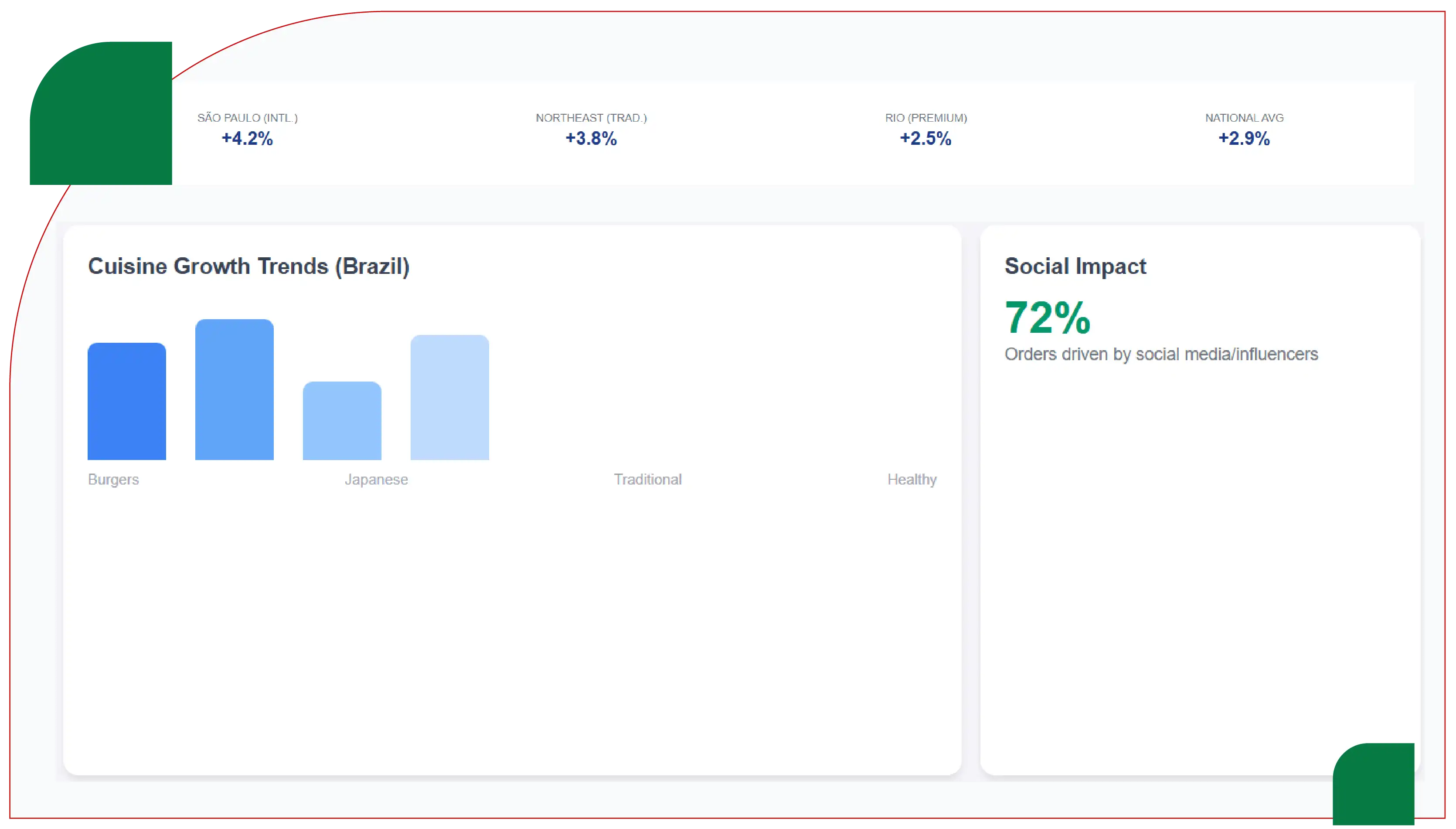
Premium burgers, Japanese cuisine, healthy meals, desserts, breakfast offerings, and specialty beverages continue to experience strong growth across major Brazilian cities. Social media trends and influencer marketing increasingly influence purchasing decisions, accelerating demand for specific cuisine categories.
Regional preferences remain important. Consumers in São Paulo demonstrate strong interest in international cuisines, while northeastern regions often show higher demand for traditional Brazilian specialties. Understanding these localized trends allows businesses to tailor their offerings more effectively.
| Cuisine Type | Annual Demand Growth | Average Order Value (BRL) | Repeat Purchase Rate | Cloud Kitchen Penetration | Consumer Popularity Score |
|---|---|---|---|---|---|
| Burgers | 18% | 44 | 72% | High | 9.4 |
| Pizza | 14% | 57 | 75% | Medium | 9.2 |
| Japanese | 22% | 71 | 69% | Medium | 9.1 |
| Healthy Food | 28% | 49 | 66% | High | 9.0 |
| Brazilian Cuisine | 12% | 39 | 78% | Low | 8.8 |
| Desserts | 31% | 27 | 61% | High | 8.7 |
| Breakfast & Bakery | 25% | 23 | 70% | Medium | 8.6 |
| Mexican | 19% | 46 | 59% | Medium | 8.3 |
| Seafood | 11% | 63 | 54% | Low | 7.9 |
| Vegetarian/Vegan | 24% | 48 | 62% | High | 8.8 |
| Asian Fusion | 21% | 58 | 64% | Medium | 8.5 |
| Gourmet Sandwiches | 17% | 41 | 67% | Medium | 8.2 |
The continued growth of healthy eating and specialty cuisine segments demonstrates how consumer preferences are becoming increasingly diverse across Brazil's urban centers.
Comprehensive restaurant intelligence solutions frequently utilize an iFood Food Dataset from Brazil to support market analysis, investment research, and operational optimization. These datasets typically include restaurant listings, menu details, pricing information, ratings, delivery fees, operating hours, and promotional activity.
Investors use restaurant datasets to evaluate market opportunities and identify high-growth segments. Restaurant chains leverage the data to benchmark performance against competitors and assess expansion opportunities. Food-tech startups utilize restaurant intelligence to develop recommendation systems, demand forecasting models, and customer acquisition strategies.
The growing availability of structured restaurant data has transformed how businesses evaluate market conditions and make strategic decisions.
The increasing volume of marketplace information has accelerated demand for automated collection technologies. Many organizations utilize an Ifood Food Delivery Scraping API to collect and process restaurant data at scale.
Modern data collection systems enable continuous monitoring of restaurant listings, menu updates, pricing changes, customer reviews, and promotional campaigns. Through Web Scraping Food Delivery Data, businesses gain access to real-time intelligence that supports faster and more informed decision-making.
Companies frequently Extract Restaurant Menu Data to analyze product assortment strategies, identify popular menu items, monitor price adjustments, and evaluate promotional effectiveness. These insights help restaurants improve menu engineering and maximize profitability.
The adoption of advanced analytics has increased significantly as businesses recognize the value of data-driven decision making. A comprehensive Food Delivery Scraping API can provide continuous access to market intelligence, enabling organizations to monitor changing conditions across thousands of restaurants simultaneously.
Organizations that invest in Restaurant Data Intelligence gain deeper visibility into consumer behavior, competitor activity, pricing strategies, and operational performance. This intelligence supports strategic initiatives including market entry planning, expansion analysis, promotional optimization, and customer retention efforts.
As competition continues to intensify, access to timely and accurate restaurant intelligence will remain a key differentiator for businesses operating within Brazil's food delivery ecosystem.
Brazil's food delivery market is expected to remain one of the most dynamic and competitive sectors in Latin America throughout 2026. iFood's dominant market position, extensive restaurant network, and large consumer base make it an essential source of industry intelligence for restaurants, investors, cloud kitchen operators, and technology companies.
Organizations that effectively leverage Food delivery Intelligence can identify emerging trends, optimize pricing strategies, improve customer acquisition efforts, and uncover new growth opportunities before competitors. The implementation of a comprehensive Food Price Dashboard enables businesses to monitor restaurant performance, menu changes, promotional activity, and competitive movements in real time.
As demand for analytics-driven decision making continues to increase, comprehensive Food Datasets derived from Brazil's food delivery ecosystem will play a critical role in shaping future business strategies, investment decisions, and market expansion initiatives.
If you are seeking for a reliable data scraping services, Food Data Scrape is at your service. We hold prominence in Food Data Aggregator and Mobile Restaurant App Scraping with impeccable data analysis for strategic decision-making.