
India's quick commerce industry has emerged as one of the fastest-growing segments within the digital retail ecosystem, transforming consumer purchasing behavior through ultra-fast delivery services. The market is driven by increasing smartphone penetration, urban lifestyles, expanding dark-store networks, and rising demand for convenience-based shopping experiences. Leading platforms such as Blinkit, Zepto, Instamart, and BigBasket Now continue to compete aggressively through pricing strategies, promotional campaigns, assortment expansion, and delivery efficiency improvements. This report provides comprehensive insights into market share distribution, consumer preferences, pricing trends, inventory dynamics, and competitive positioning across India's evolving quick commerce landscape. It examines how real-time data intelligence helps businesses monitor product availability, promotional effectiveness, category performance, and regional expansion opportunities. The report also highlights the growing importance of data-driven decision-making for retailers, brands, manufacturers, investors, and logistics providers seeking sustainable growth and competitive advantages in India's rapidly expanding quick commerce market.

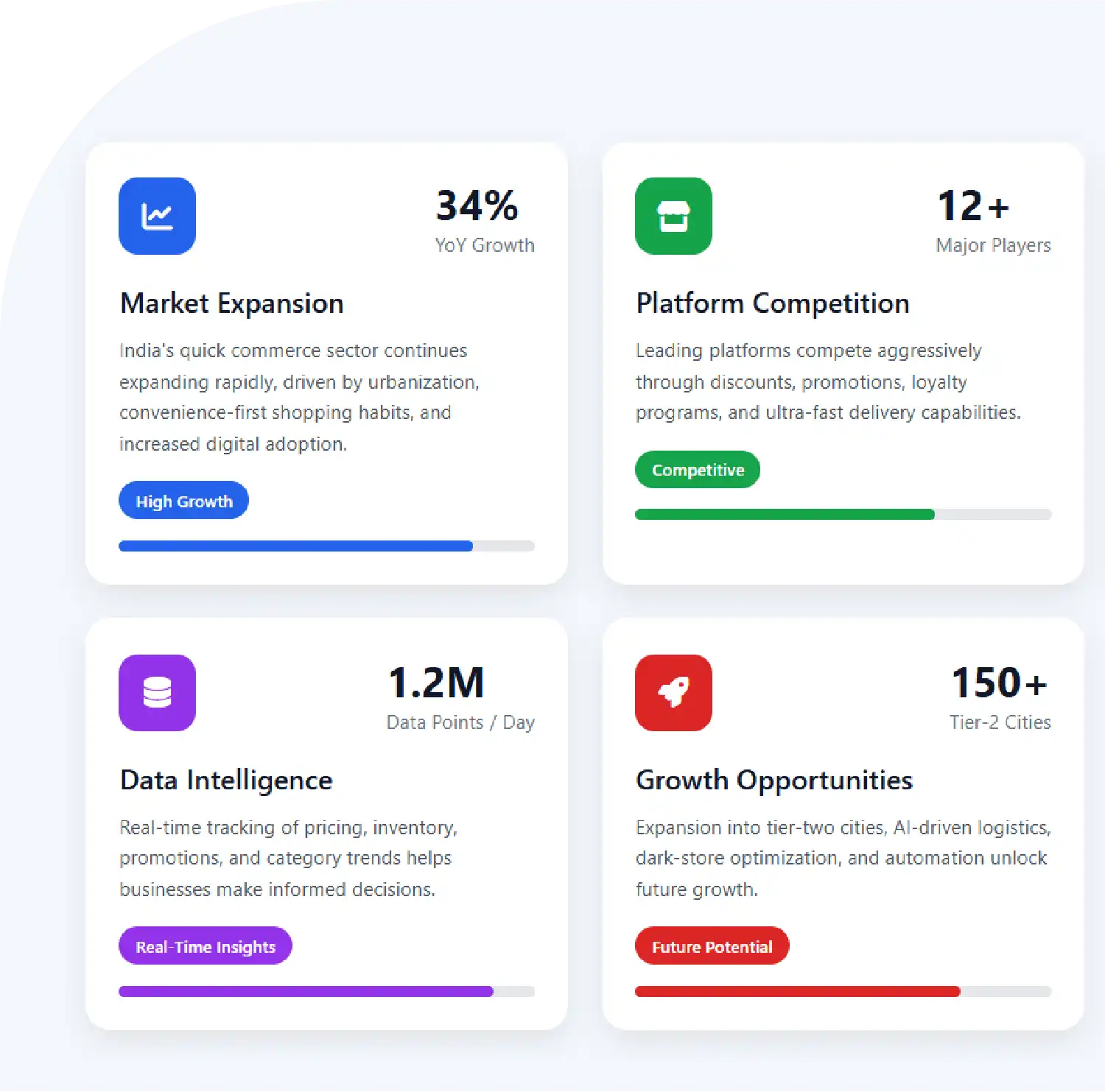
Market Expansion
India's quick commerce market grows rapidly through
convenience, urbanization, and adoption.
Platform Competition
Leading platforms compete aggressively using
pricing, promotions, delivery speed advantages.
Consumer Behavior
Consumers increasingly prefer instant deliveries for
groceries and daily essentials.
Data Intelligence
Real-time intelligence helps track pricing, inventory,
promotions, and market trends.
Growth Opportunities
Tier-two expansion and technology innovations create
significant future growth opportunities.

India's quick commerce sector has rapidly evolved into one of the most competitive segments of the digital retail ecosystem. Driven by urbanization, smartphone penetration, changing consumer behavior, and demand for instant deliveries, quick commerce platforms are reshaping how consumers purchase groceries, personal care products, electronics, and daily essentials. Businesses increasingly rely on India Quick Commerce Market Intelligence to understand market movements, consumer preferences, and competitive strategies across leading platforms.
The growing importance of Quick Commerce Market Share Analytics allows retailers, brands, and investors to monitor platform performance, customer acquisition trends, and regional expansion opportunities. Meanwhile, Blinkit Market Share Data Scraping has emerged as a valuable approach for collecting real-time information on product availability, pricing fluctuations, promotional campaigns, and assortment strategies.
Quick commerce, often referred to as Q-commerce, focuses on delivering products within 10–30 minutes. Unlike traditional e-commerce models that emphasize large catalogues and longer delivery timelines, quick commerce prioritizes speed, convenience, and localized fulfillment.
Major players including Blinkit, Instamart, Zepto, BigBasket Now, and BB Daily have expanded aggressively across metropolitan and tier-2 cities. The sector benefits from dark stores, hyperlocal logistics networks, and advanced inventory management systems that support rapid order fulfillment.
Consumers increasingly depend on quick commerce platforms for daily grocery purchases, emergency household needs, beverages, snacks, personal care products, and pharmacy essentials. This behavioral shift has created significant opportunities for data-driven market intelligence and analytics solutions.
Several factors contribute to the remarkable growth of India's quick commerce market:
Urban Consumer Lifestyle: Modern consumers value convenience over traditional shopping experiences. Time-constrained professionals prefer ordering groceries and essentials through mobile applications rather than visiting physical stores.
Rising Digital Adoption: India's expanding internet user base and smartphone penetration continue to fuel online purchasing behavior. UPI-based payment systems further simplify transactions and encourage frequent purchases.
Expansion of Dark Stores: Dark stores strategically located within city neighborhoods enable companies to maintain inventory closer to consumers, reducing delivery times and improving operational efficiency.
Competitive Pricing Strategies: Quick commerce companies frequently introduce discounts, flash sales, bundled offers, and loyalty programs to attract and retain customers. Continuous monitoring of these strategies provides valuable competitive intelligence.
The competitive landscape continues to evolve as leading players battle for market leadership
| Platform | Estimated Market Share (%) | Primary Strength | Delivery Time | Key Focus Categories |
|---|---|---|---|---|
| Blinkit | 42 | Extensive dark store network | 10-20 mins | Groceries, FMCG |
| Instamart | 24 | Swiggy ecosystem integration | 15-30 mins | Grocery, Food Essentials |
| Zepto | 22 | Ultra-fast delivery model | 10 mins | Daily Essentials |
| BigBasket Now | 8 | Strong sourcing network | 20-30 mins | Grocery & Fresh Produce |
| Others | 4 | Regional specialization | Variable | Mixed Categories |
The market remains highly dynamic, with leadership positions influenced by geographic expansion, customer retention, delivery efficiency, and promotional campaigns.
Organizations increasingly use Quick Commerce Market Data Extraction techniques to monitor platform-specific growth indicators and identify emerging opportunities.
Data has become the foundation of decision-making within the quick commerce ecosystem. Every product listing, inventory update, promotional campaign, customer rating, and pricing adjustment generates valuable market intelligence.
Businesses leverage Quick Commerce Market Analytics In India to answer critical questions such as:
By analyzing these metrics, stakeholders can optimize pricing, inventory planning, marketing investments, and expansion strategies.
Inventory visibility plays a crucial role in quick commerce performance. Product stock-outs directly impact customer satisfaction and platform loyalty.
| Intelligence Metric | Business Value | Frequency of Monitoring | Strategic Impact |
|---|---|---|---|
| Product Availability | Prevent stock-outs | Hourly | Inventory Optimization |
| Price Changes | Monitor competitors | Daily | Dynamic Pricing |
| Promotional Offers | Track campaigns | Daily | Marketing Strategy |
| Category Rankings | Measure demand | Weekly | Product Placement |
| Customer Ratings | Assess satisfaction | Weekly | Product Improvement |
| Delivery Time | Service benchmarking | Daily | Operational Efficiency |
| Assortment Expansion | New product tracking | Weekly | Portfolio Development |
| Regional Availability | Geographic insights | Monthly | Market Expansion |
| Brand Visibility | Competitive analysis | Weekly | Market Share Growth |
| Discount Intensity | Promotion monitoring | Daily | Revenue Optimization |
Modern retailers increasingly depend on Real-time q-commerce data intelligence to react quickly to market changes and maintain competitive positioning.
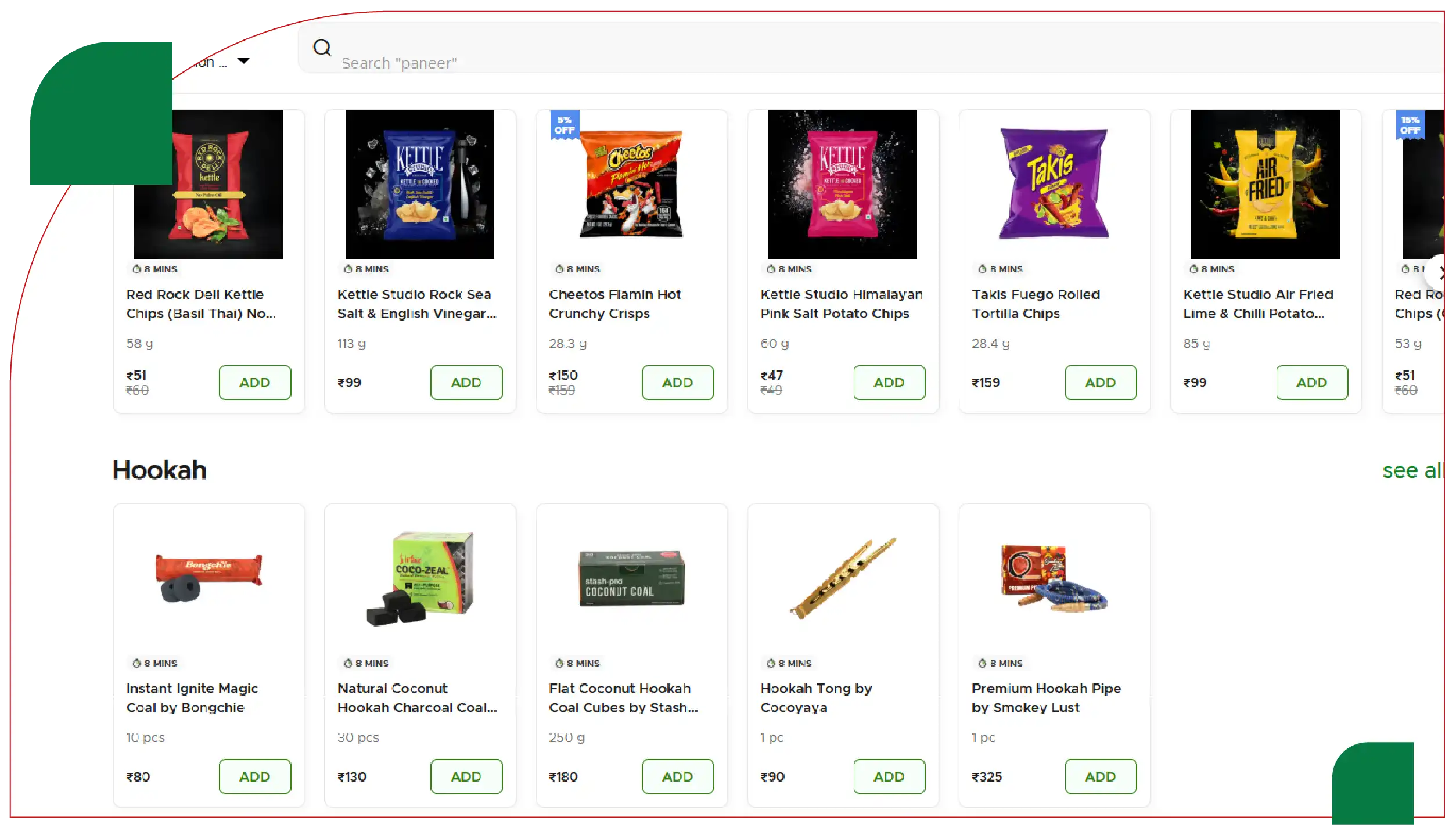
Blinkit has emerged as a dominant force within India's quick commerce ecosystem. Its extensive dark store infrastructure, broad product assortment, and aggressive expansion strategy contribute significantly to its market leadership.
Organizations frequently analyze the Blinkit Grocery Delivery Dataset to understand consumer purchasing patterns, product demand fluctuations, category performance, and regional inventory trends.
The platform generates large volumes of actionable information, including:
These insights help manufacturers, distributors, retailers, and market researchers make informed business decisions.
Advanced technologies power today's market intelligence systems. Automated data collection frameworks gather information from multiple quick commerce platforms and transform it into structured business insights.
Many organizations utilize the Blinkit Quick Commerce Data Scraping API to automate data acquisition processes, improve monitoring efficiency, and support real-time analytics initiatives.
Technologies commonly employed include:
These technologies enable continuous monitoring of rapidly changing market conditions.
Data intelligence supports various business functions across the retail ecosystem.
Pricing Optimization: Retailers compare competitor prices and adjust their pricing strategies accordingly.
Demand Forecasting: Historical sales and inventory data help businesses predict future demand patterns.
Product Assortment Planning: Companies identify top-performing products and optimize inventory allocation.
Competitive Benchmarking: Organizations monitor market leaders and evaluate strategic performance indicators.
Market Expansion Planning: Regional performance insights help determine ideal locations for expansion.
Businesses increasingly rely on comprehensive Quick Commerce Datasets to improve decision-making accuracy and reduce operational uncertainty.
The quick commerce industry generates enormous volumes of grocery-related information every day. Understanding consumer demand patterns, pricing behavior, category growth, and inventory turnover requires sophisticated analytical frameworks.
Modern Grocery Data Intelligence solutions provide actionable insights that support:
As competition intensifies, access to accurate grocery intelligence becomes a critical differentiator.
India's quick commerce sector is expected to witness continued growth over the next several years. Increasing urban density, consumer preference for convenience, and ongoing investments in logistics infrastructure will likely accelerate adoption rates.
Artificial intelligence, predictive analytics, and automated inventory management systems will further enhance operational efficiency. Additionally, expansion into tier-2 and tier-3 cities presents substantial opportunities for future growth.
Industry participants that leverage advanced market intelligence capabilities will be better positioned to identify trends, respond to competitive pressures, and capitalize on emerging opportunities.
India's quick commerce ecosystem continues to transform the retail landscape through rapid delivery models, digital innovation, and data-driven operations. Companies seeking sustainable growth increasingly depend on accurate market intelligence, competitor monitoring, and consumer behavior analysis.
The adoption of Web Scraping Quick Commerce Data enables organizations to capture valuable insights related to pricing, inventory, promotions, and product availability across leading platforms. Advanced solutions such as the Quick Commerce Data Scraping API further streamline data collection and support real-time analytics initiatives. As the industry becomes increasingly competitive, comprehensive Quick Commerce Data Intelligence Services will remain essential for retailers, brands, manufacturers, and investors seeking to maintain a competitive advantage in India's rapidly expanding quick commerce market.
Are you in need of high-class scraping services? Food Data Scrape should be your first point of call. We are undoubtedly the best in Food Data Aggregator and Mobile Grocery App Scraping service and we render impeccable data insights and analytics for strategic decision-making. With a legacy of excellence as our backbone, we help companies become data-driven, fueling their development. Please take advantage of our tailored solutions that will add value to your business. Contact us today to unlock the value of your data.