Introduction
Sales teams, suppliers and analysts all ask the same question: where are India's restaurants, what do they serve, and how do I reach them as businesses? An India restaurant database answers it in one structured file.
Short answer: An India restaurant database is a structured list of restaurant outlets built from public business listings on Zomato, Swiggy, Google Maps and brand websites. Each row holds outlet name, brand, cuisine, veg or non-veg, locality, pincode, city, coordinates, rating, cost for two, delivery availability, hours and business contact details.
This guide covers who uses the data, where it comes from, which fields matter, how outlets are matched across apps, how to segment by city and cuisine, and what stays out of scope for legal and practical reasons.
Who uses an India restaurant database?
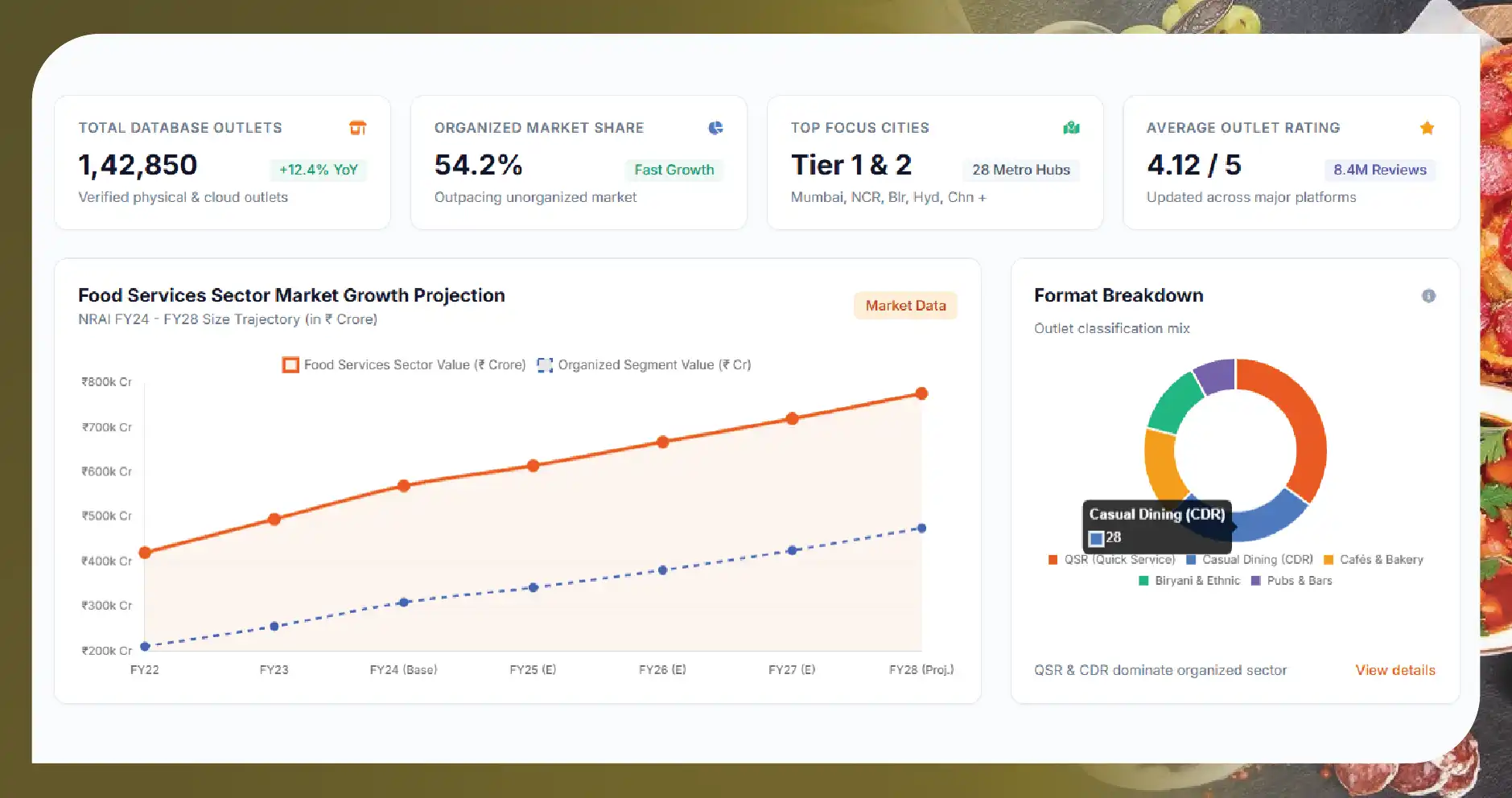
The market is big enough to justify careful targeting. The National Restaurant Association of India's India Food Services Report 2024 put the sector at ₹5,69,487 crore in FY24, rising to a projected ₹7,76,511 crore by FY28, with the organised segment growing faster than the market overall.
- FMCG and beverage go-to-market teams: build target lists of cafés, QSRs and casual dining outlets by city and cuisine for distribution and trade promotions.
- HoReCa suppliers and distributors: find outlets that match a product line, such as bakeries for dairy or biryani specialists for rice and spices, and plan sales routes by locality.
- QSR and café chains planning expansion: map competitor density and white space by pincode before committing to a site.
- Investors and analysts: track chain footprints, cuisine mix and rating trends over time.
- Apps and platforms: seed search, discovery and recommendation features with clean, structured outlet records.
Where does India restaurant data come from?
No single source lists every restaurant in India. Delivery apps are strong on menus and ratings but miss dine-in-only places. Maps cover more outlets but have thinner menu data. Combining sources gives the most complete picture.
| Source | What it adds | Gaps to plan for |
|---|---|---|
| Zomato | Dining and delivery listings, cuisines, cost for two, ratings, menus | Listings vary by city; some outlets delivery-only |
| Swiggy | Delivery listings, menus, prices, ratings, veg flags | Delivery-led; dine-in-only outlets often missing |
| Google Maps | Wide outlet coverage, coordinates, hours, business phone and website | Category labels less precise; duplicates common |
| Brand and chain websites | Official store locators for chains | Covers chains only |
| FSSAI FoSCoS FBO search | Registered business name and licensed premises, as a public check | Used for verification only, not as a lead source |
Scale on the delivery side is large. Swiggy alone reported 275,400 restaurant partners in Q4 FY26, up from 251,700 a year earlier. Our own database holds [X] outlets across [Y] cities, with totals by state in the sample file.
Each source describes location and food type a little differently. Delivery apps usually show a locality name and a veg marker, while maps give precise coordinates but looser categories. The build takes the best field from each source and records which one it came from, so you can trace any value back to a public page.
What fields should the database include?
The schema below covers outlet, location and listing data. It deliberately includes the two fields Indian buyers ask for most and many datasets leave out: veg or non-veg, and locality.
| Field | What it holds |
|---|---|
| outlet_id | Stable ID for the outlet across refreshes |
| outlet_name | Name as listed |
| brand / chain_flag | Parent brand and whether it is a chain |
| cuisines | Cuisine tags, normalised to one list |
| veg_type | Pure veg, non-veg or both, as shown on listings |
| locality | Neighbourhood, e.g. Koramangala or Bandra West |
| pincode, city, state | Postal and administrative location |
| latitude, longitude | Coordinates for mapping and radius search |
| rating, rating_count | Average rating and number of ratings per source |
| cost_for_two | Listed price band in ₹ |
| delivery_available | On Zomato, Swiggy or both |
| opening_hours | Listed hours by day |
| business_phone, website | Public business contact only |
| source_urls, last_seen | Where and when the outlet was seen |
Menu-level fields such as item name, price and category can be added as a linked table. See our Zomato dataset and Swiggy dataset pages for menu-level coverage.
How are outlets matched and de-duplicated across apps?
The same restaurant often appears on Zomato, Swiggy and Google Maps with small differences in name or address. Without matching, you count it three times. A good build follows clear steps.
- Normalise names. Remove branch suffixes, punctuation and words like "restaurant" or "cafe" for comparison only.
- Compare location. Treat listings within a short distance of each other and in the same pincode as candidates.
- Check supporting fields. Business phone, website and cuisine help confirm a match.
- Score and review. High-confidence matches merge automatically; borderline cases go to manual review.
- Keep the links. The merged record keeps every source URL, so you can see which apps list the outlet.
Which quality checks matter most?
- Coordinates in the wrong place. A pin that falls outside the listed city or pincode is flagged and re-checked against other sources.
- Franchise and branch names. "Brand – Locality" and "Brand (Locality)" are mapped to one brand so chain counts stay accurate.
- Cuisine tag sprawl. Hundreds of free-text tags are mapped to a short, consistent cuisine list, with the original tags kept.
- Phone formats. Business numbers are stored in one format, and only numbers shown on public business listings are kept.
- Closed outlets. Listings marked closed, or missing from every source for a set period, are flagged instead of being counted as live.
Matching also separates chains from independents. A chain_flag based on brand name plus multiple locations is far more useful for go-to-market planning than a raw list of names.
How should you segment the data by city and cuisine?
Most buyers do not need all of India at once. They need the cities and cuisines that match their product. Segmenting first keeps cost down and makes the list easier to act on.
| Segment | Example cut | Outlet count | Typical buyer |
|---|---|---|---|
| Metro, all cuisines | Mumbai, Delhi NCR, Bengaluru | [X] | National FMCG and beverage brands |
| Tier-2 cities | Indore, Lucknow, Coimbatore | [X] | Expansion and distribution teams |
| Cafés and bakeries | All cities, café or bakery tag | [X] | Coffee, dairy and bakery suppliers |
| QSR chains | Chain_flag = true, QSR cuisines | [X] | Competitor and site-selection analysis |
| Pure veg outlets | veg_type = pure veg | [X] | Vegetarian product lines |
Locality is the level that sales teams actually work at. A distributor covering south Bengaluru plans routes by neighbourhood, not by city. Pairing locality with pincode and coordinates lets you draw territories, count outlets per beat and find areas with few competitors.
Ratings and rating counts help rank outlets inside each segment. They are a public proxy for visibility and customer interest, not a measure of sales.
How often should the database be refreshed?
Restaurants open, close, rename and change hours all the time. For sales prospecting, a quarterly refresh is usually enough. For competitor tracking or app use, monthly or weekly updates keep closures and new openings current.
Every record should carry a last_seen date. If an outlet disappears from all sources for a set period, it is flagged as possibly closed rather than silently deleted. Standard plans refresh every [Z], with pricing from [W]; our team confirms both in your quote.
What are the compliance basics?
The database stays at business-listing level. It holds the outlet's public business name, address, business phone, website, hours and ratings. It never includes personal contacts of owners, managers or staff, and no customer data.
This matters under India's data protection law. The Digital Personal Data Protection Rules, 2025 were notified on 13 November 2025, with most obligations phased in over 18 months. Keeping the dataset to business information avoids personal data in the first place. Collection respects robots.txt, terms of service and rate limits.
Order and sales volumes are also out of scope. Zomato and Swiggy do not publish them for individual restaurants. We offer labelled public proxies instead: rating counts, bestseller tags on menu items, search rank and delivery availability.
Should you buy a ready-made database or build your own?
- Build in-house if you have engineers to maintain collectors for several apps, handle matching and keep up with site changes.
- Buy a ready-made database if you need a clean, matched file quickly for a city or state, with a dated sample before you commit.
- Choose a custom feed if you need specific cuisines, localities or fields, regular refreshes, or delivery into your CRM.
| Factor | Build in-house | Ready-made database | Custom feed |
|---|---|---|---|
| Time to first data | Weeks to months | Days | Short setup |
| Ongoing upkeep | Your team fixes collectors when sites change | None for a one-off file | Handled by the provider |
| Cross-app matching | You design and maintain it | Included | Included, tuned to your fields |
| Coverage | Whatever you build | Fixed cities and fields | Your cities, cuisines and fields |
| Best for | Teams with data engineers and a long-term need | Testing, one-off prospecting, research | CRM-fed sales teams and apps |
For an example of this work, see our India restaurant database case study. For B2B prospecting built on this data, see foodservice lead intelligence.
Get a free sample dataset. Tell us the cities and cuisines you need and we will send a dated, matched India restaurant sample.
Questions
Frequently Asked Questions
It is a structured list of restaurant outlets in India built from public business listings, with name, brand, cuisine, veg type, locality, pincode, coordinates, ratings, cost for two, hours and business contact details.
No. We include only public business contact details such as the outlet's listed phone number and website, never personal contacts of individuals.
No. Zomato and Swiggy do not publish order volumes per restaurant. We provide labelled proxies such as rating counts, bestseller tags and delivery availability.
Yes. Most buyers start with a city, state or cuisine segment, such as cafés in Bengaluru or pure veg outlets in Ahmedabad.
We match listings by normalised name, distance, pincode and business phone, merge confident matches and review borderline ones.
Get a Free Food Data Sample in 48 Hours.
Tell us your platforms, target markets and required fields — we'll map exactly what's possible with food data scraping, recommend the right approach, and send a working sample so you can verify quality before any commitment.
Request a strategy call
Thanks — our data team will reach out within 48 hours with your sample.