Introduction
The modern restaurant ecosystem is no longer limited to a single ordering channel. A customer may discover the same restaurant on Uber Eats, DoorDash, Zomato, Swiggy, Deliveroo, or the restaurant's own website, only to encounter different item names, descriptions, prices, portion sizes, add-ons, and availability. For businesses analyzing this information, simply collecting menu records is not enough. The real challenge begins when identical or similar menu items need to be recognized and compared across platforms.
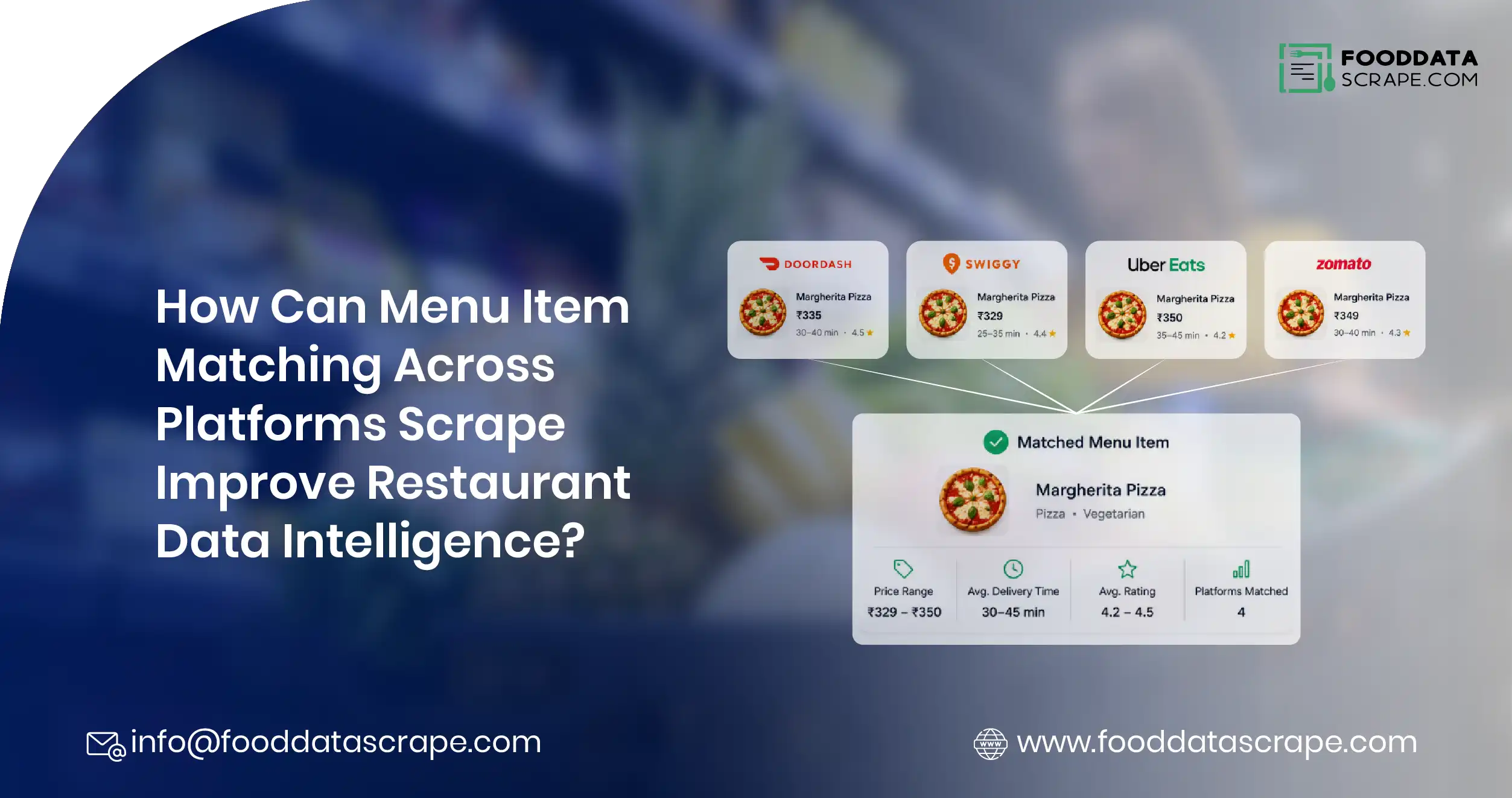
Menu item matching across platforms scrape enables businesses to collect menu information from multiple digital channels and intelligently identify corresponding dishes, categories, variants, and modifiers. Instead of treating every platform record as a separate product, businesses can build a unified view of the restaurant's actual menu.
Cross-platform restaurant menu scraping provides the underlying data required for this process, including restaurant names, menu categories, item titles, descriptions, prices, images, dietary labels, sizes, modifiers, and availability.
The strategy to Scrape restaurant menus across platforms becomes particularly valuable when restaurants operate on several marketplaces simultaneously. By combining scraped records with normalization, entity resolution, and matching algorithms, businesses can identify pricing differences, menu inconsistencies, missing products, and platform-specific changes.
The result is a structured restaurant intelligence layer where comparable items can be analyzed even when different platforms use different naming conventions or menu structures.
Why Menu Matching Is More Difficult Than It Looks?
At first glance, matching two restaurant menus may appear straightforward. If one platform contains "Chicken Burger" and another also contains "Chicken Burger," the records seem identical. However, real-world restaurant menus are rarely this consistent.
One platform might list "Classic Chicken Burger," another "Crispy Chicken Burger," and a third "Chicken Burger with Fries." These may represent completely different products—or variations of the same base item.
Descriptions create another challenge. A restaurant may describe a dish as "Grilled chicken breast, lettuce, tomato and house sauce," while another platform abbreviates it to "Grilled chicken burger." Exact text comparison would incorrectly classify these records as unrelated.
Pricing adds further complexity. A menu item may cost $10.99 on one marketplace and $12.49 on another because of platform commissions, promotions, packaging charges, or channel-specific pricing.
Therefore, effective matching requires more than comparing names. It requires contextual understanding.
Data Fields Required for Reliable Matching
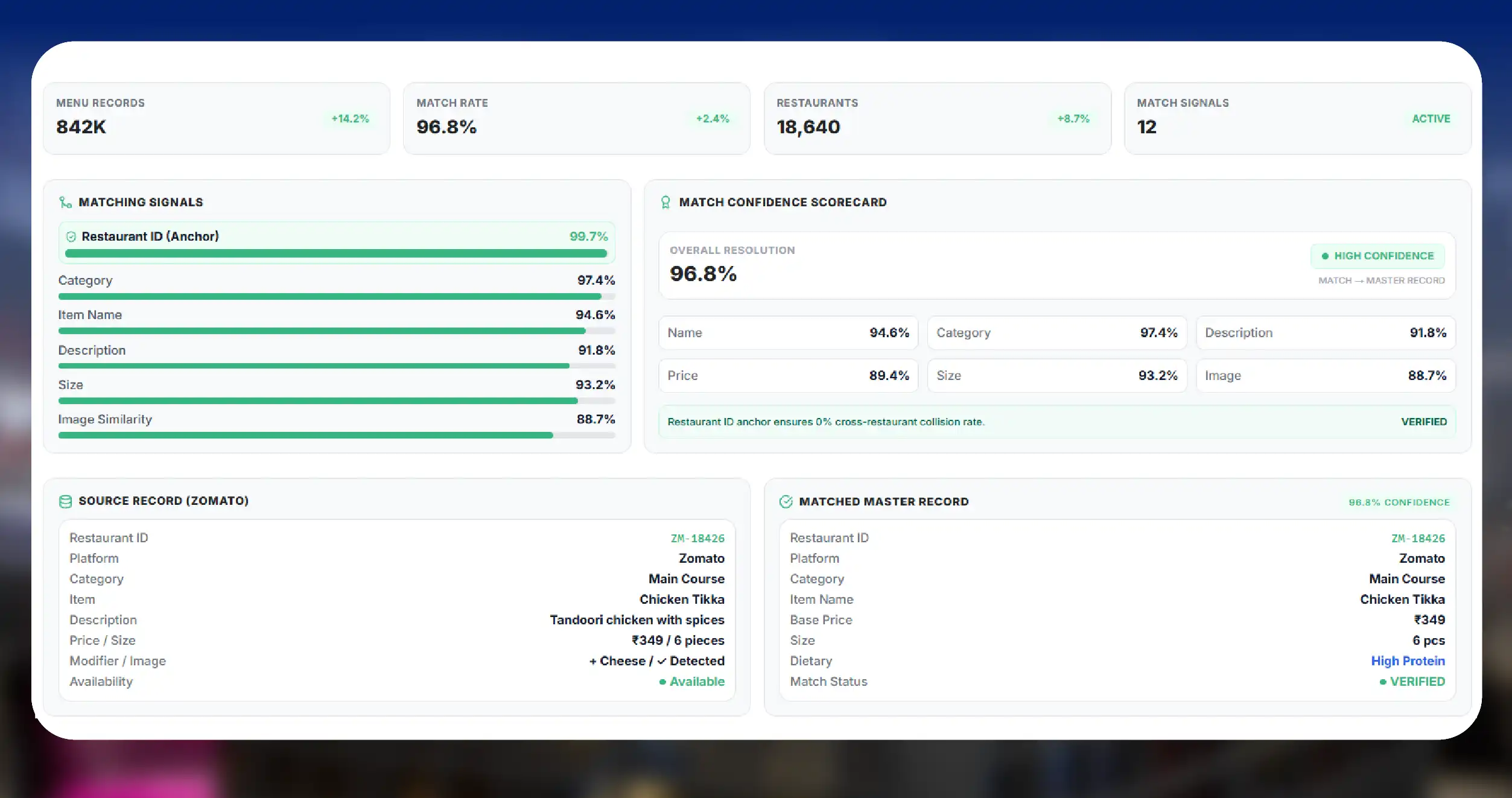
A strong matching system begins with comprehensive data collection. Each menu record should ideally contain the restaurant identifier, platform name, category, item name, description, base price, discounted price, size, serving information, modifier details, dietary attributes, availability status, image URL, and menu position.
Restaurant identifiers are particularly important because matching should normally happen within the same restaurant or restaurant location. Comparing similarly named dishes across unrelated restaurants can create false matches.
Menu categories also provide useful context. "Chicken Tikka" appearing under an Indian restaurant's main course category is more likely to match another "Chicken Tikka" record under a comparable category than a similarly named appetizer.
Descriptions can provide additional semantic signals. Ingredients, preparation methods, serving sizes, and included sides can help distinguish products with similar names.
Images can also contribute to advanced matching systems. Visual similarity can help identify menu items where titles differ substantially but the photographs are nearly identical.
The Matching Process
Matching scraped menu items across platforms generally involves multiple stages rather than a single comparison technique.
The first stage is data normalization. Text is converted into a consistent format by removing unnecessary punctuation, standardizing capitalization, correcting spacing, and handling common abbreviations. For example, "Chk. Burger," "Chicken Burger," and "Chicken Burg." can be transformed into standardized representations.
The second stage involves category normalization. Different platforms may use "Burgers," "Burger Meals," or "Handcrafted Burgers" for similar menu sections. A standardized taxonomy allows records to be grouped more effectively.
The third stage involves name similarity. Exact matching can identify obvious duplicates, while fuzzy matching can recognize minor spelling or wording differences. Techniques such as token similarity, edit distance, and n-gram comparison can support this process.
The fourth stage uses descriptions and ingredients. If two products have highly similar descriptions, they can receive a higher matching score even when their titles are different.
The fifth stage considers price and portion information. Price should not be used as the primary matching signal because platforms may intentionally display different prices. However, it can strengthen or weaken a potential match.
Finally, the system can assign confidence scores. High-confidence matches can be automatically accepted, while uncertain records can be sent for human review.
Using Advanced Matching Techniques
Restaurant menu data matching after scraping becomes significantly more powerful when semantic matching is introduced. Traditional keyword matching can fail when restaurants use creative names, abbreviations, or platform-specific descriptions.
Natural language processing can convert menu names and descriptions into embeddings that capture semantic relationships. For example, "Spicy Paneer Wrap" and "Hot Cottage Cheese Roll" may contain different words but could still represent closely related products.
A hybrid model can combine multiple signals:
| Matching Signal | Example | Potential Role |
|---|---|---|
| Restaurant ID | Same location identifier | 25% |
| Item Name | Chicken Tikka vs Chicken Tikka Masala | 20% |
| Description | Ingredient similarity | 15% |
| Category | Main Course vs Curry | 10% |
| Price | $11.99 vs $12.49 | 5% |
| Size | Regular vs Large | 10% |
| Modifiers | Cheese, sauce, toppings | 5% |
| Image Similarity | Similar dish photographs | 10% |
These percentages are illustrative rather than universal. Actual weighting should be determined through validation data and business requirements.
The system can also distinguish between base products and variants. "Margherita Pizza" and "Margherita Pizza — Large" should generally be related, but they should not necessarily be treated as identical records.
Comparing Prices and Menu Structures
Scraped restaurant menu comparison data can reveal significant differences between ordering platforms.
For example, a restaurant might offer 75 products on one platform, 68 on another, and 72 on its direct ordering channel. After matching, analysts may discover that 60 products are common across all three platforms, while others exist only on individual channels.
A comparison framework can identify:
| Metric | Uber Eats | DoorDash | Grubhub |
|---|---|---|---|
| Total Menu Items | 75 | 68 | 72 |
| Matched Items | 63 | 63 | 63 |
| Unique Items | 12 | 5 | 9 |
| Average Item Price | $13.80 | $14.35 | $13.20 |
| Discounted Items | 18 | 21 | 14 |
| Out-of-Stock Items | 7 | 11 | 5 |
| Modifier Groups | 29 | 25 | 31 |
| Vegetarian Items | 27 | 26 | 28 |
| Beverage Items | 16 | 14 | 15 |
| Dessert Items | 9 | 8 | 10 |
This structure gives restaurant operators and market researchers a much clearer picture than raw scraped datasets.
Detecting Menu Gaps and Inconsistencies
Matching technology can also uncover operational problems.
Suppose a restaurant introduces a new pasta dish. It appears on the restaurant's website but not on one delivery marketplace. A cross-platform comparison can identify the missing item automatically.
The same process can detect outdated prices. If an item costs $14.99 on the direct channel but remains listed at $11.99 on another platform, the discrepancy may require attention.
Availability inconsistencies are equally important. A popular product marked unavailable on one platform while available elsewhere could indicate inventory synchronization problems.
Menu descriptions can also be compared to detect outdated ingredients, missing allergen information, incorrect serving sizes, or obsolete promotional messaging.
Creating an Automated API-Based System
Restaurant menu matching API solutions can turn this workflow into a repeatable data pipeline. Instead of manually downloading and comparing spreadsheets, businesses can integrate scraped menu records into an automated matching service.
A typical architecture can include data collection, validation, normalization, entity resolution, matching, confidence scoring, storage, and API delivery.
For example, incoming records can be assigned a universal menu item ID. Every platform-specific record linked to the same dish then becomes a child record associated with that universal identifier.
This makes downstream analysis much easier. Businesses can query one product and retrieve its prices, availability, descriptions, modifiers, and platform presence across multiple channels.
APIs can also support scheduled updates, allowing menu changes to be detected hourly, daily, or according to the required monitoring frequency.
Business Applications
Restaurant Menu Data Scraping combined with intelligent matching supports numerous business applications.
Restaurant chains can monitor whether menus remain synchronized across marketplaces. Aggregators can standardize large restaurant datasets before analytics. Market researchers can study menu assortment and pricing across cities. Food delivery businesses can benchmark competitors.
Brands can also analyze menu innovation by tracking the appearance and disappearance of products over time. New dishes, seasonal products, bundles, combo meals, and promotional offers can be monitored systematically.
For pricing teams, matched menu records provide a reliable foundation for measuring price differences. Instead of comparing thousands of unrelated strings, analysts can evaluate the same dish across multiple channels.
Turn fragmented restaurant menus into actionable intelligence with our data scraping services—match items, compare prices, track availability, and uncover cross-platform opportunities today.
Building a Scalable Data Pipeline
A scalable workflow should separate collection from matching. Scrapers collect raw data while a processing layer handles cleaning and normalization.
A practical pipeline can follow this sequence:
- Collect restaurant and menu records from permitted sources.
- Standardize names, categories, descriptions, prices, and attributes.
- Assign restaurant and location identifiers.
- Generate candidate item pairs.
- Calculate similarity scores.
- Apply semantic and contextual matching.
- Assign universal menu item identifiers.
- Flag low-confidence matches for review.
- Store matched and unmatched records.
- Monitor changes continuously.
This architecture makes the system easier to maintain because scraping logic can evolve independently from matching logic.
How Food Data Scrape Can Help You?
1. Build Unified Menu Datasets
Our data scraping services collect restaurant menus from multiple platforms, standardize product information, and create unified datasets that make menu comparison, matching, pricing analysis, and monitoring easier.
2. Match Menu Items Accurately
We combine structured extraction, normalization, fuzzy matching, and semantic analysis to identify corresponding menu items across platforms, even when names, descriptions, categories, or formats differ significantly.
3. Monitor Cross-Platform Pricing
Our solutions capture menu prices, discounts, portion sizes, and promotional offers across platforms, helping businesses identify price differences, competitive positioning, pricing inconsistencies, and changing market trends.
4. Track Menu Changes Continuously
We provide recurring data extraction to monitor newly added dishes, removed products, availability changes, modified descriptions, updated prices, and menu structure changes across multiple restaurant ordering channels.
5. Deliver Analysis-Ready Data
We transform scraped restaurant information into structured, validated datasets suitable for dashboards, APIs, databases, competitive intelligence, menu optimization, market research, forecasting, and automated restaurant analytics workflows.
Conclusion
The value of restaurant data does not come merely from collecting thousands or millions of menu records. Its real value emerges when those records can be connected, standardized, and compared accurately.
Scrape Menu Data from multiple channels and combine it with structured normalization, fuzzy matching, semantic analysis, and confidence scoring to create a unified restaurant intelligence framework.
Scrape Restaurant Menu Data at regular intervals to monitor changing prices, availability, product assortment, modifiers, promotions, and descriptions across digital ordering channels.
Real-Time Menu Inflation Tracking becomes possible when matched menu records are continuously refreshed and historical prices are retained, allowing businesses to measure how individual dishes and broader menu categories change over time.
Restaurant Menu Data Scraping therefore becomes far more powerful when paired with cross-platform item matching. Businesses can transform fragmented marketplace records into comparable datasets that support competitive intelligence, pricing analysis, menu optimization, digital operations, and long-term restaurant market research. The result is not simply a collection of menus, but a continuously updated intelligence system capable of showing what restaurants sell, where they sell it, how much they charge, and how those offerings change across platforms.
If you are seeking for a reliable data scraping services, Food Data Scrape is at your service. We hold prominence in Food Data Aggregator and Mobile Restaurant App Scraping with impeccable data analysis for strategic decision-making.