
This report analyzes pricing behavior within the ultra-fast grocery ecosystem of Noon, specifically focusing on its rapid delivery service, Noon Minutes. The study explores how real-time price fluctuations, promotional strategies, and SKU-level variations shape consumer pricing across categories such as fruits, vegetables, dairy, staples, and packaged goods. It is based on structured data extraction frameworks that simulate continuous monitoring of product listings, discount updates, and inventory changes. The objective is to understand how dynamic pricing systems respond to demand shifts, delivery constraints, and competitive pressure in a quick commerce environment. By organizing pricing data into structured datasets, the report highlights volatility patterns and identifies category-level pricing behavior. The findings demonstrate how automated data systems can transform raw marketplace activity into actionable insights for forecasting, benchmarking, and retail optimization. Overall, the study provides a clear view of how data-driven intelligence powers modern quick commerce pricing strategies.
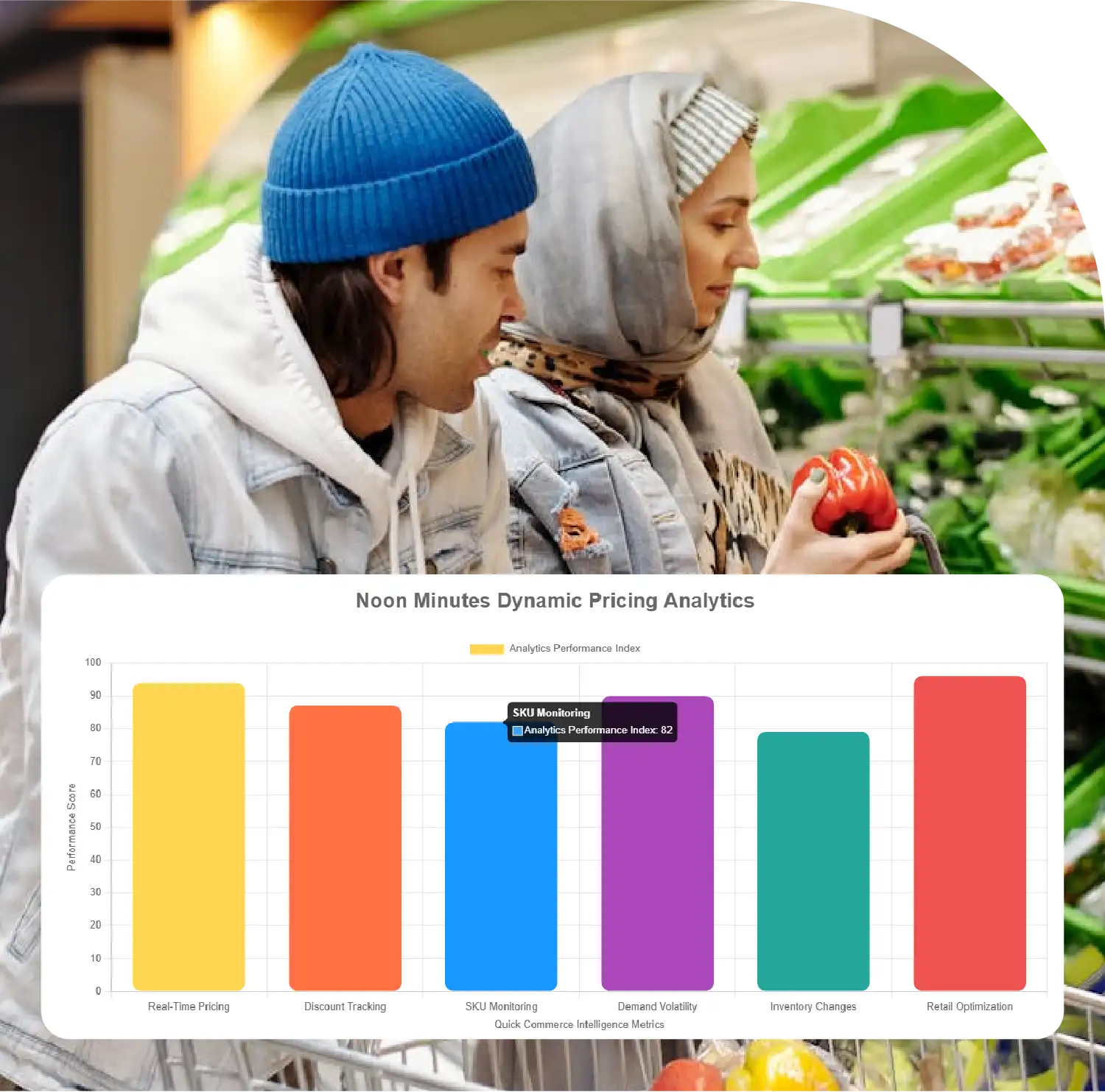
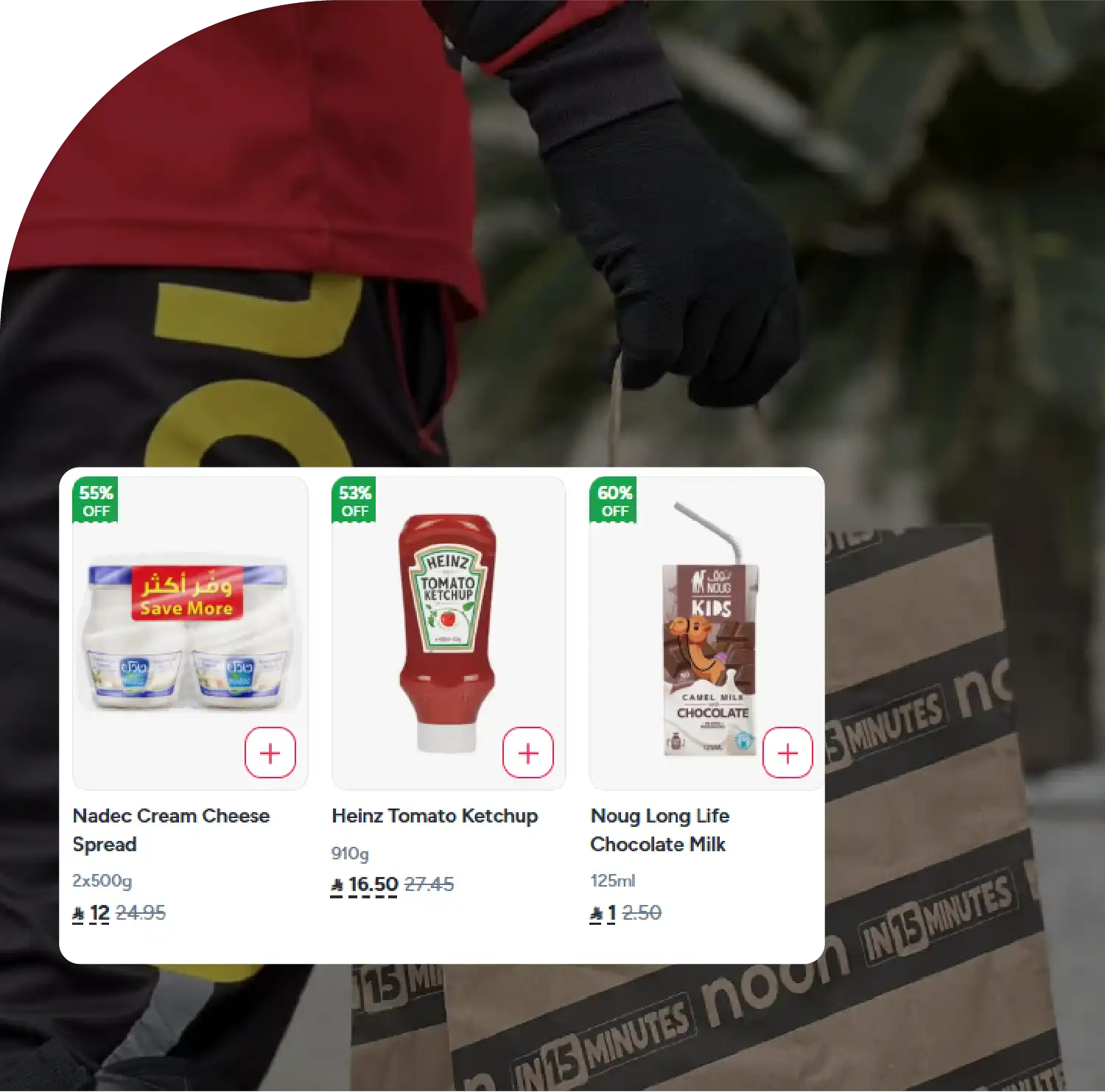
Price Volatility
Fresh produce shows the highest pricing fluctuations
due to perishability and rapid demand changes.
Discount Patterns
Promotional discounts are frequently triggered by
inventory pressure and competitive pricing adjustments.
SKU Dynamics
Individual SKU prices vary multiple times daily based on
demand and delivery urgency.
Category Stability
Staples and dairy products remain relatively
stable compared to fresh and perishable goods.
Data Intelligence
Structured extraction enables predictive insights
and real-time pricing optimization in quick commerce systems.

The quick commerce industry has rapidly evolved into one of the most data-intensive sectors in modern retail, where pricing decisions are updated in real time based on demand, inventory availability, and delivery speed. One of the leading platforms in this ecosystem is Noon, particularly through its ultra-fast delivery service, Noon Minutes. This service operates on highly dynamic pricing mechanisms where grocery and daily essentials prices can fluctuate multiple times within a single day.
In this environment, Noon Minutes pricing data scraping has become a critical approach for extracting structured insights from rapidly changing SKU-level listings. It helps analysts monitor price shifts, promotional activity, and competitive behavior across different grocery categories such as fruits, vegetables, dairy, snacks, and staples.
At the same time, Noon Minutes Promotions And Discount Data Tracking enables detailed observation of how flash sales, bundle offers, and limited-time discounts influence customer demand patterns and conversion rates.
To support continuous market visibility, Noon Minutes Price Monitoring Analytics is widely used to track micro-level pricing changes, ensuring businesses can respond quickly to competitive pressure and demand surges.
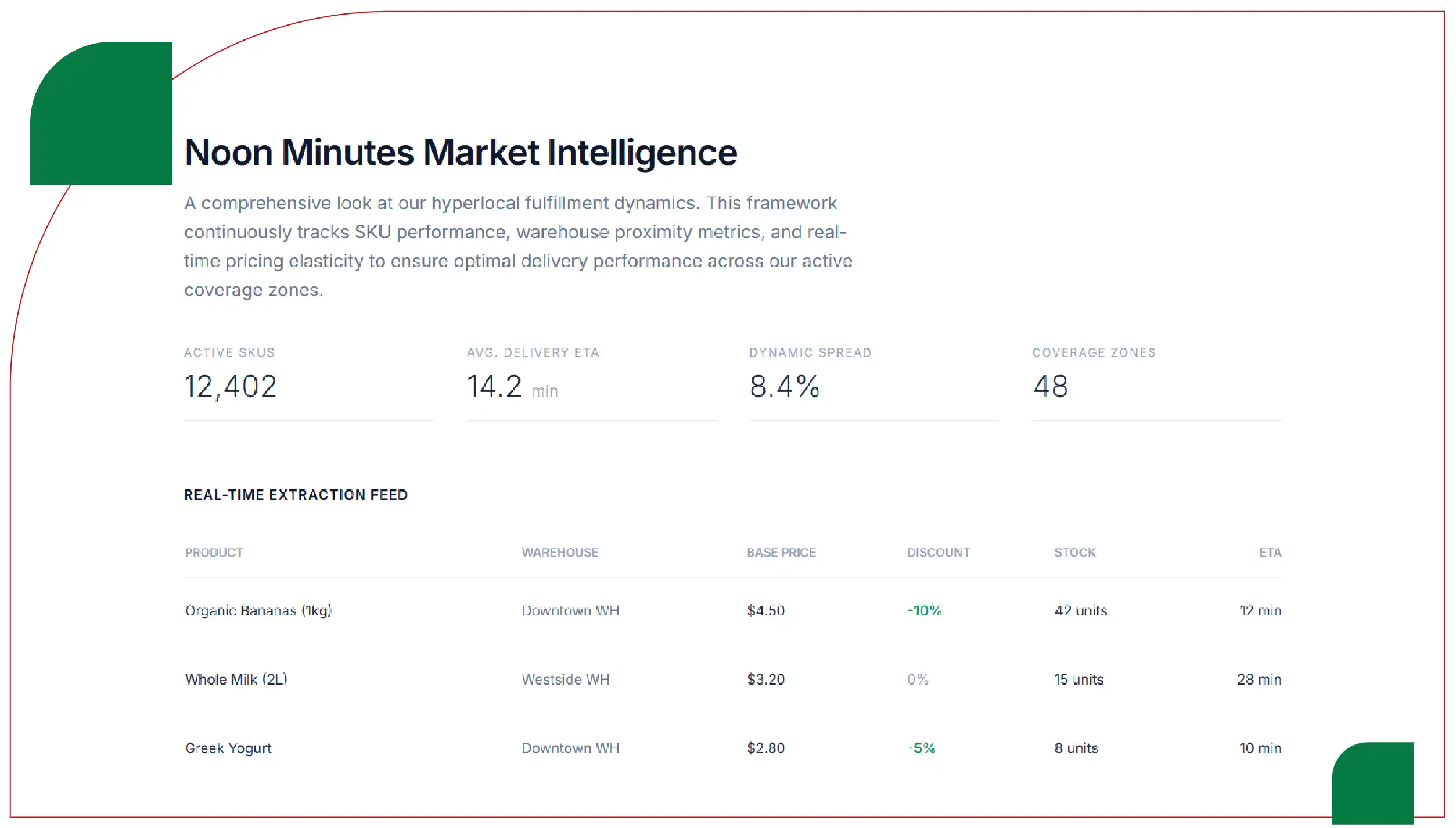
Noon Minutes operates on a hyperlocal fulfillment model where pricing is influenced by warehouse proximity, delivery time windows, inventory levels, and demand density. This creates a highly dynamic pricing environment where even identical products can have varying prices depending on location and time.
The backbone of this analysis is structured data extraction pipelines that continuously capture product listings, pricing updates, and promotional signals. Noon Minutes SKU Data Extraction is used to collect structured fields such as product ID, category, seller name, base price, discount price, stock availability, and delivery ETA.
These extracted datasets are consolidated into a , which allows analysts to perform historical comparisons, predictive modeling, and category-wise benchmarking.
The following dataset represents structured pricing behavior observed across grocery categories in Noon Minutes.
| SKU ID | Product Name | Category | Base Price (AED) | Discount Price (AED) | Discount % | Seller | Stock Status | Delivery ETA |
|---|---|---|---|---|---|---|---|---|
| NM-001 | Milk 1L | Dairy | 7.80 | 6.40 | 18% | FreshDaily | In Stock | 10 min |
| NM-002 | Eggs 12 Pack | Dairy | 12.50 | 10.20 | 18% | FarmHouse | In Stock | 15 min |
| NM-003 | Bananas 1kg | Fruits | 8.20 | 6.70 | 18% | GreenBasket | In Stock | 10 min |
| NM-004 | Apples 1kg | Fruits | 10.90 | 9.30 | 15% | FruitHub | Limited | 20 min |
| NM-005 | Whole Wheat Bread | Bakery | 6.20 | 5.30 | 14% | BakeFresh | In Stock | 10 min |
| NM-006 | Chicken Breast 1kg | Meat | 23.00 | 20.00 | 13% | MeatExpress | Limited | 20 min |
| NM-007 | Rice 5kg | Staples | 29.00 | 25.00 | 14% | GrainWorld | In Stock | 15 min |
| NM-008 | Cooking Oil 1L | Staples | 15.50 | 13.80 | 11% | OilMart | In Stock | 15 min |
| NM-009 | Tomatoes 1kg | Vegetables | 6.80 | 5.20 | 24% | VeggieDirect | In Stock | 10 min |
| NM-010 | Potatoes 2kg | Vegetables | 9.50 | 8.10 | 15% | FarmDirect | In Stock | 10 min |
The dataset shows that fresh produce categories such as fruits and vegetables exhibit the highest price volatility due to perishability and rapid demand cycles. Vegetables, in particular, show aggressive discounting patterns, often exceeding 20% during peak inventory pressure periods.
Dairy and staple categories demonstrate relatively stable pricing structures due to consistent demand and predictable supply chains. Meat products show moderate volatility due to cold-chain logistics and limited shelf life.
Advanced systems such as Noon Minutes Quick Commerce Data Scraping API enable automated extraction of such SKU-level variations across thousands of products in real time, allowing businesses to detect pricing shifts within minutes.
To understand broader pricing patterns, aggregated weekly data is used to identify category-level trends and volatility behavior.
| Category | Week 1 Avg (AED) | Week 2 Avg (AED) | Week 3 Avg (AED) | Week 4 Avg (AED) | Volatility % | Demand Level |
|---|---|---|---|---|---|---|
| Fruits | 9.60 | 9.30 | 8.90 | 8.50 | 11.5% | High |
| Vegetables | 7.40 | 7.00 | 6.60 | 6.20 | 16.2% | High |
| Dairy | 11.20 | 10.90 | 10.60 | 10.30 | 8.0% | Medium |
| Bakery | 6.90 | 6.70 | 6.40 | 6.10 | 11.6% | High |
| Meat | 24.50 | 23.80 | 23.10 | 22.40 | 8.5% | Medium |
| Staples | 18.80 | 18.20 | 17.70 | 17.10 | 9.0% | High |
| Beverages | 5.70 | 5.50 | 5.30 | 5.10 | 10.5% | Medium |
| Snacks | 7.90 | 7.60 | 7.30 | 6.95 | 12.0% | High |
Pricing strategies in Noon Minutes are heavily influenced by competitor benchmarking, demand spikes, and delivery optimization models. Sellers continuously adjust prices to maintain visibility and conversion rates within the platform.
Quick Commerce Datasets play a crucial role in identifying underpriced or over-discounted SKUs, enabling retailers to optimize margins while maintaining competitiveness.
Inventory scarcity often leads to higher prices, while overstock situations trigger automated discounting mechanisms. These behaviors are captured and analyzed using structured data pipelines.
The structured insights derived from Noon Minutes pricing data can be applied across several business domains:
These applications demonstrate how structured pricing intelligence enhances decision-making speed and accuracy in quick commerce environments.
Modern retail ecosystems rely on integrated data systems that combine pricing, inventory, and consumer behavior into unified intelligence platforms.
Grocery Data Intelligence enables businesses to convert raw marketplace signals into actionable insights, improving forecasting accuracy and operational efficiency.
By leveraging continuous data streams, companies can detect demand spikes early and adjust pricing strategies dynamically.
The future of quick commerce will be defined by automation, predictive analytics, and AI-driven pricing systems that operate in real time. Platforms like Noon Minutes will increasingly rely on algorithmic pricing engines that continuously optimize product pricing based on demand, competition, and delivery constraints.
The adoption of Web Scraping Quick Commerce Data will continue to expand as businesses require deeper visibility into SKU-level behavior and competitor pricing strategies.
Similarly, Quick Commerce Data Scraping API solutions will enable scalable, real-time data extraction across multiple retail platforms, improving analytical precision.
Finally, Quick Commerce Data Intelligence Services will evolve into fully integrated ecosystems that combine AI, machine learning, and real-time market signals to drive smarter retail decisions.
This report demonstrates how structured pricing extraction from Noon enables deep visibility into ultra-fast commerce ecosystems, supporting competitive benchmarking, predictive pricing models, and advanced grocery market intelligence systems.
Are you in need of high-class scraping services? Food Data Scrape should be your first point of call. We are undoubtedly the best in Food Data Aggregator and Mobile Grocery App Scraping service and we render impeccable data insights and analytics for strategic decision-making. With a legacy of excellence as our backbone, we help companies become data-driven, fueling their development. Please take advantage of our tailored solutions that will add value to your business. Contact us today to unlock the value of your data.