Introduction — Why Pooja Essentials Data Matters for Festive Planning in 2026
India's festive season — Ganesh Chaturthi through Diwali through Karva Chauth through Chhath Puja — drives the single largest concentrated spike in Indian grocery category volumes, and pooja essentials (agarbatti, diya, oil, kumkum, camphor, thali, pooja kits) represent one of the fastest-growing festive Q-Com categories. For FMCG brands managing category positioning, for Q-Com operators optimizing dark-store assortment for festive spike, and for regional players competing for New Delhi festive share, continuous visibility into pooja essentials pricing, assortment, and availability across Zepto, Blinkit, and Swiggy Instamart data services has moved from research luxury to festive-season imperative.
This is exactly the problem that a modern pooja essentials Q-Com data capability solves. When Indian FMCG category managers and brand managers deploy purpose-built festive category data scraping India pipelines, they gain continuous visibility across every major Indian Q-Com platform in the weeks leading into festivals — informing SKU launch timing, promotional spend allocation, dark-store availability decisions, seasonal category data pipeline decisions, and post-festive review cycles.
This guide breaks down how leading Indian FMCG brands and category teams build a pooja essentials Q-Com intelligence capability in 2026, with real sample data structures, use cases, and the specific pipeline architecture that powers festive-season programs at scale.
The 2026 India Festive Q-Com Landscape — What Changed
Three structural shifts have made continuous pooja essentials Q-Com intelligence essential in 2026.
1. Festive category has become a Q-Com competitive battleground. Zepto, Blinkit, and Swiggy Instamart now compete intensely on festive category depth — the platform with the deepest pooja essentials assortment (agarbatti brands, diya varieties, pooja kits, dry fruits, festive combos) captures disproportionate share of festive-season shopper visits and basket size.
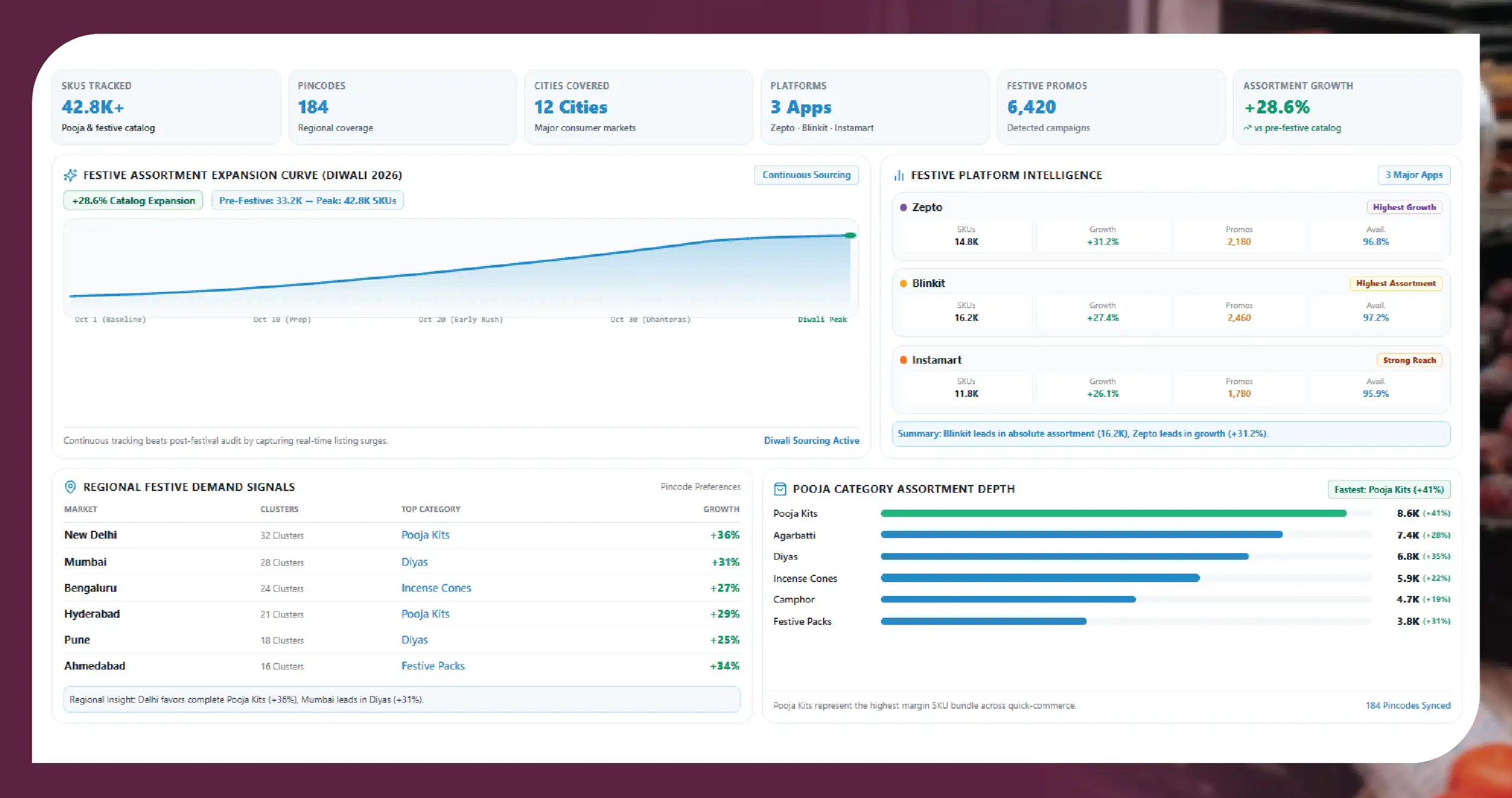
2. Festive assortment volatility is extreme. A brand's pooja essentials assortment on Zepto can expand from 20 SKUs in August to 80 SKUs by Diwali week and contract back to 25 by mid-November. Blinkit festive category tracking combined with festive season pricing data India is the only way to see this cycle as it happens rather than after post-mortem retail audits.
3. Regional festive preferences vary dramatically. New Delhi religious essentials data India patterns and agarbatti diya data extraction differ from Mumbai, Bengaluru, Chennai, and Kolkata — regional variations in diya varieties, agarbatti brands, pooja samagri catalogue tracking, and pooja combo preferences require pincode-anchored intelligence rather than national-level roll-ups. India festive Q-Com intelligence and Indian Q-Commerce festive planning at pincode granularity is essential for brands and regional teams alike.
Comprehensive India Q-Com festive analytics powers the intelligence advantage. The Indian FMCG brands and Q-Com operators winning the 2026 festive season are those with the fastest visibility into how their category is actually stocked, priced, and promoted across every major Q-Com platform.
What Pooja Essentials Q-Com Data Extraction Delivers
A modern Pooja Essentials Data Extraction pipeline is a data infrastructure that continuously scrapes festive category listings, pricing, availability, and promotional overlays from Zepto, Blinkit, and Swiggy Instamart in the weeks leading into and during festive spikes.
A well-designed Zepto pooja essentials data pipeline captures:
- Per-SKU pricing in INR across every monitored Q-Com platform
- Category and subcategory tagging (agarbatti, diya, pooja kits, camphor, oil, kumkum, dry fruits, festive combos)
- Availability signals per pincode-anchored dark store
- Promotional overlays (festive discounts, bundle offers, category promos)
- Pack size and unit-price normalization
- Brand-level assortment depth per platform
- Historical time-series to detect festive-cycle patterns
- Daily or 12-hour refresh cadence
- Regional festive-preference indicators via pincode-level assortment analysis
The output plugs directly into the brand's festive planning committee workflow — replacing post-festival retrospective audits with continuous during-festive intelligence.
Sample Data — Real Pooja Essentials Snapshot
Below is a sample of the structured output a properly designed Diwali FMCG category data pipeline produces for an FMCG brand tracking 8 pooja essentials SKUs across three Indian Q-Com platforms in New Delhi.
Sample 1 — New Delhi Multi-Platform Pooja Essentials Snapshot
| SKU | Category | Zepto (INR) | Blinkit (INR) | Instamart (INR) | Availability |
|---|---|---|---|---|---|
| Cycle Agarbatti 100gm | Agarbatti | 45 | 42 | 46 | All available |
| Zed Black Agarbatti | Agarbatti | 55 | 52 | 58 | All available |
| Mangaldeep Agarbatti | Agarbatti | 70 | 68 | 72 | All available |
| Diya Cotton Wick Pack | Diya | 39 | 35 | 42 | All available |
| Camphor 20gm | Camphor | 65 | 62 | 69 | All available |
| Kumkum 100gm | Kumkum | 79 | 75 | 82 | Zepto low stock |
| Pure Cow Ghee Diya Oil 500ml | Oil | 189 | 179 | 195 | All available |
| Pooja Kit Combo (Diwali) | Combo | 349 | 329 | 369 | Zepto only initially |
The sample reveals immediate signals for the FMCG brand's festive planning team: Blinkit is systematically priced 5-10% below Zepto and Instamart across the pooja essentials category — likely a festive-season market-share push. Kumkum shows low stock at Zepto suggesting fast-moving demand at a lower-priced platform. The Diwali Pooja Kit Combo is Zepto-exclusive at this snapshot moment — a competitive assortment gap Blinkit and Instamart need to close to defend festive-shopper share.
Sample 2 — 4-Week Pre-Diwali Assortment Depth Panel
| Category | Wk 1 (Zepto) | Wk 4 (Zepto) | Wk 1 (Blinkit) | Wk 4 (Blinkit) | Growth |
|---|---|---|---|---|---|
| Agarbatti | 22 SKUs | 48 SKUs | 20 SKUs | 45 SKUs | 2.2x on both |
| Diya | 8 SKUs | 32 SKUs | 8 SKUs | 30 SKUs | 4x on both |
| Pooja kits | 5 SKUs | 25 SKUs | 4 SKUs | 22 SKUs | 5x on both |
| Camphor | 3 SKUs | 8 SKUs | 3 SKUs | 8 SKUs | 2.7x on both |
| Combo bundles | 2 SKUs | 18 SKUs | 1 SKU | 15 SKUs | 9x on both |
| Dry fruits (festive) | 15 SKUs | 45 SKUs | 12 SKUs | 42 SKUs | 3x on both |
Four weeks of pre-Diwali data reveals the assortment expansion pattern the brand needs to track: pooja kits and combo bundles show the fastest expansion (5-9x), while core categories (agarbatti, diya) expand 2-4x. A brand launching new festive SKUs needs this pattern visibility to time launches for maximum assortment-slot capture — launching in Week 4 means competing against 40+ competitor SKUs; launching in Week 1 means holding a category-slot advantage.
The New Delhi Category Manager Case — Festive Planning Intelligence
The New Delhi festive planning pattern — an FMCG category manager or brand manager monitoring 50-200 pooja essentials SKUs across Zepto, Blinkit, and Swiggy Instamart in New Delhi metro during August-November — is a common entry point into Indian festive Q-Com intelligence.
The Indian festive season combines the intensity of concentrated demand spikes with the complexity of pincode-varying regional preferences. A category manager tracking this landscape needs both dimensions visible daily — the volume-spike timing AND the pincode-regional variation — to inform launch timing, promotional spend, and dark-store availability decisions.
The pooja essentials patterns visible in New Delhi — Blinkit's price-leadership on core categories, Zepto's exclusive combo positioning, Instamart's premium positioning — appear with local variations across Mumbai, Bengaluru, Chennai, Kolkata, and every Indian metro during festive periods.
How the Pooja Essentials Data Pipeline Architecture Works
FoodDataScrape builds Indian festive Q-Com pipelines on a five-layer architecture designed for festive-cycle data challenges — pipelines built for pooja essentials data zepto blinkit instamart requirements.
Layer 1: Category and Pincode Mapping. Team defines pooja essentials categories, subcategories, target pincodes, and festive-cycle refresh windows.
Layer 2: Cross-Platform SKU Matching. AI matching layer pairs SKUs across Zepto, Blinkit, and Swiggy Instamart with festive-brand equivalents.
Layer 3: Continuous Daily Multi-Platform Scraping. Per-platform extractors pull pricing, promo overlays, availability, and metadata daily with intraday refresh during peak festive weeks.
Layer 4: Festive Analytics Layer. Raw data transforms into decision-ready outputs — per-category assortment depth trends, per-SKU price-gap tracking, festive-cycle pattern detection, regional preference indicators.
Layer 5: Delivery and Integration. REST API, CSV, dashboards for the brand's festive planning committee.
Build timeline is 4-6 weeks for a mid-scope engagement covering 500-2,000 pooja essentials SKUs across 3 platforms and 20-40 pincodes. Free proof-of-concept sample delivered in the first week.
Why Indian FMCG Brands Choose Continuous Festive Q-Com Data
Indian FMCG brands, category teams, and Q-Com operators select continuous Pooja Essentials Data Extraction pipelines over post-festival retrospective audits for six specific reasons.
- Real-time festive-cycle visibility. Post-festival audits are too late; continuous scraping captures the assortment expansion cycle as it happens.
- Multi-platform coverage in one feed. Zepto + Blinkit + Instamart simultaneously with consistent schema.
- Pincode-level regional accuracy. New Delhi festive preferences differ from Mumbai; pincode-anchored data reveals this granularity.
- Category-specific tuning. Agarbatti, diya, pooja kits each require category-tuned matching to handle the fragmented festive-brand landscape.
- Historical festive-year comparisons. Multi-year historical data enables Diwali 2026 vs Diwali 2025 comparative analysis.
- Assortment-slot competitive intelligence. Brands can measure their category-slot share across platforms and time launches accordingly.
Key Success Metrics for Indian Festive Data Pipelines
Enterprise operators evaluating a Indian festive data intelligence pipeline benchmark deployment success against five specific metrics that separate production-grade programs from prototype-quality feeds. Understanding these metrics before scoping an engagement prevents the common trap of celebrating a working scraper while missing the underlying business signal.
Metric 1: SKU Match Accuracy at Scale. Match accuracy on a 50-SKU proof-of-concept sample is not predictive of match accuracy on a 5,000-SKU production catalog. Best-in-class India category-tuned pipelines achieve 95-97% match accuracy at production scale; generic pipelines typically drop to 70-80% once catalog complexity increases. Operators should require match-accuracy testing on a representative production-scale sample before committing to a full engagement.
Metric 2: End-to-End Latency. The gap between data event (a price change on the source platform) and data availability (in the operator's dashboard) determines whether the pipeline supports operational decisions or only retrospective analysis. Production-grade programs target sub-4-hour latency for high-priority SKUs and sub-24-hour latency for the broader catalog.
Metric 3: Missing-Data Rate. Every scraping pipeline occasionally misses SKUs due to platform anti-bot measures, network issues, or category-page restructures. Production programs monitor missing-data rate per platform per city per day and alert operators when rates exceed 3%. Operators should require missing-data rate reporting as a standard deliverable.
Metric 4: Historical Data Integrity. Pattern-detection and elasticity analytics depend on complete historical time-series. Programs that drop data on infrastructure incidents undermine downstream analytical use cases. Best-in-class pipelines preserve 24+ month historical depth with data-quality flags rather than gaps.
Metric 5: Change Adaptation Speed. Source platforms change their category page structures every few months. Production pipelines adapt within 24-48 hours; brittle pipelines break for weeks. Operators should ask potential vendors about their platform-change response cadence over the past year — the answer signals engineering maturity.
Programs monitoring these five metrics as core deliverables — rather than treating them as internal engineering concerns — consistently outperform programs treating scraping as a black-box service.
Sample Use Cases — How Indian Brands Actually Use the Data
Use Case 1: FMCG Brand Festive Launch Timing. A pooja essentials FMCG brand uses assortment-depth expansion data to time new SKU launches — hitting Zepto and Blinkit in Week 2 of the festive cycle when assortment slots are still contested.
Use Case 2: Q-Com Operator Festive Assortment Expansion. A Q-Com platform product team uses competitor assortment-depth data to build a festive expansion roadmap prioritized by competitive gap.
Use Case 3: Brand Manager Regional Preference Analysis. A brand manager analyzes pincode-level pooja essentials preferences to inform regional marketing spend allocation.
Use Case 4: Category Manager Trade Promotion Calibration. A branded manufacturer tracks their promotional support across platforms daily during festive weeks to ensure trade spend translates to shelf visibility.
Use Case 5: Post-Festival Year-Over-Year Analysis. After Diwali, the category team compares performance vs prior years using continuous historical data to inform next-year strategy.
Getting Started — The 5-Week Roadmap
Getting a Pooja Essentials Data Extraction engagement live with FoodDataScrape follows a structured process — typically starting 6-8 weeks before the festive spike to capture the full pre-festival cycle.
Week 1: Scoping and PoC. Client defines SKUs, categories, platforms, pincodes, refresh cadence.
Weeks 2-4: Production build. Platform-specific extractors, SKU matching, festive analytics layer, and API integration configured.
Week 5: Live production delivery. Daily multi-platform festive data flows into brand's planning workflows.
Ongoing: Post-festive retention. Most brands retain the pipeline year-round for adjacent festival cycles (Raksha Bandhan, Ganesh Chaturthi, Durga Puja, Christmas).
Conclusion — Continuous Pooja Essentials Q-Com Data Is the 2026 Festive Standard
The Indian festive Q-Com market in 2026 has become too fast-cycle, too assortment-dynamic, and too regionally varied for post-festival retrospective audits to serve as reliable brand-planning intelligence. Brands and Q-Com operators without continuous festive data are structurally disadvantaged against those that have moved to purpose-built pipelines.
The New Delhi 8-SKU snapshot is the entry point for most engagements. Most Indian FMCG brands and Q-Com operators expand within 2-3 festive seasons to 2,000-5,000 SKUs across every major festival, platform, and metro they compete in. Brands that establish festive intelligence infrastructure ahead of the September-November spike consistently outperform brands relying on retrospective analysis. The pipeline continues delivering value year-round for Ganesh Chaturthi, Raksha Bandhan, Karva Chauth, Durga Puja, Christmas, and regional festivals that maintain smaller but consistent demand cycles across every month of the year.
FoodDataScrape builds the pipelines that deliver this intelligence — covering Zepto, Blinkit, Swiggy Instamart, BigBasket festive assortment, and specialty platforms with daily refresh, festive-cycle analytics, and dedicated seasonal-category support.
If you are an Indian FMCG brand, a Q-Com operator, or a category manager — continuous festive Q-Com data is the fastest path to closing the visibility gap in the 2026 Indian festive market.
Ready to See Sample Data for Your Festive Category? Tell us your target SKUs, categories, and metros. Get a free proof-of-concept sample within 5 business days — no commitment required.
Related Case Studies
- 🇮🇳 India Promo ROI +18% — National chain — Zomato + Swiggy promo analysis.
- 🇮🇳 Bengaluru Cloud Kitchen Stockouts — 68% stockout cut · ₹8cr recovered.
- 🇦🇪 UAE Q-Commerce SKU — 22% assortment cut · +14% GMV growth.
Questions
Frequently Asked Questions
Per-SKU per-platform per-pincode pricing, category tagging (agarbatti, diya, pooja kits, camphor, oil, kumkum, dry fruits, combo bundles), availability signals, promotional overlays, unit-price normalization, and historical time-series across Zepto, Blinkit, and Swiggy Instamart.
Zepto, Blinkit, Swiggy Instamart, and BigBasket for their festive assortment. Regional platforms as required by client scope.
Engagements typically start 6-8 weeks before major festive spikes to capture the full assortment expansion cycle. Post-festival analysis identifies pattern shifts for next-year planning.
Yes — pincode-anchored scraping reveals regional variations in agarbatti brands, diya types, and combo preferences across New Delhi, Mumbai, Bengaluru, and Chennai.
Diwali (primary), Ganesh Chaturthi, Durga Puja, Karva Chauth, Chhath Puja, Raksha Bandhan, Holi, and regional festivals as required.
Yes — sourcing operates within Indian data compliance frameworks.
Get a Free Food Data Sample in 48 Hours.
Tell us your platforms, target markets and required fields — we'll map exactly what's possible with food data scraping, recommend the right approach, and send a working sample so you can verify quality before any commitment.
Request a strategy call
Thanks — our data team will reach out within 48 hours with your sample.