Introduction
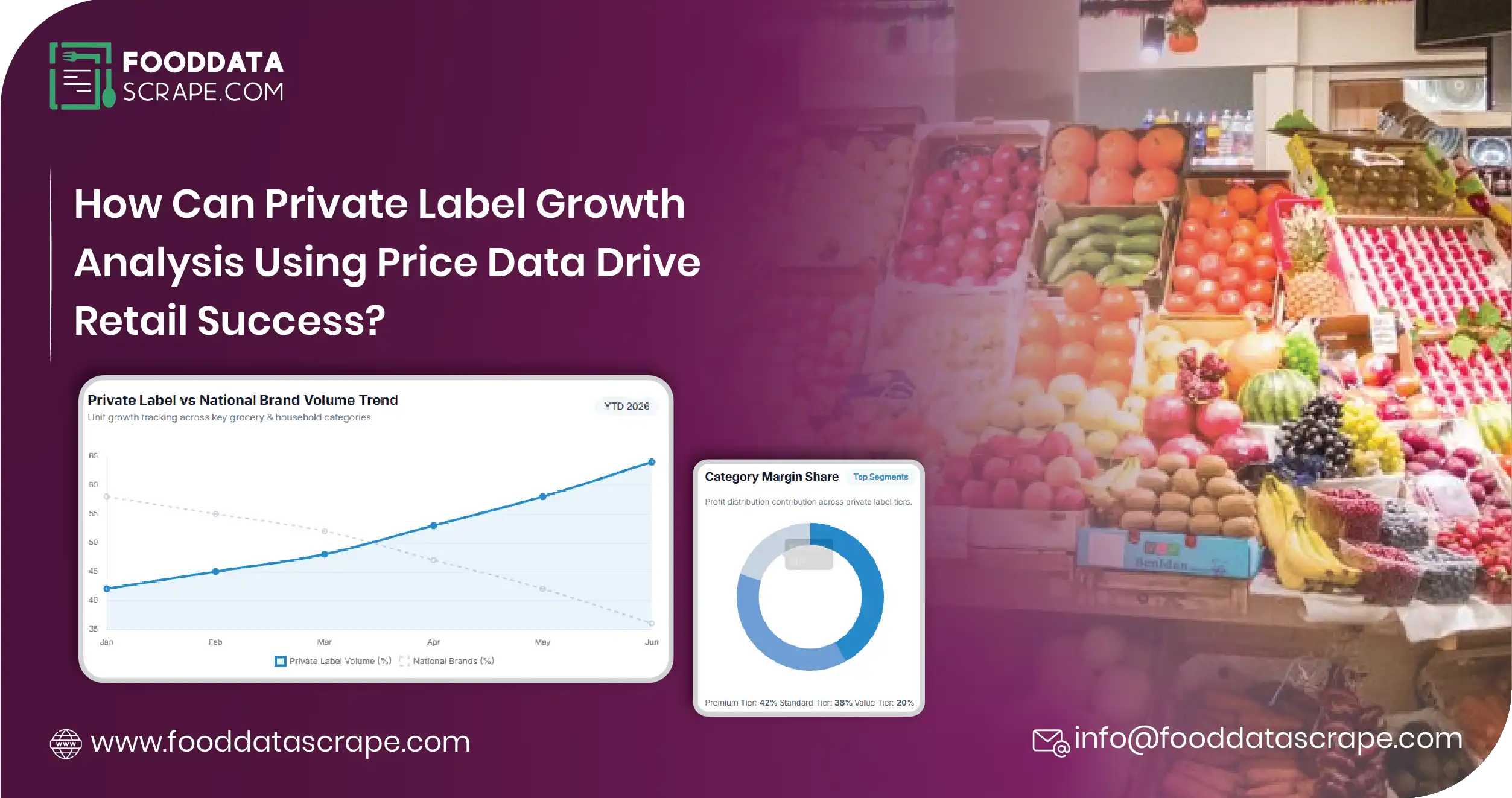
Private labels have evolved from basic low-cost alternatives into strategic growth engines for supermarkets, grocery chains, and modern retailers. Retailers now use proprietary brands to improve margins, differentiate assortments, strengthen customer loyalty, and compete more effectively with established manufacturers. This makes private label growth analysis using price data increasingly important for understanding where retailer-owned brands are gaining traction and why consumers are switching.
At the same time, retailers need sophisticated private label pricing strategy analysis to determine whether their products are priced attractively enough to drive volume without sacrificing profitability. Price data reveals much more than the amount shoppers pay. When collected consistently across stores, categories, pack sizes, competitors, promotions, and locations, it can expose pricing gaps, consumer positioning, discount intensity, and long-term movement.
Another critical measure is private label price competitiveness, which shows whether retailer brands maintain a meaningful value advantage over national brands while preserving sufficient margins. A private-label product priced too close to a leading national brand may lose its primary value proposition, while an excessively low price may leave significant revenue potential untapped.
Why Price Data Matters for Private Label Growth?
Private-label growth is rarely driven by a single factor. Product quality, packaging, availability, assortment, customer trust, inflation, promotions, and pricing all influence purchasing behavior. However, price remains one of the clearest measurable signals available to retailers.
A supermarket can compare the price of its private-label pasta against Barilla, its own-brand cereal against Kellogg's, or its store-brand detergent against Tide. These comparisons become significantly more useful when analyzed over weeks or months rather than captured as isolated observations.
For example, suppose a retailer's private-label cereal costs $3.29 while a comparable national brand costs $4.79. The 31% price gap provides a strong value proposition. If the retailer subsequently increases the private-label price to $3.89 while the national brand remains at $4.79, the gap narrows to approximately 19%. That change may influence shopper substitution, particularly in highly price-sensitive categories.
This is where private label market share analysis and pricing trends become connected. Changes in relative prices can help explain whether private labels are gaining, holding, or losing consumer preference.
Understanding Private Label Pricing Architecture
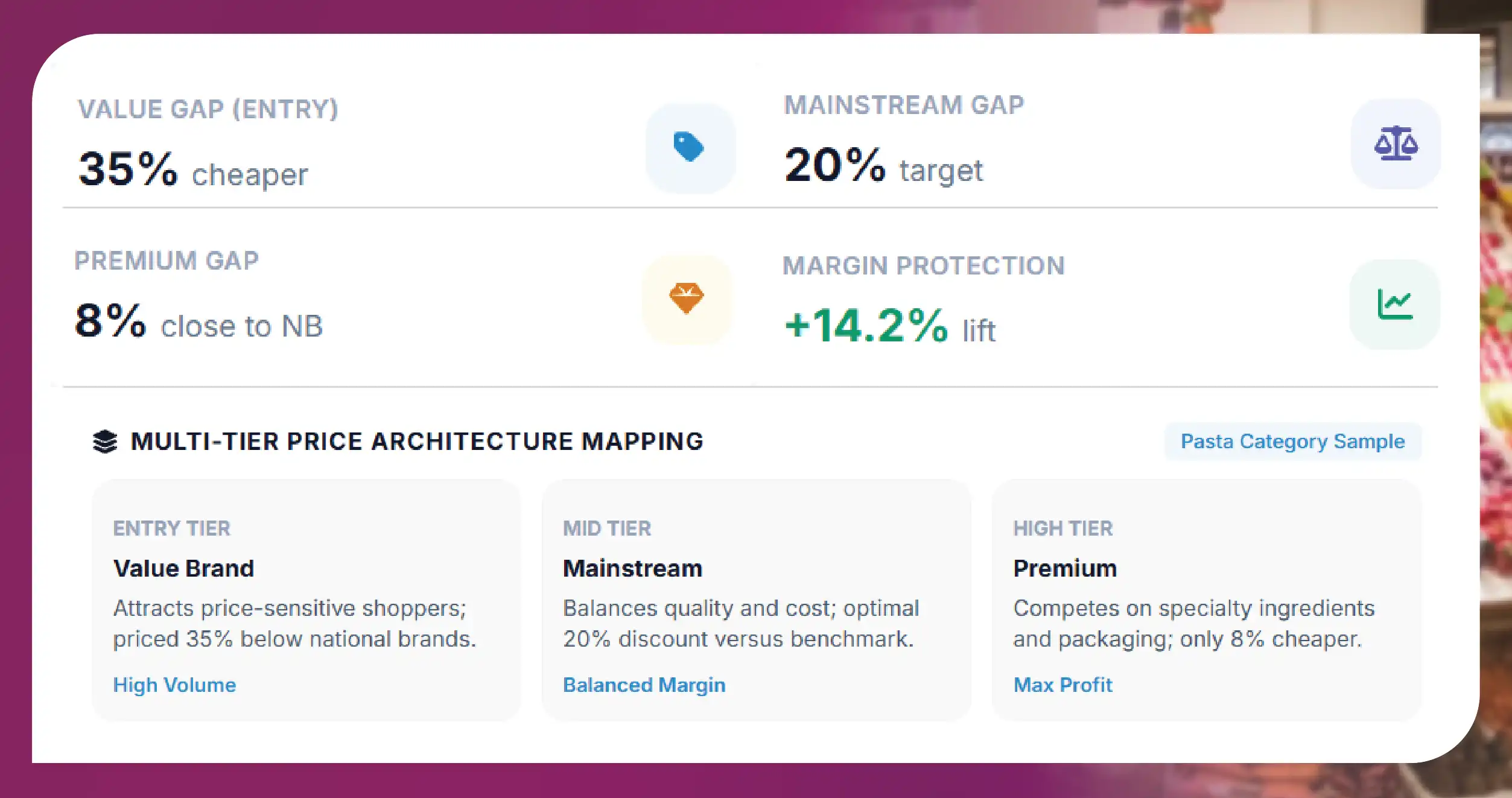
A successful private-label portfolio generally contains multiple price tiers. Entry-level products attract highly price-sensitive shoppers, mainstream products balance quality and affordability, while premium private labels compete through ingredients, sourcing, health positioning, packaging, or specialty attributes.
Price data allows retailers to map these tiers against national brands.
A retailer may discover that its value pasta is 35% cheaper than comparable branded products, its mainstream pasta is 20% cheaper, and its premium pasta is only 8% cheaper. Such a structure reveals how the retailer is positioning each tier and whether sufficient price separation exists.
The analysis can also identify categories where private labels are underpriced. If consumers already perceive the store brand as equivalent in quality to a national brand, maintaining an excessively large discount could unnecessarily reduce margins.
Conversely, categories with weak private-label adoption may require stronger price differentiation. Historical price data helps retailers identify these opportunities rather than relying exclusively on assumptions.
Grocery Private Label Price Intelligence
Grocery private label price intelligence combines product-level pricing information with competitor, category, promotional, and geographic signals. It enables retailers to understand how their own-brand products perform within the broader competitive environment.
A useful dataset can contain product name, brand type, category, subcategory, pack size, regular price, promotional price, discount percentage, unit price, retailer, store location, date, availability, and comparable national-brand products.
Unit pricing is particularly important. A 500-gram private-label product priced at $2.50 cannot be compared accurately with a 750-gram branded product priced at $3.30 without normalization.
Calculating price per kilogram, liter, ounce, or individual unit creates a more accurate comparison. This helps retailers determine whether a product is genuinely cheaper or simply appears cheaper because of pack-size differences.
Tracking Price Movements Over Time
Private label price movement tracking provides a continuous view of how retailer-owned brands respond to inflation, competitor actions, promotions, supplier costs, and changing consumer demand.
Instead of asking, "What is the price today?" retailers can ask more valuable questions:
- How frequently did this product change price?
- Did the national brand change first?
- How quickly did private-label pricing respond?
- Did price changes differ between weekdays and weekends?
- How often were temporary promotions used?
- Did discounts create sustained volume opportunities?
- Which categories experienced the greatest price volatility?
Frequency analysis can uncover retailer pricing behavior that is invisible in a single snapshot.
For instance, a private-label snack may remain at $2.99 for several weeks before moving to $3.19, while a competing branded product fluctuates between $3.49 and $4.29. This reveals not only price differences but also differences in pricing stability.
Supermarket Private Label Benchmarking
Supermarket private label benchmarking enables retailers to compare their own-brand pricing against competing supermarket chains. Instead of evaluating products in isolation, businesses can assess their positioning across multiple markets.
A retailer may discover that its private-label milk is among the cheapest in one city but comparatively expensive in another. Such differences can result from regional competition, supply costs, local promotions, consumer demand, or store-level pricing policies.
Benchmarking can also identify category-specific strengths. One retailer may have highly competitive private-label dairy products but weak positioning in snacks. Another may dominate frozen foods while struggling to compete in household essentials.
These insights help category managers prioritize pricing interventions.
Private Label vs National Brand Analysis
Private Label vs National Brand comparisons are central to understanding retailer-brand performance. The objective is not simply to identify which product is cheaper but to understand the relationship between price, product positioning, promotion, pack size, and availability.
Retailers can calculate the absolute price gap, percentage price gap, unit-price difference, promotional gap, and average price index.
For example, a private-label product priced at $2.80 against a national brand priced at $3.50 has a $0.70 absolute gap and a 20% discount versus the national brand. If this relationship remains consistent over time, it indicates deliberate price positioning.
However, if the private-label discount falls from 20% to 5%, the retailer may need to determine whether the higher price is justified by improved quality or whether the brand is becoming vulnerable to substitution.
Measuring Private Label Growth Through Pricing Signals
Price data can act as an early indicator of private-label growth. When private-label products expand into more categories, gain wider availability, maintain competitive pricing, and receive increased promotional support, retailers may be deliberately investing in their own-brand strategy.
Combining price information with product counts, assortment expansion, ratings, reviews, availability, and promotional frequency creates a broader growth framework.
A retailer can track the number of private-label SKUs introduced each quarter, average price relative to national brands, discount frequency, category penetration, and geographic expansion.
This produces a multidimensional picture of growth rather than relying only on sales data.
Using Historical Data for Strategic Decisions
Historical pricing datasets are especially valuable because they establish benchmarks. Retailers can determine whether today's private-label pricing is unusually high, unusually low, or consistent with historical patterns.
For example, if a private-label product typically maintains a 25% discount against national brands but currently offers only a 10% gap, category managers can investigate whether competitor prices have fallen, internal costs have risen, or pricing rules require adjustment.
Historical analysis can also reveal seasonal patterns. Ice cream, baking ingredients, beverages, snacks, and holiday foods often experience predictable changes in demand and promotional activity.
Understanding these patterns allows retailers to plan private-label promotions before demand peaks rather than reacting after competitors have already changed their prices.
How Food Data Scrape Can Help You?
1. Private Label Price Collection
Food Data Scrape captures private-label prices, pack sizes, promotions, availability, and comparable branded products across retailers, creating structured datasets for accurate competitive pricing analysis and benchmarking.
2. Competitor Price Comparison
It compares retailer-owned products with national brands across categories, locations, and pack sizes, helping businesses identify pricing gaps, competitive advantages, margin opportunities, and positioning weaknesses.
3. Historical Pricing Intelligence
Continuous collection creates historical datasets that reveal price changes, promotional cycles, category volatility, seasonal patterns, and long-term private-label positioning across competitive supermarket environments.
4. Category Growth Insights
Structured grocery data helps retailers identify categories where private labels are gaining competitive strength, expanding assortment, improving value perception, or requiring sharper pricing differentiation.
5. Automated Market Monitoring
Automated data collection reduces manual research while providing frequent market updates, enabling retailers to respond faster to competitor movements, pricing changes, promotions, assortment shifts, and availability issues.
Conclusion
Private-label growth is increasingly connected to intelligent pricing decisions. Retailers that understand price gaps, unit economics, promotional frequency, assortment expansion, and competitive positioning can build stronger own-brand portfolios while protecting margins.
A comprehensive pricing dataset makes it possible to connect everyday price movements with larger strategic questions about category growth, customer value, competitive pressure, and brand positioning. Food Data Scraping provides the foundation for collecting structured grocery pricing information across retailers, products, categories, and markets.
Combined with Real-Time Food Price Tracking, retailers can identify competitive movements as they happen and evaluate whether their private-label products remain appropriately positioned.
With Real-Time Price Monitoring, businesses can continuously observe price changes, promotions, availability, and competitor behavior, creating a more responsive private-label strategy.
The result is a data-driven approach where private-label decisions are based not merely on assumptions or occasional market checks, but on measurable competitive intelligence that supports pricing optimization, category management, assortment planning, and sustainable retail growth.
Ready to strengthen your private-label pricing strategy with actionable grocery intelligence? Get in touch with our data experts today to build a customized food pricing dataset tailored to your categories, retailers, and markets.
If you are seeking for a reliable data scraping services, Food Data Scrape is at your service. We hold prominence in Food Data Aggregator and Mobile Restaurant App Scraping with impeccable data analysis for strategic decision-making.